

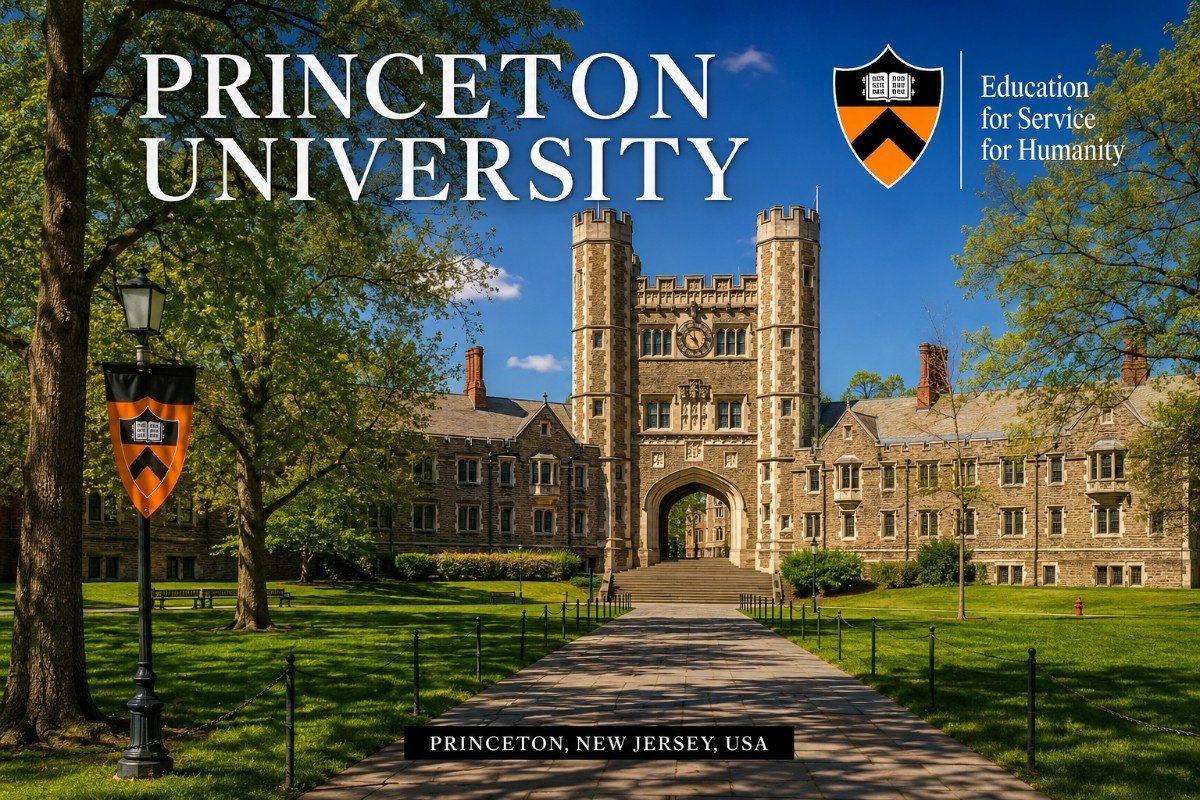
Princeton University, USA – Complete University Guide
Introduction
Princeton University is a private research university in Princeton, New Jersey, and one of the eight institutions that make up the Ivy League. It combines a strong emphasis on undergraduate education with extensive graduate-level research and is known for its liberal arts foundation, close faculty-student interaction, and highly selective admissions process.
For prospective students, Princeton stands out not simply because of its reputation but because of the academic structure it offers. Undergraduate students are encouraged to explore subjects across disciplines, while the university’s research environment gives students opportunities to work in areas ranging from the humanities and social sciences to engineering and the natural sciences. Princeton also has an unusually strong need-based financial aid program, including substantial grant support for qualifying international undergraduates.
This guide explains what prospective students should know about Princeton University, including academics, admissions, costs, financial aid, international student opportunities, campus life, research, careers, and factors to consider before applying.
Is Princeton University a Good Choice?
Princeton University may be a strong fit for students who:
- Want a highly rigorous academic environment.
- Value undergraduate teaching and faculty interaction.
- Are interested in interdisciplinary learning.
- Want access to major research opportunities.
- Prefer a residential campus experience.
- Are prepared for a very competitive admission process.
- Need significant financial assistance and qualify for need-based aid.
Princeton is particularly distinctive for students who want the resources of a major research university while studying in a relatively intimate undergraduate environment. The university reports a 5:1 student-to-faculty ratio, approximately 5,826 undergraduate students, 500+ student organizations, and 96% of undergraduates living on campus.
The main challenges are equally important to understand: admission is extremely competitive, the academic workload can be demanding, and students should carefully consider whether Princeton’s curriculum, campus setting, and residential culture match their goals.
Highlights
- Private research university located in Princeton, New Jersey.
- Member of the Ivy League.
- Strong emphasis on undergraduate education alongside advanced research.
- Offers undergraduate majors and interdisciplinary programs across many fields.
- Graduate education includes master’s and doctoral programs.
- Reported student-to-faculty ratio: 5:1.
- Approximately 5,826 undergraduate students and 3,280 graduate students are reported in Princeton’s current facts and figures.
- More than 500 student organizations are available.
- Princeton has seven residential colleges.
- The university operates 10 Princeton University Library locations.
- Princeton reports 38 varsity intercollegiate teams and 39 sport club teams.
- Financial aid is primarily need-based rather than merit-based for undergraduates.
- Princeton states that admitted international students receive financial aid under the same general need-based framework as U.S. students.
- Princeton’s undergraduate financial aid program does not use academic or athletic merit scholarships.
- The university reports 45 doctoral departments and programs and 12 master’s degree programs.
Univesity Facts
| Category | Information |
|---|---|
| Official Name | Princeton University |
| Location | Princeton, New Jersey, USA |
| Type | Private research university |
| Athletic Conference | Ivy League |
| Undergraduate Enrollment | 5,826 |
| Graduate Enrollment | 3,280 |
| Student-Faculty Ratio | 5:1 |
| Student Organizations | 500+ |
| Residential Colleges | 7 |
| Library Locations | 10 |
| Undergraduate International Students | 760 |
| Doctoral Departments & Programs | 45 |
| Master’s Degree Programs | 12 |
| Official Website | Princeton University |
The figures above come primarily from Princeton’s official facts-and-figures pages and may change as enrollment and institutional data are updated.
History
Princeton University has a long history in American higher education and is one of the country’s oldest institutions of higher learning. Its historical development has been closely connected to the evolution of American education, scholarship, public life, and research.
The university’s historical significance is relevant to prospective students because Princeton’s present-day identity still reflects its longstanding emphasis on rigorous scholarship, residential education, and intellectual exploration.
Over time, Princeton developed from a primarily undergraduate institution into a comprehensive research university. Today, it combines liberal arts education with advanced research in areas such as science, engineering, public policy, economics, the humanities, and social sciences.
For students, this history translates into an institution where undergraduate education remains central while students also have access to the resources and culture of a major research university.
Campus and Location
Princeton University is located in the town of Princeton, New Jersey, roughly between New York City and Philadelphia. Its location provides students with access to a college-town environment while also placing two major U.S. metropolitan areas within reasonable travel distance.
The university reports approximately 3,500 acres of land owned by Princeton University across Princeton and nearby New Jersey municipalities, as well as more than 400 campus buildings. It also has seven residential colleges and 10 library locations.
The campus combines traditional collegiate architecture with modern academic and research facilities. Students can find classrooms, libraries, laboratories, residential buildings, dining facilities, arts spaces, and athletic facilities within the wider university environment.
What Is Campus Life Like?
Princeton’s residential structure is an important part of the student experience. With most undergraduates living on campus, students typically have substantial opportunities to participate in academic, social, cultural, and extracurricular activities.
The university reports that 96% of undergraduate students live on campus, making residential life a central part of the undergraduate experience.
Academic Reputation
Princeton is widely recognized for combining a strong undergraduate focus with high-level research.
One of its defining characteristics is the relationship between teaching and research. Students are not simply part of a large research institution; they study in an environment where faculty scholarship and undergraduate education coexist closely.
The university’s official facts and figures report:
- 36 academic departments
- 45 doctoral departments and programs
- 12 master’s degree programs
- 71 undergraduate minors and interdisciplinary certificate programs
- 24 interdisciplinary/interdepartmental doctoral programs
- 5:1 student-to-faculty ratio
This structure can benefit students who want flexibility to explore multiple academic interests. At the same time, Princeton’s academic environment is demanding, so students should expect substantial independent work, analytical writing, research, and problem-solving.
Programs and Courses
Princeton offers academic opportunities across the humanities, social sciences, natural sciences, engineering, and interdisciplinary fields.
Undergraduate Education
Undergraduate students pursue an academic concentration while also completing broader requirements designed to support a liberal arts education.
The academic model can be attractive to students who do not want to limit their education to one narrow professional field. A student interested in economics, for example, may also explore politics, history, computer science, mathematics, or public policy.
Graduate Education
Princeton’s Graduate School supports master’s and doctoral study across a broad range of disciplines. The university reports 45 doctoral departments and programs and 12 master’s degree programs.
Graduate students generally work within a more specialized academic structure and may participate extensively in faculty-led research.
Admissions
Admission to Princeton is highly selective. The university evaluates applicants holistically, meaning academic performance is considered alongside other parts of the application.
The admissions process may consider factors such as:
- Academic preparation
- School curriculum and context
- Grades and academic performance
- Standardized testing where required
- Essays
- Extracurricular involvement
- Recommendations
- Personal circumstances
- Intellectual interests
- Overall fit with Princeton’s academic environment
Applicants should always check Princeton’s official admissions website for the latest requirements because testing policies, deadlines, application components, and required documents can change.
Princeton Undergraduate Admission
Admission Statistics
For the enrolled Class of 2029, Princeton reports:
- 1,408 first-year students enrolled.
- 14.1% of the class were international citizens.
- 69% qualified for financial aid.
- 16.7% were first-generation college students.
- 63.3% came from public schools.
These figures describe the enrolled class rather than guaranteeing future admission outcomes. Applicants should not interpret them as a target profile or assume that meeting a particular statistic will result in admission.
Tuition and Cost
Princeton is an expensive university when considering its published cost of attendance, but the amount a student actually pays can be substantially lower if they qualify for financial aid.
For the 2026–27 academic year, Princeton’s published estimated undergraduate cost of attendance is $94,624, including:
| Expense | 2026–27 Estimated Cost |
|---|---|
| Tuition | $68,140 |
| Housing | $13,010 |
| Food | $9,110 |
| Fees | $314 |
| Books and course materials | $1,050 |
| Miscellaneous personal expenses | $3,000 |
| Transportation | Varies |
The university notes that transportation costs vary and that students without qualifying family health insurance may also need to purchase student health plan coverage.
Important: Tuition and other costs can change each academic year. Students should verify the latest figures directly with Princeton before making financial decisions.
Scholarships and Financial Aid
Princeton’s undergraduate financial aid model is primarily need-based rather than merit-based.
This distinction is important. Princeton does not generally award undergraduate scholarships simply because a student has excellent grades, test scores, or athletic ability. Instead, financial aid is based on demonstrated financial need.
Princeton states that:
- Admission is need-blind for undergraduate applicants.
- The university meets 100% of demonstrated financial need for admitted students.
- Financial aid is provided through grants rather than traditional student loans.
- International students are eligible for the same general need-based financial aid policy.
- Princeton does not offer academic or athletic merit scholarships to undergraduates.
For many families, this can make Princeton financially competitive with universities that have lower published tuition but less generous financial aid.
Princeton’s current financial aid information says that its grants can cover the full cost of attendance for most families with incomes up to $150,000, while most undergraduate families with incomes up to $250,000 pay no tuition. These are general institutional guidelines, not guaranteed awards for every family, because financial need is evaluated individually.
International Students
Princeton welcomes applicants from around the world.
The university states that international applicants are reviewed in the context of their educational systems and opportunities. Students from different countries are not expected to have identical academic backgrounds because Princeton evaluates applicants within their individual educational context.
For Indian applicants, this means Princeton can consider educational records such as:
- Class X results
- Class XII results
- Predicted Class XII results
- CBSE or ISC curriculum
- State board curriculum
- International curricula
- Other recognized external examinations
Princeton specifically notes that international academic records are evaluated within the context of the student’s educational system.
Financial Aid for International Students
One of Princeton’s most significant advantages for international applicants is its financial aid policy.
The university states that the full demonstrated financial need of admitted international students is met under the same general financial aid framework used for U.S. students. Princeton also states that its aid is need-based and that it does not provide academic or athletic merit scholarships.
For a student from India or another country, this means that high cost should not automatically be a reason to avoid applying if the family cannot afford the published price. However, admission remains extremely competitive, and financial aid eligibility is determined individually.
Student Life
Princeton’s undergraduate experience is strongly residential.
Students can participate in:
- Student organizations
- Academic societies
- Performing arts
- Cultural groups
- Community service
- Entrepreneurship activities
- Athletics
- Recreational sports
- Student publications
- Residential college activities
The university reports 500+ student organizations, seven residential colleges, 38 varsity intercollegiate teams, and 39 sport club teams.
The residential college system can help students build smaller communities within the larger university. For students who enjoy an active campus environment, this can be an important part of the Princeton experience.
At the same time, Princeton’s smaller undergraduate population means the campus experience can feel different from that of a very large public research university. Students looking for a huge urban campus or a highly decentralized university structure may prefer a different environment.
Research and Innovation
Research is a major component of Princeton’s institutional identity.
The university reports $579.9 million in annual research spending for fiscal year 2025, along with 799,000 square feet of research space and 135 new inventions in fiscal year 2025.
Research activity spans fields such as:
- Physics
- Engineering
- Computer science
- Mathematics
- Biology
- Chemistry
- Public policy
- Economics
- Environmental research
- Social sciences
- Humanities
For students considering Princeton, the most useful question is not simply whether the university conducts significant research. Instead, applicants should investigate whether the specific faculty members, laboratories, institutes, and research centers match their interests.
Career Opportunities
Princeton’s combination of academic preparation, research opportunities, alumni connections, and career support can provide students with multiple pathways after graduation.
Potential pathways include:
- Graduate school
- Medical school
- Law school
- Technology
- Finance
- Consulting
- Government
- Public policy
- Research
- Entrepreneurship
- Nonprofit organizations
- Arts and humanities careers
The university reports more than 101,000 living alumni and alumni living across 146 nations, indicating a substantial global alumni network.
However, students should remember that university reputation alone does not determine career outcomes. Career success depends on factors such as academic performance, skills, internships, research, networking, work experience, and individual career choices.
Notable Alumni
Princeton has produced graduates and former students who have made significant contributions in areas including:
- Government and public service
- Science
- Economics
- Literature
- Journalism
- Business
- Technology
- Law
- Academia
- Entertainment
The university’s official facts and figures identify two alumni who served as U.S. presidents, 25 alumni Nobel Prize winners, and three alumni who serve as U.S. Supreme Court justices.
Notable Princeton alumni include figures such as:
- James Madison
- Woodrow Wilson
- Michelle Obama
- Jeff Bezos
- Alan Turing
- John Nash
- F. Scott Fitzgerald
- Toni Morrison
- Sonia Sotomayor
The presence of successful alumni should be viewed as one part of the university’s broader network rather than a guarantee of individual career success.
Princeton vs. Other Universities
Students considering Princeton often compare it with other highly selective U.S. universities.
| Factor | Princeton | Harvard | MIT | Yale |
|---|---|---|---|---|
| Overall Academic Profile | Broad research university with strong undergraduate focus | Broad research university | Science, technology and engineering emphasis | Broad research university with strong liberal arts tradition |
| Undergraduate Experience | Residential and relatively small undergraduate population | Larger undergraduate community | Highly STEM-focused environment | Residential liberal arts environment |
| Research | Extensive | Extensive | Particularly strong in STEM | Extensive |
| Campus Setting | College town | Urban Cambridge/Boston area | Urban Cambridge/Boston area | College-town environment |
| Best Fit | Students seeking rigorous academics and close-knit residential life | Students seeking broad academic choice and large alumni network | Students focused strongly on STEM and innovation | Students seeking liberal arts and residential college life |
The right choice depends on the student’s academic interests and personal preferences. A student focused on theoretical physics may prioritize different factors from someone interested in literature, public policy, economics, or international affairs.
Pros and Cons
| Pros | Considerations |
|---|---|
| Strong undergraduate teaching environment | Extremely competitive admission |
| Excellent research opportunities | Academically demanding |
| Low student-to-faculty ratio | Published cost of attendance is high before aid |
| Generous need-based financial aid | Merit scholarships are not offered for undergraduate admission |
| Strong support for qualifying international students | International admission remains highly selective |
| Residential campus experience | College-town setting may not suit students seeking a major-city campus |
| Large and influential alumni network | Students must manage a demanding workload |
| Broad interdisciplinary opportunities | Program-specific fit still needs careful research |
Application Tips
1. Build a Strong Academic Foundation
Princeton is academically demanding. Applicants should take challenging courses available within their school system while maintaining strong academic performance.
For international students, the admissions team evaluates academic records within the context of the student’s education system.
2. Do Not Apply Based Only on Prestige
Before applying, investigate the specific academic departments and programs that interest you.
Ask:
- Which professors work in my area?
- What research opportunities are available?
- What courses would I take?
- What kind of undergraduate research is possible?
- Does the campus environment suit me?
3. Make Your Application Personal
A strong application should communicate more than academic achievement. It should help the admissions committee understand your intellectual interests, experiences, values, and motivations.
4. Research Financial Aid Early
If you need financial assistance, understand Princeton’s financial aid process before submitting your application. International applicants should pay particular attention to the university’s requirements for financial aid documentation.
5. Treat Essays Seriously
Essays should sound like the applicant rather than a professional marketing document. Avoid generic statements about prestige.
Instead, explain:
- What interests you?
- What have you explored deeply?
- What questions do you want to investigate?
- Why does Princeton’s academic environment fit those interests?
6. Verify Current Requirements
Admission requirements and testing policies can change. Always consult Princeton’s official admissions website before applying.
Princeton Application Information
Frequently Asked Questions
1. Is Princeton University an Ivy League university?
Yes. Princeton is one of the eight Ivy League universities in the United States.
2. Where is Princeton University located?
It is located in Princeton, New Jersey, USA.
3. Is Princeton University private or public?
Princeton is a private research university.
4. Is Princeton University difficult to get into?
Yes. Princeton has a highly selective admissions process, and applicants should expect strong competition.
5. Does Princeton offer scholarships?
Princeton provides need-based financial aid to qualifying students. It does not offer undergraduate academic or athletic merit scholarships.
6. Does Princeton give financial aid to international students?
Yes. Princeton states that admitted international students can receive need-based financial aid under the same general policy as U.S. students.
7. Can Indian students apply to Princeton?
Yes. Princeton accepts applications from students around the world and evaluates international academic records within their educational context.
8. Does Princeton require SAT or ACT scores?
Testing policies can change. Applicants should check the current official admissions requirements before applying.
9. Does Princeton offer undergraduate programs?
Yes. Princeton offers undergraduate education across a broad range of disciplines.
10. Does Princeton offer master’s degrees?
Yes. Princeton has master’s programs, although its graduate structure is particularly prominent at the doctoral level. The university currently reports 12 master’s degree programs.
11. Does Princeton offer Ph.D. programs?
Yes. Princeton reports 45 doctoral departments and programs.
12. How much does Princeton cost?
For 2026–27, Princeton estimates undergraduate cost of attendance at $94,624 before financial aid, including tuition, housing, food, fees, and estimated personal expenses.
13. Is Princeton cheaper than other elite universities?
The published price may be similar to other private universities, but Princeton’s financial aid can significantly reduce the actual amount a qualifying family pays.
14. Does Princeton have merit scholarships?
Princeton states that it does not offer academic or athletic merit scholarships for undergraduates.
15. How many undergraduate students attend Princeton?
Princeton’s current facts and figures report approximately 5,826 undergraduate students.
16. Does Princeton have on-campus housing?
Yes. Princeton has a residential campus, and the university reports that 96% of undergraduate students live on campus.
17. Is Princeton good for international students?
It can be an excellent option for academically strong international students, particularly because of its need-based financial aid policy. However, admission is highly competitive.
18. What is Princeton known for?
Princeton is known for rigorous academics, undergraduate education, research, interdisciplinary study, and a strong residential campus experience.
19. Does Princeton have a strong research program?
Yes. Princeton reports hundreds of millions of dollars in annual research spending and substantial research infrastructure.
20. Should I apply to Princeton?
Students should consider applying if Princeton’s academic programs, research opportunities, residential culture, and financial aid structure align with their goals. Because admission is highly selective, applicants should also build a balanced university list that includes realistic alternatives.
Final Verdict
Princeton University is best understood as a highly selective research university with an unusually strong emphasis on undergraduate education. Its combination of rigorous academics, research opportunities, residential life, and generous need-based financial aid makes it attractive to students from the United States and around the world.
For international applicants, particularly those who might otherwise find the published U.S. university price unaffordable, Princeton’s need-based aid policy is an important reason to consider applying. The university states that admitted international students can receive financial aid based on demonstrated need and that its aid is provided through grants rather than traditional undergraduate loans.
The biggest consideration is selectivity. Princeton should not be treated as a predictable admission option, regardless of grades or achievements. Students should apply because they genuinely fit the university’s academic environment—not simply because of its name.
Best suited for: academically ambitious students who enjoy intellectual depth, independent learning, research, interdisciplinary exploration, and a close residential campus.
Think carefully if: you prefer a large urban university, want a less intense academic environment, or are primarily looking for merit-based undergraduate scholarships.
Overall, Princeton is particularly compelling for students who value academic rigor, undergraduate teaching, research, and need-based financial support. The strongest applicants will be those who can demonstrate not only academic ability but also genuine intellectual curiosity and a clear sense of how they would engage with the university’s opportunities.