

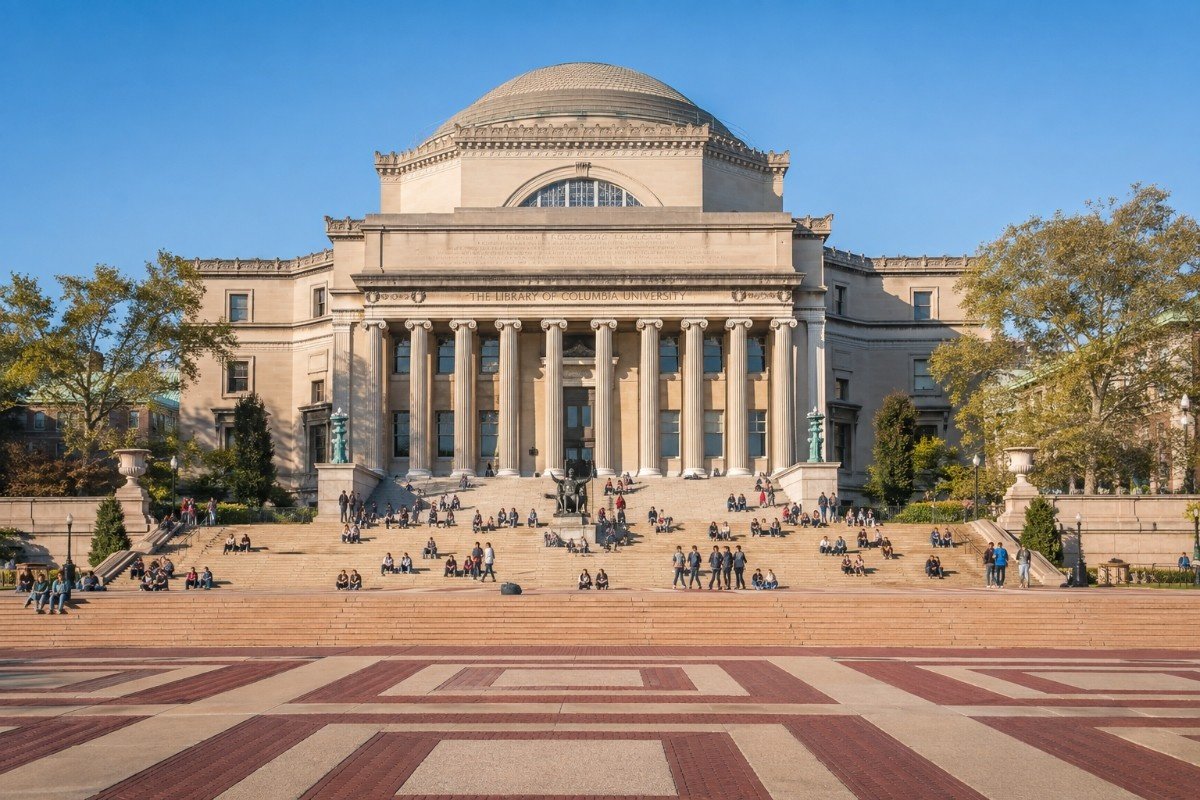
Introduction
Columbia University is one of the oldest and most academically respected universities in the United States. Located in the Morningside Heights neighborhood of Manhattan, New York City, the university combines a historic campus with direct access to one of the world’s leading centers for business, finance, media, healthcare, technology, and culture.
Founded in 1754 as King’s College, Columbia predates the founding of the United States and has developed into a globally recognized research university. It is a member of the Ivy League and is known for rigorous academics, influential research, and a long tradition of educating leaders in science, law, medicine, journalism, engineering, public policy, business, and the humanities.
Students from more than 150 countries study at Columbia, creating a diverse academic environment that encourages collaboration across disciplines. The university’s location in New York City also provides opportunities for internships, research partnerships, networking, and cultural experiences that complement classroom learning.
This guide explores Columbia University’s history, academic strengths, admissions process, campus life, research culture, career opportunities, costs, scholarships, and other key topics to help prospective students decide whether it aligns with their educational and career goals.
What is Columbia University?
Columbia University is a private Ivy League research university located in New York City, USA. It is internationally recognized for its academic excellence, groundbreaking research, distinguished faculty, and strong alumni network. The university offers undergraduate, graduate, and professional programs across a wide range of disciplines and attracts students from around the world.
Highlights
- Founded in 1754, making it one of the oldest universities in the United States.
- Member of the prestigious Ivy League.
- Located in Manhattan, New York City.
- Offers undergraduate, graduate, doctoral, and professional degree programs.
- Home to internationally recognized research institutes and laboratories.
- Known for strong programs in journalism, engineering, business, medicine, law, and international affairs.
- Provides extensive research opportunities for students across disciplines.
- Benefits from close connections with industries, hospitals, media organizations, financial institutions, and global companies in New York City.
- Welcomes a diverse student body from around the world.
- Maintains an extensive global alumni network across government, academia, business, science, and the arts.
University Facts
| Category | Information |
|---|---|
| Official Name | Columbia University |
| Founded | 1754 |
| Former Name | King’s College |
| Type | Private Research University |
| Location | New York City, New York, USA |
| Campus Setting | Urban |
| Athletic Conference | Ivy League |
| Academic Calendar | Semester-based |
| Motto | In Lumine Tuo Videbimus Lumen |
| Degrees Offered | Bachelor’s, Master’s, Doctoral & Professional |
| Official Website | https://www.columbia.edu |
History
Columbia University’s story began in 1754, when it was established by royal charter as King’s College in colonial New York. At the time, it became one of the earliest institutions of higher education in North America, created to provide advanced education in subjects such as philosophy, mathematics, classics, and theology.
The college initially occupied a campus near Trinity Church in Lower Manhattan. As New York City expanded and the university evolved, Columbia relocated several times before settling at its current campus in Morningside Heights in 1897.
Following the American Revolution, King’s College was renamed Columbia College in 1784 to reflect the newly independent nation. Over the following centuries, the institution steadily expanded its academic offerings, research capabilities, and international reputation.
Growth into a Global Research University
During the late nineteenth and twentieth centuries, Columbia transformed from a regional college into one of the world’s leading research universities.
Several developments contributed to this transformation:
- Expansion of graduate and professional education
- Establishment of internationally recognized research laboratories
- Growth of medical and health sciences education
- Development of world-renowned journalism, law, and business schools
- Strong partnerships with hospitals, research institutes, and public organizations
- Increased international collaboration in science and technology
Today, Columbia is recognized as one of the leading research universities globally, producing influential scholarship across medicine, engineering, economics, artificial intelligence, climate science, public health, and the humanities.
A Tradition of Academic Excellence
Throughout its history, Columbia has attracted distinguished scholars, scientists, authors, public servants, entrepreneurs, and innovators.
The university has played an important role in advancing knowledge through:
- Scientific discoveries
- Medical research
- Public policy development
- Journalism
- Literature
- Economics
- Engineering innovation
- International affairs
Its commitment to combining teaching with research remains a defining characteristic of the university.
Campus Overview
Columbia University’s main campus is located in Morningside Heights, Manhattan, placing students within one of the world’s most dynamic urban environments. Unlike isolated university towns, Columbia offers immediate access to museums, libraries, financial institutions, technology companies, hospitals, theaters, media organizations, and cultural landmarks.
Despite being situated in one of the busiest cities in the world, the campus provides a distinct academic atmosphere. Tree-lined walkways, historic architecture, green open spaces, and pedestrian-friendly pathways create an environment that feels separate from the surrounding city while remaining closely connected to it.
This combination allows students to enjoy a traditional university campus alongside the professional opportunities available throughout New York City.
Architecture
The campus features a blend of historic and modern buildings.
Some of the most recognizable landmarks include:
- Low Memorial Library
- Butler Library
- Alma Mater Statue
- St. Paul’s Chapel
- College Walk
These buildings reflect classical architectural influences while newer facilities incorporate modern research laboratories, collaborative learning spaces, and advanced technology.
Campus Atmosphere
Students often describe Columbia’s atmosphere as:
- Academically rigorous
- Diverse and international
- Research-focused
- Collaborative
- Fast-paced
- Intellectually stimulating
The surrounding neighborhoods offer restaurants, bookstores, parks, cafés, and convenient public transportation, allowing students to explore New York City throughout the year.
Campus Facilities
Libraries
Columbia maintains one of the largest academic library systems in the United States.
The university’s libraries provide:
- Millions of printed volumes
- Extensive digital collections
- Rare books and manuscripts
- Research databases
- Collaborative study areas
- Quiet reading rooms
- Technology support
- Subject-specialist librarians
Butler Library serves as the primary library for many undergraduate students and is one of the university’s best-known academic buildings.
Research Laboratories
Students have opportunities to participate in research across numerous disciplines.
Research facilities support work in areas such as:
- Artificial Intelligence
- Biomedical Engineering
- Neuroscience
- Climate Science
- Data Science
- Physics
- Chemistry
- Materials Science
- Public Health
Many undergraduate students also participate in faculty-led research projects, allowing them to gain practical experience before graduation.
Student Centers
Campus student centers provide spaces for:
- Student organizations
- Cultural events
- Leadership programs
- Workshops
- Community gatherings
- Career networking sessions
These facilities encourage interaction among students from different academic disciplines and cultural backgrounds.
Athletic and Recreation Facilities
Students have access to facilities that support physical fitness and recreational activities, including:
- Fitness centers
- Indoor sports courts
- Swimming facilities
- Athletic training areas
- Group exercise programs
- Intramural sports
Columbia also competes in NCAA Division I athletics as a member of the Ivy League.
Dining Services
Dining options include:
- Residential dining halls
- Cafés
- Grab-and-go locations
- International cuisine
- Vegetarian and vegan options
- Accommodations for many dietary needs
Students can also explore the wide variety of restaurants available throughout Manhattan.
Housing
Columbia offers on-campus housing for many undergraduate students, with residence halls designed to support both academic success and community life.
Residence facilities typically include:
- Study lounges
- Common areas
- Laundry facilities
- Resident advisers
- Programming and social events
- Security services
Graduate housing is also available for many eligible students, although availability varies and demand can be high.
Academic Environment
Interdisciplinary Learning
One of Columbia University’s defining characteristics is its emphasis on interdisciplinary education. Students are encouraged to explore courses across different schools and departments, helping them build a broader understanding of complex global issues.
Faculty
Columbia’s faculty includes internationally recognized scholars, researchers, physicians, economists, engineers, authors, and public policy experts. Many professors actively contribute to research while teaching, allowing students to engage with current developments in their fields.
Research Culture
Research is integrated into academic life from the undergraduate level through doctoral studies. Students often collaborate with faculty members on projects that address scientific, technological, medical, social, and policy-related challenges.
This research-focused environment encourages critical thinking, problem-solving, and innovation.
Global Perspective
Columbia emphasizes international engagement through:
- Study abroad opportunities
- Global research collaborations
- International conferences
- Exchange programs
- Cross-cultural learning experiences
The university’s diverse student body further enriches classroom discussions by bringing together perspectives from around the world.
Why This Environment Appeals to Students
Students who thrive at Columbia often value:
- Challenging academics
- Access to world-class faculty
- Research opportunities
- The professional advantages of New York City
- A diverse and intellectually engaged community
- Opportunities to connect classroom learning with real-world experiences
Academic Reputation
Columbia University has earned an international reputation for academic excellence through its long history of research, rigorous teaching, and influential scholarship. As a member of the Ivy League, the university is widely recognized for educating students who go on to become leaders in business, government, medicine, journalism, engineering, science, law, and the arts.
A defining feature of Columbia is its integration of research with education. Students are encouraged to work alongside faculty members on real-world research projects, often beginning at the undergraduate level. This emphasis on inquiry helps students develop analytical thinking, problem-solving abilities, and independent research skills.
Rather than focusing on a single academic discipline, Columbia has built strength across a wide range of fields, making it an attractive choice for students seeking interdisciplinary learning and collaboration.
Why Columbia Is Academically Respected
Several factors contribute to Columbia’s global reputation:
- Rigorous and selective academic programs
- Distinguished faculty engaged in leading research
- Strong emphasis on interdisciplinary education
- Extensive research funding and facilities
- Global partnerships with universities and research organizations
- Access to New York City’s academic, cultural, and professional resources
- A diverse student body representing countries from around the world
These strengths create an environment where students are challenged academically while benefiting from practical learning opportunities beyond the classroom.
Global Rankings
Columbia University is regularly included among the world’s leading universities by internationally recognized ranking organizations.
Common ranking publishers include:
- QS World University Rankings
- Times Higher Education (THE)
- U.S. News & World Report
- Academic Ranking of World Universities (Shanghai Ranking)
Because each organization uses different methodologies—such as research output, teaching quality, international outlook, employer reputation, and academic citations—Columbia’s position may vary from one ranking to another. Rankings also change annually, so prospective students should consult the latest editions rather than relying on historical results.
Schools and Colleges
Columbia University consists of multiple schools and colleges, each specializing in different academic areas.
Columbia College
The university’s oldest undergraduate college offers a broad liberal arts education. Students study humanities, social sciences, natural sciences, mathematics, and the arts while completing the university’s well-known Core Curriculum.
Columbia Engineering
Officially known as The Fu Foundation School of Engineering and Applied Science, Columbia Engineering combines theoretical education with practical problem-solving. Students work on projects involving artificial intelligence, robotics, biomedical engineering, computer science, civil engineering, and other rapidly evolving fields.
Columbia Business School
Columbia Business School is internationally recognized for graduate business education and research. Its location in New York City provides students with strong connections to finance, consulting, entrepreneurship, and global business organizations.
Columbia Law School
The Law School is known for programs in constitutional law, international law, corporate law, human rights, and legal scholarship. Students benefit from clinics, internships, and proximity to major legal institutions.
Vagelos College of Physicians and Surgeons
Columbia’s medical school emphasizes patient care, biomedical research, and medical innovation. Students receive clinical training through affiliated hospitals and healthcare systems.
Graduate School of Journalism
Established with support from Joseph Pulitzer, the journalism school is recognized for preparing students for careers in reporting, investigative journalism, digital media, documentary storytelling, and broadcast journalism.
School of International and Public Affairs (SIPA)
SIPA prepares students for careers in diplomacy, public policy, international development, nonprofit leadership, and global governance through interdisciplinary study and practical policy analysis.
Programs Offered
Undergraduate Programs
Columbia offers bachelor’s degree programs across a wide range of academic disciplines.
Popular undergraduate fields include:
- Computer Science
- Economics
- Political Science
- Psychology
- Biology
- Mathematics
- Physics
- Chemistry
- English
- History
- Philosophy
- Mechanical Engineering
- Biomedical Engineering
- Civil Engineering
- Data Science
Students also complete the Core Curriculum, a distinctive academic program designed to build critical thinking, writing, and analytical skills through the study of influential texts and ideas.
Graduate Programs
Graduate students can pursue master’s degrees in areas such as:
- Business Administration (MBA)
- Finance
- Engineering
- Computer Science
- Journalism
- Architecture
- Public Health
- Public Administration
- International Affairs
- Education
- Data Science
- Statistics
Many programs combine classroom learning with internships, research projects, and industry collaboration.
Doctoral Programs
Columbia supports doctoral research across numerous disciplines, including:
- Engineering
- Medicine
- Economics
- Political Science
- Psychology
- Physics
- Chemistry
- Biology
- Sociology
- History
- Computer Science
- Public Health
Doctoral students work closely with faculty while contributing original research to their respective fields.
Professional Schools
In addition to traditional undergraduate and graduate programs, Columbia offers professional education through schools specializing in:
- Law
- Medicine
- Business
- Nursing
- Journalism
- Architecture
- Dental Medicine
- Public Health
- Social Work
These programs combine academic theory with professional practice and often involve clinical, laboratory, or field-based experiences.
Research Strengths
Research is central to Columbia University’s mission. Faculty members and students contribute to advances across science, technology, medicine, engineering, public policy, and the humanities.
Major areas of research include:
- Artificial Intelligence
- Machine Learning
- Biomedical Engineering
- Neuroscience
- Cancer Research
- Climate Science
- Sustainable Energy
- Public Health
- Economics
- International Affairs
- Materials Science
- Data Science
The university encourages collaboration across departments, allowing researchers to address complex global challenges from multiple perspectives.
Innovation and Entrepreneurship
Columbia supports innovation by helping students and researchers transform ideas into practical solutions. Through entrepreneurship initiatives, startup support, mentorship, and industry partnerships, students gain opportunities to develop technologies, launch ventures, and collaborate with organizations in New York City’s dynamic innovation ecosystem.
Learning Experience
Students at Columbia typically experience:
- Small discussion-based seminars alongside larger lectures
- Research opportunities beginning in the early years of study
- Close interaction with faculty and graduate researchers
- Interdisciplinary coursework
- Access to internships and professional experiences throughout New York City
- A demanding academic workload that emphasizes critical thinking and independent learning
This environment is particularly well suited to students who enjoy intellectual challenges and want to connect academic knowledge with real-world applications.
Admissions Overview
Admission to Columbia University is highly competitive. Each year, the university receives applications from academically outstanding students across the United States and around the world.
Admissions decisions are based on a holistic review rather than a single factor. The admissions committee considers academic achievement, course rigor, extracurricular involvement, leadership, personal qualities, essays, recommendations, and evidence of intellectual curiosity.
For international applicants, English language proficiency and educational background are also evaluated.
Note: Admission policies, testing requirements, and deadlines may change from year to year. Applicants should always verify the latest information through Columbia University’s official admissions website before applying.
Undergraduate Admissions Process
Most undergraduate applicants apply through the Common Application or Coalition Application, depending on the program and admission cycle.
A typical application process includes:
- Selecting the desired undergraduate college or program.
- Completing the online application.
- Submitting academic transcripts.
- Providing teacher recommendations.
- Writing the required personal essay and supplemental essays.
- Submitting standardized test scores if applicable under the current admissions policy.
- Sending English-language proficiency scores (for eligible international applicants).
- Paying the application fee or requesting a fee waiver if eligible.
After submission, applicants can monitor their application status through the university’s applicant portal.
Graduate Admissions
Graduate admissions vary by school and department.
Applicants generally need to submit:
- Completed online application
- Bachelor’s degree (or equivalent)
- Official academic transcripts
- Statement of Purpose
- Resume or Curriculum Vitae (CV)
- Letters of Recommendation
- Writing samples or portfolio (for selected programs)
- English-language test scores (if required)
- Standardized tests where applicable
Some graduate programs may also require interviews or additional assessments.
Eligibility Requirements
Although requirements differ among programs, successful applicants typically demonstrate:
Strong Academic Performance
Competitive grades in challenging coursework are an important component of the application.
Course Preparation
Applicants should complete rigorous secondary-school or university-level coursework appropriate to their intended field of study.
Intellectual Curiosity
Columbia values students who demonstrate genuine interest in learning, research, creativity, and independent thinking.
Leadership and Engagement
Participation in clubs, sports, volunteer work, research, community service, internships, or entrepreneurial activities can strengthen an application when accompanied by meaningful contributions.
Required Documents
Undergraduate applicants generally prepare:
- Completed application form
- Official academic transcripts
- School report
- Teacher recommendations
- Counselor recommendation (where applicable)
- Personal essay
- Columbia supplemental essays
- English proficiency results (if required)
- Financial documentation for international students (after admission when applicable)
Graduate applicants should review the specific requirements of their chosen department, as documentation varies across programs.
English Language Requirements
Applicants whose previous education was not primarily conducted in English may be required to demonstrate English proficiency.
Commonly accepted examinations include:
- TOEFL iBT
- IELTS Academic
- Duolingo English Test (for programs that accept it)
- Other approved English proficiency assessments where applicable
Some applicants may qualify for an exemption based on Columbia’s official policy.
Standardized Tests
Testing requirements vary by program and admission cycle.
Examples include:
- SAT or ACT (undergraduate, depending on current policy)
- GRE (selected graduate programs)
- GMAT or GRE (certain business programs)
- MCAT (Medicine)
- LSAT or other accepted alternatives (Law, depending on current admissions policies)
Applicants should confirm the latest testing requirements directly with the relevant school or department.
Application Timeline
While exact dates change annually, Columbia typically offers admission rounds such as:
| Admission Stage | Typical Timeline* |
|---|---|
| Early Decision | Fall application cycle |
| Regular Decision | Winter application cycle |
| Graduate Admissions | Varies by department |
*Deadlines differ by school and program. Always refer to the official admissions calendar for current dates.
Tuition and Educational Costs
Tuition at Columbia University varies significantly depending on:
- Undergraduate or graduate status
- Academic program
- Professional school
- Enrollment status
- Housing choices
- Meal plans
- Health insurance
- Additional university fees
Because tuition is reviewed and updated periodically, prospective students should consult the official tuition and financial services pages for the latest figures.
Additional Costs to Consider
Students should also budget for:
- Housing
- Meals
- Books and academic supplies
- Health insurance
- Personal expenses
- Local transportation
- Technology needs
- Recreation and miscellaneous expenses
Living in New York City can be more expensive than many other university locations, making careful financial planning important.
Cost of Living in New York City
Living expenses depend on lifestyle and housing choices.
Typical expenses may include:
- Rent or university housing
- Food and groceries
- Public transportation
- Mobile phone and internet
- Entertainment
- Clothing
- Healthcare
- Personal expenses
Students often reduce costs by using university dining plans, student discounts, and New York City’s public transportation network.
Scholarships and Financial Aid
Columbia University offers a range of financial assistance programs designed to make education more accessible.
These may include:
- Need-based financial aid
- Merit opportunities (where applicable)
- External scholarships
- Federal financial aid (for eligible U.S. students)
- Graduate fellowships
- Research assistantships
- Teaching assistantships
- Departmental funding
Availability and eligibility vary depending on the student’s citizenship, academic level, and chosen program.
Financial Aid for International Students
International students should carefully review the financial aid policies that apply to their specific school or program.
Funding opportunities may include:
- Institutional scholarships
- Need-based assistance (where available)
- Graduate fellowships
- Research funding
- Teaching assistantships
- External scholarship programs
Because funding policies differ among Columbia’s schools, applicants should review the relevant financial aid office before applying.
Tips for International Applicants
Students applying from outside the United States should:
- Begin preparing application materials well in advance.
- Arrange certified translations if academic records are not in English.
- Check passport validity and future visa requirements.
- Demonstrate English-language proficiency if required.
- Research estimated living costs in New York City.
- Explore scholarship and funding opportunities early.
- Follow the official application checklist carefully.
- Submit all documents before published deadlines.
Application Tips
A competitive application typically reflects more than excellent grades. Applicants should aim to:
- Challenge themselves with rigorous coursework.
- Develop meaningful extracurricular involvement.
- Write thoughtful and authentic personal essays.
- Obtain strong recommendation letters from teachers or professors who know them well.
- Demonstrate genuine interest in their intended field of study.
- Proofread all application materials carefully before submission.
- Keep copies of all submitted documents and correspondence.
Student Life
Student life at Columbia University extends far beyond the classroom. The university brings together students from more than 150 countries, creating a multicultural and intellectually vibrant community.
The urban setting allows students to combine campus life with everything New York City has to offer, including museums, theaters, startups, financial institutions, hospitals, media companies, and cultural events.
Student Organizations
Students can participate in hundreds of student-run organizations, including:
- Academic clubs
- Entrepreneurship societies
- Debate and public speaking groups
- Cultural associations
- Music and performing arts organizations
- Volunteer and community service groups
- Robotics and technology clubs
- Political and public policy organizations
- Environmental initiatives
- Religious and faith-based communities
These organizations help students develop leadership, teamwork, and networking skills outside the classroom.
Athletics and Recreation
Columbia competes in NCAA Division I athletics as a member of the Ivy League.
Students can participate in:
- Varsity sports
- Club sports
- Intramural competitions
- Fitness programs
- Yoga and wellness classes
- Outdoor recreation activities
Whether students are competitive athletes or simply looking to stay active, the university provides a variety of recreational opportunities.
Diversity and Inclusion
One of Columbia’s defining strengths is its diverse student population. Students come from a wide range of cultural, socioeconomic, and academic backgrounds, contributing to an inclusive learning environment.
The university supports diversity through cultural centers, mentoring programs, affinity groups, and campus events that celebrate different traditions and perspectives.
Research & Innovation
Research is central to Columbia’s mission. Students and faculty collaborate on projects addressing challenges in healthcare, engineering, climate science, artificial intelligence, economics, public policy, and many other fields.
Major research strengths include:
- Artificial Intelligence
- Machine Learning
- Biomedical Engineering
- Climate Science
- Neuroscience
- Cancer Research
- Public Health
- Data Science
- Economics
- Sustainable Energy
Students often gain research experience through faculty-led projects, independent studies, and interdisciplinary initiatives.
Career Services
Columbia’s career services offices assist students throughout their academic journey.
Support commonly includes:
- Career counseling
- Resume and CV reviews
- Mock interviews
- Internship guidance
- Career fairs
- Employer networking events
- Graduate school advising
- Alumni mentoring
Because of the university’s location in New York City, students have access to employers in finance, consulting, technology, media, healthcare, law, nonprofit organizations, and government.
Internship Opportunities
Many students complete internships before graduation.
Popular internship sectors include:
- Investment Banking
- Software Engineering
- Consulting
- Journalism
- Public Policy
- Healthcare
- Biotechnology
- Marketing
- Data Analytics
- Nonprofit Organizations
Internships allow students to apply classroom knowledge while building professional experience and industry connections.
Famous Alumni
Columbia University has educated many influential leaders across politics, science, literature, business, and the arts.
Some well-known alumni include:
- Barack Obama
- Warren Buffett
- Ruth Bader Ginsburg
- Alexander Hamilton
- Madeleine Albright
- Jake Gyllenhaal
- Alicia Keys
These alumni have made significant contributions in public service, business, law, entertainment, and academia.
Columbia University vs Other Ivy League Universities
| University | Best Known For | Ideal For |
|---|---|---|
| Columbia University | Research, Journalism, Business, Urban Experience | Students seeking strong academics with New York City opportunities |
| Harvard University | Broad academic excellence, Law, Medicine | Students seeking a wide range of elite academic programs |
| Yale University | Humanities, Arts, Law | Students interested in liberal arts and close-knit residential colleges |
| Princeton University | Undergraduate education, Mathematics, Physics | Students who value small class sizes and undergraduate research |
| University of Pennsylvania | Business, Economics, Healthcare | Students interested in interdisciplinary professional education |
No single university is objectively “better.” The right choice depends on a student’s academic interests, career goals, preferred campus environment, and financial considerations.
Pros & Cons
| Pros | Cons |
|---|---|
| Prestigious Ivy League reputation | Highly competitive admissions |
| Excellent research opportunities | High cost of attendance |
| Prime location in New York City | Living expenses in Manhattan can be significant |
| Distinguished faculty | Academically demanding workload |
| Extensive global alumni network | Housing demand may exceed availability |
| Strong internship and networking opportunities | Fast-paced urban environment may not suit everyone |
Frequently Asked Questions (FAQs)
1. Is Columbia University an Ivy League university?
Yes. Columbia is one of the eight Ivy League universities.
2. Where is Columbia University located?
It is located in Manhattan, New York City, USA.
3. Is Columbia difficult to get into?
Yes. Admission is highly competitive, with a holistic review process.
4. Does Columbia accept international students?
Yes. Students from around the world are encouraged to apply.
5. What are Columbia’s strongest academic fields?
Business, Engineering, Journalism, Law, Medicine, Computer Science, Economics, International Affairs, and Public Health.
6. Does Columbia offer scholarships?
Yes. Financial aid and scholarship opportunities vary by program and eligibility.
7. Can undergraduate students participate in research?
Yes. Many undergraduates work with faculty on research projects.
8. Is on-campus housing available?
Yes, although availability depends on the student’s program and housing policies.
9. What makes Columbia unique?
Its combination of Ivy League academics, extensive research, and direct access to New York City’s professional opportunities.
10. Is Columbia a good choice for international students?
For students seeking rigorous academics, global recognition, and strong career opportunities, Columbia can be an excellent option.
Final Verdict
Columbia University is one of the world’s leading research universities, offering an exceptional combination of academic excellence, interdisciplinary learning, and access to the professional opportunities of New York City.
Its strengths include internationally recognized faculty, outstanding research resources, a diverse student community, and strong connections with industries ranging from finance and technology to healthcare and media.
Prospective students should also consider the university’s highly competitive admissions process, demanding academic environment, and the higher cost of living associated with Manhattan.
For students who are academically motivated, enjoy intellectual challenges, and want to study in a globally connected urban setting, Columbia University remains one of the strongest higher education choices available.