

Introduction
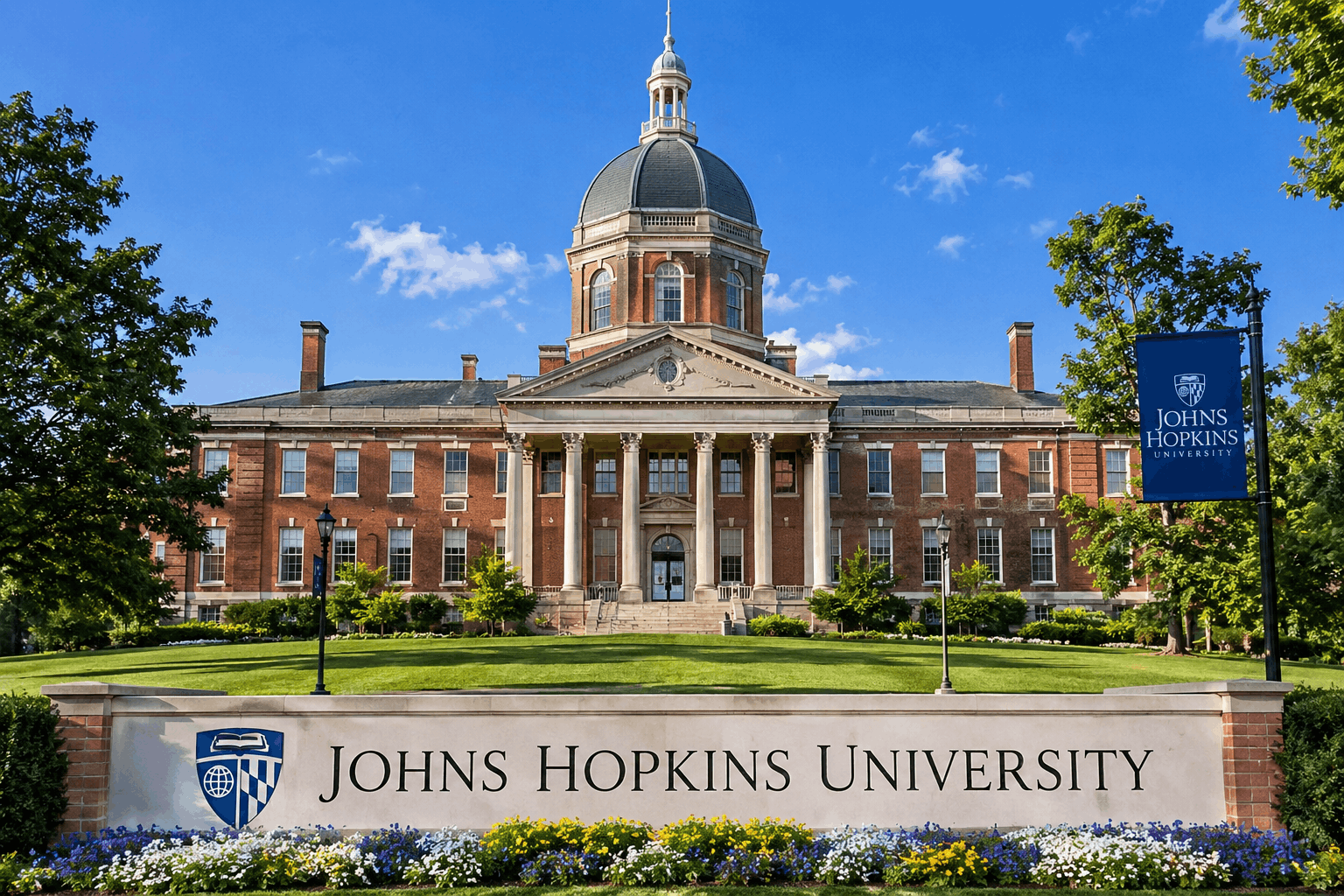
Johns Hopkins University (JHU) is a private research university in Baltimore, Maryland, with an academic identity built around the close relationship between research, teaching, and discovery. Founded in 1876, Johns Hopkins describes itself as America’s first research university and was established around the idea that universities should not only teach existing knowledge but also create new knowledge through research.
Today, Johns Hopkins has 10 academic divisions covering areas such as arts and sciences, engineering, medicine, nursing, public health, international studies, education, business, government and policy, and music and dance. The university says it offers more than 400 programs across these areas.
For students considering JHU, the university is particularly notable for its research culture and its connections across disciplines. Undergraduate students can pursue research and internships while also receiving opportunities to study subjects outside a traditional academic boundary. Johns Hopkins’ undergraduate admissions site currently reports that 80% of students participate in research and 85% have at least one internship experience.
However, Johns Hopkins is not simply a university for students interested in medicine or science. Its academic structure includes humanities, social sciences, engineering, business, international affairs, public policy, education, and music. This makes the university relevant to a much broader group of applicants.
Johns Hopkins University Fact
| Category | Information |
|---|---|
| Official Name | Johns Hopkins University |
| Common Name | Johns Hopkins / JHU |
| Founded | 1876 |
| Location | Baltimore, Maryland, United States |
| Institution Type | Private research university |
| Academic Divisions | 10 |
| Programs | 400+ across the university |
| Undergraduate Community | Approximately 5,600 undergraduates, according to current undergraduate admissions materials |
| Research Identity | Research-intensive |
| Main Undergraduate Campus | Homewood |
| Official Website | Johns Hopkins University |
Johns Hopkins University History
The Founding of Johns Hopkins
The story of Johns Hopkins University begins with Johns Hopkins, a 19th-century Maryland businessman and philanthropist. The university was named in his honor after he directed a substantial portion of his wealth toward institutions intended to serve education and healthcare. According to Johns Hopkins’ historical account, his will allocated $7 million to establish a university, hospital, training colleges, and an orphanage—described by the university as the largest philanthropic bequest in U.S. history at the time.
The university’s legal foundation predates its opening. On August 24, 1867, 12 trustees signed the Certificate of Incorporation for The Johns Hopkins University.
Johns Hopkins University officially opened in 1876, with Daniel Coit Gilman serving as its first president.
Daniel Coit Gilman and a New University Model
Daniel Coit Gilman played an important role in defining what Johns Hopkins would become.
At a time when many American colleges were heavily influenced by traditional models of undergraduate education, Gilman promoted an institution in which advanced research and teaching were closely connected.
This approach became one of the defining characteristics of Johns Hopkins.
The university’s official history describes Gilman’s mission as educating students, encouraging independent and original research, and bringing the benefits of discovery to society.
That philosophy helps explain why research remains such a central part of the Johns Hopkins identity more than a century later.
Why the Research Model Matters
The importance of Johns Hopkins University’s founding model extends beyond the institution itself.
The university’s research office describes Johns Hopkins as the first university in the Western Hemisphere established according to the European research-university model. Its founding helped introduce a stronger connection between advanced research and university education in the United States.
For students, this history has a practical implication.
At a research-intensive university, students may encounter professors who are actively involved in research, laboratories where new discoveries are being pursued, and academic programs that encourage investigation rather than simply memorizing established information.
This can be particularly valuable for students who want to pursue:
- Scientific research
- Medicine
- Public health
- Engineering
- Biomedical sciences
- Data and technology
- International affairs
- Academic careers
- Graduate or professional education
Johns Hopkins University’s Research Legacy
Research is not simply an additional feature of Johns Hopkins University. It is one of the foundations on which the institution was built.
The university says its faculty, students, clinicians, and researchers have contributed to discoveries and developments involving areas such as water purification, CPR, medical surgery, public health, genetic engineering, and space exploration.
The university’s research environment also extends beyond a single academic discipline.
For example, research at Johns Hopkins can involve combinations of:
- Medicine and engineering
- Public health and data science
- Biology and technology
- International relations and economics
- History and political thought
- Neuroscience and biomedical research
- Environmental science and public policy
This interdisciplinary character is an important part of understanding JHU.
Academic Structure
Johns Hopkins University currently operates across 10 academic divisions:
- Krieger School of Arts and Sciences
- Whiting School of Engineering
- Carey Business School
- School of Education
- School of Advanced International Studies
- School of Medicine
- School of Nursing
- Bloomberg School of Public Health
- Peabody Institute
- School of Government and Policy
The university’s current website identifies these 10 schools/divisions as the major academic components of the institution.
This structure means that students can encounter an unusually broad academic ecosystem within one university.
A student interested in biology, for example, may find opportunities connected to medicine, public health, engineering, or data science. Similarly, a student interested in international affairs may encounter connections with economics, political science, public health, or policy.
What Makes Johns Hopkins Academically Different?
One of the clearest characteristics of Johns Hopkins is its emphasis on learning through discovery.
The undergraduate admissions office explains that students can work with academic advisers and faculty mentors, explore interests across disciplines, and develop a research-oriented approach to solving complex problems.
For students who enjoy asking questions rather than simply receiving answers, this can be an important advantage.
JHU’s academic model may be especially attractive to students who want:
- Early exposure to research
- Close interaction with faculty
- Interdisciplinary learning
- Strong academic advising
- Laboratory or project-based experiences
- Internship opportunities
- Preparation for graduate or professional school
The university currently reports 100+ majors and minors, along with pre-professional advising tracks and special programs for undergraduates.
Johns Hopkins and Baltimore
Location is another important part of the Johns Hopkins experience.
The university’s primary undergraduate environment is associated with its Homewood campus in Baltimore, while Johns Hopkins as an institution has a much broader footprint across the city and beyond.
Baltimore is not simply the geographical location of the university. Johns Hopkins describes the city as an extension of campus, providing students with opportunities for cultural experiences, learning, research, and community engagement.
For prospective students, this means that evaluating Johns Hopkins should involve more than looking at academic programs.
Students should also consider whether they would enjoy living and studying in an urban environment and whether Baltimore’s culture, transportation, neighborhoods, and surrounding opportunities fit their expectations.
Who Might Be a Good Fit for Johns Hopkins?
Johns Hopkins may be particularly suitable for students who are highly motivated academically and want substantial opportunities to explore research and interdisciplinary learning.
It can be a strong fit for students interested in fields such as:
- Biology and life sciences
- Medicine
- Public health
- Biomedical research
- Engineering
- Computer science and technology
- International studies
- Political science and policy
- Economics and business
- Humanities
- Music
- Education
- Nursing
However, the university’s research intensity can also mean that students should think carefully about workload, academic expectations, and the type of learning environment they prefer.
A student looking for a university where research is deeply integrated into the educational experience may find Johns Hopkins appealing. A student who prefers a less research-oriented college environment may want to compare JHU with other institutions before making a decision.
Johns Hopkins University Campus Experience
The Johns Hopkins University experience extends beyond classrooms and lecture halls. Its academic environment is shaped by research facilities, libraries, student spaces, laboratories, cultural institutions, athletic facilities, and the surrounding Baltimore community.
For prospective students, understanding the campus is important because the physical environment can influence how students study, collaborate, socialize, conduct research, and participate in university life.
Johns Hopkins has multiple campuses and facilities serving different academic purposes. The Homewood campus is the primary undergraduate campus and is home to the Krieger School of Arts and Sciences and the Whiting School of Engineering. Other locations support medicine, public health, international studies, business, education, nursing, music, and other areas.
Homewood Campus
The Homewood campus is the central undergraduate environment for many Johns Hopkins students.
Located in northern Baltimore, Homewood combines academic buildings, research spaces, residential facilities, student organizations, recreational areas, and outdoor spaces.
The campus is known for its traditional university architecture and collegiate atmosphere. Academic buildings are arranged around areas that provide students with places to walk, study, meet friends, or participate in campus activities.
For undergraduate applicants, Homewood is particularly important because it is where much of the day-to-day undergraduate experience takes place.
Students can move between classes, laboratories, libraries, dining facilities, residential areas, and student organizations without needing to leave the broader campus environment for every activity.
Campus Architecture and Environment
The Homewood campus has a mixture of historic and modern university architecture.
One of its recognizable landmarks is Gilman Hall, named after Daniel Coit Gilman, the university’s first president. The building has long been associated with the university’s academic history.
At the same time, Johns Hopkins has continued to develop and modernize its facilities to accommodate contemporary teaching and research.
This combination gives the university an environment in which historic academic traditions exist alongside modern research and learning spaces.
For students, the campus environment can provide a balance between a traditional university setting and the resources expected from a major research institution.
Academic Buildings and Learning Spaces
Johns Hopkins provides a variety of learning environments rather than relying exclusively on traditional classrooms.
Depending on the program, students may learn through:
- Lecture courses
- Seminars
- Laboratory classes
- Research projects
- Group projects
- Faculty-directed studies
- Independent research
- Internships
- Practical or experiential learning
This variety is particularly relevant at a university where research plays a central role.
A biology student, for example, may spend part of the academic experience in classrooms and laboratories, while a student in the humanities may spend more time in seminars, libraries, archives, and discussion-based courses.
Engineering students can encounter design and project-based environments, while students studying international affairs may engage with policy analysis, economics, history, and global political issues.
Libraries and Study Resources
Libraries play an important role in the academic environment at Johns Hopkins.
The university’s library system provides students and researchers with access to books, scholarly publications, databases, digital resources, research assistance, study spaces, and specialized collections.
The Milton S. Eisenhower Library, commonly known as MSEL, is the primary library associated with the Homewood campus.
It supports undergraduate and graduate students across many disciplines and provides spaces for both individual study and collaborative work.
For students writing research papers or completing major academic projects, library resources can be particularly valuable because research-intensive universities require students to work with scholarly sources rather than relying solely on general internet information.
Research Facilities
Research facilities are one of the most important components of the Johns Hopkins environment.
Because the university was founded around the principle of combining teaching with research, students can encounter research activity throughout their academic experience.
Research may involve:
- Laboratory science
- Biomedical research
- Engineering
- Public health
- Computer science
- Data analysis
- Social sciences
- International affairs
- Environmental research
- Humanities
- Medicine
Undergraduate students are not necessarily limited to learning about research from textbooks. Johns Hopkins actively promotes opportunities for students to participate in research and work with faculty.
According to the university’s undergraduate admissions materials, 80% of students participate in research.
This statistic should be understood as a university-reported figure and may be updated over time.
Interdisciplinary Learning
One of the advantages of studying at a large research university is the ability to connect subjects that are normally taught separately.
Johns Hopkins’ academic structure makes interdisciplinary study particularly relevant.
For example, a student interested in public health might combine interests in:
- Biology
- Statistics
- Economics
- Policy
- Medicine
- Data science
Similarly, an engineering student could explore subjects related to entrepreneurship, computer science, biomedical research, or public policy.
This flexibility can be valuable because many modern professional problems do not fit neatly into one academic discipline.
Climate change, global health, artificial intelligence, biotechnology, international security, and healthcare innovation are examples of areas that require knowledge from multiple fields.
The Krieger School of Arts and Sciences
The Krieger School of Arts and Sciences represents the liberal arts and sciences component of Johns Hopkins.
Its academic areas include disciplines across the humanities, social sciences, natural sciences, and related fields.
Students can explore subjects such as:
- Biology
- Chemistry
- Physics
- Mathematics
- Economics
- Political science
- History
- Philosophy
- Psychology
- Writing
- Languages
- Sociology
- Neuroscience
- Other interdisciplinary fields
The liberal arts environment is important even for students pursuing scientific or technical careers.
Courses in communication, ethics, history, economics, and social sciences can help students understand the broader consequences of scientific and technological developments.
The Whiting School of Engineering
The Whiting School of Engineering is another major part of the undergraduate academic environment.
Engineering at Johns Hopkins is strongly connected with the university’s broader research ecosystem.
Students can pursue areas such as:
- Biomedical engineering
- Chemical and biomolecular engineering
- Civil and systems engineering
- Electrical and computer engineering
- Mechanical engineering
- Applied mathematics and statistics
- Computer science
- Materials-related research and other technical areas
Biomedical engineering has a particularly strong relationship with Johns Hopkins’ medical and research ecosystem.
This can create opportunities for students interested in the intersection of engineering and human health.
Biomedical Engineering at Johns Hopkins
Biomedical engineering is one of the areas for which Johns Hopkins has developed a particularly strong academic and research identity.
The field combines engineering principles with biological and medical problems.
Students may encounter topics involving:
- Medical devices
- Biomaterials
- Imaging
- Biological systems
- Computational methods
- Rehabilitation technology
- Drug delivery
- Healthcare technology
The connection between engineering, medicine, and research can provide a distinctive environment for students who want to work on healthcare-related technological problems.
However, prospective students should evaluate individual programs carefully rather than assuming that the reputation of one department automatically applies equally to every academic field.
Johns Hopkins School of Medicine
The Johns Hopkins School of Medicine is one of the most internationally recognized components of the university.
It is based in Baltimore and is closely connected with Johns Hopkins Medicine.
The medical school contributes significantly to the university’s research and healthcare ecosystem.
Its environment includes:
- Medical education
- Clinical training
- Biomedical research
- Translational research
- Healthcare innovation
- Patient care
The connection between the university and medical system can be especially relevant to students interested in medicine, biomedical science, public health, nursing, or healthcare technology.
Undergraduate students should remember, however, that being an undergraduate at Johns Hopkins does not automatically mean admission to the School of Medicine. Medical school admission is a separate and highly competitive process.
Bloomberg School of Public Health
The Bloomberg School of Public Health is another major component of Johns Hopkins’ academic ecosystem.
Public health focuses on improving health at the population level rather than concentrating exclusively on individual medical treatment.
Academic areas can include:
- Epidemiology
- Biostatistics
- Environmental health
- Health policy
- Global health
- Social and behavioral sciences
- Population health
- Health systems
The school’s presence gives Johns Hopkins an unusually broad environment for students interested in the relationship between science, healthcare, policy, and society.
Public health research can also overlap with medicine, economics, political science, engineering, data science, and international affairs.
School of Nursing
The Johns Hopkins School of Nursing focuses on nursing education, research, clinical practice, and healthcare leadership.
Its connection with Johns Hopkins Medicine provides an environment in which nursing education can exist alongside medical research and clinical care.
Students interested in nursing may therefore encounter opportunities connected with a much broader healthcare ecosystem.
As with other professional programs, applicants should review the specific admissions requirements and curriculum of the program they intend to enter because requirements can differ considerably between schools.
School of Advanced International Studies
The School of Advanced International Studies, commonly known as SAIS, focuses on international affairs.
SAIS has an academic and professional orientation involving subjects such as:
- International relations
- Economics
- Diplomacy
- International development
- Security studies
- Global policy
- Regional studies
Its presence broadens Johns Hopkins beyond the traditional perception of a science- and medicine-focused institution.
Students interested in diplomacy, international organizations, global economics, security, or public policy may find the SAIS environment particularly relevant.
SAIS also contributes to Johns Hopkins’ international presence beyond Baltimore.
Carey Business School
The Carey Business School provides business education within the Johns Hopkins ecosystem.
Its programs cover areas associated with modern business and management, including fields such as:
- Finance
- Marketing
- Management
- Business analytics
- Entrepreneurship
- Healthcare business
- Other management disciplines
The business school is particularly relevant to students interested in the intersection of business, healthcare, technology, and innovation.
The university’s broader research ecosystem can also provide business students with exposure to industries where scientific and technological knowledge has direct economic applications.
School of Education
The School of Education focuses on teaching, learning, educational policy, leadership, and related areas.
Education is a significant field because it connects academic research with practical questions about how people learn and how educational institutions operate.
Students and researchers may explore subjects involving:
- Teaching
- Learning science
- Education policy
- Leadership
- Counseling
- Special education
- Educational technology
- Human development
The school adds another dimension to Johns Hopkins’ academic portfolio and demonstrates that the university’s research culture extends beyond laboratory science.
Peabody Institute
The Peabody Institute is Johns Hopkins’ music and performing arts institution.
Founded in the 19th century, Peabody provides specialized education in music and performance.
Its presence gives Johns Hopkins an academic environment that includes:
- Music performance
- Composition
- Music education
- Conducting
- Other specialized musical disciplines
For students interested in professional music education, the Peabody Institute provides a very different academic experience from the university’s scientific and research-oriented programs.
This diversity is one of the notable features of the broader Johns Hopkins institution.
School of Government and Policy
Johns Hopkins also has a School of Government and Policy, expanding its academic offerings in government, politics, policy, and related areas.
Students interested in public policy may examine questions involving:
- Government institutions
- Public administration
- Political systems
- Policy analysis
- Economic policy
- Social policy
- International and domestic governance
These areas can connect naturally with the university’s programs in international studies, economics, public health, and social sciences.
Student Research Opportunities
Research is one of the most significant opportunities available to Johns Hopkins students.
The university’s undergraduate admissions materials emphasize opportunities for students to work alongside faculty and participate in research.
Students may become involved through:
- Faculty research projects
- Laboratory research
- Independent studies
- Departmental opportunities
- Summer research
- Interdisciplinary projects
- Research programs
This can be particularly useful for students considering graduate school, medical school, doctoral research, or research-intensive careers.
However, students should not assume that research participation happens automatically. Students typically need to actively seek opportunities, communicate with faculty, explore departments, and take initiative.
Internship Opportunities
Research is not the only form of experiential learning at Johns Hopkins.
The university’s undergraduate admissions website currently reports that 85% of students have at least one internship experience.
Internships can help students connect academic knowledge with professional environments.
Depending on the student’s field, opportunities may involve:
- Healthcare
- Technology
- Government
- Finance
- Consulting
- Research organizations
- Nonprofit organizations
- International institutions
- Media
- Education
- Engineering companies
Baltimore’s location and the university’s broader connections can provide students with opportunities beyond traditional campus activities.
Students should evaluate internships based on relevance and learning value rather than simply counting the number of experiences.
Student Support and Advising
Academic support is another important part of the Johns Hopkins experience.
Students can work with academic advisers and faculty mentors to plan coursework, explore academic interests, and make decisions about research or future study.
This can be especially helpful at a university with a large number of programs and academic disciplines.
Students entering Johns Hopkins with a clear academic plan may still change direction after discovering new subjects.
A flexible research university can therefore be useful for students who know the general area they enjoy but have not yet determined their precise specialization.
Who Will Benefit Most From the Johns Hopkins Academic Environment?
The academic environment may be especially attractive to students who:
- Enjoy challenging academic work
- Want opportunities to conduct research
- Are interested in interdisciplinary subjects
- Prefer learning through investigation and projects
- Are considering graduate or professional school
- Want access to a broad research ecosystem
- Are interested in medicine, science, engineering, public health, international affairs, or related fields
- Want to combine multiple academic interests
At the same time, students should honestly evaluate their preferred learning style.
Johns Hopkins’ research-oriented environment may be demanding. Applicants should consider not only whether they can meet admission requirements but also whether they would enjoy the academic culture after enrolling.
Johns Hopkins University Admissions Overview
Admission to Johns Hopkins University is highly selective, and prospective students should approach the application as a complete academic and personal profile rather than as a collection of individual scores.
Johns Hopkins uses a holistic review process. This means admissions officers consider multiple components of an applicant’s preparation and experiences rather than relying on one number or qualification.
For first-year applicants, the university’s application includes academic information, activities, achievements, personal writing, the Hopkins supplement, and standardized test scores. Johns Hopkins currently requires SAT or ACT scores for first-year admission.
Because admission requirements and deadlines can change by application cycle, applicants should always confirm the current requirements on the official Johns Hopkins admissions website before submitting an application.
Who Can Apply as a First-Year Student?
Johns Hopkins currently considers a student a first-year applicant if the student:
- Is currently completing high school; or
- Has graduated from high school or earned a GED and has completed fewer than 12 semester-based college credits at another institution.
College credits earned while the student was still in high school do not count toward that 12-credit threshold.
Students who have already earned a bachelor’s degree are not eligible to apply for undergraduate admission as first-year students. Johns Hopkins directs those students toward graduate-level opportunities instead.
Students who have completed more than 12 semester-based credits at another institution after high school generally apply through the transfer process rather than first-year admission.
Johns Hopkins Application Options
First-year applicants can choose among several admissions plans.
Early Decision I
Early Decision I is intended for students who have identified Johns Hopkins as their first-choice university.
The application deadline is currently November 1.
Early Decision is binding. If admitted, students who enter the agreement are expected to enroll at Johns Hopkins and withdraw applications from other institutions, subject to the terms of the agreement.
Because it is binding, students should not choose Early Decision simply because they believe it might improve their chances of admission.
A student should consider it only after carefully researching:
- Academic programs
- Campus environment
- Financial aid
- Career goals
- Family financial circumstances
- Overall university fit
Early Decision II
Early Decision II provides another binding option for students who decide later that Johns Hopkins is their first-choice university.
The current application deadline is January 2, with the financial-aid deadline listed as January 15.
The university specifically describes Early Decision II as an option for students who may want additional time to:
- Gather application materials
- Take standardized tests
- Submit first-semester grades
- Complete additional research about Hopkins
As with Early Decision I, Early Decision II is binding.
Regular Decision
Regular Decision is the appropriate option for students who want more flexibility in their college search.
The current application deadline is January 2.
Regular Decision can be particularly useful for applicants who want to compare:
- Multiple admission offers
- Financial-aid packages
- Academic programs
- Campus environments
- Career opportunities
Students who are not certain that Johns Hopkins is their first choice should generally consider whether the flexibility of Regular Decision better matches their circumstances.
Transfer Admission
Johns Hopkins also accepts transfer applicants.
The transfer process is different from first-year admission, including its eligibility requirements, deadlines, and application materials.
The current transfer application deadline listed by Johns Hopkins is March 1.
Students considering transfer admission should review the current transfer-specific requirements rather than assuming that the first-year process applies to them.
How to Apply to Johns Hopkins
First-year applicants can apply through the Common Application or Coalition on Scoir.
The university’s application requirements currently include several major components.
Application Components
Applicants should prepare:
- Completed application
- High school transcript
- Activities list
- Family or work responsibilities, when applicable
- Academic achievements and honors
- Personal statement
- Parent or guardian information
- Johns Hopkins supplemental materials
- Standardized test scores
Early Decision applicants must also complete the required Early Decision Agreement.
High School Academic Preparation
Academic preparation is one of the most important parts of a Johns Hopkins application.
The university evaluates standardized testing in the context of:
- High school transcript
- Course rigor
- AP or IB results, when available
- School curriculum
- Other application components
Johns Hopkins states that test scores are considered as part of the broader application rather than in isolation.
This means applicants should focus on building a strong academic record throughout high school instead of attempting to rely on a single test score.
SAT and ACT Requirements
Johns Hopkins currently requires first-year applicants to submit either:
- SAT, including Math and Evidence-Based Reading and Writing; or
- ACT, including Math, Reading, and English sections.
The university says standardized testing is required for students applying for Fall 2026 and beyond.
Applicants should verify the testing policy for their specific application cycle because universities can revise testing requirements.
How Johns Hopkins Uses Test Scores
The admissions committee considers testing alongside other academic evidence.
This can include:
- High school grades
- Course difficulty
- AP or IB performance
- School curriculum
- Academic achievements
- Broader application context
Therefore, students should not view the SAT or ACT as a replacement for strong coursework.
The Importance of Course Rigor
A challenging high school curriculum can demonstrate that an applicant is prepared for university-level academic work.
Course selection should be considered in the context of what the student’s school offers.
Applicants should generally pursue appropriately challenging coursework in areas connected to their academic interests while maintaining a strong overall academic record.
For example:
A student interested in engineering may naturally demonstrate preparation through advanced mathematics and science coursework.
A student interested in humanities might demonstrate academic preparation through challenging literature, history, writing, language, or social-science courses.
The goal is not simply to accumulate advanced courses. The stronger approach is to build an academic record that demonstrates intellectual curiosity, preparation, and consistency.
Johns Hopkins Supplemental Essay
The Hopkins supplement is an important part of the application.
For the 2025–2026 application cycle, the university asked applicants to write about an important first in their life, with a 350-word limit. The prompt connected the idea of personal first steps with the university’s history of discovery and innovation.
Because supplemental prompts can change from year to year, future applicants should never reuse an old prompt without checking the current application.
What Makes a Strong Supplemental Essay?
A useful supplemental essay should reveal something that the rest of the application does not fully communicate.
Applicants can consider:
- A meaningful experience
- A personal challenge
- An intellectual discovery
- A new responsibility
- A project
- A moment that changed their perspective
- An unexpected interest
- A meaningful first attempt at something
The strongest response does not need to describe the most dramatic event in a student’s life.
A relatively ordinary experience can become compelling when it reveals genuine reflection, growth, curiosity, or personal values.
Activities and Extracurricular Experience
Johns Hopkins asks applicants to provide an activities list.
Activities can include much more than traditional school clubs.
Examples include:
- Academic competitions
- Research
- Sports
- Music
- Art
- Community service
- Family responsibilities
- Employment
- Entrepreneurship
- Independent projects
- Community involvement
- Leadership
- Creative work
Importantly, students should not assume that they need dozens of activities.
Depth can be more meaningful than simply collecting activities.
A student who spends several years developing one meaningful project may have a more interesting story than a student who joins many organizations without substantial involvement.
Family and Work Responsibilities
Johns Hopkins specifically allows applicants to include family or work responsibilities within the application activities information.
This is important because students have different circumstances outside school.
An applicant may spend significant time:
- Caring for family members
- Working a part-time job
- Helping with a family business
- Managing household responsibilities
- Supporting relatives
- Participating in community responsibilities
These experiences can provide important context for understanding how a student has used their available time.
Choosing a Major at Johns Hopkins
One useful feature of Johns Hopkins undergraduate admission is that students are not required to declare a major when applying, although there are specific exceptions and special programs.
The university offers 100+ majors and minors across its undergraduate academic areas.
This gives students room to explore their interests before committing to a particular academic direction.
Students can also combine interests across fields.
Popular Academic Areas
Johns Hopkins offers undergraduate programs across a wide range of disciplines.
Natural Sciences
Natural-science options include fields such as:
- Biology
- Chemistry
- Physics
- Neuroscience
- Molecular and cellular biology
- Biophysics
- Mathematics
- Psychology
- Environmental science
- Earth and planetary sciences
The university also offers interdisciplinary options that allow students to connect multiple scientific fields.
Engineering
Engineering programs include:
- Biomedical Engineering
- Chemical and Biomolecular Engineering
- Civil Engineering
- Computer Engineering
- Computer Science
- Electrical Engineering
- Environmental Engineering
- Materials Science and Engineering
- Mechanical Engineering
- Systems Engineering
- Applied Mathematics and Statistics
- General Engineering
These programs reflect the university’s emphasis on combining engineering with scientific and interdisciplinary research.
Humanities
Students interested in humanities can study areas including:
- English
- History
- Philosophy
- Classics
- Archaeology
- Film and Media Studies
- History of Art
- Languages
- Near Eastern Studies
- Writing Seminars
- Medicine, Science, and the Humanities
- Interdisciplinary Studies
This demonstrates that Johns Hopkins is not exclusively a science or medical university.
Social, Behavioral, and Political Sciences
Students can explore:
- Economics
- Political Science
- Psychology
- Sociology
- Anthropology
- International Studies
- Public Health Studies
- Cognitive Science
- Interdisciplinary Studies
These areas can also be combined with other academic interests.
Biomedical Engineering: An Important Application Detail
Biomedical Engineering deserves special attention because Johns Hopkins has a specific application procedure for this program.
Students who want to be considered for the biomedical engineering program must indicate it as their first-choice major in the Hopkins supplement when applying.
This is different from the university’s general approach in which applicants do not have to declare a major when applying.
Therefore, students interested in biomedical engineering should carefully review the current application instructions before submitting their application.
Can Students Change Their Major?
Yes.
Johns Hopkins allows students to change their major as they explore different academic areas.
According to the university’s academic advising information:
- Most engineering students declare their major by the end of their first year.
- Arts and Sciences students have until the end of their second year.
- Biomedical Engineering is an exception because students must apply to that program when seeking admission.
Students can also pursue combinations of majors and minors.
This flexibility can be particularly useful for students who arrive at college with broad interests rather than one fixed career plan.
Double Majors and Interdisciplinary Study
Johns Hopkins permits students to pursue a double major or combinations of majors and minors.
Students can combine areas within the same school or across the Krieger School of Arts & Sciences and the Whiting School of Engineering.
For example, a student could potentially build an academic path connecting:
- Computer science and public policy
- Biology and economics
- Engineering and entrepreneurship
- International studies and economics
- Psychology and neuroscience
The exact requirements depend on the programs involved, so students should work with academic advisers before designing a combined degree plan.
Pre-Health and Pre-Law Opportunities
Students interested in medicine or law do not have to select a specific undergraduate major solely because they plan to enter one of these professions.
Johns Hopkins provides pre-health and pre-law advising tracks, allowing students to pursue different majors while preparing for professional school.
This is an important distinction.
For example, a future medical-school applicant could study biology, but could also pursue another academic field while completing the required preparation for medical school.
The best choice should depend on the student’s academic interests, strengths, and long-term plans.
Special Undergraduate Programs
Johns Hopkins offers several special pathways that can be relevant to applicants.
International Relations Direct Matriculation Program
This program can allow eligible students to pursue a combined bachelor’s and master’s degree involving the School of Advanced International Studies.
The university describes the pathway as a five-year combined bachelor’s and master’s opportunity.
Global Health Studies Direct Matriculation Program
This pathway connects undergraduate study with graduate education through the Bloomberg School of Public Health.
It can be particularly relevant to students interested in global health and population-level health challenges.
Peabody Double Degree
Students can combine study in the Krieger School of Arts & Sciences or Whiting School of Engineering with a second bachelor’s degree from the Peabody Institute.
These programs are specialized and may have additional requirements, so interested applicants should review the current program-specific information.
Research as Part of the Application-to-College Journey
Johns Hopkins’ research culture makes research experience relevant for many prospective students.
However, applicants should not assume that every successful applicant needs to have published academic research.
Research can take many forms.
A student might:
- Conduct a school science project
- Work with a university professor
- Participate in a summer research program
- Build an independent project
- Analyze publicly available data
- Investigate a question through an academic paper
- Participate in a science or engineering competition
What matters is genuine intellectual engagement.
Students should avoid participating in research solely because they believe it will look impressive on a college application.
A Practical Johns Hopkins Application Strategy
A strong application should tell a coherent story.
1. Build a strong academic foundation
Take challenging courses appropriate to your school and academic goals.
2. Prepare for standardized testing
Because Johns Hopkins currently requires SAT or ACT scores, plan testing early enough to allow time for preparation and, if necessary, another attempt.
3. Develop meaningful activities
Focus on genuine interests rather than collecting activities for appearance.
4. Explore academic interests
Research the programs you may want to study and understand how they connect with your long-term goals.
5. Write honestly
Use the personal statement and supplemental essay to communicate your experiences and perspective rather than trying to imitate what you think an admissions officer wants to hear.
6. Review every requirement
Check the current Johns Hopkins admissions website before submission because deadlines and requirements can change.
7. Consider finances early
Students should investigate financial aid before choosing an admissions plan, particularly when considering binding Early Decision.
Important Application Dates
For the 2025–2026 application cycle, Johns Hopkins listed:
| Admission Plan | Application Deadline | Financial Aid Deadline | Decision |
|---|---|---|---|
| Early Decision I | November 1, 2025 | November 15, 2025 | December 12, 2025 |
| Early Decision II | January 2, 2026 | January 15, 2026 | February 13, 2026 |
| Regular Decision | January 2, 2026 | January 15, 2026 | March 18, 2026 |
| Transfer | March 1, 2026 | March 15, 2026 | May 8, 2026 |
These dates are for the 2025–2026 cycle and should not be treated as future deadlines. Johns Hopkins states that updated dates are made public in August each year.
Applicants preparing for a later cycle should check the university’s current admissions calendar.
What Johns Hopkins Looks For
There is no single formula that guarantees admission.
A thoughtful applicant should aim to demonstrate:
- Strong academic preparation
- Intellectual curiosity
- Genuine interests
- Initiative
- Meaningful involvement
- Personal growth
- Ability to contribute to a community
- Clear communication
- Authenticity
The application should make it possible for admissions officers to understand not only what the student has accomplished, but also how the student thinks and what motivates them.
Common Mistakes Applicants Should Avoid
Applying Without Researching the University
Students should understand why Johns Hopkins fits their goals before applying.
Choosing Early Decision Casually
Early Decision is binding. It should be used only after serious consideration of academic fit and financial circumstances.
Focusing Only on Test Scores
Testing matters, but Johns Hopkins reviews scores alongside the rest of the application.
Listing Activities Without Meaning
A long list does not automatically create a compelling application.
Writing a Generic Essay
An essay should sound like the applicant rather than a template.
Ignoring Application-Specific Requirements
Programs such as biomedical engineering have special application considerations, making careful review particularly important.
Waiting Until the Deadline
Leaving essays, recommendations, testing, and financial-aid documents until the final days can create unnecessary problems.
Admission to Johns Hopkins University is highly selective. Applicants should approach the process as a complete academic and personal presentation rather than focusing on one test score, activity, or achievement.
Johns Hopkins evaluates applicants through a holistic process that considers academic preparation, extracurricular involvement, personal experiences, essays, recommendations, standardized testing, and the context of the student’s educational background.
Because admission requirements, testing policies, deadlines, and application procedures can change, prospective students should always verify the latest information through Johns Hopkins University’s official admissions resources before applying.
First-Year Admission
Students generally apply as first-year applicants if they are completing high school or have graduated from high school but have not completed the amount of post-secondary coursework that would make them transfer applicants.
Students who have already completed substantial college coursework after high school may need to apply through the transfer process instead.
Applicants should carefully review the university’s current definition of a first-year applicant before selecting an application category.
Johns Hopkins Application Options
Johns Hopkins offers several application plans.
Early Decision I
Early Decision I is designed for students who consider Johns Hopkins their first-choice university.
Because Early Decision is binding, applicants should choose this option only after carefully considering:
- Academic fit
- Intended programs
- Campus environment
- Financial circumstances
- Career objectives
- Family expectations
Students should never select a binding admission plan simply because they believe it will automatically improve their admission chances.
Early Decision II
Early Decision II provides another binding option for students who decide later in the application cycle that Johns Hopkins is their first-choice institution.
This option may be useful for students who need additional time to complete testing, evaluate their college choices, or strengthen their application.
Regular Decision
Regular Decision provides greater flexibility because students can apply to and compare multiple universities.
This can be especially important for families that want to compare financial-aid packages before making a final enrollment decision.
Transfer Admission
Students who have already completed qualifying college coursework may apply as transfer students.
Transfer applicants should use the university’s transfer-specific requirements rather than relying on the first-year application instructions.
How to Apply to Johns Hopkins
Applicants should prepare their application well before the relevant deadline.
A typical first-year application can involve:
- Application form
- High school transcript
- Academic information
- Activities and achievements
- Personal statement
- Johns Hopkins supplemental essay
- Standardized test scores when required
- Recommendation materials
- Additional materials for certain programs
Requirements can vary by applicant type and program, so students should check the official Johns Hopkins admissions instructions for their specific application cycle.
Academic Preparation
A strong academic record is fundamental to a competitive application.
Students should demonstrate that they have challenged themselves appropriately within the opportunities available at their high school.
Admissions officers can consider factors such as:
- Grades
- Course difficulty
- Academic progression
- Advanced coursework
- Academic interests
- School context
- Standardized testing
- Academic achievements
The strongest academic profile is not necessarily the one with the greatest number of advanced courses. A more useful goal is to demonstrate consistent intellectual engagement while maintaining strong performance.
SAT and ACT
Applicants should pay close attention to the university’s current standardized-testing policy.
Testing policies can change between admission cycles, so students should not rely on information from older application years.
When testing is required, applicants should plan early enough to allow adequate preparation and, if necessary, another testing opportunity.
Students should also remember that standardized testing is only one component of a university application.
A strong score cannot compensate for every weakness elsewhere in an application, just as one imperfect score does not necessarily define an otherwise strong applicant.
High School Course Selection
Students interested in Johns Hopkins should take challenging courses that align with their academic interests whenever those courses are available.
For example, a prospective engineering student may want substantial preparation in:
- Mathematics
- Physics
- Chemistry
- Computer science
A prospective humanities student might demonstrate preparation through:
- Literature
- History
- Writing
- Languages
- Social sciences
Students interested in medicine or biological sciences may naturally pursue advanced coursework in:
- Biology
- Chemistry
- Mathematics
- Physics
The objective should be meaningful academic preparation rather than taking advanced classes solely to make an application appear impressive.
Johns Hopkins Supplemental Essay
The supplemental essay gives applicants another opportunity to explain something meaningful about themselves.
A strong response should add information that is not already obvious from the rest of the application.
Applicants can use the essay to demonstrate:
- Curiosity
- Personal growth
- Intellectual interests
- Reflection
- Initiative
- Resilience
- Values
- A meaningful experience
The essay should sound natural and personal.
Applicants should avoid writing what they believe an admissions officer wants to hear. Authenticity is generally more valuable than exaggerated claims.
Supplemental prompts can change from year to year, so applicants should answer the prompt provided for their own admission cycle.
Extracurricular Activities
Extracurricular activities are another important way for applicants to demonstrate interests and experiences outside traditional coursework.
Relevant activities may include:
- Research
- Sports
- Music
- Art
- Community service
- Employment
- Entrepreneurship
- Academic competitions
- Student organizations
- Family responsibilities
- Independent projects
- Community involvement
Students do not necessarily need dozens of activities.
Long-term commitment to a meaningful interest can provide more useful context than a large collection of short-term activities.
Research Experience
Research can be particularly relevant for students interested in Johns Hopkins because research is deeply connected to the university’s academic identity.
However, applicants should not believe that admission requires a published scientific paper or professional laboratory experience.
Research can take many forms.
For example, a student might:
- Complete an independent science investigation
- Participate in a school research project
- Work with a university professor
- Conduct data analysis
- Participate in a summer research program
- Develop an engineering project
- Investigate a humanities question
- Complete an independent academic study
The quality of intellectual engagement matters more than simply having the word “research” on an application.
Choosing a Major
One advantage for many undergraduate applicants is the opportunity to explore academic interests before committing to a final major.
Johns Hopkins offers undergraduate study across the humanities, social sciences, natural sciences, engineering, and interdisciplinary fields.
Students may explore areas such as:
Sciences
- Biology
- Chemistry
- Physics
- Neuroscience
- Mathematics
- Psychology
- Environmental science
Engineering
- Biomedical engineering
- Chemical and biomolecular engineering
- Civil engineering
- Computer engineering
- Computer science
- Electrical engineering
- Mechanical engineering
- Systems engineering
Humanities
- English
- History
- Philosophy
- Writing
- Languages
- Classics
- Art history
- Film and media studies
Social Sciences
- Economics
- Political science
- Sociology
- Anthropology
- International studies
- Cognitive science
- Public health studies
The availability of multiple academic fields allows students to explore connections between disciplines.
Biomedical Engineering
Biomedical engineering deserves particular attention because of its close relationship with the university’s broader medical and research ecosystem.
The field combines engineering principles with biological and medical applications.
Potential areas of study include:
- Medical devices
- Biomedical imaging
- Biomaterials
- Computational biology
- Rehabilitation technology
- Biological systems
- Healthcare technology
Students interested specifically in biomedical engineering should carefully follow the current application instructions because program-specific admission procedures can differ from the general undergraduate process.
Double Majors and Minors
Students may have opportunities to combine different academic interests through majors, minors, and interdisciplinary programs.
Possible combinations might connect areas such as:
- Computer science and economics
- Biology and public health
- Engineering and entrepreneurship
- International studies and economics
- Psychology and neuroscience
- Political science and history
The exact requirements depend on the programs selected.
Students should consult academic advisers before creating a double-major or major/minor plan to ensure that all graduation requirements can be completed efficiently.
Pre-Health Preparation
Students interested in medical careers do not necessarily have to choose one specific undergraduate major.
A student interested in medical school can pursue an academic field that genuinely interests them while completing the required preparation for professional school.
Possible undergraduate fields could include:
- Biology
- Neuroscience
- Chemistry
- Public health
- Engineering
- Psychology
- Humanities
The appropriate choice depends on the student’s interests and professional goals.
Pre-Law Preparation
Students interested in law also have flexibility in choosing an undergraduate discipline.
Possible areas include:
- Political science
- History
- Economics
- Philosophy
- International studies
- Writing
- Sociology
Strong reading, writing, analytical reasoning, and communication skills can be useful regardless of the chosen major.
Special Academic Opportunities
Johns Hopkins provides students with opportunities to connect undergraduate education with broader academic and professional interests.
Depending on eligibility and program availability, students may encounter pathways involving:
- International affairs
- Global health
- Public health
- Engineering
- Medicine
- Research
- Music
- Education
Some specialized programs have separate eligibility requirements and application procedures.
Students should therefore research each program individually rather than assuming that every opportunity is available through the standard undergraduate application.
How to Build a Strong Johns Hopkins Application
1. Start With Academics
Build a strong academic record throughout high school.
Do not wait until the final year to demonstrate academic ambition.
2. Choose Meaningful Activities
Invest time in interests that genuinely matter to you.
Depth, commitment, and impact can be more meaningful than simply collecting activities.
3. Prepare for Testing
If standardized testing is required for your application cycle, begin preparation early.
4. Research Johns Hopkins Carefully
Learn about the specific schools, departments, programs, research opportunities, and student environment that interest you.
5. Write Authentically
Your essays should communicate your actual experiences and perspective.
Avoid generic statements such as saying that Johns Hopkins is simply “the best university in the world.”
Instead, explain what specifically attracts you to the university and why that connection matters to your goals.
6. Review Your Application
Before submitting, check:
- Names
- Dates
- Academic information
- Test scores
- Activities
- Essays
- Recommendations
- Program selections
- Application plan
- Required documents
A final review can prevent avoidable errors.
Common Application Mistakes
Mistake 1: Focusing Only on Rankings
Rankings can provide context, but they should not be the sole reason for choosing Johns Hopkins.
Mistake 2: Applying Early Decision Without Understanding the Commitment
Because Early Decision is binding, students should understand the financial and enrollment implications before applying.
Mistake 3: Writing a Generic Essay
An essay that could have been written for any university is unlikely to communicate a strong sense of fit.
Mistake 4: Listing Activities Without Explanation
Activities become more meaningful when they demonstrate genuine interests, commitment, responsibility, or growth.
Mistake 5: Ignoring Program-Specific Requirements
Applicants interested in specialized programs should carefully review the applicable requirements.
Mistake 6: Waiting Until the Deadline
Starting late can make it difficult to obtain recommendations, complete testing, revise essays, and prepare financial-aid documents.
Johns Hopkins Admissions: What Applicants Should Remember
There is no single formula that guarantees admission.
A strong applicant should aim to demonstrate a combination of:
- Academic preparation
- Intellectual curiosity
- Genuine interests
- Personal initiative
- Meaningful involvement
- Strong communication
- Academic ambition
- Personal character
- Awareness of future goals
The application should give admissions officers a clear understanding of the person behind the grades and scores.
Johns Hopkins University Tuition and Financial Aid
The cost of attending Johns Hopkins University is an important consideration for students and families. As a private research university, its published cost of attendance is substantial before financial aid.
However, Johns Hopkins has significantly expanded its undergraduate financial-aid program. Beginning with the 2026–2027 academic year, eligible undergraduate students from families earning up to $200,000 can receive enough scholarship support to cover full tuition, while families earning up to $100,000 can receive aid covering tuition, fees, housing, dining, and most personal expenses under the university’s policy.
This means prospective students should not judge the affordability of Johns Hopkins solely by looking at its published tuition price.
The actual amount a family pays can be considerably lower depending on financial circumstances.
Important: Financial-aid eligibility depends on more than income alone. Johns Hopkins also considers a family’s broader financial circumstances, including assets. Students should use the university’s official cost-estimation tools for a personalized estimate.
2026–2027 Undergraduate Tuition
For the 2026–2027 academic year, Johns Hopkins lists undergraduate tuition for the Krieger School of Arts and Sciences at $68,670 for full-time undergraduate study.
The published tuition figure is only one component of the total cost of attendance.
Students may also have expenses associated with:
- Housing
- Meals
- Books and course materials
- Transportation
- Personal expenses
- Health insurance
- Other university fees
Therefore, families should look at the complete cost of attendance rather than tuition alone.
Estimated Cost of Attendance
For a first-year undergraduate living on campus during 2026–2027, Johns Hopkins’ Student Financial Support office lists the following estimated costs:
| Expense | 2026–2027 Estimated Cost |
|---|---|
| Tuition | $68,670 |
| One-time matriculation fee | $500 |
| On-campus housing | $13,073 |
| Meal expenses | $8,894 |
| Books, supplies, and equipment | $1,377 |
| Transportation | $738 |
| Personal expenses | $1,606 |
| Estimated total | $94,858 |
These are published estimates and can vary according to a student’s circumstances.
The university notes that the cost of attendance can differ depending on whether a student lives on campus, off campus, or at home with parents.
Health Insurance Costs
Health insurance is another cost that students should consider.
For the 2026–2027 academic year, Johns Hopkins lists the student health insurance cost at approximately $3,624, consisting of separate fall and spring charges.
Students who already have qualifying health insurance may be able to waive the university’s coverage in certain circumstances.
However, the university states that international students holding F-1 or J-1 visa status cannot waive the required coverage through the usual family-insurance waiver process.
Because insurance requirements can change, students should verify the current policy before enrollment.
Why Published Cost and Actual Cost Can Be Different
A university’s published cost of attendance represents the estimated cost before financial aid.
The amount a family actually pays is called the net cost after scholarships and other financial assistance are taken into account.
For example, a student may see a published cost approaching $95,000 per year but receive substantial institutional aid that significantly reduces the amount the family needs to pay.
Johns Hopkins therefore encourages prospective students to use its financial-aid estimation tools instead of assuming that the published price represents their final cost.
Johns Hopkins Tuition Promise
Johns Hopkins introduced a significantly expanded financial-aid policy for undergraduate students beginning in the 2026–2027 academic year.
Under the current policy:
Families earning up to $100,000
Eligible families with typical assets can receive aid that covers:
- Tuition
- Fees
- Housing
- Dining
- Most personal expenses
The university describes this as a $0 parent-cost policy for qualifying families.
Families earning $100,000–$200,000
Eligible students can receive scholarship support covering full tuition.
Families in this range will generally still have costs associated with housing, dining, and personal expenses, although additional aid may be available depending on the family’s circumstances.
Families earning $200,000–$250,000
The university says most families in this income range continue to qualify for significant financial aid.
Families earning above $250,000
Higher-income families can still qualify for financial assistance, particularly when other financial circumstances increase demonstrated need.
These income ranges should not be interpreted as guaranteed awards. Johns Hopkins evaluates the family’s overall financial situation.
Does Johns Hopkins Use Need-Blind Admission?
For undergraduate admission, Johns Hopkins states that it uses a need-blind admission process.
This means the university says an applicant’s ability to pay is not considered when making the admission decision.
For admitted undergraduate students who qualify for financial aid, Johns Hopkins states that it meets 100% of demonstrated financial need through its financial-aid program.
This is an important distinction:
Need-blind admission concerns the admission decision.
Financial aid determines how the cost is covered after admission.
No-Loan Financial Aid
One of the most significant aspects of Johns Hopkins’ undergraduate financial-aid program is its no-loan approach.
The university says its financial-aid packages do not include student loans as a required component of meeting demonstrated financial need. Instead, scholarships and other aid can be used to reduce the amount students and families need to borrow.
Johns Hopkins reports that more than 80% of students graduate debt-free.
This does not mean every student will have zero educational borrowing under every circumstance. Families can choose to borrow separately if they want to use loans as part of their financing strategy.
Need-Based Scholarships
Need-based scholarships form the majority of Johns Hopkins’ financial-aid offers.
These scholarships are based primarily on a family’s demonstrated financial need and do not have to be repaid.
The university states that students who apply for financial aid are automatically considered for Hopkins need-based scholarships, assuming they complete the required financial-aid process.
Examples of need-based funding include:
- Hopkins Scholarships
- Federal Pell Grants
- Federal Supplemental Educational Opportunity Grants
- Eligible state grants
- Other qualifying sources of financial assistance
Eligibility for federal and state programs can depend on separate rules.
Merit Scholarships
Johns Hopkins also awards merit scholarships.
Merit scholarships are based on factors such as academic and personal achievement and are not limited to students who demonstrate financial need.
The university states that applicants are automatically considered for Hopkins merit scholarships when they apply, so there is generally no separate merit-scholarship application.
This is useful for applicants because they do not necessarily have to submit an additional scholarship application to be considered for the university’s major merit awards.
Hodson Trust Scholarship
The Hodson Trust Scholarship is one of Johns Hopkins’ merit-based scholarships.
The university describes it as a renewable award for incoming first-year students based on academic and personal achievement and leadership.
Recipients also participate in the Hodson Scholars Program.
Because merit scholarships can be competitive, students should not assume that meeting a particular academic threshold guarantees an award.
Charles R. Westgate Scholarship in Engineering
Engineering students may also be considered for the Charles R. Westgate Scholarship in Engineering.
According to Johns Hopkins, the scholarship covers full tuition for four years of undergraduate engineering study, with up to two scholarships available for incoming students each year.
This makes it a particularly significant opportunity for highly accomplished engineering applicants.
Need-Based and Merit Aid Can Work Together
Financial aid at Johns Hopkins does not have to come from only one source.
A student may receive a combination of:
- Need-based scholarships
- Merit scholarships
- Federal grants
- State grants
- Work-study
- Outside scholarships
Johns Hopkins explains that merit scholarships can be combined with need-based scholarships to reduce a student’s net price.
The exact composition of a student’s financial-aid package depends on the individual’s circumstances.
Financial Aid for International Students
International students should pay especially close attention to the financial-aid process.
Johns Hopkins states that international students must indicate their interest in financial aid as first-year applicants in order to be considered for need-based assistance.
International students can also be considered for merit scholarships regardless of citizenship or ability to pay, according to the university.
This is important because international applicants should not assume that financial aid will automatically be considered unless they follow the appropriate application procedures.
FAFSA and Financial Aid Applications
Domestic applicants who want need-based financial aid generally need to complete the FAFSA.
Johns Hopkins lists its FAFSA school code as:
E00473.
The FAFSA helps determine eligibility for federal funding and other forms of financial assistance.
Applicants should complete the FAFSA by the financial-aid deadline associated with their admission plan.
Because FAFSA procedures and federal requirements can change, students should use the current federal and Johns Hopkins instructions during their application year.
CSS Profile
Johns Hopkins also uses the CSS Profile as part of its financial-aid process.
The university’s Student Financial Support office lists the Johns Hopkins CSS Profile code as:
5332.
Students should verify the current CSS Profile requirements and deadlines before submitting their financial-aid application.
Work-Study
Work-study can be another component of financial aid.
The university describes work-study opportunities as part of its broader financial-aid system.
Unlike a scholarship, work-study generally involves students earning money through eligible employment rather than receiving the amount as a direct scholarship reduction of tuition.
Students should understand the difference between:
- Scholarship aid
- Grants
- Work-study
- Loans
These forms of assistance operate differently.
Outside Scholarships
Students may also receive scholarships from organizations outside Johns Hopkins.
Examples can include:
- Community organizations
- Foundations
- Employers
- Nonprofit organizations
- State programs
- National scholarship organizations
Outside scholarships can help reduce the amount families need to pay.
However, students should tell Johns Hopkins about outside scholarships because outside funding can affect the overall financial-aid package depending on the circumstances and applicable rules.
Can Families Pay Johns Hopkins Without Financial Aid?
Yes.
Families who do not qualify for significant financial aid can pay the published cost through family resources or other financing methods.
However, the university encourages families to use its cost-estimation tools because income alone does not determine the amount a family may ultimately pay.
Johns Hopkins considers factors such as:
- Household income
- Savings
- Other assets
- Number of students in college
- Family circumstances
- Other financial information
The university notes that its income-based aid tiers generally assume typical asset levels.
Payment Plans
Johns Hopkins offers a payment-plan option to help families spread educational expenses over time.
The university describes the plan as a no-interest, flexible payment plan.
Families may also choose to use borrowing as part of their overall college-financing strategy, although Johns Hopkins’ need-based undergraduate financial-aid packages do not require student loans to meet demonstrated need.
What International Families Should Budget For
For international students, the published university cost is only one part of the financial planning process.
Families may also need to consider:
- Travel to and from the United States
- Visa-related expenses
- Health insurance
- Personal expenses
- Currency fluctuations
- Winter clothing and other relocation costs
- Books and supplies
- Local transportation
- Emergency funds
The exact amount varies significantly by student.
International students should therefore create a realistic personal budget rather than relying exclusively on the university’s standard cost-of-attendance estimate.
Is Johns Hopkins University Affordable?
The answer depends heavily on the student’s financial circumstances.
At full published price, Johns Hopkins is an expensive private university.
However, its current financial-aid policy substantially changes the calculation for many families.
For eligible undergraduate students:
- Families earning up to $100,000 can qualify for $0 parent cost under the university’s policy.
- Families earning up to $200,000 can qualify for full tuition coverage.
- Many families earning above $200,000 can still receive significant financial assistance.
- The university maintains a no-loan approach for demonstrated financial need.
- Merit scholarships are also available.
Therefore, the correct question is not simply “How much is Johns Hopkins tuition?”
A better question is:
“How much would Johns Hopkins cost my family after financial aid?”
A Practical Financial Planning Strategy
Before applying, students and parents should:
Step 1: Check the published cost
Understand the university’s current tuition, fees, housing, meals, and other estimated expenses.
Step 2: Use the official cost calculator
Estimate the likely net price using Johns Hopkins’ financial-aid tools.
Step 3: Understand your financial-aid requirements
Determine whether you need FAFSA, CSS Profile, or other documents.
Step 4: Research scholarships
Review both need-based and merit-based opportunities.
Step 5: Compare net prices
Do not compare universities based only on advertised tuition.
Compare the estimated amount your family would actually pay.
Step 6: Consider four-year affordability
A college should remain financially manageable throughout the entire degree.
Step 7: Plan for non-tuition expenses
Transportation, books, health insurance, personal expenses, and travel can add significantly to the total budget.
Key Financial Takeaways
| Question | Johns Hopkins Answer |
| Is Johns Hopkins a private university? | Yes |
| 2026–27 undergraduate tuition | $68,670 |
| Estimated 2026–27 first-year on-campus cost | $94,858 before additional health-insurance consideration |
| Families up to $100,000 | Eligible families can receive $0 parent cost under the current policy |
| Families up to $200,000 | Eligible families can receive full tuition coverage |
| Need-based aid | Available |
| Merit scholarships | Available |
| Student loans required in need-based aid? | No |
| FAFSA code | E00473 |
| CSS Profile code | 5332 |
| Financial-aid policy | Subject to eligibility and university rules |
The figures above reflect Johns Hopkins’ currently published information and should be checked again for the student’s specific enrollment year.
Johns Hopkins University Tuition and Cost of Attendance
Johns Hopkins University is a private research university, and its published cost of attendance is high compared with many public universities. However, the amount a student actually pays can be substantially lower because of Johns Hopkins’ need-based financial-aid program.
For the 2026–2027 academic year, Johns Hopkins lists undergraduate tuition at $68,670. For a first-year student living on campus, the university estimates a total annual cost of attendance of $94,858, including tuition, the one-time matriculation fee, housing, meals, books and supplies, transportation, and personal expenses.
2026–2027 Estimated Undergraduate Cost
| Expense | Estimated Cost |
|---|---|
| Tuition | $68,670 |
| One-time matriculation fee | $500 |
| On-campus housing | $13,073 |
| Meals | $8,894 |
| Books and supplies | $1,377 |
| Personal expenses | $1,606 |
| Transportation | $738 |
| Estimated total | $94,858 |
These figures are estimates rather than a guarantee of what every student will spend. Actual costs can vary depending on housing arrangements, personal spending, transportation, and other circumstances.
Health insurance is an additional consideration. Johns Hopkins currently lists the 2026–2027 student health insurance cost at $3,624. Students with qualifying alternative coverage may be able to waive the university plan, while international students with F-1 or J-1 status cannot waive the required coverage through the standard family-insurance waiver process.
Johns Hopkins Tuition Promise
One of the most important changes for prospective students is Johns Hopkins’ expanded undergraduate financial-aid policy beginning with the 2026–2027 academic year.
Under the current Tuition Promise:
- Families earning up to $100,000 can receive financial aid covering tuition, fees, housing, dining, and most personal expenses, resulting in a $0 parent contribution under the stated policy for families with typical assets.
- Families earning up to $200,000 can receive aid covering full tuition.
- Families earning up to $250,000 generally remain eligible for significant financial assistance.
- Families earning above $250,000 may also qualify for aid depending on their complete financial circumstances.
Income alone does not determine financial aid. Johns Hopkins also considers the family’s overall financial picture, including savings and other assets.
This is why prospective students should not assume that the published $68,670 tuition figure represents their actual family cost.
Need-Blind Admission and No-Loan Financial Aid
Johns Hopkins states that it is need-blind for undergraduate admission and meets 100% of demonstrated financial need.
The university also follows a no-loan approach in its need-based undergraduate financial-aid packages. In other words, students are not expected to take out student loans as a required part of meeting demonstrated financial need.
Johns Hopkins reports that more than 80% of its students graduate debt-free.
Students and families can still choose to borrow independently, but loans are not included as a required component of the university’s need-based aid package.
Merit Scholarships
Financial aid at Johns Hopkins is not limited to demonstrated financial need.
The university also provides merit-based scholarships to recognize outstanding academic and personal achievement.
Some scholarships can provide substantial assistance, and applicants are generally considered for Hopkins merit scholarships through the admissions process rather than having to complete a completely separate general merit application.
Students should nevertheless distinguish between need-based aid and merit-based scholarships, because eligibility and selection criteria are different.
Cummings Scholars Program
The Cummings Scholars Program provides another important financial-aid opportunity for eligible students from Baltimore City and Washington, DC.
For qualifying families earning up to $100,000, the program can cover the full cost of attendance, including tuition, housing, meals, fees, books, and associated expenses, along with a startup grant.
For qualifying families earning $100,000–$200,000, the family contribution is capped at 10% of family income under the program’s stated conditions.
This program is particularly significant for eligible local students because it combines financial support with leadership development and access to funding for internships, research, and learning-abroad opportunities.
Financial Aid for International Students
International students should carefully research Johns Hopkins’ financial-aid rules before applying.
International applicants who want to be considered for need-based financial aid must follow the university’s financial-aid application procedures.
International students can also be considered for merit scholarships.
However, international students should prepare a realistic financial plan that includes:
- Tuition
- Housing
- Dining
- Health insurance
- Books
- Personal expenses
- Travel between the United States and home country
- Visa-related expenses
- Emergency expenses
The actual financial situation can vary significantly from one student to another.
FAFSA and CSS Profile
Students seeking need-based aid should pay close attention to the required financial-aid forms.
Johns Hopkins currently lists:
Code: E00473
CSS Profile Code: 5332
Students should always verify the forms and deadlines applicable to their specific admission year because financial-aid procedures can change.
Student Life at Johns Hopkins
Academic life is only one part of the Johns Hopkins experience.
Student life includes:
- Residential communities
- Student organizations
- Athletics
- Arts and music
- Cultural events
- Community service
- Recreation
- Campus traditions
- Research activities
- Social events
Johns Hopkins currently reports 430+ student organizations, giving students opportunities to participate in activities ranging from cultural organizations and performing arts to academic groups, service organizations, and recreational clubs.
Students can also create new organizations when they cannot find an existing group that matches their interests.
Campus Culture
The Homewood campus combines a traditional college environment with the resources of a major research university.
Students can spend their day moving between:
- Classrooms
- Laboratories
- Libraries
- Student organizations
- Dining facilities
- Residence halls
- Recreation facilities
- Research spaces
The campus culture encourages students to participate beyond academics.
Johns Hopkins describes its student community as diverse and close-knit, with students encouraged to celebrate their identities, participate in community activities, and contribute to campus life.
Housing at Johns Hopkins
Housing is an important component of the undergraduate experience.
Johns Hopkins currently states that Homewood-based undergraduates are required to live on the Homewood campus for their first two years.
The university provides several types of residential arrangements, including:
- Traditional residence halls
- Single rooms
- Double rooms
- Suite-style housing
- Gender-inclusive housing options
Residence halls also provide common areas where students can study, socialize, and participate in community activities.
First-Year Residence Halls
First-year students can encounter different residential formats.
Examples include:
Alumni Memorial Residence I
A traditional residence hall with shared hallway bathrooms and common spaces.
Alumni Memorial Residence II
Provides traditional residence-hall living along with study areas, social spaces, a kitchen, music rooms, and other amenities.
Alumni Memorial Residence III
Provides suite-style housing with shared bathrooms.
Wolman Hall
Offers suite-style rooms and amenities including common spaces, a game room, study areas, and other facilities.
McCoy Hall
Provides suite-style housing for first- and second-year students with additional community and recreational spaces.
The availability and configuration of residence halls can change, so students should consult the current housing information before enrollment.
Residential Community
Residence halls are not simply places to sleep.
They can become an important part of students’ social networks.
Resident Advisors, common areas, study spaces, and residence-hall programming can help first-year students meet people and adjust to university life.
For many students, some of their closest friendships develop through residential life.
Dining at Johns Hopkins
Dining is another major part of campus life.
Johns Hopkins currently lists seven on-campus dining locations on its Homewood campus.
Dining options include meals and snacks designed for different preferences and schedules.
The university states that its dining program accommodates students with dietary restrictions, food allergies, and other requirements.
Students can find options including:
- Vegetarian food
- Vegan food
- Kosher-friendly choices
- Allergy-conscious options
- Global cuisines
- Grab-and-go meals
- Coffee and snacks
Menus and dining locations can change, so students should check the latest Hopkins Dining information before enrollment.
Student Organizations and Clubs
With 430+ registered student organizations, students have many opportunities to find communities outside the classroom.
Organizations can involve:
- Academic interests
- Cultural communities
- Politics and public affairs
- Entrepreneurship
- Technology
- Arts
- Music
- Media
- Community service
- Recreation
- Sports
- Student advocacy
This variety allows students to develop leadership skills while meeting people who share their interests.
Athletics at Johns Hopkins
Athletics are an important part of the university’s identity.
Johns Hopkins has 24 varsity sports teams, according to the university, and more than half of undergraduates participate in intramural or club sports.
The university is especially well known for its men’s lacrosse tradition, but students can participate in or support many other sports.
Students who are not varsity athletes can still become involved through:
- Club sports
- Intramural sports
- Fitness programs
- Recreational activities
- Campus sporting events
Recreation and Fitness
Students have access to recreational facilities and fitness opportunities.
The Ralph S. O’Connor Center for Recreation & Well-Being provides spaces and programs supporting physical activity and wellness.
Students can participate in activities such as:
- Fitness classes
- Intramural sports
- Exercise programs
- Recreational activities
- Other wellness-focused programming
This gives students opportunities to balance demanding academic schedules with physical activity.
Arts, Music and Cultural Life
Johns Hopkins also has a strong arts and cultural dimension.
The university’s broader ecosystem includes the Peabody Institute, while the Homewood campus hosts performances, student arts organizations, music groups, speaker events, and cultural programs.
Students can participate in or attend:
- Concerts
- Dance performances
- Theater
- Student music groups
- A cappella
- Cultural festivals
- Lectures
- Art-related events
The Hopkins Symphony Orchestra is also part of campus cultural life.
Campus Traditions
Several traditions contribute to the social identity of Johns Hopkins.
One notable annual event is the Spring Fair, which the university describes as a major student-run festival.
Other campus traditions include:
- Lighting of the Quads
- Hoptoberfest
- Sporting events
- Cultural celebrations
- Student performances
- Community events
These traditions provide opportunities for students to step away from academic work and build memories with classmates.
Community Service and Civic Engagement
Johns Hopkins students can also participate in community engagement and service activities in Baltimore.
Opportunities may involve:
- Local nonprofits
- Education
- Healthcare
- Government
- Community development
- Public policy
- Volunteer programs
The university emphasizes engagement with Baltimore and encourages students to use their academic interests in practical community settings.
For students interested in public service, Baltimore can therefore become an extension of the classroom.
Life in Baltimore
One of the defining features of Johns Hopkins is its location in Baltimore, Maryland.
The Homewood campus combines a traditional university environment with access to a major American city.
Students can explore:
- Museums
- Restaurants
- Parks
- Music
- Sports
- Cultural events
- Neighborhoods
- Community organizations
- Professional opportunities
Johns Hopkins describes Baltimore as a city with a rich history, cultural diversity, and a distinctive community atmosphere.
Food and Restaurants in Baltimore
Baltimore provides students with many opportunities to eat outside campus.
The city is particularly associated with seafood and Maryland-style cuisine, but students can also find international restaurants and vegetarian and vegan options.
For students who enjoy exploring food, the city can add considerable variety to the university experience.
Johns Hopkins highlights the city’s restaurant scene and its range of cuisines.
Transportation
Students living around Homewood can use a combination of walking, university transportation, public transportation, and other local options.
Johns Hopkins operates shuttle services connecting different university locations and nearby residential areas.
The university’s transportation resources also include services such as the Blue Jay Night Ride, designed to support students traveling around the campus area during evening hours.
Students living off campus should evaluate transportation options carefully when choosing housing.
Off-Campus Housing
After the required period of university housing, many students transition to off-campus apartments or houses.
Johns Hopkins’ Off-Campus Housing Office provides resources for students searching for properties near campus and maintains information about available housing.
Students should consider:
- Rent
- Utilities
- Distance from campus
- Transportation
- Lease terms
- Roommates
- Neighborhood environment
- Security
- Grocery access
Off-campus housing may provide more independence, but it also requires students to manage responsibilities that are handled by the university in residence halls.
Safety at Johns Hopkins
Safety is an important consideration for any student choosing an urban university.
Johns Hopkins provides campus safety resources, emergency preparedness information, transportation services, and community support.
Students should remember that the Homewood campus exists within Baltimore rather than being an isolated suburban campus.
That means students should develop sensible urban-campus habits, including:
- Being aware of their surroundings
- Using university transportation resources when appropriate
- Following campus safety guidance
- Taking reasonable precautions when traveling at night
- Understanding local neighborhoods
- Keeping emergency contact information available
Johns Hopkins provides dedicated safety and community-well-being resources for students.
Health and Well-Being
A demanding research university requires students to manage their physical and emotional well-being alongside academics.
Johns Hopkins provides resources involving:
- Healthcare
- Counseling
- Mental health support
- Fitness
- Wellness
- Peer support
- Student assistance
The university emphasizes a broad approach to student well-being, including physical, emotional, social, and academic support.
Students should not hesitate to use these resources when they need assistance.
First-Year Experience
The transition from high school to Johns Hopkins can be significant.
The university provides first-year resources that can include:
- Orientation
- First-Year Mentors
- First-Year Seminars
- Academic advising
- Residential communities
- Student organizations
These programs are designed to help students become familiar with the university, meet classmates, understand available resources, and establish a foundation for their undergraduate experience.
Research and Student Life
One of the distinctive aspects of Johns Hopkins is that research can become part of student life rather than remaining separate from undergraduate education.
Students can connect with research opportunities across areas such as:
- Medicine
- Public health
- Engineering
- Biology
- Computer science
- International affairs
- Social sciences
- Humanities
The university’s network of campuses makes interdisciplinary interaction possible.
For example, undergraduate students can have opportunities to connect with research at the East Baltimore campus involving the School of Medicine, School of Nursing, and Bloomberg School of Public Health.
Balancing Academics and Student Life
Johns Hopkins is academically demanding, so time management can be important.
Students may need to balance:
- Classes
- Laboratory work
- Homework
- Research
- Clubs
- Athletics
- Social activities
- Internships
- Personal responsibilities
A successful student does not necessarily participate in everything available.
Instead, students should identify activities that genuinely matter to them and create a sustainable schedule.
What Makes Johns Hopkins Student Life Different?
Several characteristics distinguish the Johns Hopkins experience.
1. Research-focused environment
Students are surrounded by a university culture built around research and discovery.
2. Urban location
Baltimore provides opportunities outside the traditional campus environment.
3. Strong residential community
The first two years of required Homewood residential life can help students establish friendships and campus connections.
4. Large number of organizations
With 430+ student organizations, students have many options for involvement.
5. Broad academic ecosystem
Students can encounter connections between undergraduate study and medicine, public health, engineering, business, international affairs, education, and other disciplines.
Johns Hopkins University: Overall Student Experience
The Johns Hopkins experience is best suited to students who want more than a traditional classroom education.
Students can combine:
Academic study + research + residential life + student organizations + athletics + Baltimore + professional opportunities
This combination can create a highly active undergraduate experience.
However, the university’s demanding academic culture means students should be prepared to manage their time carefully and take responsibility for their own academic and personal development.
Tuition and Student Life: Quick Comparison
| Area | Johns Hopkins University |
|---|---|
| 2026–27 Tuition | $68,670 |
| 2026–27 First-Year On-Campus Estimated COA | $94,858 |
| Tuition-free income threshold | Up to $200,000, subject to policy and typical-asset conditions |
| $0 parent-cost threshold | Up to $100,000, subject to policy and typical-asset conditions |
| Need-based loans | Not included as required component |
| Student organizations | 430+ |
| Varsity sports | 24 |
| First two years on campus | Required for Homewood-based undergraduates |
| Homewood dining locations | 7 |
| Location | Baltimore, Maryland |
| Major urban advantage | Access to research, culture, internships, healthcare and community opportunities |
Financial figures and student-life numbers can change, so prospective students should verify them for their admission year.
Conclusion
Johns Hopkins University combines the environment of a highly selective research university with a residential undergraduate experience in Baltimore.
The financial side is more nuanced than the headline tuition suggests. Although the published 2026–2027 tuition is $68,670 and the estimated first-year on-campus cost of attendance is $94,858, Johns Hopkins’ expanded financial-aid policy can significantly reduce the actual cost for eligible families.
The student-life side is equally substantial. Students have access to hundreds of organizations, residence-hall communities, dining options, athletics, recreation, cultural activities, community-service opportunities, and the wider Baltimore area.
For students who enjoy challenging academics, research, interdisciplinary learning, and an active campus environment, Johns Hopkins can offer a particularly rich undergraduate experience.
At the same time, prospective students should consider the university realistically. The academic workload can be demanding, Baltimore is an urban environment, and the cost of attendance requires careful financial planning even when substantial aid is available.