

Introduction
The University of Toronto (U of T) is one of Canada’s largest and most internationally recognized research universities. Founded in 1827, the university has developed from its early beginnings as King’s College into a comprehensive institution with three campuses across the Greater Toronto Area: St. George in downtown Toronto, Mississauga to the west, and Scarborough in the eastern part of the city.
For prospective students, the University of Toronto stands out not simply because of its reputation, but because of the breadth of academic opportunities available. The university currently offers more than 700 undergraduate programs across its three campuses, covering areas ranging from engineering, computer science, business, and life sciences to humanities, architecture, music, and social sciences.
U of T also has a substantial international community. According to the university’s Fall 2025–26 figures, total enrollment was 103,140 students, including 81,412 undergraduate students and 21,728 graduate students. International students came from 176 countries and territories.
That scale creates both opportunities and challenges. Students can access an unusually broad academic and research environment, but they also need to be prepared to navigate a large university system, choose programs carefully, and understand the differences between the three campuses.
This guide examines the University of Toronto from a student-focused perspective, covering its history, campuses, academics, admissions, costs, student life, research, career opportunities, and other factors applicants should consider.
What Is the University of Toronto?
The University of Toronto is a public research university in Ontario, Canada, founded in 1827. It operates through three campuses—St. George, Mississauga, and Scarborough—and offers hundreds of undergraduate, graduate, and professional programs.
The university is particularly significant for students interested in research-intensive education and a wide choice of academic disciplines. Its programs span science, engineering, business, humanities, social sciences, health-related fields, architecture, music, and many interdisciplinary areas.
A major feature of U of T is its tri-campus structure. Rather than treating the three locations simply as satellite campuses, the university describes each as a comprehensive center for teaching and research. Students therefore need to consider the individual campus environment when choosing a program.
For international students, the university also provides access to a highly multicultural metropolitan environment. U of T reports students from 176 countries and territories, making international diversity an important part of the institution’s student population.
University of Toronto Facts
| Category | Information |
|---|---|
| Official Name | University of Toronto |
| Common Name | U of T |
| Founded | 1827 |
| Location | Toronto, Ontario, Canada |
| Institution Type | Public research university |
| Campuses | St. George, Mississauga, Scarborough |
| Undergraduate Programs | 700+ |
| Graduate Programs | 300+ |
| Total Enrollment | 103,140 in Fall 2025–26 |
| Undergraduate Enrollment | 81,412 |
| Graduate Enrollment | 21,728 |
| International Student Reach | 176 countries and territories |
| Student Organizations | 1,800+ across three campuses |
| Official Website | University of Toronto |
History of the University of Toronto
The Early Years
The history of the University of Toronto begins in the 19th century. The institution was founded in 1827 as King’s College, making its origins part of the early development of higher education in what was then Upper Canada. Over time, the institution changed substantially in structure, academic scope, and identity.
The university eventually became the University of Toronto and developed into a major center for teaching and research. Its historical growth was not simply a matter of increasing student numbers. The institution expanded its academic disciplines, research activities, affiliated colleges, professional education, and connections with the broader Toronto community.
Today, the university’s historical development can still be seen in its academic structure, particularly through the college system associated with the St. George campus.
From a College to a Major Research University
Over nearly two centuries, U of T evolved into a large, comprehensive research institution. The university describes itself as a global research and teaching institution with an extensive international presence.
Its academic expansion has produced a university that covers a remarkably wide range of subjects. Students can pursue programs in fields as different as engineering, computer science, medicine-related disciplines, humanities, social sciences, business, architecture, music, and environmental studies.
This breadth is one of U of T’s defining characteristics. Instead of focusing on a narrow set of professional disciplines, the university combines a broad undergraduate curriculum with extensive graduate education and research.
University of Toronto’s Three Campuses
One of the most important things prospective students should understand about U of T is that there is not just one University of Toronto campus experience.
The university operates three campuses:
- St. George
- Mississauga
- Scarborough
All three are part of the same university, but their locations, physical environments, academic structures, and student experiences differ.
St. George Campus
The St. George campus is located in downtown Toronto and is the university’s historic central campus.
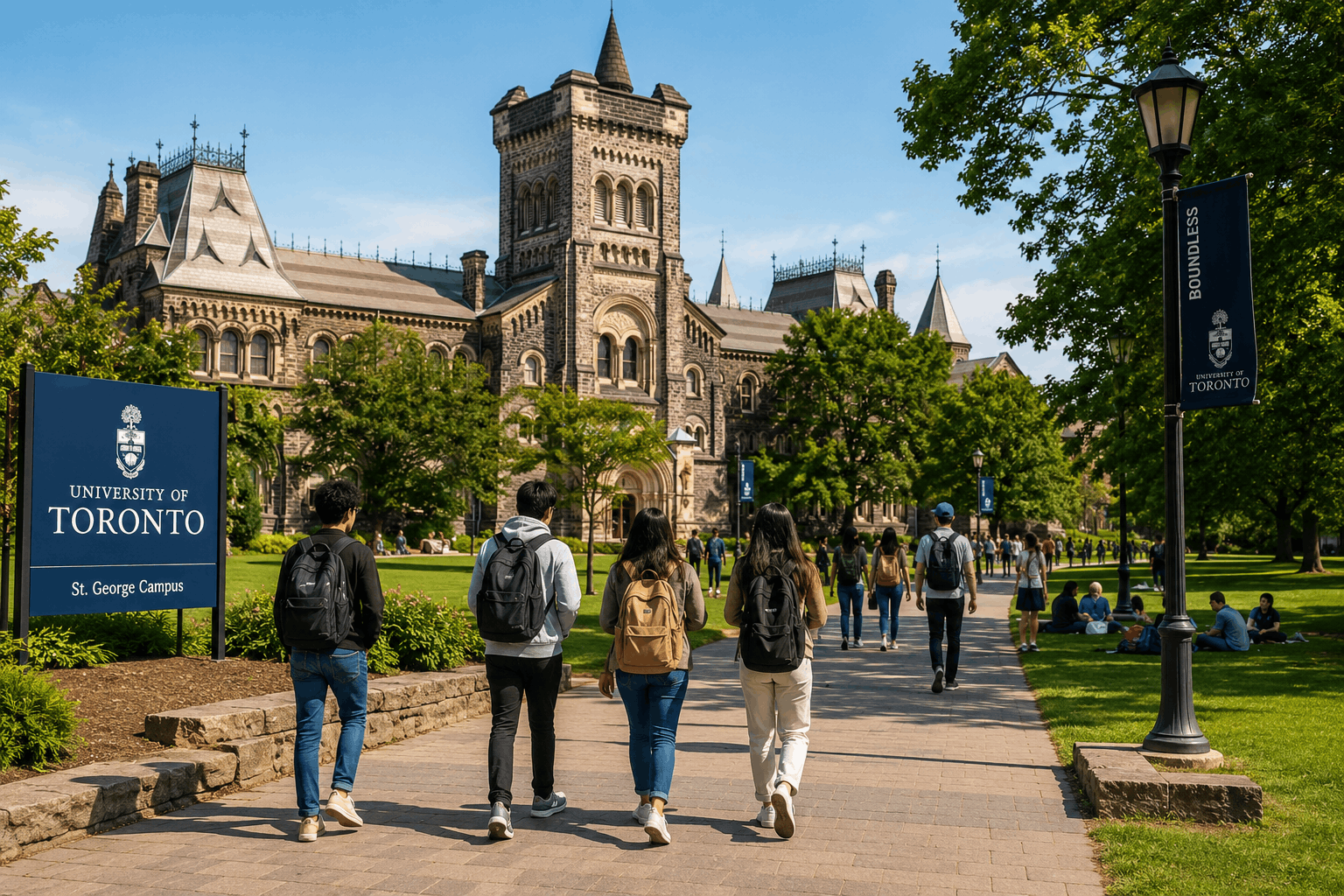
Its location places students in the middle of one of Canada’s largest urban environments. The campus combines historic architecture, academic buildings, libraries, research facilities, student residences, green spaces, and access to the wider Toronto community.
St. George is also home to the distinctive college system within the Faculty of Arts & Science. Undergraduate students in Arts & Science at St. George are affiliated with one of seven colleges:
- Innis College
- New College
- St. Michael’s College
- Trinity College
- University College
- Victoria College
- Woodsworth College
The college system provides a smaller community structure within the much larger research university.
This can be particularly useful for students who want access to the resources of a major research university while also having a smaller academic and social community around them.
University of Toronto Mississauga
The University of Toronto Mississauga (UTM) is located west of downtown Toronto in Mississauga.
The campus provides a different setting from the dense urban environment of St. George. UTM combines academic facilities, research opportunities, student services, residences, and green spaces.
The Mississauga campus offers undergraduate programs across a broad range of disciplines. Current U of T program listings include fields such as commerce, chemistry, history, English, human biology, financial economics, forensic science, and other areas.
For students deciding between campuses, UTM should therefore be evaluated not only by its location but also by the specific program and learning environment associated with the degree they want.
University of Toronto Scarborough
The University of Toronto Scarborough (UTSC) is located in the eastern part of Toronto.
Like the other campuses, Scarborough is a comprehensive teaching and research environment. Its programs include subjects across areas such as business, social sciences, science, humanities, and interdisciplinary studies.
The Scarborough campus also has a strong focus on experiential learning and opportunities that connect academic study with practical experience.
For applicants, the most important point is that selecting U of T means selecting a specific academic pathway and campus environment, rather than simply choosing between three versions of the same experience.
Why the Three-Campus Structure Matters
The tri-campus model gives U of T considerable academic breadth, but it also means applicants should research their intended program carefully.
A student’s experience can depend on:
- Which campus offers the program
- The specific faculty or academic division
- Program structure
- Available residence options
- Transportation needs
- Campus culture
- Co-op or internship opportunities
- Access to specialized facilities
- The surrounding neighborhood
The university itself emphasizes that the three campuses form one university while each provides its own teaching, research, and learning environment.
Therefore, applicants should avoid choosing a campus based solely on general reputation. The better approach is to start with the intended academic program and then examine the campus experience associated with it.
University of Toronto’s Academic Environment
U of T’s academic model is notable for its breadth. The university currently lists more than 700 undergraduate programs and more than 300 graduate programs.
Undergraduate programs are organized through options such as majors, minors, and specialists, depending on the program and campus. Some programs also include co-op, internships, or other forms of work-integrated learning.
This gives students considerable flexibility, but that flexibility also requires planning.
A prospective student should ask:
- What degree do I want?
- Which campus offers it?
- Is the program a major, minor, or specialist?
- Are there additional admission requirements?
- What courses are required in first year?
- Can I combine multiple academic interests?
- Are internships or co-op opportunities available?
- What progression requirements apply after admission?
These questions become especially important because admission to the university and progression into a particular academic program are not always the same thing.
University of Toronto’s Undergraduate Program Range
The university’s undergraduate offerings cover a broad academic spectrum.
Major Academic Areas Include
- Humanities and Social Sciences
- Life Sciences
- Physical and Mathematical Sciences
- Computer Science
- Engineering
- Commerce and Management
- Kinesiology and Physical Education
- Music
- Architecture, Landscape and Design
U of T also has second-entry professional programs in areas including education, nursing, dentistry, pharmacy, law, and medicine.
This breadth makes the university suitable for students with very different academic goals. A student interested in computer science may have a very different experience from someone studying history, engineering, commerce, music, or architecture.
That is why a useful University of Toronto application strategy begins with program research rather than university-name research alone.
A Large University With Smaller Learning Communities
A common question prospective students have about a very large university is whether they can still find a sense of community.
U of T’s answer partly comes through its smaller academic structures.
At St. George, for example, the seven-college system provides Arts & Science students with a more focused community within the larger university.
Across all three campuses, students can also participate in clubs, organizations, activities, and other communities. U of T reports more than 1,800 student clubs, organizations, and activities across the tri-campus university.
This means the university’s size does not necessarily determine a student’s entire social experience. Students can build smaller communities around academic interests, residence, clubs, sports, cultural activities, volunteering, and other shared interests.
University of Toronto and International Students
International students are an important part of the University of Toronto community.
U of T reports students from 176 countries and territories, with China, India, the United States, South Korea, and Hong Kong among the leading countries and regions represented in its Fall 2025–26 statistics.
For international applicants, this means the university offers an environment with a substantial global student presence.
However, international applicants should pay particular attention to:
- Program-specific admission requirements
- Academic credential requirements
- English-language requirements
- Tuition and mandatory fees
- Immigration and study-permit requirements
- Housing arrangements
- Health coverage
- Living costs in the Toronto area
- Application deadlines
These details can change from one admission cycle to another, so students should verify the latest requirements directly with U of T before submitting an application.
What Makes the University of Toronto Distinctive?
Several characteristics help explain why U of T attracts applicants from Canada and around the world.
1. Exceptional Academic Breadth
Few universities offer such a wide range of undergraduate and graduate subjects within one institution. U of T’s 700+ undergraduate programs allow students to explore highly specialized academic interests as well as broad disciplines.
2. Research-Intensive Environment
Research is central to U of T’s identity. The university describes itself as one of the world’s leading research universities and highlights collaborations with academic institutions around the world.
3. Three Distinct Campuses
Students can choose among three campuses, each with its own setting and academic communities.
4. International Community
The university’s international student population and representation from 176 countries and territories contribute to a highly global student environment.
5. Toronto Location
Students have access to the broader Toronto metropolitan environment, including its cultural institutions, businesses, technology sector, healthcare organizations, professional networks, and diverse communities.
Academic Experience at the University of Toronto
The academic experience at the University of Toronto is shaped by the university’s enormous range of disciplines and its research-intensive environment. Rather than following one standardized academic model across every subject, U of T organizes education through faculties, divisions, departments, colleges, and campuses.
This structure gives students considerable choice, but it also means that applicants should investigate their specific program carefully before applying. The academic experience of an engineering student, for example, can differ substantially from that of a student studying humanities, commerce, computer science, or life sciences.
The university currently offers more than 700 undergraduate programs and more than 300 graduate programs, providing opportunities across a very broad range of subjects.
Major Academic Areas
University of Toronto programs cover traditional academic disciplines as well as professional and interdisciplinary fields.
Major areas include:
- Arts and humanities
- Social sciences
- Life sciences
- Physical and mathematical sciences
- Computer science
- Engineering
- Business and commerce
- Architecture and design
- Music
- Kinesiology and physical education
- Education
- Nursing
- Pharmacy
- Dentistry
- Law
- Medicine
- Graduate and doctoral research
The exact programs, admission routes, and academic requirements differ by faculty and campus. Students should therefore treat the university’s overall program list as a starting point rather than assuming that every program follows the same admission process.
Undergraduate Programs
U of T’s undergraduate portfolio is one of its most significant features.
The university offers more than 700 undergraduate programs across its three campuses. Students can explore subjects ranging from highly specialized scientific fields to literature, history, economics, computer science, engineering, business, and interdisciplinary studies.
Depending on the program and campus, students may work toward different academic combinations such as:
- Major programs
- Minor programs
- Specialist programs
- Combined areas of study
- Professional pathways
- Experiential learning opportunities
This flexibility can be particularly useful for students who have multiple academic interests.
For example, a student interested in technology might combine computer science with another field, while someone interested in economics could explore business, statistics, mathematics, or related social sciences.
However, students should check the requirements for their specific program because not every combination is available in every faculty or campus.
Graduate Programs
The University of Toronto also has an extensive graduate education system.
Graduate study includes:
- Master’s degrees
- Doctoral degrees
- Professional graduate education
- Research-based programs
- Interdisciplinary graduate programs
Graduate applicants generally need to evaluate a program at a much more detailed level than undergraduate applicants.
Important considerations include:
- Faculty research interests
- Potential supervisors
- Research facilities
- Funding opportunities
- Program length
- Coursework requirements
- Thesis or dissertation requirements
- Professional outcomes
For research-focused applicants, identifying faculty members whose research interests align with their own goals can be particularly important.
Faculty of Arts & Science
The Faculty of Arts & Science at the St. George campus represents one of the university’s largest academic communities.
Its subject range covers areas such as:
- Humanities
- Social sciences
- Life sciences
- Physical sciences
- Mathematical sciences
- Computer science
One distinctive feature is the college system.
Arts & Science students at St. George are associated with one of seven colleges:
- Innis College
- New College
- St. Michael’s College
- Trinity College
- University College
- Victoria College
- Woodsworth College
The college structure gives students a smaller community within the much larger university environment.
This can influence residence, social activities, advising, and the sense of community students experience during their undergraduate years.
Engineering at the University of Toronto
The Faculty of Applied Science & Engineering is one of U of T’s major professional faculties.
Engineering education combines theoretical study with practical and design-oriented learning. Students can pursue different engineering disciplines and later specialize according to the available academic pathways.
Areas associated with engineering include fields such as:
- Mechanical engineering
- Electrical and computer engineering
- Civil engineering
- Chemical engineering
- Industrial engineering
- Materials-related engineering
- Biomedical engineering
- Engineering science
Applicants should examine the exact program structure before applying because engineering admissions and program selection can involve requirements that differ from those of other undergraduate faculties.
Engineering students also benefit from being part of a research-intensive university where engineering overlaps with medicine, computer science, materials research, artificial intelligence, and other disciplines.
Computer Science
Computer science is another major area of interest at the University of Toronto.
Students interested in computing can study subjects connected to:
- Software development
- Artificial intelligence
- Machine learning
- Data science
- Algorithms
- Computer systems
- Human-computer interaction
- Computational theory
One of the advantages of studying computer science within a broad research university is the ability to connect computing with other disciplines.
Computational methods can intersect with areas such as healthcare, economics, neuroscience, engineering, mathematics, and social science.
Students considering U of T for computer science should pay close attention to program-specific admission and academic progression requirements rather than relying only on the university’s overall reputation.
Business and Commerce
Students interested in business have access to programs covering areas such as:
- Management
- Finance
- Accounting
- Marketing
- Economics
- Entrepreneurship
- Business analytics
The university’s business education also benefits from Toronto’s position as a major Canadian business center.
Students can potentially connect classroom learning with organizations and professional networks across sectors such as finance, consulting, technology, accounting, retail, healthcare, and entrepreneurship.
However, applicants should distinguish between different business-related programs and examine the specific curriculum, admission process, internship or experiential-learning opportunities, and career resources associated with each one.
Life Sciences and Health-Related Study
The University of Toronto has a particularly broad academic ecosystem around life sciences and health.
Students can explore areas such as:
- Biology
- Biochemistry
- Neuroscience
- Pharmacology
- Immunology
- Human biology
- Psychology
- Biomedical sciences
- Public health
- Health-related research
U of T’s broader health and medical ecosystem also creates opportunities for interdisciplinary research.
Students interested in medicine should remember that studying a life-science subject at U of T is not the same as being admitted to medical school. Undergraduate applicants should evaluate the requirements and admission processes of professional programs separately.
Architecture, Design and Creative Disciplines
The university also provides academic pathways in areas outside traditional science and business disciplines.
These include:
- Architecture
- Landscape architecture
- Design
- Music
- Humanities
- Visual and cultural studies
This breadth means students do not have to choose U of T solely for its science or research reputation.
The university’s academic structure allows students with different intellectual interests to study within the same larger institution.
Research and Innovation
Research is central to the University of Toronto’s identity.
The university describes itself as a major global research and teaching institution, and research takes place across many disciplines.
Research at U of T extends across areas such as:
- Artificial intelligence
- Medicine
- Health sciences
- Engineering
- Climate and environmental research
- Fundamental sciences
- Social sciences
- Humanities
- Economics
- Public policy
- Computer science
One important advantage of a research-intensive university is the possibility of interdisciplinary collaboration.
A scientific problem may involve engineering, computing, biology, statistics, and medicine at the same time. A large institution such as U of T can bring researchers from these different areas into the same academic ecosystem.
Research Institutes and Interdisciplinary Work
U of T’s research environment includes departments, institutes, laboratories, centers, and affiliated research organizations.
Rather than viewing research as something limited to graduate students, prospective undergraduates should also look for opportunities to gain research exposure through:
- Faculty-led projects
- Research assistant positions
- Laboratory experiences
- Independent research
- Summer research opportunities
- Interdisciplinary projects
- Research-focused courses
Availability varies by program and faculty, so students should investigate opportunities within their own academic area.
Innovation and Entrepreneurship
Research at U of T also connects with innovation and entrepreneurship.
Students interested in turning research or ideas into practical projects can explore opportunities involving:
- Startups
- Technology development
- Entrepreneurship
- Industry collaboration
- Innovation programs
- Research commercialization
Toronto’s broader technology and business ecosystem adds another dimension to these opportunities.
Students interested in entrepreneurship should consider not only formal university programs but also the wider network of companies, investors, incubators, research organizations, and professional communities in the Toronto region.
University of Toronto Rankings
The University of Toronto is regularly included among highly ranked universities in major international and national university rankings.
However, rankings should be interpreted carefully.
Different ranking organizations use different methodologies. Some emphasize:
- Research output
- Citations
- Academic reputation
- Employer reputation
- Internationalization
- Faculty resources
- Student outcomes
As a result, U of T may occupy different positions depending on the ranking system and the year being considered.
For students, a ranking number should therefore be treated as one piece of information rather than a complete measure of educational quality.
A more useful approach is to examine:
- The university’s overall position.
- The ranking methodology.
- The ranking of the specific subject.
- Research strength in the intended field.
- Program structure.
- Student support.
- Cost.
- Location and campus environment.
- Career opportunities.
This is especially important because a university’s overall ranking does not automatically tell an applicant whether a particular program is the right fit.
Libraries and Academic Resources
Students at U of T have access to an extensive library and academic-resource system.
Libraries support students through resources such as:
- Books
- Academic journals
- Digital databases
- Research collections
- Study spaces
- Archives
- Subject-specific resources
- Research assistance
For undergraduate students, libraries can become an important part of everyday academic life, particularly when completing research papers, laboratory projects, presentations, and advanced coursework.
Graduate students may rely even more heavily on specialized collections, research databases, archives, and subject-specific resources.
Campus Facilities
Facilities differ by campus and academic discipline, but the university’s overall environment includes a broad range of academic and student resources.
These can include:
- Research laboratories
- Lecture halls
- Classrooms
- Libraries
- Student centers
- Computing facilities
- Specialized academic facilities
- Athletic facilities
- Dining facilities
- Residence facilities
- Health and wellness services
Students should examine the facilities available at their specific campus and faculty rather than assuming that every resource is located at every U of T campus.
Student Organizations and Campus Communities
A university of U of T’s size can offer an enormous variety of extracurricular opportunities.
The university reports more than 1,800 student clubs, organizations, and activities across its three campuses.
Students can potentially participate in organizations related to:
- Academic subjects
- Entrepreneurship
- Sports
- Arts
- Cultural interests
- Community service
- Professional development
- Student advocacy
- International communities
- Hobbies and special interests
For new students, joining one or two organizations can be an effective way to build friendships and develop a smaller community within a large university.
Academic Support
Large universities can sometimes feel overwhelming during the first year.
Students therefore need to make active use of academic support rather than waiting until they encounter serious difficulties.
Depending on the faculty and campus, students may find support through:
- Academic advising
- Faculty advising
- Writing support
- Tutoring
- Library research assistance
- Career advising
- Accessibility services
- Mental-health and wellness resources
- Peer programs
- Study groups
The exact services available vary, so students should learn about the support system associated with their particular program.
Experiential Learning
University education increasingly extends beyond traditional lectures and examinations.
At U of T, students may encounter experiential-learning opportunities such as:
- Internships
- Research
- Co-op programs
- Community projects
- Industry placements
- Entrepreneurship projects
- Field experiences
These opportunities can help students connect academic knowledge with practical situations.
However, not every program provides the same opportunities. Applicants should verify whether their intended degree includes formal co-op, internship, placement, or experiential-learning components.
Studying at a Research-Intensive University: What Students Should Expect
The University of Toronto’s size and academic reputation can create significant opportunities, but students should also understand the demands of the environment.
Students may need to become comfortable with:
- Independent learning
- Large introductory courses
- Managing multiple deadlines
- Seeking help proactively
- Planning their academic pathway
- Choosing courses carefully
- Building relationships with professors and teaching staff
- Using libraries and academic resources
- Balancing academics with extracurricular activities
This does not mean that every course is large or every student has the same experience. The environment varies considerably by program and course level.
Still, students who take responsibility for their academic planning are generally better positioned to take advantage of the university’s resources.
Who May Be a Good Fit for U of T?
The University of Toronto may be particularly attractive to students who:
- Want a research-intensive university.
- Prefer a very broad choice of academic programs.
- Are interested in interdisciplinary study.
- Want access to a large international student community.
- Enjoy an urban or metropolitan environment.
- Are comfortable taking initiative in their education.
- Want access to extensive research resources.
- Are interested in graduate or professional education.
- Want to explore multiple academic interests.
On the other hand, students who strongly prefer a very small university environment may want to compare U of T with smaller institutions before making a decision.
The goal should not be to determine whether U of T is universally better. The better question is whether its academic structure and environment match the student’s own priorities.
University of Toronto Admissions
Admission to the University of Toronto is organized around the specific program and campus a student applies to. Because U of T offers a very large number of programs across St. George, Mississauga, and Scarborough, applicants should not assume that one admission standard applies to the entire university.
The most important first step is to identify the exact program you want to study and then review its current admission requirements.
Requirements can vary according to:
- Academic program
- Campus
- Applicant’s educational background
- Undergraduate or graduate level
- Canadian or international status
- Required prerequisite subjects
- English-language requirements
- Program-specific requirements
The university’s official admissions resources should always be treated as the final authority because requirements and deadlines can change between admission cycles.
Undergraduate Admission
Undergraduate applicants generally begin by selecting the program or programs they want to pursue and determining which U of T campus offers the appropriate academic pathway.
Applicants should carefully review:
- Required secondary-school courses
- Minimum academic requirements
- Program prerequisites
- Application deadlines
- Supporting documentation
- English-language requirements, where applicable
- Program-specific supplementary requirements
- Scholarship or financial-aid deadlines
Meeting a minimum academic requirement does not necessarily mean that admission is guaranteed. Competitive programs may attract applicants with academic records significantly above the stated minimum.
Students should therefore distinguish between eligibility and competitiveness.
Canadian High School Applicants
Students completing Canadian secondary education should review the requirements applicable to their province and curriculum.
The exact courses required can depend on the intended program.
For example, students applying to science, engineering, computer science, business, or other specialized areas may need specific prerequisite subjects.
A good preparation strategy is to research the intended program well before the final year of high school.
Students should:
- Identify their intended program.
- Check prerequisite courses.
- Review the required academic level.
- Confirm the application deadline.
- Prepare documents early.
- Monitor their applicant portal.
- Respond promptly to any university requests.
International Student Admissions
International applicants are an important part of the University of Toronto community.
U of T reports students from 176 countries and territories, demonstrating the international nature of its student population.
However, international applicants need to pay attention to additional requirements that may not apply to domestic applicants.
These can include:
- Country-specific academic credentials
- Equivalent secondary-school qualifications
- English-language proficiency
- Passport documentation
- Study-permit requirements
- Financial planning
- International tuition
- Health coverage
- Housing
- Immigration deadlines
Applicants should not rely on information from general study-abroad websites when a current official university requirement is available.
English-Language Requirements
Applicants whose previous education does not meet U of T’s applicable English-language requirements may need to demonstrate English proficiency.
Accepted tests, minimum scores, exemptions, and conditions can change.
Possible English-language testing may involve internationally recognized examinations, but applicants should check the university’s current official requirements rather than assuming that a particular test or score will always be accepted.
This is especially important because English-language requirements can differ depending on an applicant’s educational history.
Application Process
Although the exact process depends on the applicant and program, a typical undergraduate application journey involves several stages.
Step 1: Research Programs
Begin by identifying the subject you want to study.
Do not choose the university first and the program later. Start with your academic goals.
Step 2: Check Requirements
Review the official requirements for your educational background and intended program.
Step 3: Prepare Academic Information
Make sure grades, courses, transcripts, and other academic information are accurate.
Step 4: Submit the Application
Complete the appropriate application process before the applicable deadline.
Step 5: Monitor Your Application
Applicants should regularly check their application information and university communications.
Step 6: Submit Additional Materials
If a program requires supplementary information, submit it according to the stated instructions.
Step 7: Review the Decision
Admission decisions can be released according to the university’s admission schedule.
Applicants should remember that deadlines and procedures are dynamic. Always verify the latest information directly with U of T before applying.
Admission Tips for Prospective Students
A strong application strategy begins well before the application deadline.
Research the Program First
A university’s reputation is not enough to determine whether a particular program is suitable.
Look at:
- Curriculum
- Required courses
- Faculty
- Campus
- Experiential opportunities
- Research opportunities
- Career pathways
Keep Your Academic Record Strong
Academic performance is particularly important for competitive programs.
Students should not wait until the final months of high school to address weak prerequisite subjects.
Prepare Early
International applicants in particular may need additional time for:
- Credential documentation
- English testing
- Passport preparation
- Financial planning
- Immigration procedures
- Housing arrangements
Check Official Information Regularly
Admission requirements are not permanent.
A requirement that applied to one admission cycle may change in another.
University of Toronto Tuition and Fees
Tuition at the University of Toronto varies substantially according to the program, campus, student status, and level of study.
There is no single tuition figure that accurately represents every U of T student.
Applicants should consider:
- Domestic tuition
- International tuition
- Program-specific fees
- Incidental fees
- Student services fees
- Course-related expenses
- Books and supplies
- Housing
- Food
- Transportation
- Personal expenses
International students should expect the total cost of attendance to be substantially different from the cost for domestic students.
Because tuition and fees are subject to change, students should use the university’s current official fee information when calculating their budget.
Cost of Living in Toronto
For students studying at the St. George campus, Toronto’s location can have a significant effect on living expenses.
The total cost of living can depend on:
- Housing type
- Room location
- Meal arrangements
- Transportation
- Lifestyle
- Personal spending
- Health-related expenses
- Entertainment
- Course materials
Students living away from the downtown area may have different housing and transportation costs from those living close to campus.
International applicants should create a realistic annual budget that includes both university expenses and everyday living costs.
Scholarships and Financial Aid
Financial support can come from different sources, depending on the student’s circumstances.
Potential categories include:
- Entrance scholarships
- Merit-based awards
- Need-based assistance
- Faculty-specific awards
- Program-specific awards
- Graduate funding
- External scholarships
- International student awards where available
Students should carefully distinguish between awards that are automatically considered and scholarships that require a separate application.
Not every scholarship is available to every applicant.
Applicants should also check:
- Eligibility
- Application deadlines
- Required documents
- Academic conditions
- Citizenship or residency restrictions
- Renewal conditions
Never assume that an award listed on an older website is still available.
Scholarships for International Students
International students should investigate funding opportunities before submitting their application.
However, international scholarship availability can vary significantly according to:
- Degree level
- Faculty
- Program
- Country
- Academic performance
- Financial circumstances
- Scholarship type
Students should therefore avoid planning their entire university budget around an award that has not yet been confirmed.
A safer approach is to prepare a financial plan that remains workable even if the student does not receive a competitive scholarship.
Housing at the University of Toronto
Housing is an important consideration because U of T operates across three campuses in the Greater Toronto Area.
Students may consider:
- University residence
- Private rental housing
- Shared accommodation
- Homestays
- Off-campus apartments
The best option depends on campus, budget, commute, personal preferences, and availability.
Students applying for residence should pay close attention to the applicable application procedures and deadlines.
St. George Housing
Students studying at the downtown St. George campus have access to university-affiliated residence communities.
The college system also plays an important role in the residential experience for many Arts & Science students.
Living in residence can provide advantages such as:
- Proximity to classes
- Social opportunities
- Student communities
- Residence programming
- Easier access to campus resources
However, students should compare residence costs with other housing options before making a decision.
Mississauga Housing
Students at UTM can consider campus residence as well as housing in the surrounding Mississauga area.
Because the campus is outside central Toronto, transportation patterns can differ from those experienced by students at St. George.
Students should consider commute time when evaluating off-campus housing.
A cheaper apartment may not necessarily be the most convenient choice if transportation requires substantial daily time and expense.
Scarborough Housing
Students at UTSC can similarly consider campus residence and off-campus accommodation in the surrounding Scarborough area.
The choice should take into account:
- Distance from campus
- Transportation
- Rent
- Room-sharing arrangements
- Safety considerations
- Grocery access
- Lease terms
- Daily commute
Students should carefully read rental agreements before signing them.
Student Life at U of T
Student life at the University of Toronto is shaped by the university’s size, location, and diversity.
The university reports more than 1,800 student clubs, organizations, and activities across its three campuses.
Students can participate in activities connected to:
- Academics
- Sports
- Arts
- Culture
- Entrepreneurship
- Volunteering
- Professional development
- Student leadership
- International communities
- Hobbies
The large number of organizations means students can usually find communities around specialized interests.
Campus Culture
There is no single U of T campus culture.
The three campuses have different physical settings and student environments.
St. George
St. George provides a downtown university experience surrounded by Toronto’s urban environment.
Mississauga
UTM provides a campus environment in Mississauga with a different setting from downtown Toronto.
Scarborough
UTSC offers a campus experience in eastern Toronto with its own academic and student communities.
Students should consider which environment fits their personality.
Someone who enjoys a dense urban setting may prefer the St. George experience, while another student may prefer the environment offered by Mississauga or Scarborough.
Clubs and Student Organizations
Joining a student organization can be one of the easiest ways to become involved outside the classroom.
Students can participate in organizations focused on:
- Academic subjects
- Career interests
- Entrepreneurship
- Sports
- Music
- Cultural communities
- Volunteering
- Technology
- Arts
- Student leadership
For first-year students, participating in one or two organizations can be more manageable than trying to join too many at once.
The goal should be meaningful involvement rather than collecting activities for a résumé.
Athletics and Recreation
University life is not limited to academic work.
Students can participate in recreational and athletic activities depending on campus and available programs.
Recreation can provide:
- Exercise
- Social interaction
- Stress management
- Team experience
- Opportunities to meet students outside one’s academic program
Students who are not competitive athletes can still explore recreational activities and fitness programs.
Career Opportunities
Career preparation is an important consideration for students choosing a university.
U of T provides career-related services and opportunities through university and faculty-level resources.
Students may find support involving:
- Career advising
- Résumé preparation
- Interview preparation
- Job-search guidance
- Employer events
- Networking
- Internships
- Experiential learning
- Professional development
The exact services available depend on the campus, faculty, and program.
Internships and Experiential Opportunities
Practical experience can help students connect academic knowledge with the workplace.
Depending on the program, students may have access to:
- Internships
- Co-op opportunities
- Research positions
- Industry projects
- Community placements
- Work-integrated learning
Students should verify whether these opportunities are formally built into their intended program.
If an internship is not guaranteed, students should not assume that every student will automatically receive one.
Toronto as a Career Environment
The university’s location provides another potential advantage.
Toronto is a major Canadian center for:
- Financial services
- Technology
- Healthcare
- Consulting
- Media
- Government
- Professional services
- Retail
- Entrepreneurship
Students can potentially use the city’s broader professional environment to attend networking events, seek internships, meet employers, and explore career possibilities.
However, students should remember that location alone does not guarantee employment.
Career outcomes depend on many factors, including:
- Academic performance
- Skills
- Experience
- Networking
- Communication
- Work authorization
- Program choice
- Economic conditions
International Students and Career Planning
International students should consider career planning early rather than waiting until graduation.
Important questions include:
- What careers are common for graduates of my program?
- What internship opportunities are available?
- Can international students participate in relevant work opportunities?
- What immigration rules affect employment?
- What skills do employers expect?
- What professional networks can I build?
- Does my program provide experiential learning?
Work authorization and immigration rules can change, so international students should consult current Canadian government and university guidance rather than relying on outdated online information.
Prospective Student Budget Planning
A realistic U of T budget should include more than tuition.
Education Expenses
- Tuition
- Mandatory university fees
- Books
- Course materials
- Equipment, where required
Housing Expenses
- Residence or rent
- Utilities
- Internet
- Deposits
Daily Expenses
- Food
- Transportation
- Phone
- Personal expenses
- Recreation
International Student Expenses
- Travel
- Immigration-related costs
- Health coverage
- Currency-exchange considerations
Creating this budget before applying can help students determine whether the university is financially realistic.
Important Things Applicants Should Not Assume
Prospective students should avoid several common assumptions.
Assumption 1: Admission to U of T Guarantees Admission to Every Program
It does not. Program structures and requirements vary.
Assumption 2: One Tuition Figure Applies to Everyone
It does not. Costs vary by program and student category.
Assumption 3: Every Campus Feels the Same
The three campuses have different locations and environments.
Assumption 4: A Scholarship Is Guaranteed
Scholarships have specific eligibility and selection requirements.
Assumption 5: Rankings Predict Personal Success
A ranking cannot determine whether a university or program is the right fit for an individual student.
University of Toronto Compared With Other Universities
Choosing a university should be based on academic fit, cost, location, learning environment, and career goals rather than rankings alone.
The University of Toronto is particularly distinctive because of its combination of large-scale research, extensive program choice, three campuses, and a major metropolitan location.
Students comparing U of T with other Canadian universities should consider the following factors.
| Factor | University of Toronto | What Applicants Should Consider |
|---|---|---|
| Academic breadth | Extremely broad | Useful for students who want many subject choices |
| Research | Very strong research environment | Particularly relevant to research-focused students |
| Campus structure | Three campuses | Campus choice can significantly affect student experience |
| Location | Greater Toronto Area | Offers access to a major Canadian metropolitan environment |
| Student population | Very large | Provides extensive communities but requires independence |
| International community | Highly international | Attractive to students seeking a global environment |
| Program choice | 700+ undergraduate programs | Strong choice for students with specialized interests |
| Learning environment | Varies by faculty and campus | Applicants should investigate their specific program |
| Career environment | Toronto metropolitan region | Potential access to broad professional networks |
| Cost | Varies by program and student status | Applicants should calculate their complete annual budget |
The right comparison is therefore not simply “Which university ranks higher?”
A better question is:
Which university provides the academic program, environment, support, cost, and opportunities that fit my goals?
University of Toronto vs. Smaller Universities
One of the most important comparisons for applicants is not necessarily between two specific universities, but between different types of university environments.
U of T is a very large institution.
That can provide:
- More academic choices
- Extensive research activity
- Large student communities
- Numerous clubs
- Broad professional networks
- Specialized academic resources
But a large university can also require students to be more proactive.
Students who prefer:
- Smaller classes
- A close-knit campus
- Highly personalized attention
- A smaller student population
may want to compare U of T with smaller institutions before deciding.
This does not mean one environment is better. It means the best choice depends on how a student learns and what type of university experience they want.
University of Toronto vs. Other Research Universities
When comparing U of T with another major research university, applicants should examine specific academic areas rather than relying on overall reputation.
For example, compare:
Academic Program
Look at the actual curriculum, required courses, electives, and specialization options.
Research
Examine faculty research interests, laboratories, research centers, and opportunities for undergraduate or graduate involvement.
Location
Consider whether the surrounding city and transportation system fit your lifestyle.
Cost
Compare tuition, housing, food, transportation, and other expenses.
Student Experience
Consider campus culture, clubs, residence, class sizes, and student support.
Career Preparation
Compare internships, career services, employer connections, co-op opportunities, and alumni networks.
Pros and Cons of the University of Toronto
No university is perfect for every student.
The following strengths and considerations provide a more balanced picture.
| Potential Advantages | Potential Considerations |
| Very broad academic selection | Large university environment may require independence |
| Strong research culture | Students may need to actively seek support |
| Three campus options | Campus experiences differ significantly |
| International student community | Toronto-area living costs can be substantial |
| Large number of student organizations | Navigating a large institution can initially feel overwhelming |
| Access to Toronto’s professional environment | Competition can be strong in some programs |
| Extensive academic resources | Students need careful academic planning |
| Strong interdisciplinary possibilities | Program-specific requirements can be complex |
| Large alumni and professional network | Individual outcomes depend on the student’s own preparation |
These considerations should not be interpreted as universal disadvantages. The same characteristic can be positive for one student and challenging for another.
For example, the university’s large size may feel overwhelming to one student but provide valuable academic and social choices to another.
Who Should Consider the University of Toronto?
U of T may be a particularly good fit for students who value:
- Extensive academic choice
- Research opportunities
- Interdisciplinary study
- A large university community
- International diversity
- Urban access
- Professional networking
- Graduate-school opportunities
- Specialized academic programs
It can also suit students who are comfortable taking initiative.
Students who prefer a highly structured and small-campus environment should compare alternatives carefully before making their final decision.
Application Tips for University of Toronto
1. Start With the Program
Do not begin your research with the university ranking.
Begin with the degree you want.
Ask:
- What do I want to study?
- Which campus offers it?
- What courses are required?
- What are the prerequisites?
- What academic pathway follows admission?
This approach can prevent applicants from choosing a university that looks attractive overall but does not provide the right academic experience.
2. Understand Program Requirements
U of T is not a single standardized admission pathway.
Requirements can differ by:
- Faculty
- Program
- Campus
- Educational background
- Applicant category
Read the requirements for the exact program you intend to apply to.
3. Build a Deadline Calendar
Create a personal application calendar containing:
- Application opening date
- Application deadline
- Supplementary-document deadline
- Scholarship deadlines
- Residence deadlines
- English-test deadlines
- Financial-aid deadlines
Do not assume that every deadline falls on the same date.
4. Keep Documents Organized
Depending on your applicant category, you may need academic records and other supporting documents.
Keep digital copies of important documents in a secure location.
International applicants should also allow extra time for credential documentation and other administrative requirements.
5. Check Your Email and Applicant Portal
After submitting an application, continue monitoring university communications.
A student’s application process does not necessarily end when the initial application is submitted.
The university may communicate important information through official channels.
6. Research the Campus
Do not simply search for “University of Toronto.”
Research the actual campus associated with your intended program.
Compare:
- Location
- Transportation
- Residence
- Facilities
- Student organizations
- Academic community
- Daily lifestyle
This is particularly important because St. George, Mississauga, and Scarborough offer different environments.
7. Plan Your Finances Before Applying
Calculate the complete expected cost.
Include:
- Tuition
- Mandatory fees
- Housing
- Food
- Transportation
- Books
- Personal expenses
- Health-related costs
- Travel
- Emergency funds
International students should also consider currency fluctuations and immigration-related expenses.
8. Do Not Depend Entirely on Scholarships
Scholarships can reduce the financial burden, but applicants should not assume that they will receive one.
Create a financial plan that remains realistic even without competitive scholarship funding.
9. Consider Your Long-Term Goal
Think beyond admission.
Ask:
- What career do I want?
- Will this program build relevant skills?
- What internships are available?
- What research opportunities exist?
- Do I want graduate school?
- Does the location help my career interests?
This makes the university decision more strategic.
Frequently Asked Questions About the University of Toronto
1. When was the University of Toronto founded?
The University of Toronto was founded in 1827, beginning as King’s College.
2. Where is the University of Toronto located?
The university has three campuses in the Greater Toronto Area: St. George, Mississauga, and Scarborough.
3. Is the University of Toronto a public university?
Yes. U of T is a public research university in Ontario, Canada.
4. How many campuses does U of T have?
The university operates three campuses: St. George, Mississauga, and Scarborough.
5. How many undergraduate programs does U of T offer?
The university offers more than 700 undergraduate programs across its campuses.
6. How many students attend the University of Toronto?
U of T reported 103,140 total students in Fall 2025–26, including undergraduate and graduate students.
7. Is the University of Toronto good for international students?
It can be an attractive option for international students because of its broad academic offerings and international student community. U of T reported students from 176 countries and territories.
8. Is University of Toronto difficult to get into?
Admission competitiveness varies considerably by program. Applicants should evaluate the requirements and competitiveness of their specific program rather than relying on a university-wide assumption.
9. Does U of T have computer science?
Yes. Computer science is one of the major academic areas offered at the university.
10. Does U of T offer engineering?
Yes. The university offers undergraduate and graduate engineering education through its Faculty of Applied Science & Engineering.
11. Does U of T offer business programs?
Yes. Students can pursue academic programs related to commerce, management, economics, finance, and other business fields.
12. Does the University of Toronto offer graduate programs?
Yes. U of T offers more than 300 graduate programs across its academic divisions.
13. How much does University of Toronto tuition cost?
There is no single tuition price for every student. Costs vary according to program, degree level, campus, and student status. Applicants should consult current official fee information.
14. Does U of T offer scholarships?
Yes. Different scholarships and financial-support opportunities may be available depending on student status, program, academic performance, and other eligibility criteria.
15. Does University of Toronto provide student housing?
University-affiliated residence options are available, although availability and eligibility vary by campus and student category.
16. What is student life like at U of T?
Student life varies by campus but includes clubs, organizations, athletics, cultural activities, academic communities, and other extracurricular opportunities.
17. How many student organizations does U of T have?
The university reports more than 1,800 student clubs, organizations, and activities across its three campuses.
18. Is Toronto expensive for students?
Toronto can be an expensive city, particularly for housing. Students should calculate living expenses alongside tuition when planning their budget.
19. Is U of T good for research?
Research is a central part of the university’s academic identity, with research activity spanning many disciplines.
20. Should I choose U of T because of its ranking?
Rankings can provide useful context, but they should not be the sole basis for a university decision. Program quality, academic fit, cost, location, student support, and career goals should also be considered.
Conclusion
The University of Toronto is a strong option for students seeking a large, research-intensive university with extensive academic choice and access to a major Canadian metropolitan environment.
At the same time, prospective students should approach the university realistically.
Its large scale means students may need to take significant responsibility for academic planning, finding support, building relationships, and making use of available opportunities. Program competitiveness, living costs, and differences between campuses are also important considerations.
The most important takeaway is that the University of Toronto should be evaluated at the program and campus level, not only at the university level.
A student who chooses the right program, understands the admission requirements, prepares financially, and actively participates in university life can make much better use of the opportunities U of T provides.
For international applicants, careful preparation is particularly important. Academic requirements, tuition, scholarships, housing, immigration rules, and other details should always be checked against the latest official information before making a final decision.