

Introduction
Few universities have influenced modern technology, entrepreneurship, medicine, business, and scientific research as profoundly as Stanford University. Located in the heart of California’s Silicon Valley, Stanford has become synonymous with innovation, academic excellence, and groundbreaking discoveries.
Founded in 1885 by Leland Stanford and Jane Stanford in memory of their son, the university has evolved into one of the world’s most respected private research institutions. It consistently attracts exceptional students, distinguished faculty, Nobel laureates, entrepreneurs, and global leaders.
Whether your goal is to study Computer Science, Engineering, Medicine, Business, Law, Artificial Intelligence, or the Humanities, Stanford offers an environment where interdisciplinary learning and innovation thrive.
This guide is designed for:
- Undergraduate students
- Graduate applicants
- International students
- Parents
- Researchers
- Education consultants
By the end of this guide, you’ll understand what makes Stanford unique and whether it aligns with your academic and career goals.
What is Stanford University?
Stanford University is a private research university in Stanford, California, USA, located adjacent to Palo Alto in Silicon Valley. It is internationally recognized for academic excellence, world-class research, entrepreneurship, and strong connections to the global technology industry.
Key Highlights
- Founded in 1885
- Opened in 1891
- Located in Silicon Valley
- One of the world’s leading research universities
- Seven academic schools
- Strong global reputation in Engineering, Computer Science, Medicine, Business, Law, and Humanities
- Home to numerous Nobel Prize winners and renowned scholars
- Extensive interdisciplinary research ecosystem
- Entrepreneurial culture with close ties to major technology companies and startups
Quick Facts Table
| Feature | Details |
|---|---|
| Official Name | Leland Stanford Junior University |
| Common Name | Stanford University |
| Founded | 1885 |
| Opened | 1891 |
| Type | Private Research University |
| Location | Stanford, California, USA |
| Campus Setting | Suburban |
| Academic Schools | 7 |
| Academic Calendar | Quarter System |
| Known For | Engineering, AI, Computer Science, Medicine, Business, Entrepreneurship |
| Official Language | English |
Table of Contents
- Introduction
- Quick Answer
- Key Highlights
- Quick Facts
- History
- Campus Overview
- Campus Tour
- Campus Size
- Campus Facilities
History
The Founding Vision
Stanford University was established by Leland Stanford, former Governor of California and U.S. Senator, together with Jane Stanford, in memory of their only child, Leland Stanford Jr., who died at the age of 15.
Their vision was to create a university dedicated to serving humanity through education and research. The founding principle famously reflected their desire that “the children of California shall be our children.”
Early Years
The university officially opened its doors on October 1, 1891. From the beginning, it embraced several progressive ideas for its era:
- Coeducational education
- Nonsectarian governance
- Broad access to higher education
- Strong emphasis on science and engineering alongside the liberal arts
Growth Through the 20th Century
Stanford expanded rapidly into a major research institution, developing strengths across engineering, medicine, social sciences, humanities, law, and business. Its location in what became Silicon Valley helped foster close collaboration between academia and industry, contributing to the region’s emergence as a global technology hub.
Stanford Today
Today, Stanford is recognized as one of the world’s leading research universities, with a culture that encourages interdisciplinary collaboration and innovation across its seven schools.
Campus Overview
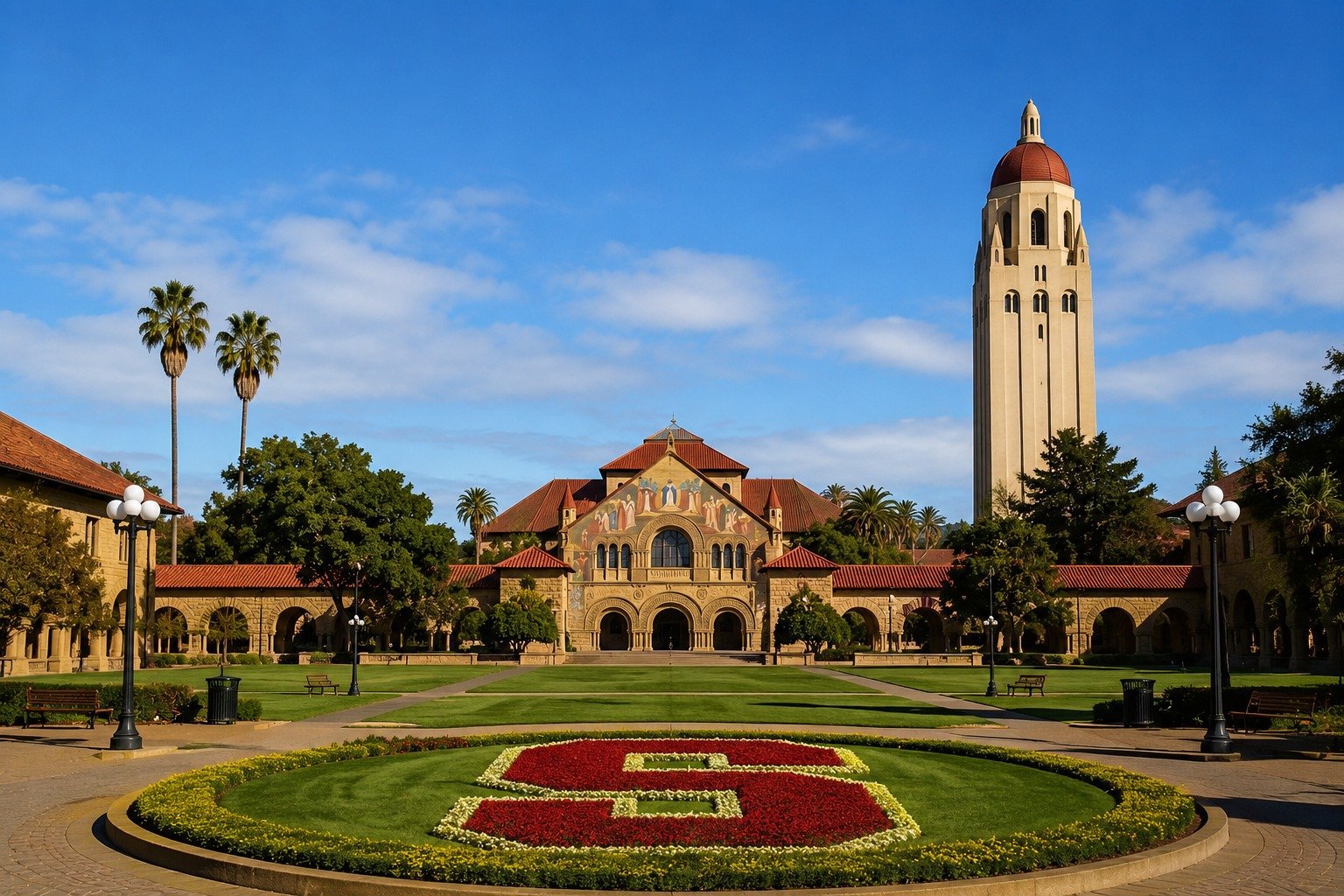
Stanford’s campus is widely regarded as one of the most beautiful university campuses in the world. It blends historic sandstone architecture, expansive green spaces, modern research facilities, museums, and athletic venues.
The campus environment is designed to encourage collaboration among students, researchers, and faculty across disciplines.
Architectural Style
Highlights include:
- Romanesque-inspired Main Quad
- Stanford Memorial Church
- Hoover Tower
- Modern research complexes
- Contemporary student residences
- Landscaped gardens and courtyards
The combination of historic landmarks and state-of-the-art facilities creates a distinctive academic setting.
Campus Tour
A typical visit to Stanford might include:
Main Quad
The academic heart of the university, featuring classrooms, courtyards, and iconic arcades.
Stanford Memorial Church
A landmark known for its architecture, mosaics, and historical significance.
Hoover Tower
Offers panoramic views of the campus and surrounding region.
Cantor Arts Center
A major art museum with collections spanning multiple cultures and time periods.
Engineering Quad
Home to many of Stanford’s engineering departments and collaborative research spaces.
Science and Research Buildings
Modern laboratories supporting research in fields such as computer science, engineering, medicine, and sustainability.
Athletics Facilities
Stanford provides extensive facilities for varsity athletes, recreational sports, and fitness activities.
Student Centers
Spaces for studying, dining, social events, and student organizations.
Campus Size
Stanford has one of the largest university campuses in the United States, covering more than 8,000 acres. The expansive grounds include:
- Academic buildings
- Residential neighborhoods
- Athletic complexes
- Research facilities
- Open spaces
- Museums
- Gardens
- Walking and cycling paths
Why Campus Size Matters
The large campus enables:
- Dedicated research zones
- Extensive recreational facilities
- Housing for many students
- Interdisciplinary collaboration
- Natural open spaces that enhance campus life
Campus Facilities
Stanford offers a wide range of facilities that support academic success, research, recreation, and student well-being.
Academic Facilities
- Modern lecture halls
- Collaborative classrooms
- Seminar rooms
- Research laboratories
- Innovation spaces
- Computer labs
Student Facilities
- Dining halls
- Cafés
- Student lounges
- Recreation centers
- Health and wellness services
- Career development offices
Innovation Spaces
Students benefit from access to maker spaces, entrepreneurship programs, startup resources, and interdisciplinary collaboration opportunities, reflecting Stanford’s strong innovation culture.
Arts and Culture
The campus includes:
- Museums
- Performance venues
- Music facilities
- Public art installations
Outdoor Spaces
Stanford’s extensive outdoor environment features:
- Lawns
- Gardens
- Walking trails
- Cycling routes
- Recreational areas
These spaces contribute to a vibrant campus community and provide opportunities for relaxation and outdoor activities.
Academic Reputation
Stanford University is widely regarded as one of the world’s leading research universities. Known for its rigorous academics, entrepreneurial culture, and interdisciplinary approach, Stanford has consistently shaped advancements in science, technology, medicine, business, law, and the humanities.
Its location in Silicon Valley has also enabled close collaboration with global technology companies, startups, venture capital firms, and research organizations, creating opportunities that are difficult to replicate elsewhere.
Why Stanford’s Academic Reputation Stands Out
World-Class Faculty
Stanford’s faculty includes:
- Nobel Prize winners
- Turing Award recipients
- Pulitzer Prize winners
- National Academy members
- Leading researchers and innovators
Students often have opportunities to learn directly from scholars who are making significant contributions to their fields.
Research Excellence
Stanford is internationally recognized for research in areas such as:
- Artificial Intelligence
- Machine Learning
- Computer Science
- Robotics
- Medicine
- Biotechnology
- Climate Science
- Sustainability
- Economics
- Public Policy
- Law
- Psychology
The university encourages interdisciplinary collaboration, allowing researchers from different schools to work together on global challenges.
Entrepreneurial Ecosystem
Few universities have contributed as much to entrepreneurship as Stanford.
Thousands of startups have connections to Stanford alumni, faculty, or researchers. Many globally recognized technology companies were founded or co-founded by individuals associated with the university.
Stanford promotes innovation through:
- Startup incubators
- Entrepreneurship programs
- Research commercialization
- Industry partnerships
- Venture funding networks
Global Recognition
Stanford graduates are highly sought after by employers worldwide due to:
- Strong academic preparation
- Research experience
- Leadership development
- Innovation mindset
- Global professional network
Its graduates work in academia, multinational corporations, startups, government, healthcare, finance, consulting, and nonprofit organizations.
Global Rankings
Stanford consistently ranks among the top universities worldwide. Rankings vary depending on methodology, indicators, and publication year.
Because rankings are updated annually, the positions below should be considered approximate and subject to change.
Major Global Rankings
| Ranking Organization | Typical Global Position* |
|---|---|
| QS World University Rankings | Top 10 |
| Times Higher Education (THE) | Top 10 |
| U.S. News Best Global Universities | Top 10 |
| Academic Ranking of World Universities (ARWU) | Top 5–10 |
*Rankings change each year.
Ranking Trends Over Time
| Period | General Trend |
|---|---|
| Early 2000s | Consistently among global leaders |
| 2010–2015 | Frequently Top 5 |
| 2016–2020 | Maintained elite global status |
| 2021–2024 | Continued Top 10 performance |
| 2025 onward | Rankings may vary by methodology |
Stanford has demonstrated remarkable consistency across major international rankings due to its excellence in research, teaching, citations, employer reputation, and international collaborations.
Subject Rankings
Stanford is especially renowned for:
| Subject | Global Reputation |
|---|---|
| Computer Science | Exceptional |
| Artificial Intelligence | Exceptional |
| Engineering | Exceptional |
| Business | Exceptional |
| Medicine | Exceptional |
| Law | Exceptional |
| Economics | Outstanding |
| Psychology | Outstanding |
| Education | Outstanding |
| Biology | Outstanding |
| Physics | Outstanding |
| Mathematics | Outstanding |
Accreditation
Stanford University is institutionally accredited by the WASC Senior College and University Commission (WSCUC), the regional accrediting body recognized in the United States for evaluating higher education institutions.
In addition to institutional accreditation, many professional schools and programs maintain specialized accreditation where applicable (for example, in engineering, business, medicine, and law).
Accreditation ensures that academic programs meet recognized standards for quality, governance, educational effectiveness, and continuous improvement.
Note: Accreditation status can be updated periodically. Applicants should verify the latest information through official university and accrediting body resources.
Programs Offered
Stanford offers academic opportunities across undergraduate, graduate, professional, and doctoral levels through its seven schools.
Stanford’s Seven Academic Schools
| School | Primary Focus |
|---|---|
| School of Humanities and Sciences | Arts, Sciences, Social Sciences, Humanities |
| School of Engineering | Engineering and Technology |
| Graduate School of Business | Management and Entrepreneurship |
| School of Law | Legal Studies |
| School of Medicine | Medical Education and Research |
| Doerr School of Sustainability | Sustainability, Earth Sciences, Climate |
| Graduate School of Education | Education and Learning Sciences |
Major Academic Fields
Students can study:
- Computer Science
- Artificial Intelligence
- Data Science
- Mechanical Engineering
- Electrical Engineering
- Civil Engineering
- Biomedical Engineering
- Chemical Engineering
- Economics
- Business
- Finance
- Medicine
- Law
- Biology
- Chemistry
- Physics
- Mathematics
- Psychology
- Sociology
- Political Science
- International Relations
- Linguistics
- Philosophy
- English
- History
- Environmental Science
- Public Policy
- Design
- Music
- Theater
Undergraduate Programs
Stanford’s undergraduate education emphasizes academic flexibility and interdisciplinary exploration.
Students generally declare a major after beginning their studies, allowing time to explore different fields before making a final decision.
Popular Undergraduate Majors
| Major | Known For |
|---|---|
| Computer Science | Global leadership in AI and software |
| Engineering | Research and innovation |
| Economics | Quantitative and policy-focused curriculum |
| Biology | Strong preparation for research and medicine |
| Mathematics | Advanced theoretical and applied study |
| Political Science | Public policy and international affairs |
| Psychology | Cognitive and behavioral sciences |
| Human Biology | Interdisciplinary health sciences |
| Symbolic Systems | AI, linguistics, philosophy, computer science |
| Management Science & Engineering | Technology and business integration |
Undergraduate Learning Experience
Students benefit from:
- Small discussion-based classes
- Research opportunities
- Faculty mentorship
- Flexible curriculum
- Study abroad opportunities
- Internship experiences
- Entrepreneurship programs
Graduate Programs
Stanford offers master’s degrees across a broad range of disciplines.
Graduate students often work closely with faculty on research while gaining specialized expertise.
Popular graduate fields include:
- Artificial Intelligence
- Data Science
- Robotics
- Computer Engineering
- Electrical Engineering
- Biomedical Engineering
- Business Administration (MBA)
- Public Policy
- International Policy
- Education
- Law
- Medicine
- Sustainability
Many programs emphasize interdisciplinary learning and practical problem-solving.
Professional Degrees
Stanford also offers professional programs including:
- MBA
- JD (Law)
- MD (Medicine)
- Various joint degrees (e.g., MBA/MS, JD/MA, MD/PhD)
These programs are designed for students preparing for leadership roles in their professions.
PhD Programs
Stanford is one of the world’s premier destinations for doctoral research.
PhD students conduct original research under faculty supervision and contribute to advancements in their fields.
Popular Doctoral Areas
- Computer Science
- Artificial Intelligence
- Engineering
- Physics
- Biology
- Chemistry
- Economics
- Education
- Psychology
- Statistics
- Mathematics
- Public Policy
- Linguistics
- Sociology
Research Opportunities
Doctoral students may engage in:
- Cutting-edge laboratory research
- Interdisciplinary research centers
- International collaborations
- Industry-sponsored projects
- Teaching assistantships
- Conference presentations
- Scholarly publications
Funding
Many doctoral students receive funding packages that may include:
- Tuition support
- Research assistantships
- Teaching assistantships
- Fellowships
- Stipends
Funding availability and eligibility vary by department and program.
Online Programs
While Stanford is primarily known for its on-campus education, it also offers selected online learning opportunities through various university initiatives.
These may include:
- Professional certificates
- Continuing education courses
- Executive education programs
- Graduate-level online courses (selected programs)
- Lifelong learning opportunities
Availability varies by school and department.
Executive Education
Stanford’s professional schools offer executive education programs for experienced professionals in areas such as:
- Leadership
- Business Strategy
- Innovation
- Artificial Intelligence
- Healthcare
- Finance
These programs are designed for working professionals seeking advanced knowledge without pursuing a full-time degree.
Continuing Studies
Through Stanford Continuing Studies, learners can access courses in subjects such as:
- Humanities
- Creative Writing
- Business
- Technology
- Science
- Personal Development
Course offerings change regularly.
Admissions
Admission to Stanford University is among the most competitive in the world. The university evaluates applicants using a holistic review process, considering academic achievement, intellectual curiosity, extracurricular involvement, leadership, personal qualities, and potential contributions to the campus community.
Undergraduate Admissions
Stanford seeks students who have challenged themselves academically and demonstrated meaningful engagement beyond the classroom.
What Stanford Looks For
- Excellent academic performance
- Challenging high school coursework
- Intellectual curiosity
- Leadership experience
- Community involvement
- Creativity and innovation
- Strong personal essays
- Positive teacher recommendations
- Potential to contribute to campus life
Admission decisions are based on the overall strength of the application rather than any single factor.
Graduate Admissions
Graduate admissions are managed by individual departments and schools. Requirements vary by program, but applicants are generally expected to have:
- A strong academic record
- Relevant undergraduate preparation
- Research experience (for research-focused programs)
- Statement of Purpose
- Letters of Recommendation
- Resume or Curriculum Vitae (CV)
- English language proficiency (if applicable)
Some professional programs may also require interviews or additional materials.
Acceptance Rate
Stanford is widely recognized as one of the most selective universities globally. In recent years, undergraduate admission rates have generally remained below 5%, though the exact figure varies by admission cycle.
Graduate program selectivity also varies significantly depending on the department.
Note: Acceptance rates fluctuate each year based on the number of applicants and available places. Always refer to official admissions statistics for the latest data.
Application Options
Undergraduate Application Plans
| Application Type | Description |
|---|---|
| Restrictive Early Action | Early application with certain restrictions on applying early elsewhere; non-binding |
| Regular Decision | Standard application process with later deadlines |
Applicants should carefully review the eligibility rules associated with each application option.
Eligibility
Undergraduate Eligibility
Applicants are generally expected to have completed a rigorous secondary school curriculum.
Recommended preparation often includes:
| Subject | Suggested Preparation |
|---|---|
| English | 4 years |
| Mathematics | 4 years |
| Laboratory Science | 3–4 years |
| History/Social Studies | 3 or more years |
| Foreign Language | 3–4 years (recommended) |
Competitive applicants typically exceed minimum expectations through advanced or challenging coursework where available.
Graduate Eligibility
Most graduate programs require:
- A bachelor’s degree (or equivalent)
- Strong academic performance
- Program-specific prerequisites
- Relevant experience (for certain professional programs)
Requirements differ by school and department.
Required Documents
Undergraduate Applicants
Typical application materials include:
- Completed application form
- Official secondary school transcripts
- School report
- Counselor recommendation
- Teacher recommendations
- Personal essays
- Application fee or approved fee waiver
- Mid-year school report (where applicable)
Some programs or circumstances may require additional documentation.
Graduate Applicants
Depending on the program, applicants may need:
- Online application
- Academic transcripts
- Statement of Purpose
- Resume/CV
- Letters of Recommendation
- Writing sample (selected programs)
- Portfolio (design-related programs)
- Research proposal (some PhD programs)
- Application fee
English Language Requirements
Applicants whose previous education was not conducted primarily in English may need to demonstrate English language proficiency.
Accepted tests may include:
| Examination | Commonly Accepted |
|---|---|
| TOEFL iBT | Yes |
| IELTS Academic | Accepted by many programs (verify program requirements) |
| Duolingo English Test | Acceptance varies by program |
Minimum score requirements differ by department and program.
Important: Always confirm accepted examinations and score requirements with the specific Stanford school or department to which you are applying.
Application Timeline
Application deadlines vary by program and level of study.
Typical Undergraduate Timeline
| Stage | Approximate Period* |
|---|---|
| Restrictive Early Action Deadline | Early November |
| Regular Decision Deadline | Early January |
| Admission Decisions | Spring |
| Enrollment Confirmation | Late Spring |
*Dates vary each admission cycle.
Graduate Timeline
Graduate application deadlines differ widely by department. Some programs admit students only once each year, while others may have multiple intake periods.
Applicants should begin preparing their materials several months in advance.
Tuition Fees
Stanford is a private university, and tuition rates are reviewed annually.
Estimated Undergraduate Costs
| Expense | Approximate Annual Cost (USD)* |
|---|---|
| Tuition | $65,000+ |
| Housing | $20,000+ |
| Food | Included in housing estimate for many plans |
| Books & Supplies | $1,000–$2,000 |
| Personal Expenses | Varies |
| Health Insurance (if required) | Varies |
*Figures are approximate and subject to annual updates.
Graduate Tuition
Graduate tuition depends on:
- School
- Degree program
- Number of enrolled units
- Professional vs. research program
Programs such as Business, Law, and Medicine often have different tuition structures from master’s and PhD programs.
Important: Always refer to the official tuition schedules published by the relevant Stanford school.
Cost of Living
Living in the Stanford/Palo Alto area is generally more expensive than in many other parts of the United States due to the region’s high housing and living costs.
Estimated Annual Living Expenses
| Category | Approximate Cost (USD) |
|---|---|
| Housing | High |
| Food | Moderate to High |
| Transportation | Moderate |
| Books & Supplies | Moderate |
| Personal Expenses | Moderate |
| Health Insurance | Varies |
Actual costs depend on accommodation choices, lifestyle, and personal spending habits.
Budgeting Tips
Students can manage expenses by:
- Living in university housing (if available)
- Sharing accommodation
- Using campus dining plans
- Taking advantage of student discounts
- Utilizing campus transportation options
Scholarships
Stanford offers financial assistance primarily based on demonstrated financial need, rather than merit alone.
Types of Financial Support
- Need-based scholarships
- Institutional grants
- External scholarships
- Departmental funding (graduate programs)
- Fellowship opportunities
Scholarship availability varies according to the applicant’s academic level and financial circumstances.
Undergraduate Financial Aid
Eligible students may receive aid packages that significantly reduce the cost of attendance. Depending on financial need, aid may cover tuition and, in some cases, additional educational expenses.
The amount awarded is determined after reviewing the family’s financial information.
Graduate Funding
Graduate students may be eligible for:
- Departmental fellowships
- Research assistantships
- Teaching assistantships
- Graduate scholarships
- External funding opportunities
Funding policies vary considerably by school and degree program.
Financial Aid
Stanford’s financial aid program aims to ensure that qualified students can attend regardless of financial background.
Financial Aid May Include
- University grants
- Scholarships
- Student employment opportunities
- Fellowships (graduate level)
- Assistantships (graduate level)
Aid eligibility is assessed through the university’s financial aid process and supporting documentation.
International Students
Financial aid policies for international students differ from those for domestic applicants. International applicants should carefully review the latest eligibility requirements and available funding options published by Stanford.
Applying for Financial Aid
Applicants are generally required to submit financial documentation by specified deadlines. Missing deadlines may affect eligibility for certain forms of assistance.
Prepare documents well in advance to ensure a complete application.
Financial Planning Tips
Before applying, prospective students should:
- Estimate the total cost of attendance.
- Research scholarships offered by their home country or external organizations.
- Compare tuition and living expenses with other universities.
- Apply for financial aid as early as possible.
- Keep copies of all submitted documents.
- Monitor official announcements for updated fees and deadlines.
Common Admission Mistakes to Avoid
- Waiting until the last minute to begin the application.
- Submitting incomplete documents.
- Writing generic personal essays that do not reflect genuine experiences.
- Ignoring program-specific requirements.
- Missing financial aid deadlines.
- Assuming standardized test policies are identical across all programs.
- Failing to proofread application materials.
- Not verifying the latest requirements on the official Stanford website.
Student Housing
Stanford University offers one of the most extensive on-campus residential systems among U.S. universities. Residential life is considered an important part of the Stanford experience, encouraging academic collaboration, personal growth, and community engagement.
Many undergraduate students live on campus, while graduate students have access to university-managed housing as availability permits.
Undergraduate Housing
Stanford provides a variety of residential options designed to support different lifestyles and interests.
Housing Options
| Housing Type | Description |
|---|---|
| Residence Halls | Traditional undergraduate communities |
| Theme Houses | Communities centered around shared interests or cultures |
| Apartment-Style Housing | Greater independence for eligible students |
| Co-op Houses | Student-managed residences with shared responsibilities |
Features
Most residences include:
- Furnished rooms
- High-speed internet
- Study lounges
- Laundry facilities
- Common kitchens (in selected residences)
- Social spaces
- Resident assistants (RAs)
- Community events
Graduate Housing
Graduate students may choose from:
- Studio apartments
- One-bedroom apartments
- Shared apartments
- Family housing
- University-managed residences
Demand often exceeds supply, so early housing applications are recommended.
Residential Life
Living on campus offers opportunities to:
- Build friendships
- Participate in cultural activities
- Attend faculty dinners
- Join educational programs
- Engage in wellness initiatives
- Develop leadership skills
Residential communities often organize workshops, guest lectures, and social events throughout the academic year.
Dining Services
Stanford provides multiple dining locations offering diverse cuisines and dietary options.
Students can typically find:
- Vegetarian meals
- Vegan options
- Halal-friendly selections (availability varies)
- Gluten-free choices
- International cuisine
- Healthy meal options
Dining facilities also emphasize sustainability through responsible sourcing and waste reduction initiatives.
Stanford Libraries
Stanford’s library system is among the most respected academic library networks in the world.
It supports teaching, learning, and research across virtually every discipline.
Highlights
- Millions of print volumes
- Extensive digital collections
- Rare manuscripts
- Historical archives
- Research databases
- Multimedia resources
- Special collections
Students have access to advanced research support, librarians, digital scholarship services, and collaborative study spaces.
Green Library
The Cecil H. Green Library serves as one of Stanford’s primary research libraries.
Key features include:
- Individual study areas
- Group study rooms
- Research assistance
- Digital resources
- Historical collections
Digital Library Resources
Students can access:
- Academic journals
- E-books
- Research databases
- Digital archives
- Citation management tools
- Online learning resources
Remote access enables students to conduct research from almost anywhere.
Laboratories
Stanford is internationally recognized for its advanced laboratory facilities supporting education and research.
Major Research Areas
Laboratories support work in:
- Artificial Intelligence
- Machine Learning
- Robotics
- Biomedical Engineering
- Biotechnology
- Materials Science
- Physics
- Chemistry
- Neuroscience
- Environmental Science
- Computer Engineering
- Electrical Engineering
Students often gain hands-on experience by participating in laboratory research alongside faculty members.
Undergraduate Research
Unlike many universities where research opportunities are primarily reserved for graduate students, Stanford encourages undergraduate participation in research through faculty mentorship and research programs.
Benefits include:
- Practical laboratory experience
- Scientific writing skills
- Conference presentations
- Collaborative projects
- Graduate school preparation
Research Centers
Stanford hosts numerous interdisciplinary research centers addressing global challenges.
These centers bring together experts from engineering, medicine, business, social sciences, humanities, and public policy.
Major Research Themes
- Artificial Intelligence
- Human-Centered AI
- Medicine
- Cancer Research
- Climate Change
- Sustainability
- Energy
- Public Health
- Economics
- Education
- Cybersecurity
- Space Science
Many projects involve collaboration with government agencies, nonprofit organizations, and industry partners.
Research Funding
Stanford receives significant research funding from:
- Federal agencies
- Private foundations
- Industry partnerships
- Philanthropic organizations
This funding supports innovative projects, graduate education, and advanced research infrastructure.
Innovation and Entrepreneurship
Innovation is deeply embedded in Stanford’s culture.
Its proximity to Silicon Valley has fostered an ecosystem where students, faculty, and alumni regularly transform ideas into impactful companies and technologies.
Entrepreneurial Resources
Students have access to:
- Startup incubators
- Innovation labs
- Entrepreneurship courses
- Business plan competitions
- Venture capital networking events
- Industry mentorship
- Accelerator programs
Many successful startups trace their origins to Stanford’s entrepreneurial environment.
Faculty
Stanford’s faculty includes internationally recognized scholars, educators, researchers, and industry leaders.
Many faculty members have received prestigious honors, including:
- Nobel Prizes
- Turing Awards
- National Medals
- Pulitzer Prizes
- MacArthur Fellowships
- Membership in national academies
Students benefit from learning directly from experts actively advancing knowledge in their disciplines.
Faculty Mentorship
Stanford encourages close interaction between students and professors through:
- Office hours
- Research supervision
- Independent study
- Small seminars
- Academic advising
- Collaborative projects
These relationships often extend beyond graduation through professional networks and mentorship.
Student Life
Student life at Stanford combines academic rigor with a vibrant campus community.
Students participate in:
- Academic organizations
- Cultural festivals
- Volunteer initiatives
- Entrepreneurship events
- Performing arts
- Outdoor recreation
- Research symposiums
- Leadership programs
The campus fosters a balance between intellectual growth and personal development.
Clubs and Student Organizations
Stanford offers hundreds of student organizations covering a wide range of interests.
Categories
- Academic clubs
- Engineering societies
- Entrepreneurship organizations
- Cultural associations
- International student groups
- Political organizations
- Community service clubs
- Debate teams
- Performing arts groups
- Music ensembles
- Media organizations
- Religious organizations
- Environmental groups
- Robotics clubs
Participation helps students build leadership skills, friendships, and professional networks.
Athletics and Sports
Stanford has a long tradition of athletic excellence.
Students may participate in:
- Varsity sports
- Club sports
- Intramural competitions
- Recreational fitness programs
- Outdoor adventure activities
Popular Sports
- Swimming
- Tennis
- Soccer
- Basketball
- Volleyball
- Track and Field
- Golf
- Baseball
- Rowing
- Water Polo
Fitness facilities include gyms, swimming pools, sports fields, and recreational centers.
Diversity and Inclusion
Stanford values a diverse academic community where individuals from different backgrounds can learn and collaborate.
The university supports initiatives related to:
- Cultural diversity
- Gender equity
- Accessibility
- Inclusion
- Global engagement
- First-generation students
- Community belonging
Students benefit from multicultural centers, identity-based organizations, and inclusion-focused programming.
International Students
International students form an important part of Stanford’s academic community.
Students from many countries contribute to the university’s global perspective in classrooms, research, and campus activities.
Support Services
International students can access:
- Immigration advising
- Visa guidance
- Orientation programs
- Academic advising
- Career support
- Cultural adjustment resources
- English language assistance (where appropriate)
- Wellness services
Benefits of Studying at Stanford as an International Student
- Globally recognized degree
- Access to world-class research
- Diverse student community
- Strong alumni network
- Opportunities for internships and innovation
- Exposure to Silicon Valley’s entrepreneurial ecosystem
Tips for International Applicants
- Begin preparing documents early.
- Confirm English language requirements.
- Research scholarship and funding opportunities.
- Monitor visa requirements and timelines.
- Attend virtual information sessions when available.
- Connect with current students or alumni to learn about campus life.
Internship Opportunities
One of Stanford University’s greatest advantages is its location in Silicon Valley, one of the world’s leading centers for technology, entrepreneurship, venture capital, biotechnology, and innovation. This location gives students access to internship opportunities across a wide range of industries.
Many students complete internships during the summer, while others participate in research, startup projects, or part-time roles during the academic year.
Popular Internship Industries
Students commonly intern in:
| Industry | Examples of Roles |
|---|---|
| Technology | Software Engineering, AI, Data Science, Product Management |
| Finance | Investment Banking, Asset Management, FinTech |
| Consulting | Strategy, Operations, Business Consulting |
| Healthcare | Clinical Research, Public Health, Biotechnology |
| Engineering | Mechanical, Electrical, Civil, Aerospace |
| Government | Policy Research, Public Administration |
| Nonprofit | Education, Sustainability, Community Development |
| Media | Journalism, Marketing, Communications |
Internship Benefits
Internships help students:
- Apply classroom knowledge to real-world challenges.
- Build professional networks.
- Develop technical and soft skills.
- Explore different career paths.
- Strengthen graduate school or job applications.
- Gain practical experience before graduation.
Many internships also lead to full-time employment offers.
Career Services
Stanford provides comprehensive career support to students and alumni through dedicated career education resources.
Career development begins early, encouraging students to explore interests, build professional skills, and prepare for long-term career success.
Career Support Services
Students can access:
- Career counseling
- Resume and CV reviews
- Cover letter guidance
- Interview preparation
- Career fairs
- Employer networking events
- Internship search assistance
- Graduate school advising
- Salary negotiation workshops
- Professional development programs
Career Fairs
Stanford hosts career fairs where employers recruit students for internships and full-time positions.
Recruiters come from sectors including:
- Technology
- Healthcare
- Finance
- Government
- Consulting
- Manufacturing
- Education
- Energy
- Aerospace
- Nonprofit organizations
These events allow students to meet hiring managers, learn about organizations, and explore career opportunities.
Employer Engagement
Employers value Stanford graduates for their:
- Analytical thinking
- Research capabilities
- Leadership potential
- Innovation mindset
- Communication skills
- Technical expertise
Many organizations maintain long-standing recruiting relationships with Stanford.
Graduate Outcomes
Stanford graduates are employed across a wide variety of industries and often pursue leadership roles in business, research, academia, public service, and entrepreneurship.
Outcomes vary by discipline, degree level, economic conditions, and individual career goals.
Common Career Paths
| Field of Study | Typical Career Areas |
|---|---|
| Computer Science | Software Engineering, AI, Cybersecurity |
| Engineering | Product Development, Research, Manufacturing |
| Business | Consulting, Entrepreneurship, Finance |
| Economics | Investment Banking, Policy, Research |
| Medicine | Clinical Practice, Biomedical Research |
| Law | Legal Practice, Public Policy |
| Education | Teaching, Research, Administration |
| Humanities | Media, Publishing, Public Service |
Graduate Outcomes Table
| Category | General Outcome |
|---|---|
| Employment | High employment rates across many programs* |
| Graduate School | Many continue to advanced studies |
| Entrepreneurship | Strong startup ecosystem |
| Research Careers | Significant number enter academia and research |
| Global Employment | Graduates work worldwide |
*Employment outcomes vary by program and year.
Entrepreneurship
Stanford has produced thousands of entrepreneurs who have founded or helped build companies across technology, healthcare, finance, education, and many other sectors.
The university’s entrepreneurial ecosystem supports students through mentorship, innovation programs, and connections with investors and industry leaders.
Alumni Network
Stanford’s alumni community spans more than 150 countries and includes leaders in science, engineering, business, government, medicine, education, sports, and the arts.
The alumni network provides valuable opportunities for:
- Professional networking
- Career mentoring
- Industry connections
- Lifelong learning
- Regional alumni events
- Volunteer opportunities
Many graduates remain actively involved with the university throughout their careers.
Famous Alumni
Stanford’s alumni have made significant contributions across many fields. Examples include:
| Name | Notable Achievement |
|---|---|
| Larry Page | Co-founder of Google |
| Sergey Brin | Co-founder of Google |
| Reed Hastings | Co-founder of Netflix |
| Phil Knight | Co-founder of Nike |
| Peter Thiel | Entrepreneur and Investor |
| Tiger Woods | Professional Golfer |
| Sandra Day O’Connor | Former Associate Justice of the U.S. Supreme Court |
| Herbert Hoover | 31st President of the United States |
| Elon Musk* | Attended Stanford’s PhD program briefly before leaving to pursue entrepreneurship |
*Elon Musk enrolled in a Stanford PhD program but did not complete a degree.
These examples illustrate the breadth of Stanford’s influence across technology, business, law, public service, and sports.
Why Choose Stanford University?
Choosing a university is a personal decision. Stanford may be an excellent fit for students seeking a combination of academic rigor, research opportunities, and an entrepreneurial environment.
Key Reasons Students Choose Stanford
1. Academic Excellence
Stanford consistently ranks among the world’s leading universities and is recognized for high-quality teaching and research.
2. Research Opportunities
Students often have opportunities to participate in research projects alongside faculty members, including at the undergraduate level.
3. Silicon Valley Location
The university’s location provides access to technology companies, startups, investors, and innovation networks.
4. Interdisciplinary Learning
Students can explore courses across different schools and collaborate on projects that span multiple disciplines.
5. Global Reputation
A Stanford degree is recognized by employers and academic institutions worldwide.
6. Strong Alumni Network
Graduates join an extensive network that supports professional development and lifelong connections.
7. Campus Environment
The campus combines historic architecture, modern facilities, green spaces, and a vibrant student community.
Best Programs
Stanford is widely recognized for excellence in numerous disciplines.
Particularly Strong Programs
| Program | Reputation |
|---|---|
| Computer Science | World-leading |
| Artificial Intelligence | World-leading |
| Electrical Engineering | Outstanding |
| Mechanical Engineering | Outstanding |
| Biomedical Engineering | Outstanding |
| Business (MBA) | Globally recognized |
| Medicine | Highly respected |
| Law | Highly respected |
| Economics | Excellent |
| Psychology | Excellent |
| Biology | Excellent |
| Mathematics | Excellent |
| Public Policy | Strong |
| Sustainability | Rapidly growing global reputation |
The “best” program depends on a student’s interests, career goals, and preferred learning environment.
Pros and Cons
Pros vs. Cons Table
| Pros | Cons |
|---|---|
| Outstanding global reputation | Extremely competitive admissions |
| World-class faculty | High cost of attendance |
| Strong research opportunities | Cost of living in the surrounding area is high |
| Excellent career prospects | Large campus may feel overwhelming to some students |
| Silicon Valley connections | Academic workload can be demanding |
| Extensive alumni network | Housing availability can be competitive |
| Diverse academic programs | Selective programs may have additional requirements |
| Vibrant campus life | Not every major emphasizes the same level of industry engagement |
Who Should Consider Stanford?
Stanford may be a good choice for students who:
- Enjoy academic challenges.
- Want access to cutting-edge research.
- Are interested in entrepreneurship or innovation.
- Value interdisciplinary learning.
- Seek a globally recognized degree.
- Thrive in collaborative environments.
Who Might Prefer Another University?
Another institution may be a better fit for students who:
- Prefer a smaller campus community.
- Need a significantly lower cost of attendance without sufficient financial aid.
- Want a university focused on a specific niche not emphasized at Stanford.
- Prefer a different geographic location or climate.
Student Success Stories
While every student’s journey is unique, many Stanford graduates have gone on to:
- Launch successful startups.
- Pursue advanced research.
- Lead multinational companies.
- Serve in public office.
- Advance medical science.
- Teach at leading universities.
- Create nonprofit organizations addressing global challenges.
These outcomes reflect the wide range of opportunities available to Stanford students rather than a guaranteed path for every graduate.
Career Prospects After Graduation
Graduates commonly pursue careers in:
- Technology
- Artificial Intelligence
- Healthcare
- Biotechnology
- Finance
- Investment Banking
- Consulting
- Law
- Public Policy
- Government
- Education
- Entrepreneurship
- Research
- Nonprofit Organizations
Many employers value Stanford graduates for their combination of technical expertise, critical thinking, and leadership skills.
Stanford vs. Similar Universities
Every top university has its own academic culture, strengths, and educational philosophy. The best choice depends on your intended major, career goals, learning style, and personal preferences.
Stanford vs MIT
Both Stanford University and the Massachusetts Institute of Technology (MIT) are globally recognized research universities with exceptional reputations in science, engineering, and technology.
Comparison Table
| Feature | Stanford University | MIT |
|---|---|---|
| Location | Stanford, California | Cambridge, Massachusetts |
| Campus Style | Large suburban campus | Compact urban campus |
| Founded | 1885 | 1861 |
| Academic Focus | Broad multidisciplinary education | Strong emphasis on STEM |
| Entrepreneurship | Exceptional Silicon Valley ecosystem | Strong innovation ecosystem in Cambridge/Boston |
| Computer Science | World-leading | World-leading |
| Engineering | Outstanding | Outstanding |
| Business School | Graduate School of Business | Sloan School of Management |
| Climate | Mild California weather | Four-season New England climate |
Key Differences
Stanford
- Strong interdisciplinary culture.
- Close ties with Silicon Valley.
- Flexible curriculum.
- Beautiful residential campus.
MIT
- Greater emphasis on engineering and technology.
- Highly quantitative curriculum.
- Strong maker culture.
- Urban environment.
Best For
- Choose Stanford if you value interdisciplinary learning, entrepreneurship, and a residential campus experience.
- Choose MIT if you want an intensive STEM-focused education with a strong engineering tradition.
Stanford vs Harvard
Stanford and Harvard are among the world’s most prestigious universities, but they offer different campus environments and historical traditions.
Comparison Table
| Feature | Stanford | Harvard |
|---|---|---|
| Location | California | Massachusetts |
| Founded | 1885 | 1636 |
| Campus Environment | Suburban | Urban |
| Technology Connections | Exceptional | Strong |
| Business | Excellent | Excellent |
| Law | Excellent | Excellent |
| Medicine | Excellent | Excellent |
| Entrepreneurship | Outstanding | Strong |
| Humanities | Excellent | Outstanding |
Key Differences
Stanford
- Entrepreneurial culture.
- Silicon Valley partnerships.
- Modern research environment.
- Strong engineering and AI programs.
Harvard
- Long academic history.
- Extensive humanities tradition.
- Broad global influence.
- Strong public policy and government connections.
Best For
- Students interested in technology, startups, and engineering may find Stanford especially appealing.
- Students seeking a historic university with broad strengths across disciplines may be drawn to Harvard.
Stanford vs Oxford
Stanford and the University of Oxford are both globally respected institutions, but they differ in educational structure and campus culture.
Comparison Table
| Feature | Stanford | Oxford |
|---|---|---|
| Country | United States | United Kingdom |
| Founded | 1885 | 12th century origins |
| Academic Calendar | Quarter System | Term System |
| Teaching Style | Research + classroom | Tutorial-based learning |
| Campus | Unified campus | Collegiate system |
| Research | Outstanding | Outstanding |
| Technology | Exceptional | Strong |
| Humanities | Excellent | Outstanding |
Key Differences
Stanford
- Large integrated campus.
- Strong startup ecosystem.
- Flexible academic structure.
- Extensive undergraduate research opportunities.
Oxford
- Historic college system.
- Personalized tutorials.
- Rich traditions.
- Strong emphasis on independent study.
Best For
- Stanford may suit students seeking a research-intensive environment with strong industry connections.
- Oxford may appeal to students who enjoy close tutorial-based instruction and a collegiate atmosphere.
Nearby Attractions
Stanford’s location offers students access to cultural, recreational, and technological attractions throughout the San Francisco Bay Area.
Popular Places to Visit
| Attraction | Approximate Distance |
|---|---|
| Downtown Palo Alto | Nearby |
| Stanford Shopping Center | Adjacent to campus |
| Cantor Arts Center | On campus |
| Hoover Tower | On campus |
| Stanford Dish Trail | Near campus |
| Computer History Museum | Short drive |
| Shoreline Park | Short drive |
| San Francisco | Approximately one hour (traffic dependent) |
| Santa Cruz Beaches | About one hour (traffic dependent) |
Why the Location Matters
Students benefit from access to:
- Technology companies
- Museums
- Hiking trails
- Restaurants
- Cultural events
- Startup communities
- Research organizations
Transportation
Stanford provides multiple transportation options for students, faculty, staff, and visitors.
On-Campus Transportation
Students commonly travel by:
- Walking
- Bicycles
- Campus shuttle services
- Electric scooters (where permitted)
The campus is designed to support cycling and pedestrian travel.
Public Transportation
Nearby transportation options include:
- Caltrain
- Regional buses
- Rideshare services
- Local transit connections
These services make it easier to travel to nearby cities such as Palo Alto, Mountain View, San Jose, and San Francisco.
Airports
Major airports serving the region include:
| Airport | General Proximity |
|---|---|
| San Jose International Airport (SJC) | Closest major airport |
| San Francisco International Airport (SFO) | Convenient option |
| Oakland International Airport (OAK) | Alternative airport |
Campus Safety
Stanford places significant emphasis on maintaining a safe learning and residential environment.
Safety Services
The university offers services such as:
- Campus security patrols
- Emergency communication systems
- Safety escorts (where available)
- Emergency preparedness programs
- Crime prevention education
- Health and wellness resources
Students are encouraged to familiarize themselves with campus safety procedures upon arrival.
Important: Like any large university, no campus can guarantee complete safety. Students should remain aware of their surroundings and follow university safety guidance.
Student Reviews (Common Themes)
The following summary reflects recurring themes commonly discussed by students and alumni across publicly available reviews and experiences. It does not represent every student’s experience.
Frequently Praised
- Excellent professors and academic resources.
- Beautiful campus.
- Strong research opportunities.
- Collaborative learning environment.
- Entrepreneurial culture.
- Outstanding networking opportunities.
- Access to Silicon Valley.
- Diverse student community.
Common Challenges
- Competitive admissions.
- High academic workload.
- Expensive cost of living.
- Busy schedules.
- Competitive housing availability.
- Time management can be demanding.
Overall, many students describe Stanford as academically challenging but highly rewarding.
Application Tips
A strong Stanford application demonstrates both academic ability and personal character.
Tips for Undergraduate Applicants
1. Challenge Yourself Academically
Take the most rigorous courses available that align with your interests and strengths.
2. Write Authentic Essays
Admissions officers value essays that reflect your genuine experiences, curiosity, and values rather than trying to impress with exaggerated achievements.
3. Demonstrate Impact
Highlight meaningful contributions through activities, leadership, research, employment, family responsibilities, or community service.
4. Build Strong Relationships with Teachers
Thoughtful recommendation letters often provide valuable insight into your character and academic potential.
5. Start Early
Begin preparing your application several months before deadlines to allow time for revisions and document collection.
Common Mistakes Applicants Make
Avoid these common errors:
| Mistake | Why It Matters |
|---|---|
| Submitting generic essays | Misses the opportunity to showcase your individuality |
| Ignoring application instructions | May lead to incomplete applications |
| Waiting until the deadline | Increases the risk of technical or administrative issues |
| Weak proofreading | Errors can distract from otherwise strong applications |
| Overemphasizing achievements without reflection | Admissions values personal growth and context |
| Not researching Stanford | Makes it harder to explain why the university is a good fit |
Is Stanford the Right Fit for You?
Stanford may be a strong choice if you:
- Enjoy challenging academics.
- Want to participate in research.
- Are interested in entrepreneurship or innovation.
- Appreciate interdisciplinary learning.
- Value collaboration and leadership.
- Are excited about studying in Silicon Valley.
Another university may be a better fit if you prefer:
- A smaller campus.
- Lower overall educational costs.
- A different academic structure or location.
- A more specialized institutional focus.
There is no single “best” university for everyone—the right choice depends on your goals, interests, financial considerations, and preferred learning environment.
Frequently Asked Questions (FAQs)
1. Where is Stanford University located?
Stanford University is located in Stanford, California, USA, adjacent to the city of Palo Alto in the heart of Silicon Valley.
2. Is Stanford University public or private?
Stanford is a private research university founded in 1885.
3. Is Stanford difficult to get into?
Yes. Stanford is one of the world’s most selective universities, with undergraduate admission rates that have generally remained below 5% in recent years. Admission standards vary by program and year.
4. What is Stanford best known for?
Stanford is internationally recognized for:
- Computer Science
- Artificial Intelligence
- Engineering
- Business
- Medicine
- Entrepreneurship
- Research
5. Does Stanford offer scholarships?
Yes. Stanford provides need-based financial aid and various funding opportunities. Graduate funding varies by department and program.
6. Can international students apply?
Yes. Stanford welcomes international applicants from around the world and provides support services for international students.
7. Is English proficiency required?
Applicants whose previous education was not primarily in English may need to demonstrate English language proficiency. Requirements vary by program.
8. What majors are most popular?
Some of the most popular majors include:
- Computer Science
- Engineering
- Economics
- Biology
- Human Biology
- Mathematics
- Psychology
- Political Science
9. Does Stanford have student housing?
Yes. Stanford offers a wide range of on-campus housing for undergraduate and graduate students, subject to availability.
10. What is student life like?
Student life is active and diverse, with hundreds of student organizations, cultural events, athletics, research opportunities, and leadership programs.
11. Is Stanford good for research?
Yes. Stanford is one of the world’s leading research universities, offering extensive opportunities for undergraduate, graduate, and doctoral students.
12. What academic calendar does Stanford use?
Stanford follows a quarter system, with Autumn, Winter, Spring, and optional Summer terms.
13. Are internships available?
Yes. Students often pursue internships in technology, healthcare, finance, consulting, research, and many other fields.
14. What industries hire Stanford graduates?
Graduates work in:
- Technology
- Finance
- Consulting
- Healthcare
- Government
- Education
- Research
- Entrepreneurship
- Nonprofit organizations
15. Does Stanford have a strong alumni network?
Yes. Stanford’s alumni network spans more than 150 countries and includes leaders in business, technology, science, government, sports, and the arts.
16. Is Stanford suitable for international students?
Many international students choose Stanford because of its academic reputation, research opportunities, diverse campus community, and global recognition.
17. What makes Stanford different from other universities?
Stanford is particularly known for:
- Silicon Valley connections
- Entrepreneurial culture
- Interdisciplinary education
- World-class research
- Strong innovation ecosystem
18. Does Stanford offer online courses?
Stanford offers selected online learning opportunities, continuing education, executive education, and professional development programs. Availability varies by school and department.
19. What is the campus environment like?
The campus combines historic architecture, modern research facilities, green spaces, museums, athletic venues, and residential communities.
20. Is Stanford worth it?
For many students, Stanford offers exceptional academic resources, research opportunities, career support, and a globally recognized degree. Whether it is the right choice depends on your academic goals, financial situation, and personal preferences.
Final Verdict
Stanford University stands among the world’s leading institutions of higher education. Its strengths include rigorous academics, interdisciplinary learning, cutting-edge research, entrepreneurship, and a strong global reputation.
The university’s location in Silicon Valley provides unique opportunities to engage with technology companies, startups, investors, and research organizations. Combined with distinguished faculty, extensive research facilities, and an active campus community, Stanford offers an environment where students can pursue academic excellence while preparing for diverse careers.
However, Stanford is also highly selective, academically demanding, and located in a region with a high cost of living. Prospective students should carefully evaluate admissions requirements, financial considerations, and personal goals when deciding whether Stanford is the right fit.
For students seeking a research-intensive education with broad opportunities for innovation and interdisciplinary collaboration, Stanford remains one of the most compelling options in the world.
Internal Link Ideas (20)
These related articles can strengthen your website’s internal linking and SEO:
- Stanford University Acceptance Rate Explained
- How to Apply to Stanford University
- Stanford University Scholarships for International Students
- Stanford University Tuition Fees Guide
- Stanford University Campus Life
- Stanford University Housing Guide
- Best Majors at Stanford University
- Stanford University Computer Science Program
- Stanford University MBA Guide
- Stanford University Graduate Programs
- Stanford University PhD Admissions
- Living in Palo Alto as a Student
- Student Visa Guide for the USA
- Best Universities for Artificial Intelligence
- Top Engineering Universities in the World
- Stanford vs MIT: Which Should You Choose?
- Stanford vs Harvard: Key Differences
- Stanford vs Oxford: Complete Comparison
- Tips for Writing a Strong University Application Essay
- How to Prepare for Studying in the United States
Image Suggestions by Section
| Section | Image Suggestion | Suggested Alt Text |
|---|---|---|
| Introduction | Aerial view of Main Quad | Aerial view of Stanford University campus |
| History | Historic Stanford buildings | Historic Stanford University architecture |
| Campus Overview | Main Quad | Stanford Main Quad |
| Campus Tour | Hoover Tower | Hoover Tower at Stanford |
| Academic Reputation | Classroom with faculty | Stanford professor teaching students |
| Rankings | Campus panorama | Stanford campus skyline |
| Programs | Students in lecture | Students attending a Stanford lecture |
| Admissions | Admissions office | Stanford admissions building |
| Scholarships | Student receiving scholarship | Scholarship recipient at Stanford |
| Housing | Residence halls | Stanford student residence |
| Libraries | Green Library | Students studying in Green Library |
| Research | Laboratory | Stanford research laboratory |
| Innovation | Startup presentation | Students presenting startup ideas |
| Student Life | Campus event | Students participating in campus activities |
| Athletics | Sports stadium | Stanford student athletes |
| Alumni | Alumni networking | Stanford alumni event |
| Nearby Attractions | Hoover Tower | Stanford campus landmark |
| Transportation | Campus bicycles | Students cycling on campus |
| Safety | Campus security | Stanford campus safety services |
| Final Verdict | Sunset campus view | Sunset over Stanford University |
Official Stanford Resources
For the most current and authoritative information, refer to the following official resources:
| Resource | Purpose |
|---|---|
| Official University Website | https://www.stanford.edu |
| Undergraduate Admissions | https://admission.stanford.edu |
| Graduate Admissions | https://gradadmissions.stanford.edu |
| Academics | https://academics.stanford.edu |
| Schools | https://www.stanford.edu/academics/schools/ |
| Financial Aid | https://financialaid.stanford.edu |
| Research | https://research.stanford.edu |
| Housing | https://rde.stanford.edu |
| Libraries | https://library.stanford.edu |
| Career Education | https://careereducation.stanford.edu |
Editorial Quality Checklist
Before publishing this article, verify the following:
- ✅ No fabricated facts or unsupported claims are included.
- ✅ Dynamic information (fees, rankings, deadlines, and admission rates) is clearly marked as subject to change.
- ✅ Headings follow a logical H1/H2/H3 hierarchy.
- ✅ Tables improve readability and organization.
- ✅ The content is optimized for SEO while remaining natural and informative.
- ✅ Grammar, spelling, and formatting have been thoroughly reviewed.
- ✅ Official Stanford resources are linked for further reference.
- ✅ Image suggestions and descriptive alt text are included for major sections.
- ✅ Internal linking opportunities are identified to improve website navigation and SEO.
- ✅ The article is easy to scan, mobile-friendly, and suitable for publication.
Conclusion
Stanford University combines academic excellence, groundbreaking research, entrepreneurial spirit, and a vibrant campus community to create one of the world’s most respected higher education institutions. Whether your goal is to become a scientist, engineer, entrepreneur, physician, lawyer, educator, or public leader, Stanford provides an environment that encourages curiosity, innovation, and lifelong learning.
Prospective students should review the latest admissions requirements, financial aid policies, and program details on Stanford’s official websites and carefully consider how the university aligns with their academic interests, career aspirations, and personal circumstances.