

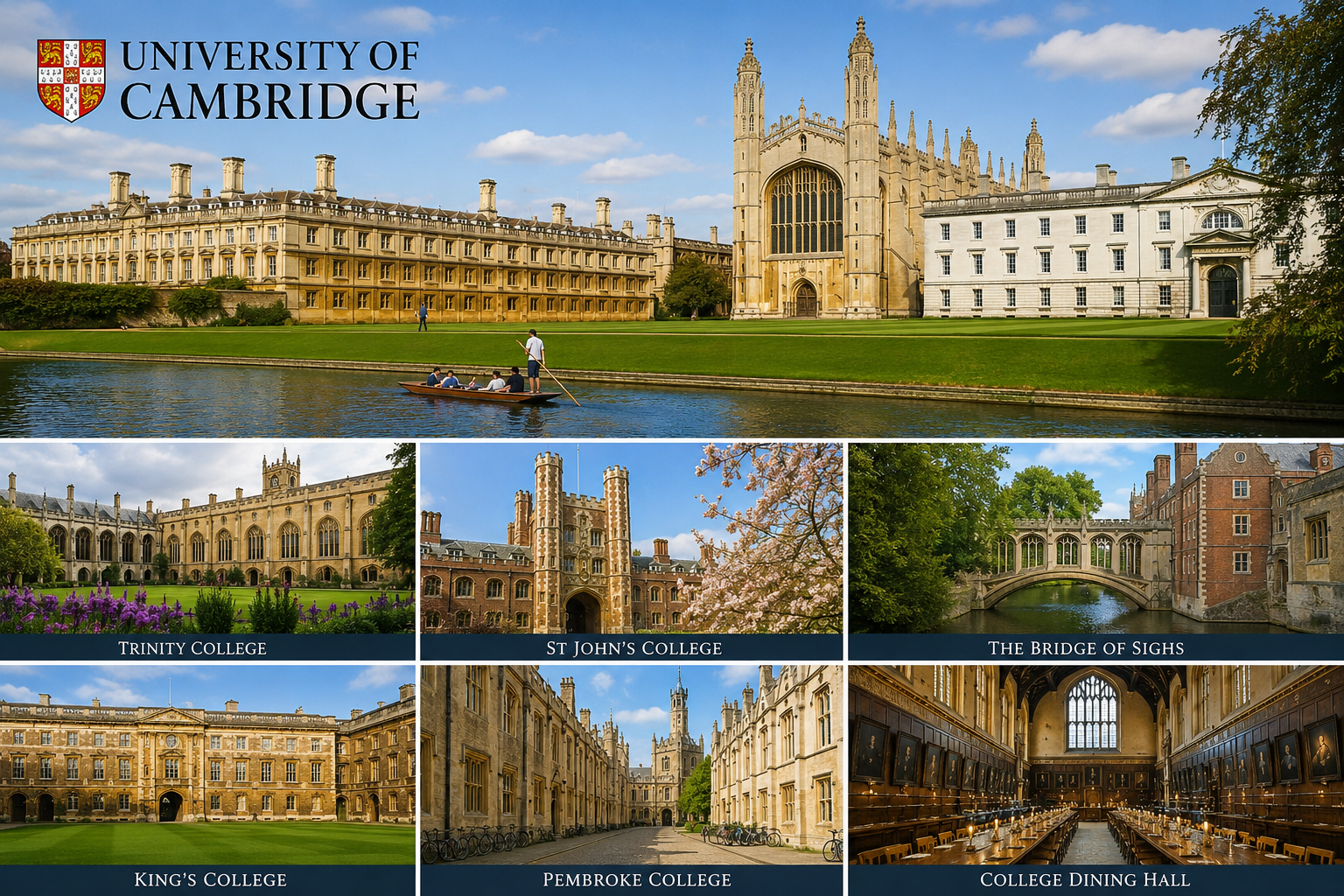
Introduction
The University of Cambridge is one of the world’s oldest and most respected universities. Founded more than eight centuries ago, it has built a global reputation for academic excellence, groundbreaking research, and influential alumni. Located in the historic city of Cambridge, England, the university attracts talented students and researchers from more than 140 countries.
Unlike many universities, Cambridge follows a unique collegiate system in which students belong to one of its individual colleges while also studying within an academic department or faculty. This structure creates a close-knit learning environment alongside access to world-class research facilities.
Cambridge consistently ranks among the leading universities worldwide for teaching quality, research output, graduate employability, and innovation. It is particularly well known for strengths in science, engineering, mathematics, medicine, law, economics, and the humanities.
Studying at Cambridge is academically demanding. The university expects students to demonstrate strong analytical thinking, intellectual curiosity, and independent learning. In return, students gain access to outstanding academic resources, internationally recognized faculty, and one of the world’s most influential alumni networks.
Whether you are a high school student considering undergraduate study, a graduate applicant exploring research opportunities, or an international student planning to study in the United Kingdom, this guide explains everything you need to know about the University of Cambridge—from its history and colleges to admissions, academics, student life, scholarships, and career opportunities.
University of Cambridge Information & Category
| Category | Information |
|---|---|
| Official Name | University of Cambridge |
| Location | Cambridge, England, United Kingdom |
| Founded | 1209 |
| Institution Type | Public Collegiate Research University |
| Global Reputation | One of the world’s leading universities |
| Known For | Research, Science, Engineering, Medicine, Mathematics, Humanities, Economics |
| Student Population | More than 25,000 students (figures may change over time; check official sources) |
| International Students | Students from over 140 countries |
| Academic Structure | 31 autonomous colleges and more than 150 academic departments, faculties, schools, and institutions |
| Official Website | https://www.cam.ac.uk |
Cambridge Highlights
- Founded in 1209, making it one of the oldest universities in the English-speaking world.
- Member of the prestigious Russell Group and internationally recognized for research excellence.
- Home to 31 autonomous colleges, each providing accommodation, student support, and a unique community.
- Offers undergraduate, postgraduate, and doctoral programs across a wide range of disciplines.
- Known for its distinctive supervision system, where students receive small-group or one-to-one teaching.
- Produces influential research in artificial intelligence, medicine, engineering, climate science, economics, and many other fields.
- Has educated numerous Nobel Prize winners, world leaders, scientists, entrepreneurs, and authors.
- Maintains strong collaborations with industry, government organizations, and international research institutions.
- Welcomes students from across the globe, creating a highly diverse academic environment.
- Provides extensive libraries, museums, laboratories, and research centers that support advanced learning and innovation.
- The historic city of Cambridge offers a safe, student-focused environment with excellent cycling infrastructure and cultural attractions.
- Graduates benefit from a globally recognized degree and a strong professional network.
Why Students Choose the University of Cambridge
Students from around the world choose Cambridge for several reasons:
- Outstanding academic reputation recognized globally.
- Personalized teaching through the supervision system.
- Access to leading researchers and internationally respected faculty.
- Exceptional research facilities and libraries.
- Strong graduate employability across many industries.
- Opportunities to collaborate with students from diverse cultural and academic backgrounds.
- Rich traditions combined with modern research and innovation.
- Extensive extracurricular activities, societies, and sports.
- Worldwide alumni network that supports professional growth.
- A historic yet forward-looking academic environment that encourages critical thinking and independent research.
Who Should Consider Cambridge?
The University of Cambridge is especially well suited for students who:
- Excel academically and enjoy intellectual challenges.
- Want to learn from leading scholars in their field.
- Are interested in research-driven education.
- Prefer small-group discussions alongside lectures.
- Value a close college community.
- Plan to pursue careers in academia, research, technology, medicine, finance, law, engineering, public policy, or entrepreneurship.
- Seek an internationally recognized degree with strong global career prospects.
Because admissions are highly competitive, applicants should demonstrate excellent academic preparation, subject-specific interest, and the ability to think critically and independently.
History of the University of Cambridge
The University of Cambridge is one of the oldest continuously operating universities in the world. Its history dates back to 1209, when a group of scholars left Oxford following a dispute with local townspeople and settled in the town of Cambridge. Over the centuries, this community of scholars evolved into a globally recognized institution known for academic excellence, pioneering research, and influential graduates.
From its beginnings as a small community of teachers and students, Cambridge gradually developed into a major center of learning. During the Middle Ages, it became well known for theology, philosophy, and the liberal arts. As knowledge expanded, the university introduced new disciplines in mathematics, natural sciences, engineering, medicine, economics, and the humanities.
One of Cambridge’s defining characteristics has been its ability to adapt to changing educational and scientific needs while preserving centuries-old academic traditions. Today, it combines historic colleges with modern laboratories, digital learning resources, and internationally respected research institutes.
Major Historical Milestones
| Year | Milestone |
|---|---|
| 1209 | Scholars established the University of Cambridge after leaving Oxford. |
| 1231 | Royal recognition helped formalize the university’s status. |
| 1284 | Peterhouse, the first Cambridge college, was founded. |
| 14th–16th Centuries | Additional colleges were established, strengthening the collegiate system. |
| 17th Century | Cambridge became a major center for scientific and mathematical study. |
| 19th Century | The university expanded significantly with new academic disciplines and research facilities. |
| 20th Century | Growth in scientific research, international collaboration, and postgraduate education accelerated. |
| 21st Century | Cambridge continues to lead in research, innovation, entrepreneurship, and global academic partnerships. |
The Collegiate System
A defining feature of Cambridge is its collegiate structure. Instead of studying at a single central campus, every student belongs to one of the university’s 31 colleges while also being part of an academic faculty or department.
This system creates two complementary experiences:
- The college provides accommodation, dining, social activities, academic support, and a close community.
- The faculty or department delivers lectures, practical classes, laboratories, and research opportunities.
The colleges have their own traditions, architecture, and student communities, but all students graduate with a degree awarded by the University of Cambridge.
Growth into a Global Research University
During the nineteenth and twentieth centuries, Cambridge transformed from a traditional teaching institution into one of the world’s leading research universities.
The university expanded in areas such as:
- Engineering
- Computer Science
- Artificial Intelligence
- Medicine
- Genetics
- Physics
- Chemistry
- Economics
- Environmental Science
- Mathematics
Its researchers have contributed to discoveries that have shaped modern science, healthcare, technology, and public policy. Cambridge also maintains partnerships with universities, governments, charities, and industries around the world.
Campus Overview
Unlike many universities that operate from a single enclosed campus, Cambridge is spread throughout the historic city of Cambridge in eastern England. Colleges, academic departments, libraries, museums, laboratories, and research institutes are integrated into the city’s streets, creating a unique blend of academic and urban life.
Students can walk or cycle between lectures, libraries, laboratories, and their colleges within a relatively compact area, making daily life convenient and environmentally friendly.
A Historic Yet Modern Environment
One of Cambridge’s most distinctive qualities is the combination of centuries-old architecture with cutting-edge research facilities.
Students encounter:
- Historic stone colleges and courtyards
- Modern science and engineering buildings
- Advanced research laboratories
- Contemporary libraries
- Museums and galleries
- Green open spaces
- Riverside walking paths
- Student cafés and study spaces
This balance between tradition and innovation creates an inspiring environment for learning and research.
Colleges Across the City
Each of the university’s 31 colleges has its own identity, history, and facilities. Colleges vary in size, age, architectural style, and atmosphere, but all provide:
- Student accommodation
- Dining halls
- Libraries
- Study rooms
- Social events
- Student welfare services
- Sports facilities (vary by college)
- Common rooms and community spaces
Because students spend much of their daily life within their college, the collegiate system often becomes a defining part of the Cambridge experience.
Academic Departments and Research Facilities
Academic teaching and research are organized through numerous faculties, departments, and institutes located across the city.
Major academic areas include:
- Arts and Humanities
- Biological Sciences
- Clinical Medicine
- Engineering
- Computer Science and Technology
- Earth Sciences
- Mathematics
- Physics
- Chemistry
- Social Sciences
- Education
- Business and Management
Many departments are equipped with specialized laboratories, collaborative research spaces, and advanced scientific equipment that support both teaching and internationally recognized research.
Campus Facilities
Libraries
Cambridge is home to one of the largest academic library systems in Europe. Students have access to:
- Extensive printed collections
- Digital journals and databases
- Historical manuscripts
- Specialized subject libraries
- Quiet study spaces
- Collaborative learning areas
- Rare books and archives
In addition to the central university libraries, individual colleges maintain their own libraries for students.
Museums and Collections
The university manages several museums and collections that support teaching, research, and public engagement. These include exhibitions in areas such as:
- Archaeology
- Zoology
- Earth sciences
- Classical art
- Anthropology
- History of science
These resources allow students to learn directly from historical artifacts, scientific specimens, and cultural collections.
Research Laboratories
Cambridge provides advanced laboratory facilities across many disciplines, including:
- Biomedical sciences
- Engineering
- Physics
- Chemistry
- Materials science
- Environmental science
- Computer science
These laboratories support undergraduate practical work as well as internationally recognized research projects.
Innovation and Entrepreneurship
Cambridge has developed a strong reputation for innovation and entrepreneurship. Through incubators, enterprise programs, and collaboration with industry, students and researchers can transform ideas into startups, technologies, and real-world solutions.
The university’s close links with businesses and research organizations have contributed to the growth of the Cambridge innovation ecosystem, often referred to as “Silicon Fen.”
Student Support Facilities
Students have access to a wide range of support services, including:
- Academic advising
- Mental health and well-being services
- Career guidance
- Disability support
- International student assistance
- Language support
- Financial guidance
- Student unions and societies
These services are offered through both the university and individual colleges.
Sports and Recreation
Cambridge encourages students to balance academics with extracurricular activities. Facilities include:
- Sports fields
- Boating and rowing facilities
- Fitness centers
- Tennis courts
- Cricket grounds
- Football pitches
- Indoor sports halls
Students can participate in recreational activities as well as competitive university sports.
Sustainability Initiatives
The University of Cambridge has made sustainability an important part of its long-term strategy. Ongoing initiatives include:
- Improving energy efficiency across university buildings
- Supporting low-carbon research
- Encouraging cycling and sustainable transport
- Protecting biodiversity within university-managed spaces
- Reducing waste and promoting responsible resource management
As sustainability policies evolve, prospective students should refer to the university’s official sustainability resources for the latest information.
Why the Campus Experience Stands Out
The Cambridge campus experience is shaped by a rare combination of:
- More than 800 years of academic history
- A unique collegiate community
- World-class research facilities
- Extensive libraries and museums
- Strong support services
- A compact, walkable city
- Rich cultural traditions
- Opportunities for innovation and entrepreneurship
Rather than being defined by a single campus, Cambridge offers an interconnected academic environment where historic colleges and modern research facilities work together to create one of the world’s most distinctive university experiences.
Academic Reputation
The University of Cambridge has earned a worldwide reputation for academic excellence through more than eight centuries of teaching, research, and innovation. It is recognized not only for its long history but also for its continued contribution to modern science, technology, medicine, economics, law, and the humanities.
Cambridge emphasizes intellectual curiosity, independent thinking, and evidence-based learning. Rather than focusing only on classroom instruction, students are encouraged to question ideas, conduct original research, and develop analytical skills that prepare them for leadership in academia, industry, government, and entrepreneurship.
Its graduates and researchers have made significant contributions across a wide range of disciplines, helping establish Cambridge as one of the world’s most respected research-intensive universities.
What Makes Cambridge Academically Unique?
Several characteristics distinguish Cambridge from many other universities around the world.
1. The Supervision System
One of Cambridge’s defining features is its Supervision System, a personalized teaching approach that complements lectures and practical classes.
In a supervision, students usually meet in very small groups—or sometimes one-to-one—with an academic expert to:
- Discuss lecture topics
- Review assignments
- Receive detailed feedback
- Explore complex concepts
- Develop critical thinking
- Strengthen problem-solving abilities
This system allows students to engage deeply with their subjects and receive individualized academic support.
2. Research-Led Teaching
At Cambridge, teaching is closely connected with research. Many lecturers and professors are active researchers who contribute to advancements in their fields.
As a result, students often learn:
- Current scientific developments
- Emerging technologies
- Contemporary policy issues
- Modern research methodologies
- Real-world applications of academic theories
This approach helps students understand how knowledge is created and applied beyond the classroom.
3. Interdisciplinary Learning
Many of today’s global challenges require expertise from multiple disciplines. Cambridge encourages collaboration across departments, allowing researchers and students to work together on topics such as:
- Artificial Intelligence
- Climate Change
- Public Health
- Biotechnology
- Sustainable Energy
- Data Science
- Quantum Computing
- Economics and Public Policy
This interdisciplinary culture prepares graduates to address complex real-world problems.
Teaching Philosophy
Cambridge promotes active learning rather than passive memorization.
Students are expected to:
- Read extensively before classes.
- Participate in discussions and debates.
- Analyze evidence critically.
- Develop independent opinions.
- Complete research-based assignments.
- Communicate ideas clearly in writing and presentations.
This educational philosophy encourages lifelong learning and intellectual independence.
Schools and Academic Structure
Academic departments are organized into several major schools, each bringing together related faculties and disciplines.
School of Arts and Humanities
This school covers subjects such as:
- History
- Philosophy
- Literature
- Languages
- Music
- Theology
- Classical Studies
Students benefit from extensive library collections, archives, and opportunities for original research.
School of Humanities and Social Sciences
Programs include:
- Economics
- Politics
- Sociology
- Education
- Law
- Geography
- Business-related disciplines
These subjects explore how societies function and address contemporary global issues.
School of Biological Sciences
The university is internationally recognized for research in:
- Genetics
- Molecular Biology
- Biochemistry
- Plant Sciences
- Zoology
- Physiology
- Neuroscience
Students gain access to advanced laboratories and collaborative research environments.
School of Clinical Medicine
Cambridge has long been respected for medical education and biomedical research.
Areas of study include:
- Clinical Medicine
- Medical Research
- Public Health
- Cancer Research
- Neuroscience
- Infectious Diseases
Medical students benefit from research-led teaching and partnerships with healthcare institutions.
School of Physical Sciences
Subjects include:
- Physics
- Chemistry
- Earth Sciences
- Materials Science
- Astronomy
Research in these areas contributes to scientific discoveries with global impact.
School of Technology
This school includes world-renowned departments such as:
- Engineering
- Computer Science
- Chemical Engineering
- Manufacturing
Students learn through lectures, laboratory work, design projects, and industry collaboration.
Popular Undergraduate Programs
Cambridge offers a wide range of undergraduate degrees across multiple disciplines.
Popular choices include:
- Computer Science
- Engineering
- Mathematics
- Natural Sciences
- Medicine
- Economics
- Law
- History
- English
- Architecture
- Psychological and Behavioural Sciences
- Chemical Engineering
- Veterinary Medicine
- Geography
Programs combine lectures, practical sessions, independent study, and supervisions.
Postgraduate Programs
Graduate students can pursue:
- Master’s Degrees
- Research Master’s Programs
- Doctoral (PhD) Programs
- Professional Degrees
- Graduate Diplomas
- Postgraduate Certificates
Many postgraduate students work closely with internationally recognized researchers on specialized projects.
Research Excellence
Research is central to Cambridge’s mission.
Major research strengths include:
Artificial Intelligence
Researchers explore machine learning, robotics, computer vision, and responsible AI.
Medicine and Health
Research addresses:
- Cancer
- Infectious diseases
- Neuroscience
- Genomics
- Public health
- Drug discovery
Engineering
Projects involve:
- Robotics
- Aerospace
- Sustainable infrastructure
- Advanced manufacturing
- Renewable energy
Climate and Sustainability
Researchers study:
- Climate science
- Biodiversity
- Environmental policy
- Renewable technologies
- Sustainable agriculture
Mathematics and Physics
Cambridge continues its long tradition of excellence in:
- Pure Mathematics
- Applied Mathematics
- Quantum Physics
- Cosmology
- Astrophysics
Global Rankings
The University of Cambridge is consistently placed among the world’s leading universities by internationally recognized ranking organizations.
Commonly referenced rankings include:
- QS World University Rankings
- Times Higher Education (THE) World University Rankings
- Academic Ranking of World Universities (ARWU/Shanghai Ranking)
Although Cambridge regularly appears near the top of these rankings, it is important to remember that methodologies differ. Rankings may evaluate factors such as:
- Academic reputation
- Employer reputation
- Research output
- Citations
- International outlook
- Teaching environment
Prospective students should view rankings as one source of information rather than the sole measure of university quality.
International Recognition
Cambridge degrees are respected by employers, governments, research organizations, and universities around the world.
Graduates pursue careers in sectors such as:
- Technology
- Healthcare
- Engineering
- Finance
- Consulting
- Government
- Education
- Law
- Scientific Research
- Entrepreneurship
The university’s global alumni network also provides valuable professional and academic connections.
Academic Strengths
Cambridge is particularly recognized for excellence in:
| Subject Area | Global Reputation |
|---|---|
| Mathematics | Outstanding |
| Computer Science | Outstanding |
| Engineering | Outstanding |
| Medicine | Outstanding |
| Natural Sciences | Outstanding |
| Physics | Outstanding |
| Economics | Excellent |
| Law | Excellent |
| English | Excellent |
| History | Excellent |
| Biological Sciences | Outstanding |
| Chemistry | Outstanding |
Reputation varies by discipline and evolves over time based on research developments and independent evaluations.
Why Students Value a Cambridge Education
Students often choose Cambridge because it offers:
- Personalized supervision-based learning.
- Access to internationally respected researchers.
- Strong emphasis on independent thinking.
- Exceptional research opportunities.
- Collaboration across disciplines.
- High-quality academic resources.
- A globally recognized degree.
- An intellectually stimulating environment.
- Strong graduate employment prospects.
- A lifelong international alumni network.
The university challenges students academically while providing the support and resources needed to develop as scholars, researchers, and future professionals.
Admissions Overview
Admission to the University of Cambridge is among the most competitive in the world. The university looks beyond grades alone, seeking applicants who demonstrate exceptional academic ability, intellectual curiosity, critical thinking, and genuine enthusiasm for their chosen subject.
Unlike many universities, Cambridge evaluates applicants through a combination of academic achievements, personal statements, references, written assessments (for some courses), and interviews. The exact process varies by course and may change over time, so applicants should always consult the official admissions website for the latest requirements.
Undergraduate Admissions
Who Can Apply?
Cambridge welcomes applications from students worldwide. Applicants typically include:
- High school graduates
- A-Level students
- International Baccalaureate (IB) students
- Students with nationally recognized secondary qualifications
- Mature students meeting course-specific requirements
Admission standards are intentionally high because of the university’s rigorous academic environment.
Undergraduate Application Process
The application process generally involves the following steps:
Step 1: Choose a Course
Before applying, carefully review the available undergraduate programs and ensure the course matches your academic interests and career goals.
Questions to consider include:
- Which subjects do you enjoy most?
- What career path are you considering?
- Does the course content align with your interests?
- Are there any required prerequisite subjects?
Step 2: Select a College
Applicants may:
- Apply to a specific Cambridge college, or
- Submit an open application, allowing the university to assign a college if appropriate.
Since all colleges provide access to the same university degree, students are encouraged to choose based on community, facilities, location, and personal preferences rather than perceived prestige.
Step 3: Submit Your Application
Undergraduate applications are typically submitted through the UCAS (Universities and Colleges Admissions Service) system. Applicants should prepare all required materials well before the annual application deadline, as Cambridge deadlines are often earlier than those for many other UK universities.
Step 4: Complete Additional Assessments
Depending on the course, applicants may be required to complete:
- Subject-specific written assessments
- Admissions tests
- Submitted written work
- Additional questionnaires
Not every program requires the same assessments, so applicants should review the requirements for their chosen course.
Step 5: Attend an Interview
Many shortlisted applicants are invited to participate in an admissions interview.
The interview is designed to evaluate:
- Problem-solving ability
- Analytical thinking
- Subject knowledge
- Academic curiosity
- Communication skills
- Ability to think through unfamiliar questions
Interviewers are generally interested in how applicants approach problems rather than whether every answer is perfect.
Step 6: Admission Decision
Following the review process, applicants may receive:
- An offer of admission
- A conditional offer (subject to meeting academic requirements)
- An unsuccessful decision
Offer conditions vary depending on the applicant’s educational background and chosen course.
Graduate Admissions
Cambridge offers a wide variety of postgraduate programs, including:
- Master’s Degrees
- Research Master’s Programs
- Doctoral (PhD) Programs
- Professional Qualifications
- Postgraduate Diplomas
Graduate admissions are managed by individual faculties and departments, and requirements vary significantly by program.
Typical Graduate Admission Requirements
Applicants are generally expected to provide:
- A strong academic record
- Official academic transcripts
- Letters of recommendation
- A statement of purpose or research proposal (where applicable)
- English language test results (if required)
- Curriculum Vitae (CV) for some programs
Research applicants may also need to identify a potential supervisor before applying.
Academic Requirements
While requirements differ across programs and countries, successful applicants generally demonstrate:
- Excellent academic performance
- Strong preparation in relevant subjects
- Independent learning ability
- Critical thinking skills
- Academic motivation
- Clear interest in the chosen discipline
Meeting the minimum academic requirements does not guarantee admission, as competition is exceptionally strong.
Required Documents
Applicants should prepare documents such as:
- Completed application form
- Academic transcripts
- School or university certificates
- Personal statement
- Academic references
- English language proficiency results (if applicable)
- Passport or identification documents
- Portfolio (for selected creative courses)
- Research proposal (for research degrees, where required)
Always verify the required documents for your specific program before applying.
English Language Requirements
Since courses are taught in English, applicants whose first language is not English may need to demonstrate proficiency through an approved English language qualification.
Accepted qualifications can vary, but may include internationally recognized English language tests accepted by the university. The required scores differ by course and are subject to change.
Applicants should always consult the official admissions guidance for the most current language requirements.
Application Timeline
Although exact dates vary by program, the admission process generally follows this sequence:
| Stage | Typical Timeline |
|---|---|
| Course Research | 12–18 months before enrollment |
| Application Preparation | Several months before submission |
| Application Submission | According to official deadlines |
| Interviews/Assessments | After initial application review (where applicable) |
| Admission Decisions | Following completion of the evaluation process |
| Enrollment | At the start of the academic year |
Important: Application deadlines differ for undergraduate, graduate, and professional programs. Always confirm current dates on the official University of Cambridge admissions website.
Tuition Fees
Tuition fees at the University of Cambridge depend on several factors, including:
- Course of study
- Undergraduate or postgraduate level
- Student residency status
- Individual college
- Program-specific costs
Because fees are reviewed periodically, applicants should consult the university’s official fee schedules for the most up-to-date information.
Additional costs may include:
- College fees (where applicable)
- Laboratory or course materials
- Health-related charges (if applicable)
- Books and supplies
- Personal expenses
Cost of Living
In addition to tuition, students should budget for living expenses such as:
- Accommodation
- Food
- Transportation
- Utilities
- Internet and mobile services
- Books and study materials
- Clothing
- Personal expenses
- Recreation
Actual costs vary based on lifestyle, accommodation choice, and individual spending habits.
Scholarships and Financial Aid
The University of Cambridge and its colleges offer a range of financial support options. Availability depends on the course, academic level, eligibility criteria, and funding source.
Common forms of support include:
Merit-Based Scholarships
Awarded to students with outstanding academic achievements or exceptional potential.
Need-Based Financial Support
Designed to assist eligible students who demonstrate financial need.
International Student Funding
Some scholarships and funding opportunities are specifically intended for international students. Eligibility and availability vary by program and funding organization.
Research Funding
Many doctoral and research students may be eligible for funding through:
- Research councils
- University grants
- Departmental funding
- External scholarship organizations
Funding availability differs by discipline and project.
Financial Planning Tips
Before applying, prospective students should:
- Research tuition and college fees.
- Estimate annual living expenses.
- Explore scholarship opportunities early.
- Prepare financial documents if required.
- Review visa-related financial requirements for international study.
- Monitor official funding announcements and deadlines.
Careful financial planning can help applicants better understand the total cost of studying at Cambridge.
Guidance for International Students
International applicants should also consider:
- Student visa requirements
- Immigration regulations
- Health insurance or healthcare arrangements
- Accommodation options
- Travel planning
- Currency exchange and banking
- Cultural adjustment and student support services
The university provides dedicated resources to help international students prepare for life and study in Cambridge.
Admission Tips for Strong Applicants
Applicants can strengthen their application by:
- Achieving excellent academic results.
- Demonstrating genuine interest in their chosen subject.
- Reading beyond the school curriculum.
- Preparing thoughtfully for interviews.
- Developing strong analytical and communication skills.
- Applying well before deadlines.
- Carefully reviewing all application requirements.
While no strategy guarantees admission, thorough preparation can help applicants present their strongest possible application.
Student Life at the University of Cambridge
Student life at the University of Cambridge extends far beyond lectures and examinations. While the university is known for its rigorous academics, it also offers a vibrant community where students can participate in hundreds of societies, sports, cultural events, research projects, and leadership opportunities.
The collegiate system plays a central role in everyday life. Each college functions as a close-knit community, giving students opportunities to build friendships, receive academic support, and engage in social activities throughout their time at Cambridge.
Although the workload can be demanding, students are encouraged to maintain a healthy balance between academic commitments and extracurricular involvement.
The College Experience
Unlike many universities where students primarily identify with a single campus, Cambridge students belong to one of 31 colleges.
Each college provides:
- Student accommodation
- Dining halls
- College libraries
- Study spaces
- Academic support
- Social events
- Student societies
- Sports teams
- Welfare and wellbeing services
Every college has its own traditions, architecture, and community, creating a unique experience while remaining part of the wider University of Cambridge.
A Strong Sense of Community
One of the greatest advantages of the collegiate system is the sense of belonging it creates.
Students often develop close relationships with:
- Tutors
- Supervisors
- College staff
- Fellow students
- Alumni
Because colleges are relatively small communities, students frequently receive personalized support throughout their academic journey.
Accommodation
Most undergraduate students are offered college accommodation for at least part of their studies. Depending on the college, housing options may include:
- Historic college buildings
- Modern student residences
- Shared apartments
- Studio accommodation
- Graduate housing
Accommodation costs vary by college and room type.
Benefits often include:
- Walking distance to lectures
- Easy access to libraries
- College dining facilities
- Strong student community
- Academic support nearby
Graduate accommodation availability varies, and early planning is recommended.
Dining and Food
Most colleges operate traditional dining halls where students can enjoy meals in a social setting.
Dining options generally include:
- Breakfast
- Lunch
- Dinner
- Vegetarian meals
- Vegan options
- International cuisine
- Special dietary accommodations
Students also have access to cafés, restaurants, grocery stores, and local markets throughout the city.
Student Societies
Cambridge has one of the largest selections of student organizations in the United Kingdom.
Students can join societies related to:
Academic Interests
- Artificial Intelligence
- Computer Science
- Engineering
- Economics
- Law
- Medicine
- Philosophy
- Mathematics
- History
- Politics
Cultural Societies
Students from around the world celebrate diverse cultures through societies representing different countries, languages, and traditions.
Examples include:
- Asian societies
- African societies
- European societies
- South Asian societies
- Middle Eastern societies
- Latin American societies
These organizations help international students feel connected while promoting cultural exchange.
Arts and Creativity
Creative students can participate in:
- Theatre productions
- Music ensembles
- Choirs
- Dance groups
- Photography clubs
- Film societies
- Creative writing groups
- Debate societies
Entrepreneurship
Students interested in innovation can participate in:
- Startup competitions
- Business networking events
- Innovation workshops
- Pitch competitions
- Entrepreneurship societies
Cambridge has developed a strong entrepreneurial culture, providing opportunities for students to transform ideas into real businesses.
Sports and Recreation
Sport is an important part of student life.
Popular activities include:
- Rowing
- Football
- Cricket
- Rugby
- Tennis
- Athletics
- Swimming
- Basketball
- Cycling
- Badminton
Students may compete:
- Within their college
- Across the university
- Nationally
- Internationally
The historic Boat Race between Cambridge and Oxford remains one of the university’s most recognized sporting traditions.
Student Wellbeing
Cambridge recognizes that university life can be both exciting and challenging.
Support services include:
- Academic advisors
- College tutors
- Mental health counseling
- Disability support
- International student services
- Financial advice
- Peer support programs
- Career guidance
Students are encouraged to seek assistance whenever needed.
Diversity and International Community
The University of Cambridge welcomes students from more than 140 countries, creating an internationally diverse learning environment.
International students benefit from:
- Cultural societies
- Language support
- Orientation programs
- International student advisors
- Visa guidance
- Community events
- Networking opportunities
Learning alongside classmates from different backgrounds helps students develop global perspectives and cross-cultural communication skills.
Libraries and Study Spaces
Students have access to numerous study environments, including:
- University libraries
- College libraries
- Department libraries
- Digital learning resources
- Quiet reading rooms
- Collaborative study areas
Many libraries offer extended opening hours during examination periods.
Research and Innovation
Research is at the heart of Cambridge’s identity.
Students at both undergraduate and postgraduate levels often have opportunities to contribute to research projects in collaboration with faculty members.
Major research areas include:
- Artificial Intelligence
- Robotics
- Biotechnology
- Climate Science
- Quantum Computing
- Genetics
- Public Health
- Renewable Energy
- Materials Science
- Economics
Research activities frequently involve collaboration with industry, government organizations, hospitals, and international universities.
The Cambridge Innovation Ecosystem
Cambridge is internationally recognized for its innovation ecosystem, often referred to as “Silicon Fen.”
This regional technology cluster includes numerous startups, research organizations, and established technology companies working in areas such as:
- Software development
- Artificial Intelligence
- Biotechnology
- Electronics
- Medical technology
- Advanced manufacturing
Students interested in entrepreneurship can benefit from internships, networking opportunities, and collaborations with local companies.
Career Services
The University of Cambridge provides comprehensive career support throughout a student’s academic journey.
Services include:
- Career counseling
- CV and résumé reviews
- Interview preparation
- Internship guidance
- Employer networking events
- Career fairs
- Skills workshops
- Graduate school advice
Students are encouraged to begin career planning early to make the most of available opportunities.
Internship Opportunities
Depending on the program and discipline, students may pursue internships with:
- Technology companies
- Financial institutions
- Healthcare organizations
- Engineering firms
- Government agencies
- Research laboratories
- Consulting firms
- Non-profit organizations
Internships help students gain practical experience and build professional networks before graduation.
Graduate Employability
A Cambridge degree is widely recognized by employers around the world. Graduates pursue careers across a broad range of sectors, including:
- Technology
- Finance
- Healthcare
- Engineering
- Scientific Research
- Law
- Education
- Public Policy
- Consulting
- Entrepreneurship
While career outcomes vary based on individual skills, experience, and chosen field, the university’s strong academic reputation and employer connections can support graduates in competitive job markets.
Alumni Network
The University of Cambridge has an extensive global alumni network spanning academia, business, government, science, technology, literature, and the arts.
Benefits of this network include:
- Professional networking
- Mentorship opportunities
- Alumni events
- Career guidance
- Lifelong learning opportunities
- International connections
Many alumni remain actively involved with the university and their colleges, supporting current students through mentoring, philanthropy, and professional engagement.
Why Student Life at Cambridge Stands Out
Students often describe Cambridge as a place where academic excellence is matched by a rich and supportive community. Key advantages include:
- Personalized college communities
- A diverse international student population
- Hundreds of clubs and societies
- World-class libraries and research facilities
- Strong traditions alongside modern innovation
- Comprehensive wellbeing and career support
- Opportunities for entrepreneurship and industry collaboration
- A historic city that is walkable and cycle-friendly
The combination of rigorous academics, vibrant extracurricular life, and global networking opportunities makes the University of Cambridge a distinctive place to study and grow.
Famous Alumni
Over more than 800 years, the University of Cambridge has educated many of the world’s most influential scientists, writers, political leaders, entrepreneurs, economists, philosophers, and Nobel Prize winners. Its alumni have shaped discoveries, governments, literature, and industries across the globe.
Notable Alumni
| Name | Known For |
|---|---|
| Sir Isaac Newton | Physicist and mathematician; formulated the laws of motion and universal gravitation |
| Charles Darwin | Naturalist; developed the theory of evolution by natural selection |
| Stephen Hawking | Theoretical physicist and cosmologist |
| Alan Turing | Pioneer of computer science and artificial intelligence |
| John Maynard Keynes | Economist whose ideas transformed modern economics |
| Francis Crick | Co-discoverer of the DNA double-helix structure |
| Sylvia Plath | American poet and novelist |
| Jawaharlal Nehru | First Prime Minister of independent India |
| Amartya Sen | Nobel Prize-winning economist |
| S. Ramanujan* | Conducted influential mathematical research in collaboration with Cambridge scholars (*studied and researched at Cambridge) |
Nobel Prize Legacy
The University of Cambridge has one of the largest associations with Nobel Prize recipients in the world. Alumni, researchers, and faculty members have received Nobel Prizes in fields including:
- Physics
- Chemistry
- Physiology or Medicine
- Economics
- Literature
- Peace
These achievements reflect the university’s long-standing contribution to research and global scholarship.
Global Impact
Cambridge research has influenced:
- Modern medicine
- Artificial Intelligence
- Computer Science
- Climate research
- Genetics
- Space science
- Economics
- Public policy
- Engineering
- Quantum technology
Its discoveries continue to shape industries and public life worldwide.
University Comparison
| Feature | Cambridge | Oxford | Harvard | MIT | Stanford |
|---|---|---|---|---|---|
| Country | United Kingdom | United Kingdom | United States | United States | United States |
| Founded | 1209 | 1096 (teaching began) | 1636 | 1861 | 1885 |
| Teaching Style | Collegiate + Supervisions | Collegiate + Tutorials | Liberal Arts & Research | STEM-focused | Research & Innovation |
| Best Known For | Research across disciplines | Humanities, PPE, Law | Business, Medicine, Law | Engineering & Technology | Technology & Entrepreneurship |
| Student Experience | Historic collegiate community | Historic collegiate community | Residential campus | Urban research environment | Large suburban campus |
| Global Reputation | Outstanding | Outstanding | Outstanding | Outstanding | Outstanding |
Which University Fits You?
Choose Cambridge if you:
- Enjoy rigorous academic study.
- Prefer small-group learning.
- Want a strong research environment.
- Appreciate historic traditions.
- Value a close college community.
Oxford may suit you if:
- You prefer tutorial-based learning.
- You’re interested in humanities, philosophy, or politics.
Harvard may suit you if:
- You want flexibility through a liberal arts curriculum.
- You are interested in leadership, business, or law.
MIT may suit you if:
- Your primary interest is engineering, computer science, or technology.
Stanford may suit you if:
- You aspire to entrepreneurship and innovation, especially within the technology sector.
Pros & Cons
| Pros | Cons |
|---|---|
| World-renowned academic reputation | Extremely competitive admissions |
| Personalized supervision system | Academically demanding workload |
| Exceptional research opportunities | Cost of studying can be high |
| Strong international reputation | Limited places for many popular courses |
| Historic colleges with supportive communities | Some accommodation options vary by college |
| Outstanding graduate employability | Living expenses require careful budgeting |
| Extensive libraries and research facilities | Fast-paced academic environment |
Who Should Choose Cambridge?
The University of Cambridge is an excellent choice for students who:
- Have consistently strong academic records.
- Enjoy intellectual challenges.
- Want to participate in research.
- Prefer discussion-based learning.
- Are self-motivated and independent learners.
- Wish to build an international career.
- Value a globally recognized degree.
Students seeking a less academically intensive environment may find other universities better suited to their learning preferences.
Practical Application Tips
To strengthen your application:
- Maintain excellent academic grades.
- Develop deep subject knowledge beyond the classroom.
- Read books and research related to your intended course.
- Practice critical thinking and problem-solving.
- Prepare thoroughly for admissions interviews.
- Write a genuine and well-structured personal statement.
- Apply well before official deadlines.
- Verify all requirements through official university resources.
Frequently Asked Questions (FAQs)
1. Where is the University of Cambridge located?
Cambridge, England, United Kingdom.
2. When was Cambridge founded?
In 1209.
3. Is Cambridge a public university?
Yes. It is a public collegiate research university.
4. How many colleges does Cambridge have?
There are 31 autonomous colleges.
5. Is admission highly competitive?
Yes. Admission is highly selective, and successful applicants typically have outstanding academic records.
6. Does Cambridge accept international students?
Yes. Students from more than 140 countries study at Cambridge.
7. What is the supervision system?
It is a personalized teaching method where students learn in very small groups or one-to-one with academic experts.
8. Which subjects is Cambridge famous for?
Mathematics, Computer Science, Engineering, Medicine, Natural Sciences, Economics, Law, and the Humanities.
9. Are scholarships available?
Yes. Scholarships and financial support are available, subject to eligibility and funding availability.
10. Does Cambridge provide accommodation?
Most undergraduate students receive college accommodation for at least part of their studies.
11. Are internships available?
Many students gain internship opportunities through departments, colleges, research groups, and industry collaborations.
12. Is research important at Cambridge?
Yes. Research is central to the university’s mission.
13. What is the language of instruction?
English.
14. Can international students work during their studies?
International students may be able to work subject to UK immigration regulations and visa conditions.
15. Is Cambridge good for engineering?
Yes. It is internationally respected for engineering education and research.
16. Is Cambridge good for computer science?
Yes. It is recognized globally for Computer Science and Artificial Intelligence research.
17. What makes Cambridge unique?
Its collegiate system, supervision-based teaching, historic traditions, and world-class research environment.
18. Is student life active?
Yes. Students can participate in hundreds of clubs, societies, sports, cultural activities, and research projects.
19. Does Cambridge have a strong alumni network?
Yes. Its alumni network spans academia, business, science, government, and the arts worldwide.
20. Where can I find the latest admissions and tuition information?
Always consult the official University of Cambridge website, as policies, fees, and deadlines may change.
Final Verdict
The University of Cambridge remains one of the world’s most respected institutions for higher education. Its combination of centuries-old traditions, personalized supervision, internationally recognized research, and global academic reputation creates an environment that attracts talented students from around the world.
Cambridge is particularly well suited to students who are intellectually curious, academically ambitious, and eager to contribute to research and innovation. While admission is highly competitive and the workload can be demanding, students gain access to exceptional teaching, extensive academic resources, and a worldwide alumni network.
Prospective applicants should carefully research their chosen course, prepare a strong application, and rely on official university resources for the most up-to-date information on admissions, fees, scholarships, and deadlines.
Conclusion
This completes the University of Cambridge – Complete University Guide, covering admissions, academics, campus life, research, scholarships, career opportunities, comparisons, FAQs, and practical guidance. The structure is suitable for publication on an education-focused website and can serve as a comprehensive resource for prospective students.