

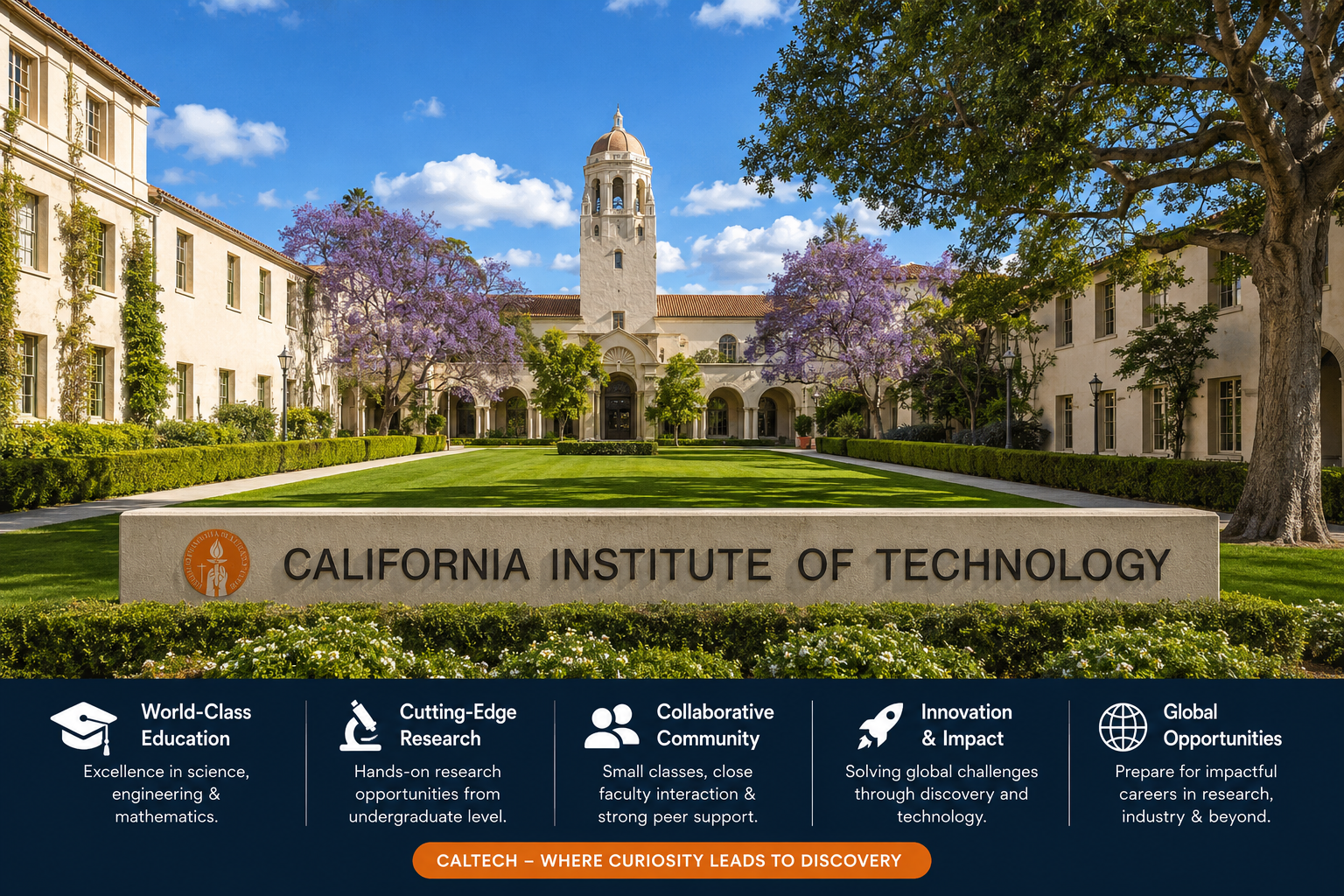
Introduction
The California Institute of Technology (Caltech) is one of the world’s most respected private research universities, renowned for its exceptional achievements in science, engineering, mathematics, and technology. Although relatively small in student population compared with many major universities, Caltech has earned a global reputation for producing groundbreaking discoveries, Nobel Prize winners, influential researchers, and innovative entrepreneurs.
Located in Pasadena, California, Caltech emphasizes intensive research, close faculty-student collaboration, and rigorous academics. Its low student-to-faculty ratio allows students to work directly with leading scientists and engineers, often contributing to research projects early in their academic careers.
Unlike many universities that offer hundreds of academic majors across diverse disciplines, Caltech focuses primarily on STEM (Science, Technology, Engineering, and Mathematics). This specialized approach has helped establish the institute as a leader in scientific discovery and technological innovation.
Whether you are considering undergraduate admission, graduate studies, or research opportunities, understanding Caltech’s academic culture, admissions process, campus environment, and career outcomes is essential. This guide provides a balanced overview to help prospective students determine whether Caltech aligns with their educational goals.
University Fact
| Category | Information |
|---|---|
| Official Name | California Institute of Technology |
| Common Name | Caltech |
| Established | 1891 |
| Location | Pasadena, California, USA |
| University Type | Private Research University |
| Campus Setting | Urban |
| Known For | Science, Engineering, Mathematics, Physics, Space Research |
| Undergraduate Size | Small, highly selective |
| Graduate Programs | Research-intensive Master’s and PhD programs |
| Research Strength | Among the world’s leading research institutions |
| Official Website | https://www.caltech.edu |
Why Students Choose Caltech
Students choose Caltech because of its unique combination of world-class faculty, cutting-edge research, and a collaborative academic environment. Unlike larger universities, Caltech offers a close-knit community where students have direct access to professors and advanced research facilities.
Many students are attracted by opportunities to participate in groundbreaking research in areas such as:
- Artificial Intelligence
- Machine Learning
- Aerospace Engineering
- Physics
- Quantum Computing
- Biotechnology
- Robotics
- Climate Science
- Earth Sciences
- Space Exploration
Caltech’s close relationship with NASA’s Jet Propulsion Laboratory (JPL) further enhances opportunities for students interested in space science and engineering.
Key Highlights
- One of the world’s leading science and engineering universities.
- Home to numerous Nobel Prize-winning faculty and alumni.
- Small student population with exceptional faculty access.
- Highly research-focused undergraduate and graduate education.
- Strong collaboration with NASA’s Jet Propulsion Laboratory.
- Outstanding reputation in Physics, Engineering, Chemistry, Mathematics, and Computer Science.
- Extremely competitive admissions process.
- Global reputation for scientific innovation.
- Strong entrepreneurial and startup culture.
- Graduates are highly sought after by academia, research laboratories, and technology companies.
History of California Institute of Technology
The origins of Caltech date back to 1891, when it was founded as Throop University by businessman and philanthropist Amos G. Throop in Pasadena, California. Initially established as a vocational and preparatory institution, it gradually evolved into a center for advanced scientific education.
During the early 20th century, influential scientists such as astronomer George Ellery Hale, physicist Robert A. Millikan, and chemist Arthur Amos Noyes transformed the institution into a leading scientific university. Their vision emphasized research excellence, scientific discovery, and close collaboration between faculty and students.
In 1920, the institution officially adopted the name California Institute of Technology, reflecting its growing commitment to advanced science and engineering education.
Throughout the 20th century, Caltech expanded its influence through pioneering work in physics, chemistry, astronomy, engineering, biology, and earth sciences. The institute played a significant role during World War II through scientific research and later became closely associated with NASA’s space exploration efforts via the Jet Propulsion Laboratory (JPL), which it manages for NASA.
Over the decades, Caltech researchers have contributed to major breakthroughs in fields including:
- Seismology
- Molecular Biology
- Astrophysics
- Quantum Physics
- Chemical Engineering
- Planetary Science
- Artificial Intelligence
- Climate Science
Its emphasis on curiosity-driven research and interdisciplinary collaboration has helped maintain its reputation as one of the world’s premier scientific institutions.
Campus Overview
California Institute of Technology (Caltech) is located in Pasadena, California, approximately 11 miles (18 km) northeast of downtown Los Angeles. Although its campus is relatively compact—covering about 124 acres—it is carefully designed to support world-class teaching, research, and collaboration.
Unlike many universities with sprawling campuses, Caltech’s smaller size is considered one of its greatest strengths. Academic departments, research laboratories, libraries, residence halls, and student facilities are all within easy walking distance, making it convenient for students and faculty to interact regularly.
The campus is known for its blend of historic architecture, modern research buildings, beautifully landscaped gardens, and tree-lined walkways. The environment is quiet and academically focused, reflecting Caltech’s mission as a research-intensive institution.
Pasadena itself is a vibrant city with museums, restaurants, cultural venues, hiking trails, and easy access to Los Angeles, giving students opportunities to balance rigorous academics with recreational activities.
Campus Atmosphere
The atmosphere at Caltech is often described as:
- Highly collaborative rather than competitive
- Research-driven
- Innovative
- Academically challenging
- Diverse and international
- Close-knit due to its small student population
Students frequently work together on problem sets, laboratory projects, research initiatives, and interdisciplinary collaborations. Faculty members are accessible, creating opportunities for meaningful mentorship.
Architecture and Campus Design
Caltech combines historic Spanish-inspired architecture with state-of-the-art research facilities.
Notable campus landmarks include:
- Beckman Auditorium
- Millikan Library
- Athenaeum
- Beckman Institute
- Cahill Center for Astronomy and Astrophysics
- Linde Hall
- Chen Neuroscience Research Building
These buildings house classrooms, laboratories, research centers, and community spaces designed to encourage innovation and scientific collaboration.
Campus Facilities
Although Caltech is much smaller than many major universities, it offers facilities that support advanced scientific research and student life.
Libraries
The Caltech Library system provides access to:
- Millions of digital research resources
- Scientific journals
- Rare historical collections
- Technical databases
- Research support services
- Data management assistance
Students can access extensive electronic resources from anywhere, supporting coursework and research projects.
Research Laboratories
Caltech’s laboratories are among its greatest strengths.
Students may gain experience in areas such as:
- Physics
- Chemistry
- Biology
- Computer Science
- Mechanical Engineering
- Electrical Engineering
- Aerospace Engineering
- Environmental Science
- Earth and Planetary Sciences
Many undergraduate students begin participating in research early in their academic journey.
Innovation and Entrepreneurship
Caltech encourages students and researchers to transform scientific discoveries into practical applications.
Support includes:
- Technology commercialization
- Startup guidance
- Industry partnerships
- Patent support
- Entrepreneurship programs
- Innovation competitions
This ecosystem has contributed to numerous successful startups and technological advancements.
Residential Life
Most undergraduate students live on campus during their early years.
Residence halls emphasize:
- Academic collaboration
- Student traditions
- Community engagement
- Leadership opportunities
- Peer mentoring
Caltech’s unique “House System” helps create strong social and academic communities where students support one another throughout their studies.
Dining Services
Students have access to multiple dining options offering:
- Vegetarian meals
- Vegan meals
- International cuisine
- Healthy food choices
- Allergy-conscious menus
Dining spaces also serve as informal gathering places where students and faculty interact outside the classroom.
Health and Wellness
Caltech provides a range of student support services, including:
- Primary healthcare
- Mental health counseling
- Wellness programs
- Disability services
- Health education
- Crisis support
These resources are designed to help students maintain their physical and mental well-being while managing the demands of a rigorous academic environment.
Athletics and Recreation
Although Caltech is internationally recognized for academics rather than athletics, students can participate in:
- NCAA Division III sports
- Intramural competitions
- Fitness programs
- Recreation clubs
- Outdoor activities
The institute promotes a healthy balance between academic responsibilities and personal well-being.
Academic Reputation
Caltech has earned a global reputation for excellence in science, engineering, and technology. Despite enrolling only a few thousand students, it consistently ranks among the world’s leading research universities due to its high-impact research, distinguished faculty, and strong academic culture.
What Makes Caltech Academically Unique?
Small Class Sizes
One of Caltech’s defining characteristics is its exceptionally low student-to-faculty ratio. This allows students to engage directly with professors, receive personalized mentorship, and participate in collaborative learning.
Research-First Philosophy
Research is integrated into the student experience from the beginning. Undergraduates often work alongside graduate students and faculty members on projects that address real-world scientific and engineering challenges.
Interdisciplinary Learning
Modern scientific problems often require expertise across multiple fields. Caltech encourages students to combine disciplines such as:
- Computer Science + Biology
- Physics + Mathematics
- Engineering + Artificial Intelligence
- Chemistry + Materials Science
- Earth Science + Climate Modeling
This interdisciplinary approach prepares graduates for complex careers in academia, industry, and research.
Distinguished Faculty
Caltech’s faculty includes internationally recognized scientists and engineers, many of whom have received prestigious honors for their contributions. Students benefit from learning directly from experts who are actively advancing their fields.
Global Rankings
Caltech is consistently recognized among the world’s top universities, particularly in STEM disciplines. Its strong reputation is reflected across major international ranking organizations.
Because methodologies differ and rankings change each year, prospective students should consult the latest editions of rankings such as:
- QS World University Rankings
- Times Higher Education (THE) World University Rankings
- U.S. News Best Global Universities
- Academic Ranking of World Universities (ARWU)
Rather than focusing on a single position, it is more useful to consider Caltech’s long-standing strengths in research quality, faculty impact, and scientific innovation.
Academic Divisions
Caltech organizes its teaching and research into six primary academic divisions:
- Biology and Biological Engineering
- Chemistry and Chemical Engineering
- Engineering and Applied Science
- Geological and Planetary Sciences
- Humanities and Social Sciences
- Physics, Mathematics and Astronomy
This structure encourages collaboration across disciplines while maintaining deep expertise in each field.
Undergraduate Programs
Caltech offers a focused selection of undergraduate majors emphasizing science and engineering. Students build a strong foundation through core coursework before specializing.
Popular undergraduate majors include:
- Aerospace
- Applied and Computational Mathematics
- Biology
- Bioengineering
- Chemical Engineering
- Chemistry
- Computer Science
- Electrical Engineering
- Engineering
- Environmental Science
- Geophysics
- History
- Mathematics
- Mechanical Engineering
- Physics
The curriculum emphasizes analytical thinking, laboratory experience, and problem-solving.
Graduate Programs
Graduate education at Caltech is heavily research-oriented. Master’s and doctoral students work closely with faculty on advanced research in specialized areas.
Graduate opportunities span:
- Artificial Intelligence
- Robotics
- Quantum Science
- Machine Learning
- Materials Science
- Astrophysics
- Biomedical Engineering
- Chemical Engineering
- Environmental Engineering
- Space Science
- Neuroscience
- Applied Physics
Graduate students benefit from access to advanced laboratories, research funding opportunities, and collaborations with leading scientific organizations.
Doctoral Research
Caltech is especially renowned for its PhD programs. Doctoral students contribute original research under faculty supervision, often publishing in leading scientific journals and presenting at international conferences.
Research areas include:
- Quantum Computing
- Nanotechnology
- Renewable Energy
- Climate Science
- Space Exploration
- Artificial Intelligence
- Biotechnology
- Planetary Science
- High-Energy Physics
- Computational Biology
Why Employers Value Caltech Graduates
Graduates are highly regarded for their:
- Advanced analytical skills
- Strong quantitative reasoning
- Research experience
- Innovation mindset
- Technical expertise
- Ability to solve complex problems
- Collaborative approach to scientific work
These qualities make Caltech alumni competitive for careers in technology companies, research laboratories, startups, government agencies, and higher education.
Admissions Overview
California Institute of Technology (Caltech) has one of the most selective admissions processes in the world. The university seeks students who demonstrate exceptional academic achievement, intellectual curiosity, creativity, and a strong interest in science, engineering, and mathematics.
Admissions officers evaluate applicants using a holistic review process. While academic performance is a major factor, Caltech also considers research potential, problem-solving ability, extracurricular involvement, leadership, and personal qualities.
Rather than relying solely on grades or test scores, the admissions committee looks for students who have challenged themselves through rigorous coursework and who show a genuine passion for learning.
Undergraduate Admissions
Prospective undergraduate students apply through the Common Application or QuestBridge (for eligible applicants). Applicants are expected to present a strong academic record, particularly in mathematics and science.
General Admission Requirements
Typical components of an undergraduate application include:
- Completed online application
- High school transcripts
- School report
- Teacher recommendations
- Counselor recommendation
- Personal essays
- List of extracurricular activities
- Application fee or approved fee waiver
- Additional supporting documents if requested
Because requirements can change, applicants should always consult the latest admissions instructions provided by Caltech.
Academic Preparation
Successful applicants often complete rigorous high school coursework such as:
- Calculus
- Advanced Mathematics
- Physics
- Chemistry
- Biology
- Computer Science (recommended where available)
- English
- History or Social Sciences
Students who challenge themselves academically generally present stronger applications.
Standardized Tests
Testing policies may change over time. Depending on the admissions cycle, standardized testing requirements (such as the SAT or ACT) may differ.
Applicants should review the official admissions website to confirm the current testing policy before submitting an application.
Graduate Admissions
Graduate admission is managed by individual academic departments, and requirements vary by program.
Most graduate applications include:
- Online application
- Bachelor’s degree (or equivalent)
- Academic transcripts
- Letters of recommendation
- Statement of purpose
- Resume or CV
- Research experience (where applicable)
- Additional departmental requirements
Many PhD applicants are expected to demonstrate prior research experience relevant to their intended field of study.
International Student Admissions
Caltech welcomes applications from students around the world. International applicants follow a process similar to domestic applicants but may need to provide additional documentation.
Possible additional requirements include:
- Proof of English language proficiency (if required)
- Financial documentation for visa purposes
- Passport information
- Academic credential evaluation where applicable
Admission standards remain consistent regardless of citizenship.
English Language Requirements
Applicants whose primary language is not English may be asked to demonstrate English proficiency.
Accepted English-language examinations can vary and may include internationally recognized tests.
Since language policies are occasionally updated, applicants should verify current requirements directly through the official admissions website.
Application Timeline
Application timelines differ for undergraduate and graduate programs.
Applicants should carefully monitor:
- Application opening dates
- Early application options (if offered)
- Regular decision deadlines
- Department-specific graduate deadlines
- Financial aid deadlines
- Document submission deadlines
Submitting required materials well before the deadline can help avoid last-minute issues.
What Caltech Looks For
Beyond outstanding grades, Caltech values applicants who demonstrate:
Intellectual Curiosity
Students should enjoy exploring difficult scientific questions and pursuing knowledge beyond the classroom.
Research Interest
Participation in science fairs, independent research, laboratory work, or engineering projects can strengthen an application.
Problem-Solving Skills
Applicants who enjoy solving challenging mathematical or scientific problems often fit well within Caltech’s academic environment.
Collaboration
Caltech emphasizes teamwork. Students who have worked effectively in collaborative settings may adapt more successfully to campus life.
Persistence
The institute values resilience, curiosity, and the willingness to tackle difficult academic challenges.
Tuition and Fees
Caltech is a private university, meaning tuition rates are generally the same for domestic and international undergraduate students.
The total cost of attendance typically includes:
- Tuition
- Mandatory university fees
- Housing
- Meal plans
- Books and supplies
- Health insurance (if applicable)
- Personal expenses
- Transportation
Because tuition and fees are reviewed annually, applicants should consult Caltech’s official financial services website for the most up-to-date figures.
Estimated Additional Living Expenses
Students should budget for expenses beyond tuition, including:
- Housing
- Food
- Books
- Laboratory materials
- Local transportation
- Personal expenses
- Technology needs
- Recreation
Careful financial planning is recommended before beginning studies.
Scholarships and Financial Aid
Caltech is committed to helping admitted students finance their education through a variety of aid programs.
Financial support may include:
- Need-based financial aid
- Institutional grants
- Merit-based awards (where applicable)
- External scholarships
- Federal financial aid programs (for eligible U.S. students)
- Graduate fellowships
- Research assistantships
- Teaching assistantships
Availability depends on eligibility, academic program, and current university policies.
Undergraduate Financial Aid
Many undergraduate students receive financial assistance based on demonstrated financial need.
Financial aid packages may combine:
- Grants
- Scholarships
- Student employment opportunities
- Limited loan options (where applicable)
Applicants should complete all required financial aid forms before published deadlines.
Graduate Funding
Many doctoral students receive financial support through:
- Research assistantships
- Teaching assistantships
- Departmental fellowships
- External research grants
Funding arrangements vary by department and research program.
Opportunities for International Students
International students may qualify for institutional aid depending on university policies and available funding.
Additional funding opportunities may include:
- Government-sponsored scholarships
- International education foundations
- Private scholarship organizations
- Home-country funding agencies
Students should begin researching scholarship opportunities well before application deadlines.
Cost of Living in Pasadena
Living expenses vary depending on lifestyle and housing choices.
Students typically budget for:
- Accommodation
- Utilities
- Groceries
- Dining
- Transportation
- Internet and phone services
- Health-related expenses
- Entertainment
- Personal purchases
Pasadena generally has a higher cost of living than many U.S. cities, so applicants should prepare a realistic financial plan before enrollment.
Tips for a Strong Application
Admission to Caltech is extremely competitive, but applicants can strengthen their chances by focusing on quality rather than quantity.
Consider the following strategies:
- Maintain excellent academic performance throughout high school or university.
- Take the most challenging mathematics and science courses available.
- Participate in meaningful research or STEM projects.
- Write thoughtful and authentic personal essays.
- Secure strong recommendation letters from teachers who know your academic abilities well.
- Demonstrate curiosity through competitions, independent learning, or scientific exploration.
- Review application materials carefully before submission to avoid errors.
- Submit all required documents before the official deadlines.
No single achievement guarantees admission, but a consistent record of academic excellence and genuine interest in STEM can make an application more competitive.
Student Life at Caltech
Although California Institute of Technology (Caltech) is best known for its rigorous academics and groundbreaking scientific research, student life extends well beyond classrooms and laboratories. The university fosters a close-knit community where collaboration, curiosity, and creativity are central to the student experience.
With a relatively small student population, students quickly become part of a supportive academic network. It is common for classmates to work together on assignments, conduct research as teams, and participate in campus traditions that strengthen lifelong friendships.
Unlike larger universities where students may feel anonymous, Caltech’s intimate environment encourages meaningful interactions with fellow students, faculty members, and researchers.
A Collaborative Academic Culture
One of Caltech’s defining characteristics is its Honor Code, which promotes trust, integrity, and personal responsibility. This philosophy influences many aspects of campus life, from flexible examination arrangements to shared academic resources.
Rather than encouraging competition between classmates, Caltech emphasizes cooperation. Students frequently:
- Study together in small groups.
- Share ideas while solving challenging problems.
- Collaborate on laboratory research.
- Mentor younger students.
- Participate in interdisciplinary projects.
This culture helps students develop teamwork and communication skills that are valuable in both research and industry.
Residential Life
Most undergraduate students live on campus, particularly during their first years. Residence halls are designed to provide more than just accommodation—they serve as active learning communities where students build friendships and support one another academically.
The House System
Caltech’s well-known House System is a distinctive feature of campus life. Each house has its own traditions, leadership structure, social events, and community identity.
Benefits of the House System include:
- Peer mentoring
- Academic support
- Social activities
- Leadership opportunities
- Community engagement
- Lifelong alumni connections
The House System contributes significantly to the university’s collaborative and welcoming atmosphere.
Student Organizations
Students can participate in a variety of organizations that complement their academic interests and personal hobbies.
Popular areas of involvement include:
- Engineering clubs
- Robotics teams
- Astronomy organizations
- Entrepreneurship groups
- Artificial Intelligence clubs
- Programming communities
- Cultural organizations
- Music and performing arts
- Volunteer programs
- Sustainability initiatives
Participation in these activities allows students to develop leadership skills, expand professional networks, and explore interests outside the classroom.
Campus Traditions
Caltech has developed many unique traditions over the decades that contribute to its distinctive campus culture.
These traditions often emphasize:
- Creativity
- Scientific humor
- Teamwork
- Problem-solving
- Friendly competition
- Community spirit
While traditions evolve over time, they continue to play an important role in creating memorable student experiences.
Diversity and Inclusion
Caltech welcomes students from many countries and educational backgrounds. The university strives to create an inclusive learning environment where individuals from different cultures and perspectives can succeed.
Campus initiatives support:
- International students
- First-generation college students
- Women in STEM
- Underrepresented communities
- Accessibility services
- Inclusive research opportunities
Diverse perspectives enrich classroom discussions, research collaborations, and campus life.
Research and Innovation
Research is at the heart of Caltech’s mission. Unlike institutions where research opportunities are primarily reserved for graduate students, Caltech encourages undergraduate participation from an early stage.
Students often work directly with professors on projects that address significant scientific and engineering challenges.
Major research areas include:
- Artificial Intelligence
- Machine Learning
- Quantum Computing
- Aerospace Engineering
- Astrophysics
- Neuroscience
- Climate Science
- Renewable Energy
- Biotechnology
- Nanotechnology
- Planetary Science
- Computational Biology
This hands-on approach helps students develop critical thinking, laboratory skills, and experience with cutting-edge technologies.
Interdisciplinary Research
Many of today’s scientific challenges require expertise from multiple disciplines. Caltech promotes collaboration across departments to encourage innovative solutions.
Examples include:
- AI applied to biology
- Physics combined with computer science
- Engineering for medical technologies
- Climate modeling using advanced computing
- Materials science for sustainable energy
Students gain experience working on projects that cross traditional academic boundaries, preparing them for complex careers in research and industry.
NASA Jet Propulsion Laboratory (JPL)
One of Caltech’s most significant research partnerships is its management of NASA’s Jet Propulsion Laboratory (JPL).
JPL is a federally funded research and development center that designs and operates many of NASA’s robotic space exploration missions.
Students and researchers may have opportunities to engage in work related to:
- Mars exploration
- Planetary missions
- Spacecraft engineering
- Satellite technology
- Earth observation
- Deep-space communications
- Robotics
- Autonomous systems
The connection with JPL enhances Caltech’s reputation as a leader in aerospace engineering and space science.
Innovation and Entrepreneurship
Caltech supports students interested in transforming research discoveries into real-world technologies.
Resources available include:
- Technology transfer support
- Startup mentoring
- Innovation workshops
- Business competitions
- Industry partnerships
- Intellectual property guidance
Students interested in entrepreneurship can work with faculty, investors, and industry experts to explore commercialization opportunities.
Career Services
Caltech provides career development resources to help students prepare for employment or further academic study.
Career support typically includes:
- Career counseling
- Resume and CV reviews
- Interview preparation
- Internship guidance
- Graduate school advising
- Networking events
- Employer information sessions
- Career fairs
Students are encouraged to begin career planning early in their academic journey.
Internship Opportunities
Internships provide valuable practical experience before graduation.
Caltech students often pursue internships with:
- Technology companies
- Aerospace organizations
- Research laboratories
- Government agencies
- Biotechnology firms
- Engineering companies
- National laboratories
- Startup organizations
Internships help students apply classroom knowledge to real-world scientific and engineering problems.
Employment Outcomes
Graduates from Caltech are highly respected for their technical expertise, analytical thinking, and research experience.
Common career destinations include:
- Research scientist
- Software engineer
- Aerospace engineer
- Data scientist
- Mechanical engineer
- Electrical engineer
- Physicist
- Biomedical researcher
- Entrepreneur
- University professor
Many graduates also continue their education through master’s or doctoral programs at leading universities around the world.
Because employment outcomes vary by discipline and graduation year, prospective students should refer to the university’s official career services resources for the latest information.
Global Employer Reputation
Employers value Caltech graduates because they are known for:
- Strong quantitative reasoning
- Advanced problem-solving skills
- Research experience
- Adaptability
- Innovation
- Technical expertise
- Collaboration
- Independent thinking
These qualities make graduates competitive across academia, government research institutions, and the private sector.
Famous Alumni
Although Caltech is relatively small, its alumni have made significant contributions to science, engineering, technology, and public service.
Some notable alumni include:
Gordon Moore
Co-founder of Intel Corporation and the scientist behind the observation commonly known as Moore’s Law, which described the rapid growth in computing power.
Frank Capra
Academy Award-winning filmmaker known for directing influential American films such as It’s a Wonderful Life and Mr. Smith Goes to Washington. He studied chemical engineering at Caltech.
Frances Arnold
Nobel Prize-winning scientist recognized for pioneering work in directed evolution, advancing fields such as biotechnology and sustainable chemistry.
Kip Thorne
Theoretical physicist and Nobel Prize winner whose research on gravitational waves and black holes has significantly influenced modern astrophysics.
Harrison Schmitt
Geologist, former NASA astronaut, and one of the last humans to walk on the Moon during the Apollo 17 mission.
Why Students Choose Caltech
Students who thrive at Caltech are often those who:
- Enjoy solving complex scientific problems.
- Want to participate in cutting-edge research.
- Prefer small class sizes and close faculty interaction.
- Aspire to careers in STEM fields.
- Value collaboration over competition.
- Seek opportunities to contribute to scientific discovery.
For students with a strong passion for science, engineering, mathematics, and technology, Caltech offers an environment where curiosity and innovation are encouraged at every stage of their education.
Caltech vs Other Top Universities
Students often compare Caltech with other world-renowned universities before deciding where to apply. While all of these institutions are academically outstanding, each has its own strengths and learning environment.
| Feature | Caltech | MIT | Stanford | Harvard |
|---|---|---|---|---|
| Primary Focus | STEM | STEM | Broad (STEM + Business + Humanities) | Broad Academic Fields |
| Institution Type | Private Research University | Private Research University | Private Research University | Private Research University |
| Undergraduate Size | Very Small | Medium | Larger | Larger |
| Research Intensity | Extremely High | Extremely High | Extremely High | Extremely High |
| Faculty Interaction | Exceptional | Excellent | Excellent | Excellent |
| Entrepreneurship | Strong | Outstanding | Outstanding | Strong |
| Campus Culture | Close-knit and collaborative | Fast-paced and innovative | Entrepreneurial and interdisciplinary | Broad liberal arts tradition |
| Best For | Students focused on advanced scientific research | Engineering and technology innovators | Innovation, startups, and interdisciplinary learning | Students seeking a broad academic experience |
Which University Is Right for You?
- Choose Caltech if you:
- Want a highly focused STEM education.
- Prefer small classes and close faculty mentorship.
- Are passionate about scientific research.
- Enjoy solving complex mathematical and engineering problems.
- Choose MIT if you:
- Want a larger STEM-focused environment.
- Are interested in technology, entrepreneurship, and engineering innovation.
- Choose Stanford if you:
- Want a balance of engineering, business, humanities, and entrepreneurship.
- Hope to work closely with Silicon Valley industries.
- Choose Harvard if you:
- Prefer a comprehensive university with strengths across many academic disciplines.
- Are interested in law, medicine, business, social sciences, or liberal arts in addition to STEM.
There is no universally “best” university. The right choice depends on your academic interests, career goals, preferred campus environment, and learning style.
Pros and Cons of Studying at Caltech
| Pros | Cons |
|---|---|
| World-class STEM education | Extremely competitive admissions |
| Outstanding faculty and research opportunities | Rigorous academic workload |
| Small class sizes | Limited number of academic majors outside STEM |
| Strong undergraduate research opportunities | Higher cost of attendance compared with many public universities |
| Excellent reputation among employers | Smaller campus community than many universities |
| Close collaboration with professors | Academic pace may feel demanding for some students |
| Strong alumni and research network | Limited intercollegiate athletics compared with larger institutions |
Who Should Consider Caltech?
Caltech may be an excellent choice for students who:
- Have a strong interest in mathematics, science, and engineering.
- Enjoy challenging academic environments.
- Want early involvement in research.
- Appreciate small class sizes and personalized instruction.
- Hope to pursue graduate study or research careers.
- Aspire to work in technology, aerospace, medicine, or scientific innovation.
Students looking for a wide variety of non-STEM majors or a large university experience may find other institutions better suited to their interests.
Frequently Asked Questions (FAQs)
1. Where is Caltech located?
Caltech is located in Pasadena, California, United States.
2. Is Caltech a public or private university?
It is a private research university.
3. What is Caltech best known for?
Caltech is internationally recognized for excellence in science, engineering, mathematics, and research.
4. Is Caltech difficult to get into?
Yes. Admission is highly selective, and applicants typically have outstanding academic records and strong STEM backgrounds.
5. Does Caltech accept international students?
Yes. Students from many countries apply and study at Caltech each year.
6. What are Caltech’s strongest academic fields?
Physics, Computer Science, Mathematics, Engineering, Chemistry, Biology, and Earth Sciences are among its strongest areas.
7. Does Caltech offer undergraduate research?
Yes. Undergraduate students are encouraged to participate in research early in their academic careers.
8. Is campus housing available?
Yes. Most undergraduate students live on campus, particularly during their first years.
9. Does Caltech offer scholarships?
Financial aid and scholarship opportunities are available for eligible students. Applicants should consult the official financial aid office for current information.
10. Is Caltech good for Computer Science?
Yes. Computer Science is one of Caltech’s highly respected academic disciplines.
11. Can students participate in internships?
Yes. Many students complete internships with research laboratories, technology companies, government agencies, and engineering organizations.
12. What is student life like?
Student life is collaborative, research-oriented, and supported by a strong residential community.
13. Does Caltech have sports teams?
Yes. The university participates in NCAA Division III athletics.
14. What makes Caltech different from larger universities?
Its small size, close faculty interaction, and strong emphasis on scientific research distinguish it from many larger institutions.
15. Is Caltech suitable for students interested in entrepreneurship?
Yes. Students interested in commercializing research and launching startups have access to entrepreneurship resources and industry connections.
16. Does Caltech have graduate programs?
Yes. It offers master’s and doctoral programs across many STEM disciplines.
17. Are English language tests required?
Requirements depend on the applicant’s educational background and the university’s current admissions policies.
18. Can students collaborate with NASA?
Some students may have opportunities to work on research connected with NASA’s Jet Propulsion Laboratory through academic or research programs.
19. Should applicants rely on university rankings?
Rankings can provide useful context, but students should also evaluate academic programs, research opportunities, faculty, campus culture, and career outcomes.
20. Where can I find the latest admissions information?
The most reliable source is Caltech’s official admissions website.
Official Resources
For the most up-to-date information, prospective students should use official university resources:
- Official University Website
- Undergraduate Admissions
- Graduate Admissions
- Academic Programs
- Financial Aid Office
- International Student Services
- Housing Services
- Career Development Center
- Library
- Campus Map
Because policies and deadlines may change, always verify current information directly through these official resources.