

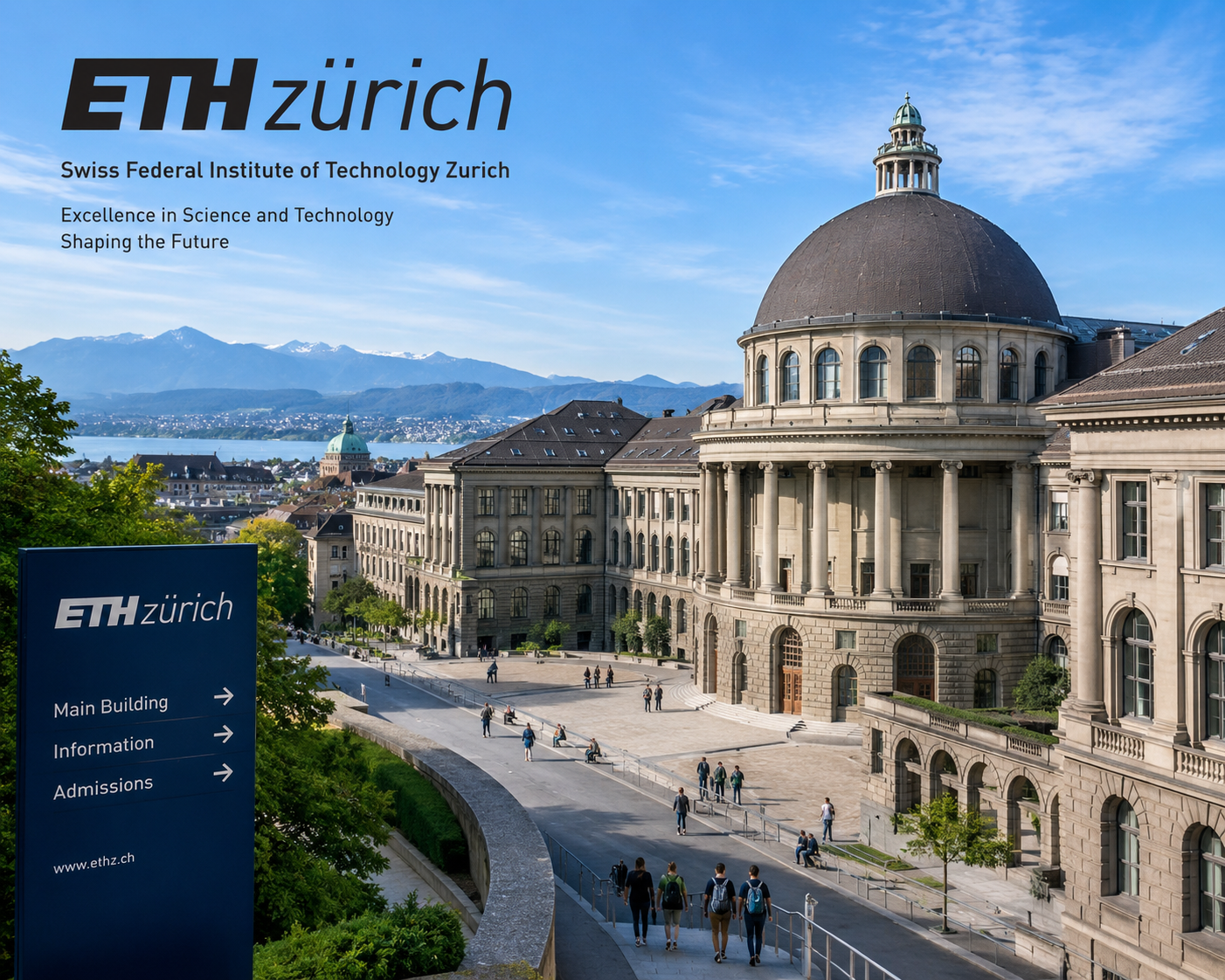
Introduction
ETH Zurich is widely recognized as one of the world’s leading science and technology universities. Officially known as the Swiss Federal Institute of Technology in Zurich, the university has built an international reputation for excellence in engineering, computer science, mathematics, natural sciences, and architecture.
Located in Zurich, Switzerland’s largest city, ETH Zurich attracts talented students, researchers, and faculty from around the globe. Its strong emphasis on research, innovation, and interdisciplinary collaboration has helped shape advancements in areas ranging from artificial intelligence and robotics to climate science and sustainable engineering.
Many prospective students consider ETH Zurich because of its rigorous academic environment, outstanding research facilities, relatively affordable tuition compared with many other top universities, and strong connections with industry and innovation. Graduates are highly regarded by employers worldwide, particularly in science, engineering, and technology-related fields.
However, studying at ETH Zurich also comes with challenges. Academic expectations are demanding, admission to certain programs can be highly competitive, and adapting to Switzerland’s educational system may require careful preparation, especially for international students.
This guide is designed to help prospective undergraduate, graduate, and doctoral applicants understand what ETH Zurich offers, how admissions work, what student life is like, and whether the university is the right fit for their academic and career goals.
University Fact
| Question | Answer |
|---|---|
| Official Name | ETH Zurich (Swiss Federal Institute of Technology Zurich) |
| Location | Zurich, Switzerland |
| University Type | Public Research University |
| Known For | Engineering, Computer Science, Natural Sciences, Mathematics, Architecture |
| Research Strength | One of Europe’s leading research universities |
| Student Population | International and diverse student community from more than 100 countries (figures may vary over time) |
| Language | Bachelor’s programs are primarily taught in German, while many master’s and doctoral programs are offered in English |
| Best For | Students seeking research-intensive education in science, engineering, and technology |
Note: Admissions policies, tuition, rankings, and program details may change over time. Applicants should always verify the latest information through ETH Zurich’s official website before applying.
Key Highlights
- One of Europe’s premier science and technology universities.
- Founded in the mid-19th century to support Switzerland’s scientific and industrial development.
- Internationally recognized for engineering, computer science, mathematics, physics, chemistry, and architecture.
- Home to numerous internationally renowned researchers and Nobel Prize winners.
- Offers a research-focused learning environment with strong emphasis on innovation.
- Collaborates extensively with global universities, research institutes, startups, and industry partners.
- Provides modern laboratories, research centers, libraries, and innovation facilities.
- Located in Zurich, one of the world’s leading financial, technology, and innovation hubs.
- Attracts students and researchers from across the world, creating a multicultural campus environment.
- Graduates are highly sought after in academia, research institutions, multinational companies, and technology startups.
Why Students Choose ETH Zurich
Students from around the world choose ETH Zurich for several reasons beyond its academic reputation. The university combines rigorous coursework with opportunities to participate in cutting-edge research from an early stage of study. This hands-on approach appeals to students who want to solve real-world scientific and engineering problems.
Another major advantage is the university’s location. Zurich offers access to a thriving ecosystem of technology companies, multinational corporations, financial institutions, startups, and research organizations. This environment creates opportunities for internships, collaborative projects, and networking that can support students’ long-term career goals.
ETH Zurich is also known for fostering innovation and entrepreneurship. Many students work on research projects, participate in startup initiatives, or collaborate with industry partners while completing their degrees. These experiences help bridge the gap between academic theory and practical application.
International students often appreciate the university’s diverse community, where people from many countries and academic backgrounds work together. This multicultural environment encourages collaboration, broadens perspectives, and prepares graduates for careers in an increasingly global workforce.
Who Should Consider ETH Zurich?
ETH Zurich may be an excellent choice for students who:
- Have a strong academic background in mathematics and science.
- Enjoy analytical thinking and solving complex problems.
- Want to study at a research-intensive university.
- Are interested in engineering, computer science, data science, architecture, physics, chemistry, or related STEM fields.
- Hope to pursue careers in research, technology, innovation, or academia.
- Are prepared for a challenging academic workload.
- Value an international learning environment with access to cutting-edge research and industry collaborations.
Students looking for a highly structured, research-focused education with global recognition may find ETH Zurich particularly attractive. At the same time, applicants should be prepared for demanding coursework and should carefully review the language requirements and admission criteria for their chosen program.
History of ETH Zurich
ETH Zurich has played a central role in Switzerland’s scientific and technological development for more than a century and a half. Since its founding in 1855, the university has grown from a national engineering school into one of the world’s leading institutions for science, technology, engineering, and mathematics (STEM).
Its history reflects Switzerland’s commitment to innovation, precision, and research excellence. Today, ETH Zurich is recognized not only for educating future engineers and scientists but also for contributing discoveries that influence industries, governments, and societies worldwide.
Why Was ETH Zurich Founded?
During the mid-19th century, Switzerland was undergoing significant economic and industrial transformation. As industries expanded and engineering projects became increasingly complex, the country recognized the need for an institution dedicated to advanced scientific and technical education.
The Swiss federal government established ETH Zurich to:
- Train highly skilled engineers and scientists.
- Support industrial and economic development.
- Promote scientific research.
- Strengthen Switzerland’s global competitiveness.
- Encourage innovation across multiple disciplines.
Unlike many older European universities that initially emphasized classical education, ETH Zurich was created with a strong focus on practical science and engineering. This mission continues to shape the university’s identity today.
Major Historical Milestones
1855 – Foundation
ETH Zurich officially opened in 1855 under the name Swiss Federal Polytechnic School. Its initial academic offerings focused primarily on engineering, mathematics, architecture, chemistry, and forestry.
At the time, the institution consisted of only a few departments and a relatively small number of students. Despite its modest beginnings, the university quickly earned respect for its rigorous academic standards.
Expansion During the Industrial Revolution
As Europe experienced rapid industrial growth, demand for engineers and technical experts increased dramatically.
ETH Zurich responded by:
- Expanding engineering disciplines.
- Developing modern laboratory facilities.
- Recruiting internationally respected professors.
- Increasing scientific research activities.
These developments helped transform the university into one of Europe’s most influential technical institutions.
Becoming an International Research University
Throughout the 20th century, ETH Zurich gradually shifted from primarily educating engineers to becoming a comprehensive research university.
Major investments were made in:
- Physics
- Chemistry
- Biology
- Environmental sciences
- Earth sciences
- Computer science
- Materials science
- Mechanical engineering
- Electrical engineering
This expansion allowed researchers from different disciplines to collaborate on increasingly complex scientific challenges.
Growth of Scientific Discovery
ETH Zurich’s reputation grew steadily because of groundbreaking research conducted by its faculty and graduates.
Research at the university has contributed to advances in:
- Physics
- Robotics
- Artificial intelligence
- Climate science
- Sustainable energy
- Biotechnology
- Space technologies
- Advanced materials
- Quantum science
- Data science
Many discoveries developed at ETH Zurich have influenced industries around the world and continue to shape modern technology.
Nobel Prize Legacy
One of ETH Zurich’s distinguishing characteristics is its association with numerous Nobel Prize winners.
Among the university’s most famous figures is Albert Einstein, who studied at ETH Zurich before becoming one of history’s most influential physicists. While Einstein’s achievements extended far beyond the university, his education at ETH Zurich remains an important part of the institution’s history.
Over the decades, many faculty members, researchers, and alumni have received Nobel Prizes in fields such as:
- Physics
- Chemistry
- Medicine
- Economics
This tradition reflects the university’s long-standing emphasis on scientific excellence and research innovation.
Modern Era
Today, ETH Zurich is consistently recognized as one of Europe’s leading research universities.
Its mission now extends far beyond traditional engineering education. The university actively addresses global challenges, including:
- Climate change
- Sustainable development
- Artificial intelligence
- Renewable energy
- Public health
- Food security
- Digital transformation
- Robotics
- Smart cities
- Advanced manufacturing
Researchers frequently collaborate with governments, international organizations, universities, and industry partners to develop practical solutions with global impact.
Campus Overview
ETH Zurich operates across two primary campuses, each designed to support different aspects of teaching, research, and innovation.
Together, these campuses create an academic environment that combines historic architecture with state-of-the-art scientific infrastructure.
Zentrum Campus
The Zentrum Campus is located near the heart of Zurich and serves as the university’s historic center.
Many of ETH Zurich’s iconic buildings are located here, including lecture halls, administrative offices, libraries, and research facilities.
Students appreciate the campus because it offers:
- Historic academic buildings
- Easy access to downtown Zurich
- Excellent public transportation
- Museums and cultural attractions nearby
- Student study spaces
- Cafeterias and restaurants
- Beautiful city views
The campus blends traditional European architecture with modern research facilities, reflecting the university’s long academic history.
Hönggerberg Campus
As scientific research expanded, ETH Zurich developed the Hönggerberg Campus, located northwest of the city center.
This campus focuses heavily on science, engineering, and technology.
Major facilities include:
- Advanced laboratories
- Engineering research centers
- Computer science buildings
- Chemistry laboratories
- Biotechnology facilities
- Innovation centers
- Student housing
- Sports facilities
Many students spend time on both campuses, depending on their academic programs.
Campus Environment
ETH Zurich offers an academic atmosphere that emphasizes learning, collaboration, and research rather than a traditional residential college experience.
Students often describe the campus as:
- Highly international
- Academically demanding
- Research-oriented
- Collaborative
- Innovative
- Professional
- Diverse
The university encourages interdisciplinary collaboration, making it common for students from different departments to work together on research projects and innovation initiatives.
Architecture
The architecture of ETH Zurich reflects both its history and its future.
Visitors can observe:
Historic Buildings
Older campus buildings feature classical European architectural styles with elegant facades, large lecture halls, and grand staircases.
These buildings preserve the university’s heritage while continuing to serve modern academic purposes.
Contemporary Research Buildings
Newer facilities emphasize:
- Energy efficiency
- Flexible laboratories
- Collaborative workspaces
- Sustainable construction
- Digital learning environments
The combination of historic and modern architecture creates a unique campus identity.
Campus Facilities
ETH Zurich invests heavily in facilities that support education, research, and student development.
Rather than focusing on luxury amenities, the university prioritizes resources that enhance academic excellence.
Libraries
The ETH Library is among Switzerland’s largest scientific libraries.
Students have access to:
- Millions of books
- Scientific journals
- Digital databases
- Historical archives
- Research publications
- Study rooms
- Quiet reading areas
- Collaborative workspaces
The library also provides extensive digital resources, enabling students and researchers to access academic materials remotely.
Laboratories
Modern laboratories are central to the ETH Zurich learning experience.
Depending on their field of study, students may work in laboratories equipped for:
- Robotics
- Artificial intelligence
- Mechanical engineering
- Chemistry
- Physics
- Nanotechnology
- Biotechnology
- Environmental science
- Materials engineering
- Earth sciences
Many undergraduate students gain laboratory experience early in their academic journey.
Research Centers
ETH Zurich hosts numerous specialized research institutes that bring together experts from multiple disciplines.
Research areas include:
- Robotics
- Machine Learning
- Artificial Intelligence
- Quantum Computing
- Biomedical Engineering
- Sustainable Energy
- Climate Research
- Environmental Systems
- Aerospace Engineering
- Advanced Manufacturing
These centers often collaborate with international universities, research institutes, and private industry.
Innovation and Entrepreneurship
Innovation is deeply integrated into campus life.
Students interested in entrepreneurship can participate in:
- Startup incubation programs
- Innovation competitions
- Industry partnerships
- Business mentoring
- Technology commercialization initiatives
- Networking events
- Entrepreneur workshops
Many successful technology startups have emerged from research conducted at ETH Zurich.
Student Study Spaces
Across both campuses, students can find:
- Quiet study rooms
- Group collaboration areas
- Computer labs
- Digital learning spaces
- Project workrooms
- Seminar spaces
These facilities are designed to support both independent study and collaborative learning.
Sports and Recreation
ETH Zurich encourages students to maintain a healthy lifestyle alongside their academic responsibilities.
Sports opportunities include:
- Fitness centers
- Swimming
- Climbing
- Football
- Basketball
- Volleyball
- Tennis
- Running
- Winter sports
- Outdoor recreation
Participation in sports also helps students build friendships and manage academic stress.
Student Support Services
To support academic success and personal well-being, ETH Zurich offers services such as:
- Academic advising
- Career counseling
- Psychological counseling
- International student support
- Disability services
- Language support
- Study skills workshops
- Financial guidance
These resources help students navigate both academic and personal challenges during their studies.
Sustainability Initiatives
Sustainability is an important priority across teaching, research, and campus operations.
ETH Zurich supports initiatives related to:
- Renewable energy
- Sustainable buildings
- Climate research
- Circular economy
- Carbon reduction
- Biodiversity
- Green transportation
- Environmental engineering
Students frequently have opportunities to participate in sustainability-focused research projects and interdisciplinary initiatives aimed at addressing global environmental challenges.
Academic Reputation
ETH Zurich has earned a global reputation for excellence in science, technology, engineering, and mathematics (STEM). Over more than 170 years, the university has combined rigorous academic standards with pioneering research, producing graduates and discoveries that have influenced industries, governments, and academia around the world.
Rather than focusing on teaching alone, ETH Zurich integrates education with research. Students are encouraged to engage in scientific inquiry, practical problem-solving, and interdisciplinary collaboration throughout their studies. This approach helps develop both deep subject knowledge and the ability to apply it to real-world challenges.
The university is especially respected for its contributions to engineering, computer science, physics, chemistry, mathematics, environmental sciences, and architecture. Employers and research organizations value ETH Zurich graduates for their strong analytical skills, technical expertise, and experience working on complex projects.
What Makes ETH Zurich Academically Strong?
Several factors contribute to ETH Zurich’s academic standing:
- Research-led education: Courses are informed by the latest scientific developments, allowing students to learn from faculty actively engaged in cutting-edge research.
- Rigorous curriculum: Programs emphasize critical thinking, mathematical foundations, laboratory work, and independent research.
- Interdisciplinary collaboration: Students often work across departments to address challenges that require expertise from multiple fields.
- Global outlook: The university attracts faculty and students from around the world, fostering an international academic environment.
- Industry connections: Partnerships with technology companies, research institutes, and startups help bridge academic learning with practical applications.
This combination creates an environment where students are challenged academically while gaining skills that are highly relevant to research and industry.
Global Rankings
ETH Zurich is consistently ranked among the world’s leading universities by internationally recognized ranking organizations. While rankings differ because each organization uses its own methodology, ETH Zurich regularly performs exceptionally well in areas such as academic reputation, employer reputation, research output, citations, and international collaboration.
Some of the most widely referenced ranking organizations include:
- QS World University Rankings
- Times Higher Education (THE) World University Rankings
- Academic Ranking of World Universities (ARWU or Shanghai Ranking)
Across these rankings, ETH Zurich is frequently placed among the top universities globally and is often recognized as one of the highest-ranked institutions in continental Europe.
Important Note: University rankings are updated annually and methodologies may change. Prospective students should review the latest published rankings and understand the criteria used rather than relying solely on numerical positions.
Schools and Academic Departments
ETH Zurich is organized into multiple academic departments, each specializing in a particular area of study while encouraging interdisciplinary collaboration.
Major academic departments include:
- Architecture
- Civil, Environmental and Geomatic Engineering
- Mechanical and Process Engineering
- Information Technology and Electrical Engineering
- Computer Science
- Mathematics
- Physics
- Chemistry and Applied Biosciences
- Biology
- Earth and Planetary Sciences
- Environmental Systems Science
- Health Sciences and Technology
- Materials Science
- Management, Technology, and Economics
- Humanities, Social and Political Sciences
This structure enables students to build strong expertise within their chosen discipline while also exploring related fields through elective courses and collaborative research.
Undergraduate Programs
Bachelor’s programs at ETH Zurich are designed to provide a strong foundation in scientific principles, mathematics, and engineering.
Popular undergraduate fields include:
- Computer Science
- Mechanical Engineering
- Electrical Engineering
- Civil Engineering
- Architecture
- Mathematics
- Physics
- Chemistry
- Biology
- Environmental Sciences
- Materials Science
- Earth Sciences
Most bachelor’s programs are primarily taught in German, so international applicants should carefully review language requirements before applying.
The curriculum typically combines:
- Lectures
- Laboratory sessions
- Tutorials
- Group projects
- Practical assignments
- Independent study
Students are expected to develop both theoretical understanding and practical problem-solving skills.
Master’s Programs
ETH Zurich offers a wide range of master’s degrees that allow students to specialize in advanced areas of science, engineering, technology, and related disciplines.
Many master’s programs are taught in English, making them accessible to students from around the world.
Popular areas include:
- Artificial Intelligence
- Data Science
- Robotics
- Cybersecurity
- Computational Science
- Environmental Engineering
- Biomedical Engineering
- Energy Science
- Quantum Engineering
- Financial Engineering
- Materials Science
- Sustainable Development
Master’s students often participate in research projects, industry collaborations, and thesis work that address current scientific and technological challenges.
Doctoral Programs
Doctoral education at ETH Zurich is centered on original research under the supervision of experienced faculty members.
PhD candidates work within research groups and contribute to advancements in fields such as:
- Engineering
- Computer Science
- Physics
- Chemistry
- Biology
- Mathematics
- Environmental Sciences
- Health Sciences
- Architecture
Doctoral students frequently publish research papers, present at international conferences, and collaborate with researchers from universities and organizations worldwide.
Teaching and Learning Approach
ETH Zurich emphasizes active learning rather than passive memorization.
Students are encouraged to:
- Analyze complex problems.
- Conduct independent research.
- Work collaboratively in teams.
- Apply theoretical knowledge to practical situations.
- Develop innovative solutions using scientific methods.
Teaching methods commonly include:
- Interactive lectures
- Laboratory experiments
- Design projects
- Programming assignments
- Case studies
- Research seminars
- Independent coursework
This approach prepares graduates for both academic research and professional careers in technology, engineering, and science.
Research Excellence
Research is a defining characteristic of ETH Zurich. The university invests heavily in laboratories, advanced equipment, and interdisciplinary research centers that address some of the world’s most pressing challenges.
Major research areas include:
- Artificial Intelligence
- Machine Learning
- Robotics
- Quantum Science
- Climate Change
- Renewable Energy
- Biotechnology
- Precision Medicine
- Nanotechnology
- Materials Engineering
- Space Science
- Sustainable Infrastructure
Research projects often involve collaboration with international universities, government agencies, and private industry, providing students with opportunities to contribute to meaningful scientific work.
Innovation and Entrepreneurship
ETH Zurich encourages students and researchers to transform scientific discoveries into practical innovations.
The university supports entrepreneurship through:
- Startup incubation programs
- Innovation grants
- Business mentoring
- Technology transfer initiatives
- Networking events with investors
- Industry collaboration projects
Many successful technology companies have originated from ideas developed within ETH Zurich’s research community, demonstrating the university’s commitment to turning research into real-world impact.
International Collaborations
Global collaboration is an essential part of ETH Zurich’s academic strategy.
The university partners with:
- Leading universities
- International research institutes
- Government organizations
- Multinational corporations
- Technology startups
- Non-profit organizations
These partnerships support:
- Student exchange opportunities
- Joint research projects
- Dual-degree initiatives (where available)
- International conferences
- Collaborative publications
Such collaborations expose students to diverse perspectives and strengthen the university’s global research network.
Why ETH Zurich Is Considered a Top STEM University
ETH Zurich’s reputation is built on a combination of factors rather than any single achievement.
Key reasons include:
| Strength | Why It Matters |
|---|---|
| Academic rigor | Students receive a challenging, research-based education. |
| World-class faculty | Many professors are internationally recognized experts in their fields. |
| Cutting-edge research | Students learn in an environment that drives scientific discovery. |
| Industry partnerships | Collaboration with leading companies enhances practical learning. |
| Innovation ecosystem | Strong support for entrepreneurship and technology transfer. |
| International community | Students and researchers from many countries enrich the academic experience. |
| Graduate employability | Employers worldwide recognize the quality of an ETH Zurich education. |
| Interdisciplinary focus | Students address complex problems through collaboration across disciplines. |
Academic Challenges
Prospective students should also consider the demands of studying at ETH Zurich.
Common challenges include:
- Highly competitive admissions for many programs.
- Rigorous coursework with a strong emphasis on mathematics and analytical thinking.
- Significant independent study requirements.
- High academic expectations throughout the program.
- Language requirements for bachelor’s programs taught primarily in German.
- The cost of living in Zurich, which can be higher than in many other European cities.
Understanding these factors can help applicants prepare for the academic environment and determine whether ETH Zurich aligns with their goals and learning style.
Admissions
Gaining admission to ETH Zurich requires careful preparation and a clear understanding of the university’s academic expectations. As one of Europe’s leading STEM institutions, ETH Zurich seeks applicants who have demonstrated strong academic performance and the ability to succeed in a rigorous, research-oriented environment.
Admission requirements vary depending on the level of study, the applicant’s educational background, and the specific program. Because policies may change, prospective students should always consult the official admissions website before applying.
Undergraduate (Bachelor’s) Admissions
Who Can Apply?
Applicants to bachelor’s programs generally need to have completed a secondary school qualification recognized by ETH Zurich as equivalent to the Swiss Matura. The recognition of international qualifications depends on the country and curriculum.
Some applicants may qualify directly, while others may need to meet additional academic or examination requirements.
Typical Eligibility
Applicants are generally expected to have:
- Strong academic performance in mathematics and science.
- A recognized secondary school qualification.
- Appropriate language proficiency for the chosen program.
- Fulfilled any country-specific admission requirements.
Because bachelor’s programs are primarily taught in German, language proficiency is a key part of the admissions process.
Master’s Admissions
Admission to a master’s program is based on the applicant’s previous university education and the relevance of their academic background to the selected program.
Applicants typically need:
- A recognized bachelor’s degree or equivalent.
- Strong academic performance.
- Relevant coursework in the intended field of study.
- Required language proficiency.
- Additional program-specific qualifications where applicable.
Some master’s programs may have limited enrollment or additional selection criteria.
Doctoral (PhD) Admissions
Doctoral admission differs from bachelor’s and master’s admissions.
In most cases, applicants are expected to:
- Hold a relevant master’s degree.
- Identify a research area aligned with their interests.
- Secure the support of an ETH Zurich professor willing to supervise the research project.
- Meet departmental admission requirements.
Research experience, academic achievements, and a well-developed research proposal can strengthen a PhD application.
Application Process
Although requirements vary by program, the application process generally follows these steps:
Step 1: Choose a Program
Carefully review the curriculum, language of instruction, eligibility requirements, and program-specific expectations.
Step 2: Verify Eligibility
Check whether your educational qualifications meet ETH Zurich’s admission requirements.
Step 3: Prepare Documents
Gather all required application materials well before the deadline.
Step 4: Submit the Online Application
Complete the online application form and upload the necessary supporting documents through the university’s application portal.
Step 5: Await Evaluation
Applications are reviewed by the relevant department or admissions office. Depending on the program, additional evaluations may be required.
Step 6: Receive the Admission Decision
Successful applicants receive an official admission decision along with information about enrollment and the next steps.
Important: Application procedures and deadlines may change from year to year. Always confirm the latest requirements through ETH Zurich’s official admissions resources.
Required Documents
The exact list of required documents depends on the program and the applicant’s educational background. Commonly requested documents include:
- Completed online application form.
- Academic transcripts.
- Degree certificates (where applicable).
- Proof of language proficiency.
- Curriculum Vitae (CV) for many graduate programs.
- Motivation letter or statement of purpose (if required).
- Recommendation letters (for selected graduate programs).
- Valid passport or identification document.
- Additional program-specific documents, if requested.
Applicants should ensure that all documents meet the university’s formatting and certification requirements.
Language Requirements
Language requirements depend on the language of instruction for the selected program.
German Language Requirements
Most bachelor’s programs are taught primarily in German. Applicants are generally expected to demonstrate an appropriate level of German proficiency before enrollment.
English Language Requirements
Many master’s and doctoral programs are offered in English. Applicants to these programs may need to provide proof of English proficiency if required by the specific department.
Accepted language tests and minimum score requirements vary by program and may change over time.
Applicants should review the official program page for the latest language requirements.
Application Timeline
ETH Zurich operates according to official application periods that vary by program.
Applicants are encouraged to begin preparing several months before the application deadline.
A typical preparation timeline might include:
| Time Before Deadline | Recommended Activity |
|---|---|
| 12 months | Research programs and eligibility |
| 9 months | Prepare language tests if required |
| 6 months | Request transcripts and recommendation letters |
| 3 months | Complete the online application |
| After submission | Monitor application status and respond to any requests |
Official deadlines vary by program and admission cycle. Always verify the latest dates before applying.
Tuition Fees
Compared with many internationally recognized universities, ETH Zurich has historically maintained relatively moderate tuition fees because it is a public institution.
However, tuition policies can change, and students should consult the official website for the latest fee schedule.
Students should also budget for:
- Semester fees
- Student association fees
- Health insurance
- Books and study materials
- Laboratory costs (if applicable)
- Personal expenses
Cost of Living in Zurich
Although tuition is comparatively affordable, Zurich is widely regarded as one of Europe’s more expensive cities.
Students should plan for monthly expenses such as:
- Accommodation
- Food
- Public transportation
- Health insurance
- Mobile and internet services
- Study materials
- Leisure activities
- Personal expenses
The total cost of living depends on individual lifestyle, housing choices, and personal spending habits.
Careful financial planning is essential for international students.
Scholarships and Financial Aid
ETH Zurich and other organizations offer various forms of financial support to eligible students.
Opportunities may include:
Merit-Based Scholarships
Awarded to students with outstanding academic achievements.
Need-Based Assistance
Available in certain circumstances for students demonstrating financial need.
Excellence Scholarships
Some graduate students may be eligible for competitive excellence-based funding, depending on the program and available resources.
External Scholarships
Students may also explore scholarships offered by:
- Government agencies
- International organizations
- Foundations
- Private sponsors
- Home-country scholarship programs
Eligibility requirements differ significantly between funding opportunities.
Financial Planning Tips
Before beginning studies, applicants should prepare a realistic financial plan that considers:
- Tuition and semester fees
- Living expenses
- Emergency savings
- Travel costs
- Visa-related expenses
- Health insurance
- Exchange rate fluctuations
Proper planning can reduce financial stress and help students focus on their academic goals.
Tips for International Applicants
International students can strengthen their application by:
- Researching admission requirements early.
- Meeting language requirements well before deadlines.
- Maintaining strong academic performance.
- Preparing accurate and complete application documents.
- Carefully reading program-specific instructions.
- Applying as early as possible within the application window.
- Planning finances realistically.
- Learning about Swiss culture and daily life before arrival.
These steps can make the transition to studying in Switzerland smoother and help applicants avoid common mistakes.
Common Mistakes to Avoid
Prospective applicants should try to avoid:
- Missing application deadlines.
- Submitting incomplete documentation.
- Ignoring language requirements.
- Assuming admission requirements are the same for every program.
- Underestimating the academic rigor of ETH Zurich.
- Failing to budget for the cost of living in Zurich.
Careful preparation significantly improves the application experience, even though it cannot guarantee admission.
Student Life at ETH Zurich
While ETH Zurich is best known for its academic rigor and research excellence, student life extends well beyond lecture halls and laboratories. Students become part of an international community where learning, collaboration, innovation, and personal development go hand in hand.
Life at ETH Zurich can be demanding due to the university’s high academic standards, but many students find the experience rewarding because of the opportunities to engage in research, student organizations, cultural activities, sports, and entrepreneurship.
The university’s location in Zurich also gives students access to one of Europe’s safest and most dynamic cities, offering excellent public transportation, cultural attractions, outdoor recreation, and career opportunities.
International Student Community
ETH Zurich has one of the most internationally diverse student populations in Europe.
Students come from numerous countries and bring a wide range of academic, cultural, and professional experiences. This diversity enriches classroom discussions, research collaborations, and campus activities.
International students often benefit from:
- A multicultural learning environment
- Opportunities to build global networks
- International student orientation programs
- Language support services
- Student mentoring initiatives
- Cultural events and exchange activities
Working alongside classmates from different backgrounds also helps students develop cross-cultural communication skills that are valuable in global careers.
Student Accommodation
Unlike some universities with fully residential campuses, ETH Zurich offers a combination of student housing options, and many students also rent private accommodation in Zurich.
Common housing choices include:
Student Residences
Student residences generally provide:
- Furnished rooms
- Shared kitchens
- Common study areas
- Laundry facilities
- Internet access
- Opportunities to meet other students
Availability can be limited, so early planning is recommended.
Shared Apartments
Many students choose to live in shared apartments with roommates. This option can provide greater independence while helping reduce living costs.
Private Accommodation
Students may also rent private apartments or studios, although these are often more expensive than shared housing.
Because Zurich has a competitive housing market, applicants are encouraged to begin searching for accommodation well before the start of their program.
Dining Options
Students have access to a variety of dining facilities on and around campus.
Typical options include:
- University cafeterias
- Student restaurants
- Coffee shops
- Snack bars
- Vegetarian and vegan meals
- International cuisine
Many students also prepare meals at home, especially those living in shared accommodation.
The city of Zurich additionally offers restaurants representing cuisines from around the world, reflecting its international character.
Student Clubs and Organizations
Joining student organizations is one of the best ways to build friendships and develop leadership skills.
Students can participate in clubs related to:
- Engineering
- Robotics
- Artificial Intelligence
- Programming
- Entrepreneurship
- Sustainability
- Music
- Photography
- Cultural exchange
- Debate
- Sports
- Volunteer work
These organizations organize workshops, competitions, networking events, conferences, and social activities throughout the academic year.
Participation also allows students to gain practical experience beyond the classroom.
Cultural Life
ETH Zurich’s diverse student body contributes to an active cultural environment.
Students may enjoy:
- International festivals
- Language exchange programs
- Cultural celebrations
- Guest lectures
- Film screenings
- Art exhibitions
- Concerts
- Student performances
Living in Zurich also provides easy access to museums, theaters, music venues, and historical attractions.
Sports and Recreation
Maintaining a healthy balance between academics and personal well-being is important, especially at a demanding university like ETH Zurich.
Students have opportunities to participate in a wide range of sports and recreational activities, including:
- Football
- Basketball
- Volleyball
- Swimming
- Tennis
- Athletics
- Climbing
- Cycling
- Skiing
- Snowboarding
- Hiking
- Yoga
- Fitness training
Switzerland’s natural landscapes make outdoor recreation particularly popular during weekends and university breaks.
Health and Well-Being
ETH Zurich provides support services that help students maintain their physical and mental well-being.
Support may include:
- Counseling services
- Academic advising
- Mental health resources
- Disability support
- Career guidance
- Student mentoring
- Workshops on study skills and time management
These services aim to help students succeed academically while maintaining a healthy lifestyle.
Diversity and Inclusion
ETH Zurich values an inclusive academic environment where individuals from different backgrounds can learn and work together.
The university supports diversity by encouraging:
- Equal opportunities
- International collaboration
- Inclusive learning environments
- Respect for different cultures and perspectives
- Gender equality initiatives
- Accessibility improvements
A diverse campus strengthens both education and research by bringing together different viewpoints and experiences.
Research and Innovation
Research is central to ETH Zurich’s mission.
Students at many levels have opportunities to engage in research projects that address important scientific, technological, and societal challenges.
Major research themes include:
- Artificial Intelligence
- Machine Learning
- Robotics
- Climate Science
- Sustainable Energy
- Biotechnology
- Quantum Technologies
- Materials Science
- Environmental Systems
- Biomedical Engineering
- Data Science
- Space Research
Research often combines expertise from multiple disciplines, encouraging innovative approaches to complex global issues.
Industry Collaboration
ETH Zurich maintains strong relationships with companies, government organizations, and research institutions.
Industry collaborations may involve:
- Joint research projects
- Internship opportunities
- Technology development
- Innovation partnerships
- Guest lectures
- Sponsored research
- Professional networking
These collaborations help students understand how academic knowledge is applied in real-world settings.
Entrepreneurship and Startup Ecosystem
ETH Zurich is widely recognized for supporting entrepreneurship and innovation.
Students interested in launching businesses or developing new technologies can benefit from:
- Startup mentoring
- Innovation competitions
- Entrepreneurship courses
- Business incubation programs
- Technology transfer support
- Networking with investors
- Collaboration with industry experts
Many successful startups have emerged from research conducted at ETH Zurich, particularly in engineering, biotechnology, software, and artificial intelligence.
Career Services
ETH Zurich provides career support to help students prepare for professional life after graduation.
Career-related resources often include:
- Career counseling
- CV and résumé reviews
- Interview preparation
- Career workshops
- Employer presentations
- Job fairs
- Networking events
- Internship guidance
These services help students connect academic learning with future employment opportunities.
Internship Opportunities
Internships allow students to gain practical experience before graduation.
Depending on the program and field of study, students may complete internships with:
- Engineering firms
- Technology companies
- Research laboratories
- Consulting organizations
- Financial institutions
- Government agencies
- Startups
- International organizations
Internships help students develop professional skills, expand their networks, and better understand industry expectations.
Graduate Employability
Graduates of ETH Zurich are highly regarded by employers in Switzerland and internationally.
The university’s emphasis on analytical thinking, research, and technical expertise prepares students for careers in a variety of sectors.
Graduates commonly work in:
- Engineering
- Software Development
- Artificial Intelligence
- Data Science
- Finance
- Biotechnology
- Consulting
- Manufacturing
- Academia
- Government Research
- Entrepreneurship
Many alumni also pursue doctoral studies or research careers at leading universities and institutions around the world.
Why Employers Value ETH Zurich Graduates
Employers often appreciate ETH Zurich graduates because they typically demonstrate:
| Quality | Professional Value |
|---|---|
| Strong analytical skills | Solving complex technical problems |
| Research experience | Evidence-based decision-making |
| Technical expertise | Readiness for advanced STEM roles |
| Teamwork | Effective collaboration on multidisciplinary projects |
| International exposure | Ability to work in global environments |
| Innovation mindset | Developing creative solutions |
| Problem-solving ability | Tackling real-world challenges |
| Adaptability | Learning new technologies and methodologies |
Student Life: Strengths and Considerations
| Strengths | Considerations |
|---|---|
| International community | Academically demanding environment |
| Excellent research opportunities | Competitive housing market in Zurich |
| Strong industry connections | High cost of living compared with many European cities |
| Active student organizations | Coursework can be intensive |
| Safe and well-connected city | Time management is essential |
| Outstanding career prospects | Some programs have strict progression requirements |
Famous Alumni
ETH Zurich has educated numerous scientists, engineers, entrepreneurs, and innovators whose work has influenced technology, science, business, and public policy worldwide.
Albert Einstein
Perhaps the university’s most famous alumnus, Albert Einstein graduated from ETH Zurich before becoming one of the most influential physicists in history. His work on the theory of relativity transformed modern physics and continues to shape scientific research today.
John von Neumann
A pioneer in mathematics, computer science, and game theory, John von Neumann spent time studying at ETH Zurich early in his academic career. His contributions laid the foundations for modern computing and several branches of applied mathematics.
Niklaus Wirth
Computer scientist Niklaus Wirth, known for developing the Pascal programming language and for significant contributions to software engineering, is one of ETH Zurich’s distinguished alumni.
Kurt Wüthrich
A Nobel Prize-winning chemist, Kurt Wüthrich is recognized for developing nuclear magnetic resonance (NMR) methods that advanced the study of biological molecules.
Other Distinguished Alumni
Over the years, ETH Zurich has produced leaders in:
- Artificial Intelligence
- Robotics
- Aerospace Engineering
- Architecture
- Climate Science
- Mathematics
- Biotechnology
- Finance
- Government
- Entrepreneurship
Many graduates have founded successful companies, become university professors, or led major research organizations worldwide.
Nobel Prize Legacy
ETH Zurich has a long association with Nobel Prize winners through its alumni, faculty members, and researchers.
Achievements span multiple disciplines including:
- Physics
- Chemistry
- Medicine
- Economics
Rather than focusing solely on awards, the university emphasizes creating an environment where curiosity, rigorous research, and interdisciplinary collaboration can lead to meaningful scientific discoveries.
ETH Zurich vs Other Top Universities
Choosing a university depends on personal goals, academic interests, preferred learning environment, budget, and career aspirations. The comparison below highlights general differences rather than declaring one institution universally better.
| University | Best Known For | Ideal For |
|---|---|---|
| ETH Zurich | Engineering, AI, Robotics, Natural Sciences | Students seeking research-intensive STEM education in Europe |
| MIT | Engineering, Technology, Entrepreneurship | Students interested in innovation and strong U.S. industry connections |
| Stanford University | Computer Science, Entrepreneurship, Silicon Valley ecosystem | Those aiming for startups, venture capital, and technology leadership |
| University of Cambridge | Sciences, Mathematics, Humanities | Students who value a historic collegiate learning environment |
| University of Oxford | Broad academic excellence across many disciplines | Students seeking interdisciplinary education and global prestige |
| EPFL | Engineering, Computer Science, Innovation | Students preferring a French-speaking Swiss environment with strong research opportunities |
Who Should Choose ETH Zurich?
ETH Zurich may be an excellent choice for students who:
- Have strong academic performance in mathematics and science.
- Enjoy solving complex technical problems.
- Want to participate in world-class research.
- Plan careers in engineering, computer science, AI, robotics, physics, or related STEM fields.
- Appreciate a multicultural academic environment.
- Are comfortable with rigorous coursework and high academic expectations.
- Value relatively moderate tuition at a globally respected public university.
Who Might Prefer Another University?
Another institution may be a better fit if you:
- Prefer a broader liberal arts curriculum.
- Want a campus culture centered around collegiate residential life.
- Prefer smaller class sizes throughout your degree.
- Wish to study primarily in fields outside STEM.
- Are looking for a university with a stronger emphasis on business, law, or humanities.
The “best” university depends on your academic goals, interests, and learning preferences.
Pros and Cons
| Pros | Cons |
|---|---|
| Globally respected STEM university | Highly competitive admissions |
| Outstanding research opportunities | Academically demanding programs |
| Excellent reputation among employers | Zurich has a high cost of living |
| Strong industry partnerships | Student housing can be competitive |
| International learning environment | Many bachelor’s programs require German proficiency |
| Modern laboratories and research facilities | Workload can be intensive |
| Innovation and entrepreneurship support | High expectations for independent study |
| Strong career prospects worldwide | Not ideal for students seeking a less rigorous academic environment |
Best Academic Programs
ETH Zurich is particularly well known for programs in:
Engineering
- Mechanical Engineering
- Electrical Engineering
- Civil Engineering
- Environmental Engineering
Computer Science
- Artificial Intelligence
- Machine Learning
- Data Science
- Cybersecurity
- Software Engineering
Natural Sciences
- Physics
- Chemistry
- Biology
- Earth Sciences
Mathematics
- Pure Mathematics
- Applied Mathematics
- Computational Mathematics
- Statistics
Architecture
- Sustainable Design
- Urban Planning
- Structural Engineering
Emerging Fields
- Robotics
- Quantum Engineering
- Biomedical Engineering
- Climate Science
- Renewable Energy Systems
Application Tips
Applying to ETH Zurich requires careful planning. Consider the following recommendations:
Start Early
Research your preferred program well before the application period begins. This allows time to prepare language tests, academic documents, and any required supporting materials.
Build a Strong Academic Foundation
Because ETH Zurich places significant emphasis on mathematics and science, applicants should demonstrate strong performance in relevant subjects.
Meet Language Requirements
Review the language of instruction for your chosen program and complete any required proficiency tests in advance.
Prepare Complete Documentation
Ensure that transcripts, certificates, recommendation letters (if required), and identification documents are accurate and submitted before the deadline.
Understand Program Expectations
Each department may have additional admission requirements or prerequisites. Read the official program page carefully before applying.
Plan Your Budget
Consider tuition, accommodation, health insurance, transportation, food, and other living expenses before committing to study in Zurich.
Common Mistakes to Avoid
Applicants can improve their experience by avoiding common errors such as:
- Waiting until the last minute to prepare.
- Assuming all programs have identical requirements.
- Ignoring language expectations.
- Submitting incomplete documentation.
- Underestimating the academic workload.
- Failing to research housing options early.
- Not reviewing official updates before applying.
Is ETH Zurich Worth It?
For students interested in science, technology, engineering, and mathematics, ETH Zurich offers an exceptional academic environment.
The university combines:
- High-quality teaching
- World-class research
- International collaboration
- Strong employer recognition
- Excellent innovation opportunities
However, prospective students should also consider the demanding academic environment, language requirements for many bachelor’s programs, and the cost of living in Zurich. Evaluating these factors alongside personal goals can help determine whether ETH Zurich is the right choice.
Frequently Asked Questions (FAQs)
1. Where is ETH Zurich located?
ETH Zurich is located in Zurich, Switzerland.
2. Is ETH Zurich a public or private university?
It is a public research university funded by the Swiss federal government.
3. What is ETH Zurich famous for?
The university is internationally recognized for engineering, computer science, mathematics, physics, chemistry, architecture, and scientific research.
4. Is ETH Zurich good for international students?
Yes. The university has a diverse international community and many graduate programs are offered in English.
5. Are bachelor’s programs taught in English?
Most bachelor’s programs are primarily taught in German.
6. Does ETH Zurich offer English-taught master’s programs?
Yes, many master’s programs are available in English.
7. Is admission competitive?
Yes. Many programs have rigorous admission standards.
8. Does ETH Zurich provide scholarships?
Scholarship opportunities exist, but eligibility and availability vary by program and funding source.
9. Is Zurich expensive for students?
Zurich generally has a higher cost of living than many other European cities, so financial planning is important.
10. Is an ETH Zurich degree recognized internationally?
Yes. ETH Zurich is widely respected by universities, employers, and research institutions around the world.
Official Resources
For the most up-to-date information, consult the official ETH Zurich resources:
- Official Website
- Admissions
- Degree Programs
- International Students
- Financial Support
- Housing
- Career Center
- Library
- Campus Map
Final Verdict
ETH Zurich has established itself as one of the world’s premier universities for science, technology, engineering, and mathematics. Its combination of rigorous academics, pioneering research, strong industry collaboration, and international reputation makes it an outstanding destination for students who are passionate about STEM fields.
The university is best suited for motivated learners who enjoy challenging coursework, independent thinking, and research-driven education. While competitive admissions, intensive study requirements, and Zurich’s cost of living require careful consideration, many students find that the academic quality and long-term career opportunities make the experience highly rewarding.
If your goal is to study at a globally respected institution that emphasizes innovation, scientific discovery, and practical problem-solving, ETH Zurich is a university well worth considering.