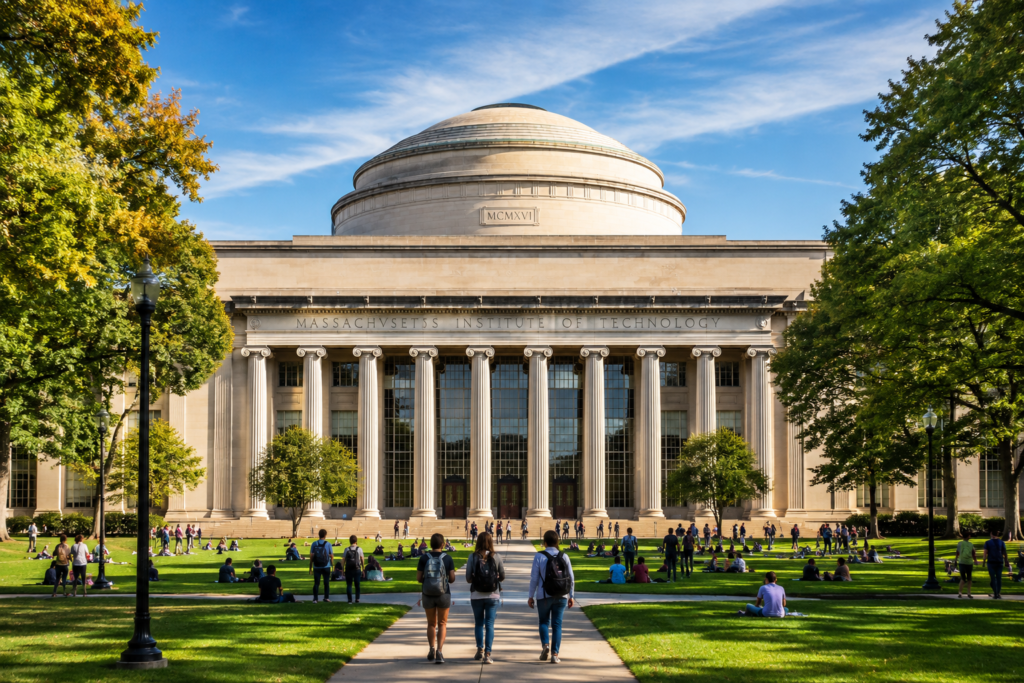
Introduction
The Massachusetts Institute of Technology (MIT) is widely recognized as one of the world’s most prestigious universities. Located in Cambridge, Massachusetts, just across the Charles River from Boston, MIT has spent more than 160 years shaping scientific discovery, technological innovation, and entrepreneurial leadership. Since its founding in 1861, the institute has built a reputation for combining rigorous academics with hands-on problem solving, a philosophy reflected in its famous motto, “Mens et Manus” (Mind and Hand).
MIT consistently attracts some of the brightest students, researchers, and faculty from around the world. Whether the goal is developing life-saving medical technologies, advancing artificial intelligence, exploring space, or creating sustainable energy solutions, MIT serves as a global hub for innovation.
For many prospective students, MIT represents more than just a university—it is a place where groundbreaking ideas become reality. Its graduates have founded influential companies, won prestigious awards, and made lasting contributions across science, engineering, business, economics, and public policy.
This guide explores everything you need to know about MIT, from its history and academic reputation to its campus, programs, rankings, and student experience.
MIT HIGLIGHT
| Feature | Details |
|---|---|
| University Type | Private Research University |
| Founded | 1861 |
| Campus | Cambridge, Massachusetts, USA |
| Motto | Mens et Manus (Mind and Hand) |
| Campus Size | Approximately 168 acres |
| Student Community | Undergraduate and graduate students from around the world |
| Primary Strengths | Engineering, Computer Science, AI, Science, Economics, Management |
| Research Focus | Technology, Innovation, Science, Entrepreneurship |
| Global Reputation | Among the world’s leading research universities |
History
MIT was founded in 1861 by geologist and educator William Barton Rogers, who envisioned an institution dedicated to scientific education and practical problem-solving. The first students enrolled in 1865, during a period of rapid industrial growth in the United States. Unlike many universities of its time, MIT emphasized laboratory work, engineering, and applied science alongside theoretical learning.
Throughout the twentieth century, MIT became a leader in technological innovation, making major contributions during World War II, the Space Race, and the rise of the digital age. Research conducted at MIT has influenced fields such as radar, computing, biotechnology, economics, artificial intelligence, and robotics.
Today, MIT continues to expand its influence through interdisciplinary collaboration, entrepreneurship, and partnerships with industry and governments worldwide.
Campus Overview
MIT’s campus is located along the Charles River in Cambridge, Massachusetts, providing easy access to Boston’s vibrant academic, cultural, and technology ecosystem. The campus combines historic architecture with modern research facilities, maker spaces, innovation centers, and student residences.
The institute is organized into five schools and one college:
- School of Engineering
- School of Science
- School of Humanities, Arts, and Social Sciences
- School of Architecture and Planning
- MIT Sloan School of Management
- MIT Schwarzman College of Computing
Campus Tour
Visitors often begin at Killian Court and the Great Dome before exploring the Infinite Corridor, one of MIT’s most recognizable architectural features. Other notable locations include the Stata Center, MIT Museum, athletics facilities, libraries, student innovation spaces, and research laboratories.
The campus also features public art installations, green spaces, and collaborative learning environments that encourage creativity and experimentation.
Campus Size
MIT occupies approximately 168 acres in Cambridge, Massachusetts. Although smaller than many large public universities, the campus is highly efficient, with academic buildings, research centers, residence halls, athletic facilities, and innovation hubs located within walking distance.
Campus Facilities
MIT offers world-class facilities that support education, research, and student life.
Academic Facilities
- Modern lecture halls
- Collaborative classrooms
- Digital learning spaces
- Department-specific laboratories
Research Infrastructure
- Artificial Intelligence labs
- Robotics facilities
- Nanotechnology centers
- Biotechnology research
- Aerospace laboratories
- Climate research initiatives
Student Amenities
- Residence halls
- Dining facilities
- Recreation centers
- Libraries
- Makerspaces
- Innovation hubs
MIT’s commitment to hands-on learning ensures students have access to advanced equipment and collaborative research environments.
Academic Reputation
MIT is internationally recognized for academic excellence across engineering, science, mathematics, economics, business, architecture, and technology. The institute is especially known for its research-intensive environment, interdisciplinary collaboration, and emphasis on solving real-world challenges.
Faculty members and alumni have earned numerous prestigious honors, including Nobel Prizes, Turing Awards, National Medals of Science, and MacArthur Fellowships. The university’s influence extends well beyond academia through startups, public policy, and technological innovation.
Global Rankings
MIT has maintained an exceptional position in international university rankings for many years.
| Ranking Organization | Recent Standing* |
|---|---|
| QS World University Rankings | Frequently ranked #1 globally |
| U.S. News Engineering | Among the top engineering programs |
| U.S. News Computer Science | Among the top programs |
| Times Higher Education | Consistently among global leaders |
Rankings Over Time
MIT has demonstrated remarkable consistency, remaining among the world’s highest-ranked universities for more than a decade, particularly in engineering, computer science, mathematics, and technology-related disciplines.
Accreditation
MIT is institutionally accredited by the New England Commission of Higher Education (NECHE). In addition, many professional degree programs hold specialized accreditation from organizations such as ABET, AACSB, the National Architectural Accrediting Board (NAAB), and others, depending on the discipline.
Programs Offered
MIT provides academic programs across science, engineering, management, architecture, humanities, social sciences, and computing.
| Level | Available |
|---|---|
| Undergraduate | Yes |
| Master’s | Yes |
| Doctoral | Yes |
| Professional Degrees | Yes |
| Executive Education | Yes |
| Online Learning | Limited (primarily through OpenCourseWare and professional education) |
Undergraduate Programs
All undergraduate degrees at MIT lead to the Bachelor of Science (SB) degree. Students complete a foundation of General Institute Requirements (GIRs) before specializing in their chosen major.
Popular undergraduate fields include:
- Computer Science
- Artificial Intelligence
- Electrical Engineering
- Mechanical Engineering
- Aerospace Engineering
- Civil Engineering
- Chemical Engineering
- Mathematics
- Physics
- Biology
- Economics
- Architecture
- Urban Studies
- Business Analytics (through related pathways)
- Humanities and Social Sciences
MIT encourages undergraduate research through programs such as the Undergraduate Research Opportunities Program (UROP), allowing students to work alongside faculty on cutting-edge projects.
Graduate Programs
MIT offers a wide range of master’s and professional degrees across its schools and departments. Graduate education emphasizes advanced coursework, independent research, and close collaboration with faculty. Popular options include Master of Science (SM), Master of Engineering (MEng), MBA, Master of Finance (MFin), and specialized professional degrees.
Admissions
Admission to the Massachusetts Institute of Technology (MIT) is among the most competitive in the world. The university evaluates applicants through a holistic review process, considering academic achievement, intellectual curiosity, leadership, initiative, creativity, and personal character.
Rather than focusing solely on grades or standardized test scores, MIT looks for students who have consistently challenged themselves academically and demonstrated a passion for learning both inside and outside the classroom.
For undergraduate applicants, the admissions process typically includes:
- Online application submission
- Academic transcripts
- Standardized testing (as required by the current admissions cycle)
- Teacher recommendations
- School counselor recommendation
- Personal essays
- Extracurricular achievements
- Interviews (when available)
Graduate admissions vary by department, with each program establishing its own academic and application requirements. Applicants should review the specific department before applying.
Undergraduate Admissions Snapshot
| Category | Information |
|---|---|
| Admission Type | Highly Selective |
| Review Process | Holistic |
| International Students | Welcome |
| Financial Need | Need-blind for undergraduate admissions |
| Financial Aid | Meets demonstrated financial need for admitted undergraduate students |
MIT admitted approximately 4.6% of first-year applicants for the Class of 2029, illustrating its highly selective admissions process.
Eligibility Requirements
Although there is no single profile that guarantees admission, competitive applicants generally demonstrate excellence across multiple areas.
Undergraduate Applicants
Students are encouraged to complete rigorous secondary school coursework, including:
- Advanced Mathematics
- Calculus (if available)
- Physics
- Chemistry
- Biology
- English
- History or Social Sciences
MIT values students who pursue challenging courses and consistently perform at a high academic level.
Graduate Applicants
Graduate candidates typically need:
- A bachelor’s degree (or equivalent)
- Strong academic performance
- Relevant research or professional experience (depending on the program)
- Department-specific prerequisites
- Competitive application materials
Many graduate programs also expect applicants to demonstrate research potential and clear academic goals.
Required Documents
Applicants should prepare the following documents before beginning the application process.
| Undergraduate | Graduate |
|---|---|
| Online Application | Department Application |
| Academic Transcripts | Academic Transcripts |
| School Report | Statement of Purpose |
| Teacher Recommendations | Letters of Recommendation |
| Essays | Resume or CV |
| Test Scores (if required) | Test Scores (where applicable) |
| English Proficiency (international applicants) | English Proficiency |
English Language Requirements
Since English is the primary language of instruction at MIT, applicants whose first language is not English may need to demonstrate English proficiency according to the requirements of the program to which they are applying.
Accepted English-language examinations commonly include:
- TOEFL iBT
- IELTS Academic
- Pearson Test of English (accepted by some programs)
Graduate departments may establish their own minimum score expectations, so applicants should always review departmental requirements before submitting an application.
Tuition Fees
MIT tuition changes annually after approval by the university.
For the 2025–2026 academic year, the estimated undergraduate cost of attendance before financial aid included:
| Expense | Estimated Cost (USD) |
|---|---|
| Tuition | $64,310 |
| Student Life Fee | $420 |
| Housing | $13,614 |
| Food | $7,650 |
| Books & Supplies | $910 |
| Personal Expenses | $2,436 |
| Estimated Total | $89,340 |
For 2026–2027, undergraduate tuition is listed as $33,360 per semester for full regular tuition (before other living costs and fees). These figures are reviewed annually and may change.
Graduate Tuition
Graduate tuition varies considerably depending on:
- Department
- Degree type
- Research funding
- Registration status
- Laboratory requirements
Professional master’s programs often have different tuition structures than research-based graduate programs.
Estimated Cost of Living
Living expenses depend on housing choices and personal lifestyle.
| Expense | Estimated Annual Cost |
|---|---|
| Housing | Included in Cost of Attendance Estimate |
| Food | Included in Cost of Attendance Estimate |
| Books | Varies |
| Transportation | Varies |
| Personal Expenses | Varies |
| Health Insurance | Additional, if applicable |
Students living in Cambridge or Boston should budget for:
- Public transportation
- Winter clothing
- Personal electronics
- Health insurance (where required)
- Recreation
- Travel expenses
International students should also consider:
- Visa expenses
- Flight costs
- Currency exchange fluctuations
Scholarships
One of MIT’s defining features is its commitment to affordability.
Unlike many universities, MIT does not award academic or athletic merit scholarships. Instead, undergraduate institutional aid is awarded solely on the basis of demonstrated financial need.
Financial Support Highlights
- Need-based MIT Scholarships
- Federal grants (eligible U.S. students)
- State grants (where applicable)
- Outside scholarships
- Employer-sponsored funding
- Private foundation scholarships
Beginning with the 2025–2026 academic year, students from families earning under $200,000 (with typical assets) generally qualify for tuition-free attendance, while families earning under $100,000 (with typical assets) are generally not expected to contribute toward educational costs.
Scholarship Overview
| Scholarship Type | Availability |
|---|---|
| MIT Scholarship | Need-Based |
| Merit Scholarship | Not Offered |
| Athletic Scholarship | Not Offered |
| External Scholarships | Accepted |
| Research Funding | Available for many graduate students |
Financial Aid
MIT is one of the few universities that combines need-blind undergraduate admissions with a commitment to meeting 100% of demonstrated financial need for admitted students.
Financial aid packages may include:
- MIT Scholarships
- Grants
- Student employment
- Optional student loans
According to MIT, many graduates complete their education without student loan debt, and the Institute continues to invest significant endowment resources in undergraduate financial aid.
Student Housing
MIT offers a variety of residential options designed to support academic success and community engagement.
Undergraduate Housing
First-year undergraduate students generally live in campus residence halls, where they become part of vibrant residential communities. Residence halls differ in culture, traditions, architecture, and student activities.
Housing features often include:
- Furnished rooms
- Dining access
- Study lounges
- Music rooms
- Fitness facilities
- Community kitchens
- High-speed internet
Graduate Housing
Graduate students may choose from:
- Graduate residence halls
- Apartments
- Family housing
- Off-campus accommodation in Cambridge or Boston
Demand for housing can be high, so early application is recommended.
Housing Comparison
| Housing Type | Best For |
|---|---|
| Undergraduate Residence Hall | First-year and undergraduate students |
| Graduate Residence | Master’s and PhD students |
| Family Housing | Married students and families |
| Off-Campus Housing | Students seeking independent living |
Libraries
MIT’s library system is considered one of the strongest academic library networks in the world.
Students have access to:
- Millions of books
- Research journals
- Digital archives
- Government publications
- Historical collections
- Data repositories
- Specialized engineering resources
Library services also include:
- Research consultations
- Data management support
- Digital scholarship assistance
- Citation guidance
- Open-access publishing resources
These resources support coursework, interdisciplinary research, and innovation across every academic discipline.
Laboratories
Hands-on learning is central to the MIT experience. Students and researchers work in advanced laboratories across fields such as engineering, computing, life sciences, materials science, energy, and robotics.
Examples of laboratory areas include:
- Artificial Intelligence
- Robotics
- Aerospace
- Biomedical Engineering
- Materials Science
- Nanotechnology
- Quantum Computing
- Environmental Engineering
Many undergraduates participate in laboratory research early through the Undergraduate Research Opportunities Program (UROP), while graduate students often contribute to large-scale, externally funded research projects.
Research Centers
One of MIT’s defining strengths is its extensive network of interdisciplinary research centers and laboratories. These centers bring together experts from engineering, science, medicine, economics, architecture, business, and public policy to solve some of the world’s most pressing challenges.
MIT researchers collaborate with governments, hospitals, startups, multinational corporations, and nonprofit organizations across the globe. This collaborative environment allows students to contribute to meaningful research from the beginning of their academic journey.
Major Research Areas
- Artificial Intelligence
- Machine Learning
- Robotics
- Quantum Computing
- Climate Science
- Sustainable Energy
- Biotechnology
- Aerospace Engineering
- Materials Science
- Nanotechnology
- Economics
- Urban Planning
- Cybersecurity
- Data Science
- Space Exploration
Many research projects receive funding from organizations such as the U.S. National Science Foundation (NSF), the National Institutes of Health (NIH), NASA, the U.S. Department of Energy, and private industry partners.
Selected MIT Research Centers
| Research Center | Primary Focus |
|---|---|
| Computer Science and Artificial Intelligence Laboratory (CSAIL) | AI, Robotics, Computer Systems |
| MIT Media Lab | Human-Computer Interaction, Design, Digital Technologies |
| Koch Institute for Integrative Cancer Research | Cancer Biology and Biomedical Innovation |
| Plasma Science and Fusion Center | Fusion Energy and Plasma Research |
| MIT Energy Initiative (MITEI) | Clean Energy and Sustainability |
| Institute for Data, Systems, and Society (IDSS) | Data Science, Statistics, Public Policy |
Students often have opportunities to participate in research through faculty-led projects, internships, and independent study programs.
Innovation and Entrepreneurship
MIT is internationally recognized as one of the world’s leading centers for innovation and entrepreneurship. Rather than focusing only on classroom instruction, the university encourages students to transform ideas into real-world solutions.
Innovation is deeply integrated into the MIT culture. Students are encouraged to design products, build prototypes, launch startups, and collaborate with researchers across disciplines.
Entrepreneurial Ecosystem
MIT provides numerous resources for aspiring entrepreneurs, including:
- Startup accelerators
- Business competitions
- Innovation grants
- Mentorship programs
- Venture capital networking
- Technology licensing support
- Entrepreneurship courses
The university’s entrepreneurial ecosystem has helped launch thousands of companies worldwide. MIT alumni have founded or co-founded globally recognized organizations in technology, biotechnology, manufacturing, finance, and software.
Why MIT Excels in Innovation
- Strong collaboration between engineering and business
- Access to world-class laboratories
- Extensive alumni network
- Industry partnerships
- Culture of experimentation
- High levels of research funding
Students interested in launching startups often benefit from mentorship provided by experienced entrepreneurs, investors, and faculty members.
Faculty
MIT’s faculty includes internationally recognized researchers, scientists, engineers, economists, architects, and business leaders. Many professors are pioneers in their respective fields and continue to contribute to groundbreaking discoveries.
Faculty members are known for maintaining close relationships with students, particularly through research supervision and project-based learning.
Faculty Highlights
- Nobel Prize winners
- Turing Award recipients
- National Medal of Science recipients
- MacArthur Fellows
- Members of the National Academies
- Distinguished inventors and entrepreneurs
Students frequently work alongside faculty on:
- Scientific research
- Engineering projects
- Artificial intelligence development
- Biomedical innovations
- Climate solutions
- Public policy research
This close collaboration is considered one of MIT’s greatest academic strengths.
Student Life
Life at MIT extends well beyond academics. Although the curriculum is rigorous, students actively participate in cultural events, clubs, entrepreneurship competitions, athletic programs, volunteer organizations, and research initiatives.
The campus community values creativity, diversity, collaboration, and intellectual curiosity.
Students often describe MIT as:
- Challenging
- Collaborative
- Innovative
- Inclusive
- Research-driven
- Highly motivated
Throughout the academic year, students participate in:
- Orientation events
- Cultural festivals
- Career fairs
- Hackathons
- Research symposiums
- Innovation competitions
- Guest lectures
- Music and theater performances
The university also supports student wellness through counseling services, health programs, recreation facilities, and peer support initiatives.
Student Organizations and Clubs
MIT has 500+ student organizations, offering opportunities for leadership, creativity, community service, and professional development.
Popular categories include:
Academic Clubs
- Artificial Intelligence
- Robotics
- Programming
- Mathematics
- Physics
- Engineering Design
Professional Organizations
- Women in Engineering
- Entrepreneurship Clubs
- Finance Organizations
- Consulting Groups
- Data Science Communities
Cultural Organizations
- Asian student associations
- African student organizations
- Latin American organizations
- European cultural groups
- International student associations
Creative Organizations
- Music ensembles
- Theater productions
- Dance groups
- Photography clubs
- Film societies
Community Service
Students regularly participate in:
- STEM outreach
- Environmental initiatives
- Tutoring programs
- Community volunteering
- Global development projects
These activities help students build leadership skills while creating lifelong friendships.
Sports and Recreation
MIT offers a wide variety of recreational and competitive athletic opportunities.
Varsity Sports
MIT competes in NCAA Division III athletics and fields teams in sports such as:
- Basketball
- Soccer
- Swimming
- Tennis
- Track and Field
- Volleyball
- Rowing
- Baseball
- Softball
- Cross Country
Recreation
Students also enjoy:
- Fitness centers
- Indoor pools
- Climbing walls
- Sailing
- Martial arts
- Yoga
- Group fitness classes
- Running clubs
Participation in sports promotes physical wellness and provides a healthy balance to academic life.
Diversity and Inclusion
MIT is committed to creating an inclusive academic environment where students from different backgrounds can thrive.
The university welcomes students from:
- More than 100 countries
- Diverse cultural backgrounds
- Various academic disciplines
- Different socioeconomic communities
MIT supports diversity through:
- Cultural centers
- Mentorship programs
- Inclusion initiatives
- Accessibility services
- Student support networks
- Equity-focused educational programs
This global learning environment encourages students to collaborate across cultures and perspectives.
International Students
International students are an important part of the MIT community.
Students from around the world choose MIT because of its:
- Global reputation
- Research opportunities
- World-class faculty
- Innovation ecosystem
- Strong graduate outcomes
Services for International Students
MIT provides support with:
- Immigration guidance
- Visa documentation
- Orientation programs
- Cultural adjustment
- Employment regulations
- International student advising
International students also participate in language exchange programs, cultural celebrations, and global networking events throughout the year.
Internship Opportunities
MIT students gain practical experience through internships with leading organizations across multiple industries.
Popular internship sectors include:
- Technology
- Aerospace
- Biotechnology
- Artificial Intelligence
- Finance
- Consulting
- Manufacturing
- Healthcare
- Renewable Energy
- Government Research
Students often secure internships at internationally recognized companies, research institutions, startups, and government laboratories.
Internships help students:
- Apply classroom knowledge
- Build professional networks
- Develop technical skills
- Explore career interests
- Improve employment opportunities after graduation
Career Services
MIT offers comprehensive career support throughout a student’s academic journey.
Career services typically include:
- Career counseling
- Resume reviews
- Mock interviews
- Internship assistance
- Employer networking
- Career fairs
- Graduate school advising
- Salary negotiation workshops
Thousands of employers recruit MIT students each year because of the university’s reputation for producing highly skilled graduates.
Career advisors also help students identify long-term professional goals and prepare for leadership positions across industries.
Graduate Outcomes
MIT graduates are among the most sought-after professionals worldwide. Many receive job offers before graduation, while others continue into doctoral programs or launch startups. Graduates work in industries such as artificial intelligence, aerospace, biotechnology, finance, consulting, software engineering, healthcare, renewable energy, and public policy. Major employers include Google, Microsoft, Apple, Amazon, NVIDIA, Tesla, NASA, SpaceX, McKinsey & Company, and leading research institutions. Graduate employment outcomes vary by program and economic conditions, so applicants should consult the latest career reports.
Alumni
MIT has one of the world’s most influential alumni networks, with graduates making significant contributions to science, engineering, medicine, business, economics, architecture, and public service. The alumni community spans more than 140 countries, providing students with valuable networking, mentorship, and career opportunities.
Famous Alumni
Some notable MIT alumni include:
- Kofi Annan – Former Secretary-General of the United Nations
- Buzz Aldrin – Apollo 11 Astronaut
- Amar Bose – Founder of Bose Corporation
- Richard Feynman – Nobel Prize-winning Physicist
- I. M. Pei – World-renowned Architect
- Ben Bernanke – Former Chair of the U.S. Federal Reserve
- Drew Houston – Co-founder and CEO of Dropbox
These individuals represent only a small portion of MIT’s accomplished alumni community.
Why Choose MIT?
MIT is consistently recognized as one of the world’s premier universities because it combines academic excellence with practical innovation.
Top Reasons
- World-leading STEM education
- Exceptional research opportunities
- Outstanding faculty
- Strong industry partnerships
- Global reputation
- Entrepreneurial ecosystem
- Extensive alumni network
- Excellent career outcomes
- Modern laboratories
- Diverse international community
Students who enjoy solving complex problems, conducting research, and developing innovative technologies often find MIT to be an ideal academic environment.
Best Programs
MIT is especially renowned for:
| Discipline | Global Reputation |
|---|---|
| Computer Science | Outstanding |
| Artificial Intelligence | Outstanding |
| Electrical Engineering | Outstanding |
| Mechanical Engineering | Outstanding |
| Aerospace Engineering | Outstanding |
| Mathematics | Outstanding |
| Physics | Outstanding |
| Economics | Outstanding |
| Business (MIT Sloan) | Excellent |
| Data Science | Excellent |
Pros and Cons
| Pros | Cons |
| World-class education | Extremely competitive admissions |
| Outstanding faculty | Heavy academic workload |
| Cutting-edge research | High cost without financial aid |
| Excellent employment outcomes | Fast-paced learning environment |
| Strong startup ecosystem | Academic pressure can be intense |
MIT vs. Stanford vs. Harvard vs. Oxford
| University | Best Known For | Campus Style | Research Focus |
| MIT | Engineering, AI, Technology | Urban | STEM and Innovation |
| Stanford | Entrepreneurship, Computer Science | Suburban | Technology and Business |
| Harvard | Medicine, Law, Business | Urban | Broad Academic Excellence |
| Oxford | Humanities, Social Sciences, Research | Historic Collegiate | Traditional Research |
Rather than one institution being universally “better,” each university has distinct strengths. MIT is particularly attractive for students seeking intensive STEM education and innovation.
Nearby Attractions
Students can explore many attractions around Cambridge and Boston, including:
- MIT Museum
- Harvard Square
- Boston Common
- Freedom Trail
- Charles River
- Museum of Science
- New England Aquarium
- Fenway Park
- Boston Public Library
These destinations provide opportunities for recreation, learning, and cultural experiences.
Transportation
MIT is well connected through Boston’s public transportation system.
Students commonly use:
- MBTA Subway
- Public buses
- Commuter rail
- Cycling paths
- Walking routes
- Ride-sharing services
Boston Logan International Airport is also conveniently accessible for domestic and international travel.
Campus Safety
MIT maintains a dedicated campus police department and offers various safety resources, including:
- 24-hour emergency response
- Emergency call stations
- Campus escort services
- Safety awareness programs
- Emergency notification systems
Students are encouraged to remain aware of their surroundings and follow university safety guidelines.
Student Reviews (Summary)
Common themes from student experiences include:
Positive Feedback
- Exceptional professors
- Outstanding research opportunities
- Collaborative student culture
- Strong internship prospects
- Global reputation
- Modern laboratories
Challenges
- Rigorous coursework
- Competitive academic environment
- Time management demands
- Cost of living in Cambridge
Overall, students frequently describe MIT as intellectually rewarding and highly transformative.
Application Tips
- Take the most challenging courses available.
- Maintain excellent academic performance.
- Demonstrate genuine curiosity beyond the classroom.
- Participate in meaningful extracurricular activities.
- Gain research or project experience where possible.
- Write authentic and thoughtful application essays.
- Request strong recommendation letters.
- Submit all required documents before deadlines.
Common Mistakes Applicants Make
- Focusing only on grades.
- Ignoring essay quality.
- Waiting until the deadline.
- Submitting incomplete applications.
- Overlooking program-specific requirements.
- Not researching financial aid options.
- Writing generic personal statements.
- Failing to proofread application materials.
Frequently Asked Questions
1. Is MIT a private university?
Yes, MIT is a private research university.
2. Where is MIT located?
Cambridge, Massachusetts, USA.
3. Is MIT difficult to get into?
Yes. Admission is highly competitive.
4. Does MIT accept international students?
Yes.
5. Is financial aid available?
Yes, primarily based on demonstrated financial need.
6. Does MIT offer scholarships?
Institutional aid is need-based rather than merit-based.
7. Which programs is MIT famous for?
Engineering, Computer Science, AI, Mathematics, Physics, and Economics.
8. Does MIT have student housing?
Yes.
9. Can undergraduates participate in research?
Yes, through programs such as UROP.
10. Does MIT have sports teams?
Yes, including NCAA Division III athletics.
Official Resources
- Official MIT Website: https://www.mit.edu
- Undergraduate Admissions: https://mitadmissions.org
- Academics: https://catalog.mit.edu
- Financial Aid: https://sfs.mit.edu
- Undergraduate Tuition: https://facts.mit.edu
Internal Link Ideas
- MIT Acceptance Rate
- MIT Admissions Guide
- MIT Scholarships
- MIT Tuition Fees
- MIT Campus Life
- Best MIT Majors
- MIT Computer Science Program
- MIT Engineering Programs
- MIT International Students Guide
- MIT Student Housing
CONCLUSION
The Massachusetts Institute of Technology remains one of the world’s most respected institutions for science, engineering, technology, and innovation. Its combination of rigorous academics, groundbreaking research, entrepreneurial culture, and outstanding career outcomes makes it an excellent choice for students who are passionate about solving complex global challenges.
Although admission is exceptionally competitive and the academic workload is demanding, MIT rewards motivated students with access to world-class faculty, cutting-edge facilities, extensive research opportunities, and an influential global alumni network. For aspiring engineers, scientists, entrepreneurs, and innovators, MIT continues to set the global standard for excellence in higher education.