Top Universities in South Korea for International Students 2027: Rankings, Fees, GKS Scholarship & How to Apply

QS 2027 ranks, tuition fees, GKS scholarship, D-2 visa and deadlines — verified from official sources, for students from every country.
By Rohit Gupta
Last updated: 7 November 2026
South Korea is now one of the most popular study destinations for international students — and it is easy to see why. Its universities rank among the best in Asia, tuition is lower than in the USA or the UK, and the Korean government’s Global Korea Scholarship (GKS) pays for almost everything — tuition, living costs, flights and a year of Korean language training. In 2024, 208,962 international students were studying in South Korea — the highest number in 25 years — and the government’s Study Korea 300K Project aims to attract 300,000 international students by 2027 [31].
Four Korean universities sit inside the world’s top 100 in the QS World University Rankings 2027: Seoul National University (38), Yonsei University (42), Korea University (52) and KAIST (65) [1][2]. And here is the number that matters most for your budget: the average bachelor’s tuition in Korea is about ₩6,820,000 a year (about $4,995) — ₩4,270,000 a year at national and public universities and ₩7,630,000 a year at private ones [5].
But I need to be honest with you before you read further. The GKS undergraduate embassy-track window for 2027 closed on 30 September 2026 [11]. If you are reading this in November, you cannot apply for it anymore. What you can still do is apply directly to the universities for the September 2027 intake, and apply for the GKS graduate cycle when it opens around February 2027 [29]. This directory shows you both routes. One warning before the K-drama in your head takes over: Korean universities do not run on K-drama logic — the deadlines are real, the paperwork is real, and so is the 1,000-won cafeteria meal.
Key points
- Top-ranked: Seoul National University is #38 in the world (QS 2027), followed by Yonsei at #42 and Korea University at #52 [1].
- 43 Korean universities appear in the QS World University Rankings 2027 [1].
- 208,962 international students were studying in South Korea in 2024 — the highest in 25 years [31].
- Tuition: national universities charge about ₩4,270,000 a year; private universities about ₩7,630,000 a year [5]. SNU humanities tuition is ₩2,442,000 a semester [12].
- GKS scholarship: pays tuition (up to ₩5,000,000 a semester), about ₩1,200,000 a month allowance in the degree years, 1 year of Korean language training and a return airfare [11][28].
- GKS-U 2027: 286 places worldwide (156 embassy track + 130 university track); quotas are set per country — check your country’s quota in the NIIED guidelines [29][30]. The embassy track closed on 30 September 2026. The graduate cycle (GKS-G) opens around February 2027 [29].
- Intakes: the academic year starts in March (main intake), with a smaller September intake [9].
- Visa: the D-2 student visa needs proof of ₩20,000,000 and a TB test if you are from one of Korea’s 35 high-TB-burden countries [10][41].
| 12 universities | ₩4,270,000 a year | 208,962 international students |
|---|---|---|
| In this directory, ranked by QS 2027 [1] | Average bachelor’s tuition at national/public universities [5] | Studying in South Korea in 2024 — the highest in 25 years [31] |
Table of Contents
Why This Matters for International Students
South Korea matters for international students for three reasons. First, the price: a year at a national university costs about ₩4,270,000 (about $3,124) in tuition [5] — less than a single semester at most American private universities. Second, the quality: four universities in the world’s top 100, and six inside the top 110 [1]. Third, the scholarship: GKS is one of the most generous government scholarships in the world, and it invites students from countries all over the world — 74 countries on the embassy track alone in 2027 [30].
There is also a practical reason. Many degree programmes, especially in science, engineering and business, are taught fully in English [11]. You do not need Korean to apply, and GKS includes a year of Korean language training before your degree starts [11]. And Korea is safe, fast-moving and modern — Seoul’s subway, food and internet are among the best in the world. The growth is real, too: international student numbers hit 208,962 in 2024, up 25% from 2022, and the government wants 300,000 by 2027 [31]. You would not be an oddity on campus — you would be part of the plan.
But the honest warning stands: the March 2027 intake windows at most top universities have already closed by November 2026 [9]. If you are starting now, your realistic targets are the September 2027 intake and the GKS graduate cycle in February 2027. Do not waste weeks preparing an application for a window that has already shut.
Note: this is a directory, not a ranking of “best for you”. The right university depends on your subject, your budget and whether you want a Korean-taught or English-taught programme. A student who wants computer science and a student who wants business should read this list very differently.
GKS Is Not the Only Way In: Don’t Mix Them Up
This is the single most-mixed-up point about studying in South Korea, so let me say it twice: the GKS is one way in, not the only way in — and the GKS undergraduate embassy-track window for 2027 has already closed.
Important: many international students believe they must win GKS to study in Korea. That is wrong. You can apply directly to any Korean university, pay tuition yourself, and still study in Korea. At a national university, that tuition is about ₩4,270,000 a year [5] — affordable for many families without any scholarship. And at KAIST and POSTECH, tuition is waived for most admitted students through institutional scholarships [6].
| Route | Who it suits | What it pays | 2027 status |
|---|---|---|---|
| GKS undergraduate (embassy track) | Under 25, citizen of a GKS-eligible country (you and both parents non-Korean), 80% marks or top 20% [11] | Full tuition, about ₩1,200,000 a month, language year, airfare [11] | Closed 30 September 2026 [11] |
| GKS graduate (embassy track) | Under 40, bachelor’s for Master’s / master’s for PhD [11] | Full tuition, allowance, language year, airfare [11] | Opens around February 2027 [29] |
| Direct application (self-funded) | Anyone who meets the university’s requirements | You pay tuition; national universities about ₩4,270,000 a year [5] | September 2027 intake opens spring 2027 [9] |
| University scholarships (KAIST, POSTECH, SNU and others) | Admitted students | Tuition waiver or full tuition plus stipend [6][12] | Apply with your admission application |
Pro tip: if you want GKS, mark February 2027 in your calendar now — that is when the graduate cycle opens. If you want to start in September 2027 without GKS, shortlist your universities now and watch for their application windows opening in spring 2027.
The Directory: Top 12 Universities in South Korea for International Students
The table below is the whole directory at a glance. Ranks are from the QS World University Rankings 2027, published on 18 June 2026 [1][2]. South Korea placed 43 universities on the QS 2027 rankings — more than any other Asian country except China, India and Japan [4]. In the THE World University Rankings 2027, SNU is #56, KAIST #64 and SKKU #68 [14]. Tuition figures are per semester for 2026, from the universities’ own fee schedules as checked by the guides I cite; they vary by subject, and the first semester is often higher because of admission and one-time charges.
| QS 2027 rank | University | Location | Best known for | Tuition a semester (2026) |
|---|---|---|---|---|
| #38 | Seoul National University (SNU) | Seoul | All subjects; Korea’s top university | Humanities ₩2,442,000; Engineering ₩2,998,000 [12] |
| #42 | Yonsei University | Seoul | Business, Medicine, Engineering, International Studies | Humanities ₩4,556,000; Engineering ₩6,004,000 [5] |
| #52 | Korea University | Seoul | Business, Law, Engineering, Economics | Humanities ~₩5,800,000; Engineering ~₩7,700,000 [5] |
| #65 | KAIST | Daejeon | Science, Engineering, Computer Science, AI | ₩3,370,000 on paper — waived for most students [6] |
| #106 | POSTECH | Pohang | Science, Engineering, Materials Science | ~₩2,790,000 — waived for International Admissions students [3] |
| #108 | Sungkyunkwan University (SKKU) | Seoul/Suwon | Engineering, Medicine, Business | Private range ₩4,000,000–₩7,000,000 [6] |
| #155 | Hanyang University | Seoul/Ansan | Engineering, Architecture, Design, Business | ₩5,279,000–₩7,820,000 [3] |
| #299 | UNIST | Ulsan | Energy, Materials Science, Engineering | National range ₩2,000,000–₩5,000,000 [6] |
| #309 | Kyung Hee University | Seoul/Yongin | Medicine, Hospitality, International Studies | ₩4,977,400–₩6,718,400 [3] |
| #379 | GIST | Gwangju | Science, Engineering, AI | Private range ₩4,000,000–₩7,000,000 [6] |
| #432 | Chung-Ang University | Seoul | Business, Medicine, Media, Arts | Private range ₩4,000,000–₩7,000,000 [6] |
| #488 | Ewha Womans University | Seoul | All subjects (women’s university) | ₩4,640,000–₩6,430,000 [3] |
Also in the QS 2027 table: Sogang University (#494) [3][25]. The figures marked [6] are typical ranges for that university type, not figures published for that exact university — the guide says so plainly, and you should confirm the exact fee on the university’s fees page. [RESEARCH GAP: Requires manual lookup of Sogang University official site — sogang.ac.kr returned no response to automated checks]
The table below compares the top universities in South Korea for international students 2027 on the measures that matter for your choice. QS 2027 ranks and the tuition figures are verified from my sources [1][3][5][12]. The three metrics my draft does not state — acceptance rate, researcher-to-faculty ratio and publication volume — are covered by one combined [RESEARCH GAP] tag per row, in the acceptance-rate column; the other two cells show — rather than an estimate.
| University | QS 2027 rank | Tuition a semester (2026) | Acceptance rate | Researcher-to-faculty ratio | Publication volume |
|---|---|---|---|---|---|
| Seoul National University (SNU) | #38 [1] | Humanities ₩2,442,000; Engineering ₩2,998,000 [12] | [RESEARCH GAP: Requires manual lookup of acceptance rate, researcher-to-faculty ratio and publication volume for Seoul National University] | — | — |
| Yonsei University | #42 [1] | Humanities ₩4,556,000; Engineering ₩6,004,000 [5] | [RESEARCH GAP: Requires manual lookup of acceptance rate, researcher-to-faculty ratio and publication volume for Yonsei University] | — | — |
| Korea University | #52 [1] | Humanities ~₩5,800,000; Engineering ~₩7,700,000 [5] | [RESEARCH GAP: Requires manual lookup of acceptance rate, researcher-to-faculty ratio and publication volume for Korea University] | — | — |
| KAIST | #65 [1] | ₩3,370,000 on paper — waived for most students [6] | [RESEARCH GAP: Requires manual lookup of acceptance rate, researcher-to-faculty ratio and publication volume for KAIST] | — | — |
| POSTECH | #106 [1] | ~₩2,790,000 — waived for International Admissions students [3] | [RESEARCH GAP: Requires manual lookup of acceptance rate, researcher-to-faculty ratio and publication volume for POSTECH] | — | — |
| Sungkyunkwan University (SKKU) | #108 [1] | Private range ₩4,000,000–₩7,000,000 [6] [RESEARCH GAP: Requires manual lookup of exact tuition for Sungkyunkwan University] | [RESEARCH GAP: Requires manual lookup of acceptance rate, researcher-to-faculty ratio and publication volume for Sungkyunkwan University] | — | — |
| Hanyang University | #155 [1] | ₩5,279,000–₩7,820,000 [3] | [RESEARCH GAP: Requires manual lookup of acceptance rate, researcher-to-faculty ratio and publication volume for Hanyang University] | — | — |
| UNIST | #299 [1] | National range ₩2,000,000–₩5,000,000 [6] [RESEARCH GAP: Requires manual lookup of exact tuition for UNIST] | [RESEARCH GAP: Requires manual lookup of acceptance rate, researcher-to-faculty ratio and publication volume for UNIST] | — | — |
| Kyung Hee University | #309 [1] | ₩4,977,400–₩6,718,400 [3] | [RESEARCH GAP: Requires manual lookup of acceptance rate, researcher-to-faculty ratio and publication volume for Kyung Hee University] | — | — |
| GIST | #379 [1] | Private range ₩4,000,000–₩7,000,000 [6] [RESEARCH GAP: Requires manual lookup of exact tuition for GIST] | [RESEARCH GAP: Requires manual lookup of acceptance rate, researcher-to-faculty ratio and publication volume for GIST] | — | — |
| Chung-Ang University | #432 [1] | Private range ₩4,000,000–₩7,000,000 [6] [RESEARCH GAP: Requires manual lookup of exact tuition for Chung-Ang University] | [RESEARCH GAP: Requires manual lookup of acceptance rate, researcher-to-faculty ratio and publication volume for Chung-Ang University] | — | — |
| Ewha Womans University | #488 [1] | ₩4,640,000–₩6,430,000 [3] | [RESEARCH GAP: Requires manual lookup of acceptance rate, researcher-to-faculty ratio and publication volume for Ewha Womans University] | — | — |
QS 2027 Ranks at a Glance — the Chart
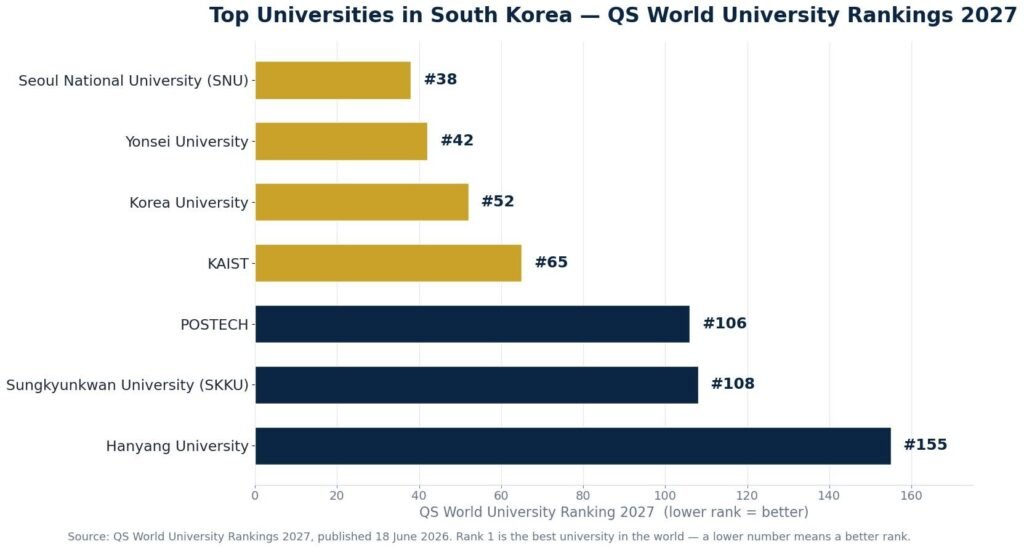
Let me explain this chart, because it tells you the whole story in one picture. The chart shows the QS World University Rankings 2027 for the top 7 universities in South Korea. The bar length is the rank number — and here is the important part: a LOWER rank is BETTER. Rank 1 is the best university in the world. So the SHORTEST bar is the best university. Seoul National University (SNU) leads at #38 — the shortest bar, and the best-ranked university in Korea. Yonsei follows at #42, then Korea University at #52, then KAIST at #65. These four are all inside the world’s top 100 — that is why I have highlighted them in gold.
Below them, POSTECH at #106, Sungkyunkwan (SKKU) at #108, and Hanyang at #155 are still strong universities, but the gap is visible: Hanyang’s bar is about four times as long as SNU’s, which means its rank number is about four times higher. What does this mean for you? If rank is your top priority, SNU, Yonsei, Korea University and KAIST are the four names to chase. But rank is not everything — KAIST and POSTECH waive tuition for most admitted students, which no top-100 ranking captures. So use this chart to shortlist, then check the fees and the scholarships in the sections below before you decide.
1. Seoul National University (SNU) — QS #38
Top courses & departments: All subjects — Engineering, Natural Sciences, Business, Economics, Medicine, Law, Humanities, Social Sciences.
Key facilities: the Gwanak main campus in southern Seoul, the Yeongeon medical campus, Seoul National University Hospital, the SNU Central Library [15].
Eligibility & entrance: international admissions (Track I: you and both parents non-Korean; Track II: schooling history decides). Language: TOPIK Level 3, or TOEFL iBT 80, or IELTS 6.0 [12]. Application fee ₩70,000 (undergraduate) or ₩90,000 (graduate) [12].
Fee summary: undergraduate tuition (2026 figures): humanities ₩2,442,000 a semester, engineering ₩2,998,000, fine arts ₩3,653,000, medicine ₩5,038,000 [12]. Humanities tuition is ₩4,884,000 a year [12]. SNU charges international students the same tuition as everyone else — there is no higher “foreigner rate” [12].
Placement glance: SNU is Korea’s top university and its graduates are recruited by Samsung, Hyundai, LG and Korea’s biggest firms, as well as by global employers. Exact programme-wise placement figures were not verified for this guide.
Aid: GKS plus SNU’s own awards — the Graduate Scholarship for Excellent Foreign Students (GSFS, full tuition up to 4 semesters plus a stipend from ₩500,000 a month), the SNU President Fellowship (full tuition up to 6 semesters, living stipend, airfare, health insurance) and the Glo-Harmony Scholarship for undergraduates from developing countries [12].
Read Full Details → Our Korea GKS guide, which covers SNU and the scholarship in detail. Our own deep-dive SNU guide is drafted and will be linked here when it is published.
2. Yonsei University — QS #42
Top courses & departments: Business, Medicine, Engineering, Social Sciences, International Studies (Underwood International College — fully English-taught).
Key facilities: the Sinchon campus in Seoul, Severance Hospital (one of Korea’s biggest hospitals), the Yonsei University Library [16].
Eligibility & entrance: international track applications for March 2027 ran 1–17 September 2026, with results on 4 December 2026 [9]. No TOPIK needed for English-taught programmes; Korean-taught programmes need TOPIK Level 3 [9].
Fee summary: international freshmen spend their first year in the Global Basic Education Division: first year ₩14,562,000 (about $10,665) [5]. From year two: humanities ₩4,556,000 a semester, engineering ₩6,004,000 a semester [5]. Underwood International College: ₩8,202,000 a semester [5].
Placement glance: Yonsei graduates are recruited by Korea’s biggest firms and by global employers in Seoul. Its business school and medical school are among the most respected in Asia.
Aid: GKS plus Yonsei’s own international scholarships, awarded on admission. Check the admissions page for the current list.
Read Full Details → Yonsei’s official site.
3. Korea University — QS #52
Top courses & departments: Business, Economics, Engineering, Law, Computer Science, Medicine, International Studies.
Key facilities: the Anam campus in Seoul, Korea University Anam Hospital, Korea University Business School [17].
Eligibility & entrance: international applications for March 2027 ran 3–31 August 2026, with supporting documents until 7 September and results on 27 November 2026 [9]. No TOPIK needed for English-taught programmes.
Fee summary: humanities about ₩5,800,000 a semester, natural sciences about ₩6,700,000, engineering about ₩7,700,000 [5]. Korea University had the highest average first-semester tuition for international students among Korean universities, at ₩7,300,000, in an analysis of the 2027 admissions guidelines [7].
Placement glance: Korea University graduates are recruited by Korea’s biggest firms; its business school is one of the most respected in Asia.
Aid: GKS plus Korea University’s own international scholarships. Check the admissions page for the current list.
Read Full Details → Korea University’s official site.
4. KAIST — QS #65
Top courses & departments: Computer Science, AI, Robotics, Electrical Engineering, Mechanical Engineering, Aerospace Engineering, Physics, Chemistry, Business.
Key facilities: the main campus in Daejeon, the KAIST Institutes (research centres), the KAIST AI graduate school [18].
Eligibility & entrance: KAIST’s early bachelor’s round for March or September 2027 ran 22 September–22 October 2026, with results on 7 January 2027 [9]. All courses are taught in English. Application fee $80 for bachelor’s [8].
Fee summary: KAIST charges ₩3,370,000 a semester on paper but covers it through institutional scholarships for virtually all students [6]. Master’s and PhD (Electrical Engineering): standard ₩9,559,000 a semester; KAIST scholars pay ₩750,000 [5].
Placement glance: KAIST graduates are recruited by Samsung, Hyundai, LG and global tech firms, and many go on to PhDs at top US universities.
Aid: KAIST scholarships cover tuition for most admitted students, plus a monthly stipend. GKS also applies.
Read Full Details → KAIST’s official site.
5. POSTECH — QS #106
Top courses & departments: Materials Science, Physics, Chemistry, Mechanical Engineering, Electrical Engineering, Computer Science, Life Sciences.
Key facilities: the Pohang Accelerator Laboratory (PAL), the POSTECH campus in Pohang [19].
Eligibility & entrance: international applications for March 2027 ran 25 August–2 September 2026 [9]. All courses are taught in English. POSTECH is small and research-focused — competition is intense.
Fee summary: undergraduate tuition about ₩2,790,000 a semester, fully waived for International Admissions students [3].
Placement glance: POSTECH graduates go into research, semiconductors, materials and tech — Pohang is home to POSCO, one of the world’s biggest steelmakers.
Aid: tuition waiver for International Admissions students, plus stipends. GKS also applies.
Read Full Details → POSTECH’s official site.
6. Sungkyunkwan University (SKKU) — QS #108
Top courses & departments: Engineering, Medicine, Business, Natural Sciences, Humanities, Social Sciences.
Key facilities: the Humanities and Social Sciences Campus in Seoul and the Natural Sciences Campus in Suwon; Samsung’s long partnership with the university [20].
Eligibility & entrance: international applications for March 2027 ran 12–21 August 2026 (first round) [9]. English-taught programmes available in engineering, business and natural sciences.
Fee summary: private university range of about ₩4,000,000–₩7,000,000 a semester [6] — confirm the exact figure for your course on SKKU’s fees page.
Placement glance: SKKU graduates are recruited by Samsung and Korea’s biggest firms; the Samsung partnership gives its engineering students a direct route into industry.
Aid: GKS plus SKKU’s own international scholarships, including tuition waivers for strong applicants.
Read Full Details → SKKU’s official site.
7. Hanyang University — QS #155
Top courses & departments: Engineering, Architecture, Design, Business, Computer Science, Medicine.
Key facilities: the Seoul campus and the ERICA campus in Ansan; Hanyang University Hospital [21].
Eligibility & entrance: direct application on the university’s own portal; English-taught programmes available in engineering and business.
Fee summary: tuition ₩5,279,000–₩7,820,000 a semester (fall 2026) [3].
Placement glance: Hanyang’s engineering graduates are recruited by Hyundai, Samsung and Korea’s construction and tech firms.
Aid: GKS plus Hanyang’s own international scholarships.
Read Full Details → Hanyang’s official site.
8. UNIST — QS #299
Top courses & departments: Energy Science and Engineering, Materials Science, Nanoscience, Chemistry, Computer Science, Business Administration.
Key facilities: the UNIST campus in Ulsan, Korea’s industrial capital; energy and materials research centres [22].
Eligibility & entrance: direct application on the university’s own portal; all courses taught in English.
Fee summary: national institute range of about ₩2,000,000–₩5,000,000 a semester [6] — confirm the exact figure for your course.
Placement glance: UNIST graduates go into energy, chemicals and materials — Ulsan is home to Hyundai Heavy Industries and Korea’s biggest petrochemical plants.
Aid: GKS plus UNIST’s own scholarships, which cover tuition for many international students.
Read Full Details → UNIST’s official site.
9. Kyung Hee University — QS #309
Top courses & departments: Medicine, Hospitality and Tourism, International Studies, Humanities, Engineering, Business.
Key facilities: the Seoul campus and the Global Campus in Yongin; Kyung Hee University Medical Center [23].
Eligibility & entrance: direct application on the university’s own portal; English-taught programmes in international studies, hospitality and business.
Fee summary: tuition ₩4,977,400–₩6,718,400 a semester (fall 2026) [3].
Placement glance: Kyung Hee graduates go into medicine, hospitality, international organisations and Korean firms.
Aid: GKS plus Kyung Hee’s own international scholarships.
Read Full Details → Kyung Hee’s official site.
10. GIST — QS #379
Top courses & departments: Science, Engineering, Artificial Intelligence, Materials Science, Life Sciences.
Key facilities: the Gwangju Institute of Science and Technology campus; AI and photonics research centres [3].
Eligibility & entrance: direct application on the university’s own portal; graduate programmes mainly in English.
Fee summary: private range of about ₩4,000,000–₩7,000,000 a semester [6] — confirm the exact figure for your course. GIST is a research institute, so most students are graduate students.
Placement glance: GIST graduates go into research, AI and tech.
Aid: GIST scholarships cover tuition and a stipend for most graduate students. GKS also applies.
Read Full Details → GIST’s official site.
11. Chung-Ang University — QS #432
Top courses & departments: Business, Medicine, Media and Communication, Arts, Engineering, Pharmacy.
Key facilities: the Seoul campus; Chung-Ang University Hospital [3].
Eligibility & entrance: direct application on the university’s own portal; English-taught programmes in business and media.
Fee summary: private range of about ₩4,000,000–₩7,000,000 a semester [6] — confirm the exact figure for your course.
Placement glance: Chung-Ang graduates go into media, entertainment, business and medicine — its film and media programmes are among Korea’s best-known.
Aid: GKS plus Chung-Ang’s own international scholarships.
Read Full Details → Chung-Ang’s official site.
12. Ewha Womans University — QS #488
Top courses & departments: All subjects — Humanities, Social Sciences, Natural Sciences, Engineering, Medicine, Arts, Business. (A women’s university.)
Key facilities: the Sinchon campus in Seoul; Ewha Medical Center [24].
Eligibility & entrance: direct application on the university’s own portal; English-taught programmes available. Ewha admits women only for undergraduate study.
Fee summary: tuition ₩4,640,000–₩6,430,000 a semester [3].
Placement glance: Ewha graduates go into education, medicine, business, media and government — Ewha’s alumnae network is one of the strongest in Korea.
Aid: GKS plus Ewha’s own international scholarships, including the Ewha Global Partnership Program.
Read Full Details → Ewha’s official site.
What It Costs: Tuition, Living Costs and the Real Budget
Korean universities bill per semester — two semesters a year — and an admission fee is often added to the first bill [5]. The averages below come from Korea’s Ministry of Education data [5].
INR equivalents in this section use ₩1 = ₹0.069 (mid-market, 7 November 2026, Wise). Rates move daily — use the converter link below the table for the live rate.
| Route | Tuition a year | Living costs a month | Total a year (approx.) |
|---|---|---|---|
| National/public university (SNU, UNIST) | About ₩4,270,000 (approx ₹2,95,000) [5] | About ₩750,000–₩1,000,000 (approx ₹52,000–₹69,000) [13] | About ₩13,000,000–₩16,000,000 (approx ₹8,97,000–₹11,04,000) |
| Private university (Yonsei, Korea University, SKKU, Hanyang) | About ₩7,630,000 (approx ₹5,26,000) [5] | About ₩750,000–₩1,000,000 (approx ₹52,000–₹69,000) [13] | About ₩17,000,000–₩20,000,000 (approx ₹11,73,000–₹13,80,000) |
| KAIST / POSTECH (scholarship) | ₩0 — waived for most students [6] | About ₩750,000–₩1,000,000 (approx ₹52,000–₹69,000) [13] | About ₩9,000,000–₩12,000,000 (approx ₹6,21,000–₹8,28,000) |
| With GKS | ₩0 — full tuition [11] | Allowance about ₩1,200,000 a month (approx ₹83,000) [11] | Covered — plus airfare [11] |
One click converts the headline figure — national-university tuition ₩4,270,000 a year — to INR at the live rate: Convert to INR (live rate) →
The Korean government’s Study in Korea platform estimates average living costs for international students at about ₩750,000 to ₩1,000,000 a month (approx ₹52,000–₹69,000) [13]. Seoul costs more than smaller cities such as Busan, Daejeon or Daegu. At SNU, a dormitory room costs ₩139,800–₩278,100 a month (approx ₹10,000–₹19,000), food ₩300,000–₩500,000 (approx ₹21,000–₹35,000), transport ₩55,000–₩80,000 (approx ₹4,000–₹6,000), and National Health Insurance about ₩75,000 a month (approx ₹5,000) — a total of about ₩860,000–₩1,200,000 a month (approx ₹59,000–₹83,000) for dormitory, food and transport [12].
A note on the numbers: the “total a year” figures are my own sums from the tuition and living-cost figures in this guide, not figures published by any university. All figures in this guide are in Korean won (KRW). INR equivalents are marked approx and use the rate stated above (7 November 2026, Wise) — rates move daily, so use the converter link for the live rate before you pay. The won figures are the ones that matter — Korean universities bill in won.
Scholarships: GKS and University Awards
There are three kinds of money for international students in South Korea, and they work very differently.
First, the Global Korea Scholarship (GKS) — the Korean government’s flagship award, run by the National Institute for International Education (NIIED). It pays full tuition (up to ₩5,000,000 a semester), a monthly allowance of ₩1,130,000 in the language year and ₩1,200,000 in the undergraduate degree years (about ₩14,400,000 a year), one year of Korean language training, and a return airfare [11][28]. Graduate scholars get more: ₩1,380,000 a month in the degree years [28].
For the undergraduate programme (GKS-U 2027), NIIED will select 286 scholars worldwide — 156 through the embassy track and 130 through the university track [29][30]. Quotas are set per country, so check your own country’s quota in the official guidelines — as one example, India was given 4 embassy-track seats (2 general + 2 regional) in 2027 [28]. You do not need TOPIK to apply; TOPIK Level 5 or 6 exempts you from the language year [11]. Our full GKS guide is here: Study in South Korea for International Students 2027: GKS Scholarship, Fees, Admissions & Complete Guide.
Second, university scholarships. KAIST and POSTECH waive tuition for most admitted students [6]. SNU offers the GSFS (full tuition up to 4 semesters plus a stipend from ₩500,000 a month), the President Fellowship (full tuition up to 6 semesters, living stipend, airfare, health insurance) and the Glo-Harmony Scholarship for undergraduates from developing countries [12]. Most university scholarships are bundled into the regular admission application — you do not apply for them separately.
Third, GKS-University track and UIC. Apart from the embassy track, universities nominate their own GKS students (130 places globally in 2027) [29]. The UIC (University-Industry Cooperation) programme offers 100 places in science and engineering and is open to applicants from every country, with no national quota [30].
Pro tip: if you missed the GKS-U 2027 embassy track, do not wait a year doing nothing. Apply directly to universities for September 2027, and apply for GKS-G in February 2027 if you are a graduate applicant. A direct admission with a university scholarship can cost you nothing in tuition — the same as GKS.
[RESEARCH GAP: Requires manual lookup of the LeapScholar top universities in Korea and Korea student visa pages — both returned 403 to automated checks]
Research & Labs at the Top Universities in South Korea for International Students
I judge the top universities in South Korea for international students 2027 by what their laboratories, hospitals and research centres let a student actually do. At SNU, the Gwanak main campus in southern Seoul, the Yeongeon medical campus, Seoul National University Hospital and the SNU Central Library put every subject — engineering, natural sciences, business, economics, medicine, law, humanities and social sciences — on one university [15]. At Yonsei, the Sinchon campus, Severance Hospital — one of Korea’s biggest hospitals — and the Yonsei University Library do the same for business, medicine, engineering and international studies [16]. At Korea University, the Anam campus, Korea University Anam Hospital and Korea University Business School do it for business, economics, engineering, law and medicine [17].
For science and engineering, the specialist facilities decide the choice. At KAIST, the main campus in Daejeon, the KAIST Institutes (research centres) and the KAIST AI graduate school give computer science, AI, robotics and engineering scholars a dedicated research base [18]. At POSTECH, the Pohang Accelerator Laboratory (PAL) lets a materials or physics scholar work with an accelerator laboratory on campus [19]. At GIST, the AI and photonics research centres give science and engineering scholars the same specialist base [3]. At UNIST, the energy and materials research centres in Ulsan — Korea’s industrial capital — put energy science and materials scholars beside the country’s biggest energy and chemicals plants [22].
Medicine and hospitals matter the same way: Hanyang University Hospital [21], Kyung Hee University Medical Center [23], Chung-Ang University Hospital [3] and Ewha Medical Center [24] let medical scholars learn inside working hospitals. And at SKKU, Samsung’s long partnership with the university gives engineering students a direct route into industry [20] — the Humanities and Social Sciences Campus in Seoul and the Natural Sciences Campus in Suwon cover the rest [20].
Working across fields is built into the top universities in South Korea for international students 2027: SNU covers all subjects [15]; Ewha covers all subjects — humanities, social sciences, natural sciences, engineering, medicine, arts and business [24]; KAIST covers computer science, AI, robotics, engineering, physics, chemistry and business [18]; UNIST covers energy science, materials science, nanoscience, chemistry, computer science and business administration [22].
Faculty. I name no professor in this guide, because my draft sources name none — and I will not invent a name to fill the gap. My advice is to find three professors whose recent papers excite you, read their lab pages, and then check whether that university fits your September 2027 plans.
Researcher Insider Tip: A laboratory matters more than a logo. A scholar who wants AI belongs at KAIST or GIST, a scholar who wants materials belongs at POSTECH or UNIST, and a scholar who wants medicine belongs at a university with its own hospital — whatever the overall ranking says.
Exact programme-wise placement packages and starting salaries were not verified for any university in this directory. [RESEARCH GAP: Requires manual lookup of per-university placement packages and starting salaries for all 12 Korean universities] The facilities listed in the university cards are famous, stable facts cited to each university’s official homepage; no separate verification of each facility’s current status was done. [RESEARCH GAP: Requires manual lookup of current status of facilities listed in the university cards] I could not verify per-university detail on library holdings, computing clusters, database access or accommodation costs for this guide. [RESEARCH GAP: Requires manual lookup of library holdings, computing clusters, database access and accommodation costs per Korean university]
Funding, Grants & Assistantships at the Top Universities in South Korea for International Students
The funding picture for the top universities in South Korea for international students 2027 has three parts. First, the Global Korea Scholarship (GKS) — the Korean government’s flagship award. It pays full tuition (up to ₩5,000,000 a semester), a monthly allowance of ₩1,130,000 in the language year and ₩1,200,000 in the undergraduate degree years — ₩1,380,000 a month for graduate scholars — one year of Korean language training, and a return airfare [11][28].
For the undergraduate programme (GKS-U 2027), NIIED will select 286 scholars worldwide — 156 through the embassy track and 130 through the university track [29][30]. Quotas are set per country, so check your own country’s quota in the official guidelines [30]. You do not need TOPIK to apply; TOPIK Level 5 or 6 exempts you from the language year [11].
Second, university scholarships. KAIST and POSTECH waive tuition for most admitted students [6]. SNU offers the GSFS (full tuition up to 4 semesters plus a stipend from ₩500,000 a month), the President Fellowship (full tuition up to 6 semesters, living stipend, airfare, health insurance) and the Glo-Harmony Scholarship for undergraduates from developing countries [12]. Most university scholarships are bundled into the regular admission application — you do not apply for them separately.
Third, the GKS university track and UIC. Apart from the embassy track, universities nominate their own GKS students (130 places globally in 2027) [29]. The UIC (University-Industry Cooperation) programme offers 100 places in science and engineering and is open to applicants from every country, with no national quota [30].
How to apply for funding, step by step:
1. Mark February 2027 for the GKS graduate cycle. The GKS scholarship 2027 graduate cycle (GKS-G) opens around February 2027 [29].
2. Apply directly for September 2027 as well. Most university scholarships are bundled into the regular admission application — you do not apply for them separately — and September 2027 applications open in spring 2027 (May–June) [9].
3. Check KAIST and POSTECH first if you want science or engineering. They waive tuition for most admitted students [6], so a direct admission can cost you nothing in tuition — the same as GKS.
4. Check SNU’s own awards. The GSFS, the President Fellowship and the Glo-Harmony Scholarship are SNU’s own awards for foreign students [12] — check the admissions page for the current list.
Crucial Compliance Note: The GKS undergraduate embassy track closed on 30 September 2026, and there were only 286 undergraduate places worldwide. If you missed it, do not wait a year doing nothing — apply directly to universities for September 2027, and apply for the GKS graduate cycle in February 2027 if you are a graduate applicant.
Teaching and research assistantships are not covered in the draft sources for this guide. [RESEARCH GAP: Requires manual lookup of teaching and research assistantship availability, hours and pay at Korean universities]
Who Can Apply: Eligibility
Korean universities run their own admissions — there is no central portal and no national entrance exam for international students [8]. Each university decides on your school certificate or degree, a language score, a personal statement and study plan, and recommendations [8]. You need to meet all of these for the universities you apply to:
- School-leaving qualification completed (or a bachelor’s degree for a master’s, a master’s for a PhD) from a recognised institution — for example, A-levels, the International Baccalaureate, or your country’s equivalent (in India, Class 12; in Nigeria, WAEC/NECO; in China, the Gaokao) — with strong marks in the subjects related to your course.
- Language: for Korean-taught programmes, TOPIK Level 3 at admission and Level 4 by graduation is the education ministry’s standard [9]. For English-taught programmes, TOEFL iBT or IELTS — SNU asks for TOPIK Level 3, or TOEFL iBT 80, or IELTS 6.0 [12]. An official English track is one where at least 50% of the credits needed to graduate are taught in English [9].
- GKS (if you apply): citizenship of a GKS-eligible country (you and both parents non-Korean), under 25 for undergraduate (born on or after 1 March 2002) or under 40 for graduate, at least 80% marks or top 20% of your class (or CGPA 2.64 on a 4.0 scale), and no bachelor’s degree yet for the undergraduate programme [11][28].
- Passport, valid for your whole stay.
- Proof of funds for the D-2 visa — ₩20,000,000 (see the visa section).
Note: SNU has two international tracks, and they are not the same thing. Track I is decided by nationality (you and both parents non-Korean); Track II is decided by schooling history (Korean nationals who studied entirely abroad can qualify) [12]. Applying on the wrong track is the easiest way to be rejected — read the admissions guide for your track before you apply.
How to Apply: Step by Step
1. Shortlist 4 to 6 universities. Mix national (SNU, UNIST) and private (Yonsei, Korea University, SKKU, Hanyang) and technical (KAIST, POSTECH). Check whether your subject is taught in English at each one.
2. Check the language requirement. If you have no Korean yet, your entry points are an English-taught programme, a university language programme on a D-4 visa, or GKS (which pays for a year of Korean) [8].
3. Prepare your documents. Transcripts and certificates, notarised translations and apostille where needed, a personal statement and study plan, recommendation letters, and language scores (TOPIK or TOEFL/IELTS) [8].
4. Apply directly on each university’s own portal. There is no shared calendar — every university sets its own window [9]. For the March 2027 intake, windows opened between early August and late September 2026 [9]. For the September 2027 intake, most universities open applications in spring 2027 (May–June) [9].
5. Pay the application fee. SNU charges ₩70,000 (undergraduate) or ₩90,000 (graduate); Yonsei graduate ₩130,000; KAIST bachelor’s $80 [8]. Fees are non-refundable.
6. Wait for results and accept your offer. Results come 2–3 months after the window closes. Then the university issues your Certificate of Admission, which you need for the visa.
7. Apply for the D-2 visa. Show your funds, get your TB test if your country requires it, and apply at the Korean embassy or consulate in your country (see the visa section below).
For GKS applicants: apply through the Korean embassy or consulate in your country (embassy track) or through the university (university track). The GKS graduate cycle opens around February 2027 [29]. The embassy-track application uses the NIIED application form (Form 1), a personal statement and study plan, transcripts, one recommendation letter, and language certificates if you have them [11].
My advice on timing: if you are starting in November 2026, most March 2027 windows have already closed. Your realistic targets are the September 2027 intake (applications open spring 2027) and the GKS graduate cycle (February 2027). Use the months in between to sit TOPIK or IELTS, order your transcripts and apostille, and build your bank balance — the visa needs 6 months of bank statements.
Key Dates and Timeline
These are the Korea university deadlines 2027 for the top universities in South Korea for international students 2027 — the March 2027 windows that have closed, and the dates that still matter.
| Step | Date |
|---|---|
| SNU spring 2027 undergraduate applications | 6–9 July 2026 (closed) [8] |
| SKKU first round, March 2027 | 12–21 August 2026 (closed) [9] |
| Korea University international applications, March 2027 | 3–31 August 2026 (closed) [9] |
| POSTECH international applications, March 2027 | 25 August–2 September 2026 (closed) [9] |
| Yonsei international track, March 2027 | 1–17 September 2026 (closed) [9] |
| GKS-U 2027 embassy track | 15–30 September 2026 (closed) [11] |
| KAIST early bachelor’s round (March or September 2027) | 22 September–22 October 2026 (closed) [9] |
| GKS-U 2027 final results | 7 January 2027 [28] |
| GKS graduate cycle (GKS-G 2027) opens | Around February 2027 [29] |
| September 2027 intake applications open | Spring 2027, mostly May–June 2027 [9] |
| September 2027 semester begins | September 2027 [9] |
| GKS-U 2028 cycle (expected) | Around September 2027 — not yet confirmed [RESEARCH GAP: Requires manual lookup of GKS-U 2028 cycle dates] |
Note: every university sets its own dates, and there is no shared calendar [9]. The dates above are the ones reported for the March 2027 intake. Always confirm the exact window on each university’s admissions page — a missed window means waiting six months for the next intake.
The D-2 Student Visa
International students study in Korea on the D-2 visa (degree study). Language students start on a D-4 visa [10]. The D-2 has sub-types you will see on forms — D-2-2 for a bachelor’s, D-2-3 for a master’s, D-2-4 for a doctorate, D-2-6 for exchange students [42]. After admission, the university issues a Certificate of Admission. You then apply at the Korean embassy or consulate in your country — in many countries applications go through VFS, the visa application centre.
The visa fee is reported as $60 for a single-entry D-2 visa, plus a service charge [10] — confirm the exact fee at your own embassy, as fees vary by country. Processing takes 3 to 8 weeks, and your passport stays at the centre [10].
Part-time work — now verified, so read this carefully. A D-2 visa does not automatically let you work. You must first get a part-time work permit from the Korea Immigration Service, and the hours you are allowed depend on your Korean level: a bachelor’s student with TOPIK 3 (years 1–2) or TOPIK 4 (years 3–4) may work up to 25 hours a week on weekdays, with no cap at weekends, on public holidays or in vacations; without the required level, the limit is 10 hours a week; master’s and PhD students with TOPIK 4 may work up to 30 hours a week [32].
Korean law states the same basic rule — up to 20 hours a week from Monday to Friday during the semester, with no restriction on holidays, Saturdays, Sundays and vacations — and working without permission can mean a fine, visa cancellation or deportation [33]. The national minimum wage is ₩10,320 an hour in 2026 [32]. Do not work a single hour before your permit is issued.
Financial proof is the most important part. D-2 applicants must show at least ₩20,000,000 in the student’s name [10]. If you use a parent’s account, add a birth certificate as proof of relationship [10]. The bank statement should cover the last 6 months — officers check the pattern, not just the total. The Ministry of Justice floor is lower outside the Seoul capital area (about $11,207 a year, against $14,009 in the capital region) [9], but embassies commonly ask applicants for the ₩20,000,000 figure — show that amount. [RESEARCH GAP: Requires manual lookup of the D-2 financial proof requirement to resolve the ₩20,000,000 embassy figure against the Ministry of Justice regional floor]
A TB test is required if you are from one of Korea’s 35 high-TB-burden countries — the list includes China, Vietnam, India, Pakistan, Nepal, Indonesia, Mongolia and Uzbekistan, among others — and you are applying to stay over 90 days [41]. The certificate must come from a hospital designated by the Korean embassy in your country, and it must have been issued within the last 3 months [41]. If your country is not on the list, you do not need the test — check the list on the official embassy notice before you book anything [41].
Health insurance: National Health Insurance enrols D-2 students automatically from the date of alien registration, at about $56 a month in 2026 [26]. At SNU the figure is about ₩75,000 a month [12].
After graduation: the D-10 job-seeker visa lets you stay in Korea while you look for work [27]. It is renewable — check the current rules on the official immigration pages before you plan around it. [RESEARCH GAP: Requires manual lookup of D-10 job-seeker visa rules on the official immigration pages]
Note: register for an alien registration card within 90 days of arrival in Korea.
Documents You Need
- School transcripts and certificates (your final school-leaving results — for example, A-levels, IB, or your country’s equivalent — and degree certificates and transcripts for graduate applicants).
- English test score report (TOEFL iBT or IELTS) and/or TOPIK score, where required.
- Passport, valid for your whole stay.
- Personal statement and study plan; 1–2 recommendation letters.
- Certificate of Admission from your university (for the visa).
- Proof of funds — bank statements for the last 6 months showing at least ₩20,000,000.
- TB test certificate, if your nationality requires one.
- Passport-size photographs (as specified by the embassy).
A simple preparation checklist — things to do this week:
- Pick your 4–6 universities and write down each one’s September 2027 application window.
- Book your TOEFL/IELTS or TOPIK test date.
- Order your transcripts and start the apostille process — it takes weeks.
- Start building your bank balance now; the visa needs 6 months of statements.
- If you are a graduate applicant, mark February 2027 for the GKS-G opening.
More University Guides
 Study in South Korea for Indian Students 2027South Korea • Scholarship Guide
 Top Universities in Japan 2027Japan • University Guide
 Top Universities in China 2027China • University Guide
Frequently Asked Questions
Which is the best university in South Korea for international students?
There is no single best university — it depends on your subject and budget. Seoul National University is #38 (QS 2027), followed by Yonsei at #42 and Korea University at #52 [1]. KAIST (#65) and POSTECH (#106) are as strong, and their tuition is waived for most students [6].
How much does it cost to study in South Korea?
Tuition at the top universities in South Korea for international students 2027 is about ₩4,270,000 a year at a national university and about ₩7,630,000 at a private one [5]. Living costs are about ₩750,000–₩1,000,000 a month [13]. With GKS, tuition is paid and you get about ₩1,200,000 a month [11].
Is the GKS scholarship still open for 2027?
The undergraduate embassy track closed on 30 September 2026 [11]. The graduate cycle (GKS-G 2027) opens around February 2027, with each country’s quota published in the guidelines [29]. If you missed the undergraduate track, apply directly to universities for the September 2027 intake instead.
Do I need to know Korean to study in South Korea?
No. Many degree programmes, especially in science, engineering and business, are taught in English [11], and you do not need TOPIK to apply for GKS [11]. For Korean-taught programmes, the standard is TOPIK Level 3 at admission [9]. GKS includes one year of Korean language training before your degree [11].
What are the intakes in South Korea?
The academic year starts in March (the main intake), with a smaller September intake [9]. Each university sets its own application windows — for March 2027 they ran between July and October 2026, and for September 2027 they mostly open in spring 2027 [9].
How much money do I need to show for the D-2 visa?
For the Korea D-2 visa, you must show at least ₩20,000,000, with bank statements covering the last 6 months [10]. A TB test is required if you are from one of Korea’s 35 high-TB-burden countries [41]. The visa fee is $60, and processing takes 3 to 8 weeks [10].
What Students Actually Say
Rankings tell you what a university is. Students tell you what it is like to actually live there — the teaching, the dorms, the food, the language wall, the loneliness and the fun. Before you trust a ranking, read what students say. These are the places I checked, and the links go straight to them.
StudyAbroad101 carries detailed reviews from exchange students at Seoul National University: affordable dorms close to class, cafeteria meals for about $3, professors who are experts in their field — and classes that are less discussion-based than at home, with most of the grade resting on midterms and finals [34]. One reviewer loved the SNU Buddy programme, which pairs international students with Korean students for palace visits, temple stays and meals out — and was honest that most of her social life stayed inside the exchange-student bubble [34].
The SNU Quill, the university’s own student paper, puts the harder truth in print: with only about 7% foreign students, language is the biggest barrier for international students at SNU, and many international students find it genuinely hard to make Korean friends — even while calling the education itself enriching and world-class [35]. Student ratings on Shiksha tell a similar two-sided story: SNU scores 4.6 out of 5 overall, with the faculty praised as Ivy League-educated and the academics described as stressful, the grading tough, and several classes taught in Korean even on supposedly English-taught courses [36].
On Quora, an exchange student in Seoul calls it a great experience — cheap food and activities, easy travel, buddy programmes and field trips — and then lists the catches plainly: occasional discrimination, clubs that do not admit international students, and how hard it is to make Korean friends if you do not speak good Korean [37]. Another Quora thread about a summer at Korea University says the same thing in happier words: the best experience of the writer’s life, a subway ten minutes from the dorm, and a study hall with 298 of 300 seats filled on a weekend — studying in Korea is no joke [38].
The most useful single read is Study International’s “9 things I wish I knew before studying in South Korea”, which asked students and graduates across the country what they wished they had known: that studying in Korea is nothing like the K-dramas, that making Korean friends takes real effort, and that the academic pressure is intense — alongside the cheap living costs and the safety [31]. On YouTube, a PhD student’s days-in-the-life vlog at Yonsei shows finals week, the business school and the campus tour in one honest sweep [39], and another vlog follows a Nigerian student’s Korea University orientation — the glow-up, the cheering day, the after-parties [40].
My honest advice: read several reviews, look for patterns rather than single complaints, and check the date — the GKS deadlines and visa rules in this guide are from 2026, so a review from 2023 describes a different Korea. And if a review mentions a university that is not in this directory, check it against the QS 2027 table before you add it to your shortlist. [RESEARCH GAP: Requires a single consistent source for per-university student satisfaction scores for all 12 universities — the figures above come from different platforms and years, so compare them with care]
Sources & Last Updated
Last updated: 7 November 2026. Ranks, fees, deadlines and visa rules change. Confirm the latest on each university’s website and the Study in Korea portal before you apply or pay anything. All figures are in Korean won (KRW) unless stated otherwise.
- QS World University Rankings 2027 — QS 2027 ranks used in this directory: SNU #38, Yonsei #42, Korea University #52, KAIST #65, POSTECH #106, SKKU #108, Hanyang #155, UNIST #299, Kyung Hee #309, GIST #379, Chung-Ang #432, Ewha #488, Sogang #494; 43 Korean universities in the table.
- Korea Herald: Korea, Yonsei universities hit record highs as gap narrows in QS global rankings — SNU #38, Yonsei #42 (up from #50), Korea University #52 (up from #61), KAIST #65, POSTECH #106, SKKU #108, Hanyang #155, Kyung Hee #309; QS 2027 published 18 June 2026.
- StudyU: Top Korean Universities for International Students & Fees — QS 2027 ranks for all 12 universities plus Sogang #494; POSTECH tuition ~₩2,790,000 a semester, waived for International Admissions students; Hanyang ₩5,279,000–₩7,820,000 a semester; Kyung Hee ₩4,977,400–₩6,718,400 a semester; Ewha ₩4,640,000–₩6,430,000 a semester.
- LeapScholar: Top Universities in South Korea 2027 — 43 Korean universities on QS 2027, more than any other Asian country except China, India and Japan; QS 2027 ranks cross-checked against Korea JoongAng Daily and Korea Herald. (Returned 403 to automated checks — bot protection; the page and figures are shown in search results.)
- StudyU: Cost of Studying in Korea 2026 — average bachelor’s tuition ₩6,820,000 a year: ₩4,270,000 at national/public, ₩7,630,000 at private; Yonsei fees (first year ₩14,562,000; humanities ₩4,556,000 a semester; engineering ₩6,004,000; UIC ₩8,202,000); Korea University fees (humanities ~₩5,800,000; engineering ~₩7,700,000); KAIST master’s/PhD EE ₩9,559,000 a semester, scholars ₩750,000. Checked against official sources on 23 September 2026.
- Study-Abroad.org: Cost of Studying in South Korea 2026 — national universities ₩2,000,000–₩5,000,000 a semester; private ₩4,000,000–₩8,000,000 a semester; KAIST charges ₩3,370,000 a semester on paper but covers it through scholarships for virtually all students.
- Korea JoongAng Daily: Korean university tuition and costs for international students in 2026 — Korea University had the highest average first-semester tuition for international students at ₩7,300,000, from an analysis of the 2027 admissions guidelines; average annual tuition at four-year universities ₩7,270,000.
- StudyU: Applying to Korean Universities 2027 — no central portal, no national entrance exam; SNU spring 2027 UG applications 6–9 July 2026; application fees (SNU UG ₩70,000, graduate ₩90,000; Yonsei graduate ₩130,000; KAIST bachelor’s $80); academic year starts March, second intake September.
- UniPage: Universities in South Korea — March 2027 windows (Korea University 3 August, SKKU 12–21 August, POSTECH 25 August–2 September, Yonsei 1–17 September, KAIST early round 22 September–22 October); TOPIK Level 3 at admission, Level 4 by graduation; English track = 50%+ credits in English; Ministry of Justice funds floor $14,009 (capital) / $11,207 (outside).
- LeapScholar: South Korea Student Visa — Fees, Funds & Processing Time — D-2 for degrees, D-4 for language; visa fee $60; processing 3–8 weeks; D-2 proof ₩20,000,000; bank statements last 6 months; TB test mandatory for applicants from high-risk countries. (Returned 403 to automated checks — bot protection; the page and figures are shown in search results.)
- Study in South Korea for Indian Students 2027: GKS Scholarship, Fees, Admissions & Complete Guide (University Researcher) — GKS: tuition up to ₩5,000,000 a semester, allowance ₩1,130,000 a month (language year) / ₩1,200,000 (degree years), 1 year language training, return airfare; embassy track 15–30 September 2026 (closed); GKS-G opens around February 2027; age limits under 25 / under 40; 80% marks or top 20% or CGPA 2.64/4.0; no TOPIK needed. (Our own live GKS guide; its title is Indian-specific — it is linked here only for its GKS detail.)
- Seoul National University — official admissions and fee pages — SNU 2026 tuition (humanities ₩2,442,000 a semester; engineering ₩2,998,000; fine arts ₩3,653,000; medicine ₩5,038,000; graduate first semester ₩3,278,000–₩3,997,000); language (TOPIK 3 / TOEFL 80 / IELTS 6.0); dormitory ₩139,800–₩278,100 a month; living total about ₩860,000–₩1,200,000 a month; NHIS about ₩75,000 a month; D-2 funds about ₩20,000,000; scholarships (GSFS, President Fellowship, Glo-Harmony). Figures verified from SNU’s own 2026 fee tables in our SNU draft.
- Study in Korea (studyinkorea.go.kr) — the Korean government’s official platform for international students; living costs about ₩750,000–₩1,000,000 a month.
- Times Higher Education: Top universities in South Korea 2027 — THE 2027: SNU #56, KAIST #64, SKKU #68, POSTECH #143, Kyung Hee #237, UNIST #281, Hanyang #296, Ewha #501–550.
- Seoul National University (SNU)
- Yonsei University
- Korea University
- KAIST
- POSTECH
- Sungkyunkwan University (SKKU)
- Hanyang University
- UNIST
- Kyung Hee University
- Ewha Womans University
- Sogang University — returned no response to automated checks; the domain is the university’s official site.
- UniPage: Study in Korea — higher education system — main intake March 2027, smaller September round; application windows September–November 2026 (March entry) and May–June 2027 (September entry); D-2/D-4 visa types; NHIS automatic from alien registration, student rate $56 a month in 2026.
- VisaEduLoans: Study in South Korea for Indian Students 2027 — D-10 job-seeker visa after graduation, renewable. Single secondary source — confirm on the official immigration pages.
- Shiksha: GKS Scholarship 2027 — NIIED guidelines released 15 September 2026; GKS-U 2027: 286 places; India 4 embassy-track seats; allowance ₩1,130,000 a month (language year) / ₩1,200,000 (undergraduate degree) / ₩1,380,000 (graduate degree); final results 7 January 2027.
- VNIS: GKS scholarship 2027 — eligibility, deadlines, benefits — NIIED published the GKS-U 2027 guidelines on 9 September 2026; embassy track closed 30 September 2026; 286 places (156 embassy + 130 university); GKS-G 2027 not yet announced, last cycle opened 12–25 February.
- Korea JoongAng Daily: GKS-U 2027 — what international students need to know — embassy track 156 scholars from 74 countries; university track 130 (UIC 100, open to all countries; associate degree 30); R-GKS 61 places.
- Study International: 9 things I wish I knew before studying in South Korea — 208,962 international students in 2024, up 25% from 2022, highest in 25 years; Study Korea 300K Project aims for 300,000 by 2027; students’ honest wishes (K-drama vs reality, making Korean friends, academic pressure).
- StudyU: Working Hours for International Students in Korea (D-2) — TOPIK-tiered part-time hours: bachelor’s with TOPIK 3/4 up to 25 hours on weekdays, no cap at weekends/holidays/vacations; without the required level 10 hours; master’s/PhD with TOPIK 4 up to 30 hours; minimum wage ₩10,320 an hour in 2026. Checked against the Hi Korea stay manual (18 September 2026).
- EasyLaw (Korea Ministry of Justice): Part-time work for foreign students — official Korean law: D-2/D-4 students may work part-time only with permission; up to 20 hours a week Monday–Friday during the semester, no restriction on holidays, Saturdays, Sundays and vacations; working without permission risks deportation or a fine up to ₩30,000,000.
- StudyAbroad101: Seoul National University student reviews — SNU exchange-student reviews: affordable dorms, ~$3 cafeteria meals, expert professors, lecture-heavy classes, SNU Buddy programme.
- SNU Quill: The Experience and Role of International Students Regarding Diversity at SNU — SNU’s student paper: about 7% foreign students; language the biggest barrier; hard to make Korean friends; education enriching and world-class.
- Shiksha: Seoul National University student ratings — SNU rated 4.6/5 by students; faculty praised, academics stressful, grading tough, some classes in Korean.
- Quora: What is it like to be an exchange student in South Korea? — exchange student’s honest account: cheap food and travel, buddy programmes — and discrimination, closed clubs, difficulty making Korean friends.
- Quora: Which country is the best to study medicine abroad — Canada, Australia, or South Korea? — Korea University summer student: best experience of their life; study hall 298/300 seats filled on a weekend.
- YouTube: Days in the Life — PhD Student in Yonsei University — Yonsei PhD vlog: campus tour, business school, finals week.
- YouTube: GLOW UP with me for KOREA UNI Orientation — Korea University — Nigerian student’s Korea University orientation vlog: orientation, cheering day, campus life.
- Embassy of the Republic of Korea to South Africa (MOFA): TB Test Certificate for Visa Applications — official list of 35 high-TB-burden countries (including China, Vietnam, India, Pakistan, Nepal, Indonesia, Mongolia, Uzbekistan); certificate from an embassy-designated hospital, issued within 3 months.
- Seoul Diaries: South Korea student visa — the complete 2026 guide (D-2 and D-4) — D-2 sub-types (D-2-2 bachelor’s, D-2-3 master’s, D-2-4 doctorate, D-2-6 exchange); TB certificate from an embassy-designated hospital for 35-country nationals; financial proof and common refusal reasons. Researched from Korean immigration and university sources, October 2026.
By Rohit Gupta. If you spot a mistake in this guide, please write to us at universityresearchers3@gmail.com and I’ll check and correct it.