
University of Toronto Guide 2027: Fees, Admissions & Scholarships for Indian Students

QS 2027 #32, CAD 66,110–72,860 fees, Pearson Scholarship, OUAC deadlines and the 3-year PGWP — verified from official sources.
By Rohit Gupta
Last updated: 11 November 2026
The University of Toronto is the university most Indian families mean when they say “Canada” — the country’s #1 university, a top-30 university in the world, in a city where a quarter of the residents were born outside Canada. It is also the most expensive undergraduate education in Canada, the hardest Canadian university to get into from India, and the one with the most confusing application system: three campuses, seven colleges, one provincial portal, and deadlines that differ by programme. This University of Toronto guide 2027 untangles all of it — the real fees by faculty, the Pearson Scholarship that can make it free, the OUAC deadlines, and the marks you actually need — with every key fact linked to its source so you can check it yourself.
Key points
- U of T is ranked #32 in the world (QS 2027) — #1 in Canada in THE, ARWU, U.S. News and Maclean’s (McGill leads in QS) — and #22 in THE 2027. It was founded in 1827 as King’s College and is Canada’s largest university, with 103,140 students. [4][5][6]
- International undergraduate tuition for 2026–27 is CAD 66,110 a year (about ₹44 lakh) in Arts & Science and CAD 72,860 (about ₹48 lakh) in Engineering — the highest undergraduate fees in Canada. [10][11][12]
- The Lester B. Pearson International Scholarship covers full tuition, books, incidental fees and residence for four years — but only about 37 students a year worldwide win it, and it needs a school nomination. Its 2027-entry nomination closed 9 October 2026. [10][11]
- Undergraduate applications go through OUAC 105 (fee CAD 156), with the primary deadline 15 January 2027 for Engineering and most programmes, including Arts & Science, Rotman Commerce and Computer Science. Their documents follow by 1 February 2027. [15][16][18]
- Competitive entry is 90%+ in Class XII for Engineering, Computer Science and Rotman Commerce — and 93–97% in the required subjects for the most competitive courses; Toronto CS at St. George needs 95%+. [15][18]
- Outcomes are strong: guides report median starting salaries of CAD 60,000+, with about 90% of graduates employed within six months, and U of T ranked 22nd in the world for graduate employability (THE 2027) — 1st in Canada. [7][20]
- A study permit needs a Provincial Attestation Letter (PAL) plus CAD 23,448 in living funds on top of first-year tuition. [10][11][17][18]
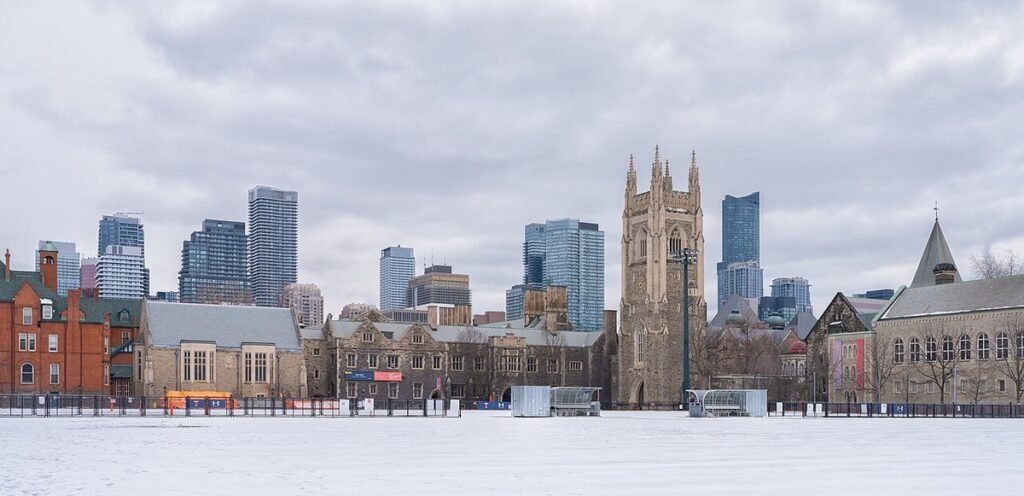
Table of Contents
University of Toronto at a Glance
| Fact | Detail |
|---|---|
| Full name | University of Toronto (U of T) |
| Founded | 1827 as King’s College (royal charter); rechartered as the University of Toronto in 1850 [4][5] |
| Location | Toronto, Ontario, Canada |
| Type | Public research university — Canada’s largest and #1 [4][5] |
| QS World Ranking 2027 | #32; THE 2027: #22; ARWU 2026: #24 [1][4][5][6] |
| Students | 103,140 across three campuses (81,412 undergraduates + 21,728 postgraduates) [2][4][5] |
| International students | About 27% from 176 countries; 27,897 international students (1,841 from India, Fall 2025) [4][5] |
| Campuses | 3 — St. George (downtown Toronto, main), Mississauga (UTM), Scarborough (UTSC) [4][5][21] |
| Programmes | 700+ undergraduate, 200+ graduate [2][7][21] |
| Colleges (St. George) | 7 colleges for Arts & Science students, including Trinity College [21] |
| Alumni | 720,000+ worldwide [7][20][21] |
| Nobel laureates | 12 who studied or taught at U of T [19] |
| UG tuition 2026–27 (international) | Arts & Science CAD 66,110/yr; Engineering CAD 72,860/yr [10][11][12] |
| PG tuition 2026–27 (international) | CAD 46,080–76,890/yr (selected programmes); Rotman MBA total academic fee CAD 144,770 (first year CAD 71,670) [10] |
| Living-funds proof (study permit) | CAD 23,448/year + first-year tuition [10][11][17] |
| Application fee (UG) | OUAC 105: CAD 156 [15][17] |
| Acceptance rate | No official figure — one guide reports 40%+ overall, but competitive programmes admit far fewer Indians [2] |
Why This Matters — the Three Myths That Cost Indian Families
Myth 1: “Canada is the cheap option — U of T costs about CAD 35,000 a year.” That figure appears in some guides [4] — and it is years out of date. U of T’s international undergraduate tuition for 2026–27 is CAD 66,110 a year in Arts & Science and CAD 72,860 in Engineering [10][11][12], and Computer Science and Commerce students pay a higher fee from year two — CAD 72,480 (CS) and CAD 78,160 (Commerce) for 2027–28 [12]. U of T charges Canada’s most expensive undergraduate tuition [13], and it projects a 4% rise in international undergraduate fees for 2027–28 [12]. Budget on the real numbers or do not budget at all.
Myth 2: “U of T accepts 40%+ of applicants, so it is a safe choice.” One guide does report an acceptance rate above 40% [2] — but that is the university-wide figure across all programmes and all applicants, including domestic students in less competitive programmes. For an Indian student applying to Computer Science at St. George, the real bar is 95%+ in the required subjects [18], and the university itself says places for non-citizens are limited and highly competitive. A 40% headline rate tells you nothing about your chances in CS, Engineering or Rotman Commerce.
Myth 3: “Apply to U of T like an American university — one form, one deadline, one essay.” There is no single Canadian form and no essay at most universities [18]. You apply through Ontario’s OUAC 105 system [15][16][18], then U of T emails you a portal login, and your supplementary forms and documents fall due two to three weeks after the application deadline [16] — and it is the document deadline students miss [18]. Engineering has an online profile with timed video and written responses; Rotman Commerce and Computer Science have their own supplementals [15][18]. Miss a supplemental and your application is incomplete, however strong your marks are.
Note: U of T is not one campus — it is three. St. George (downtown Toronto) is what most people mean by “U of T”, and it is the most competitive and the most expensive to live near. Mississauga (UTM) and Scarborough (UTSC) offer the same degree with lower living costs and slightly lower entry bars — Toronto CS at Mississauga and Scarborough sits a few points below St. George’s 95%+ [18]. Applying to the same programme at two campuses is a genuine tactic [18].
Rankings That Actually Matter
U of T is Canada’s #1 university in THE, ARWU, U.S. News and Maclean’s — but not in QS, where McGill leads Canada (#30 in QS 2027, ahead of U of T at #32). The ranking to watch is not the overall one — it is the employability ranking, which is where U of T justifies its fees.
| Ranking system | U of T’s position | What it tells you |
|---|---|---|
| QS World University Rankings 2027 | #32 | #2 in Canada (McGill #30); #1 in Canada in THE, ARWU, U.S. News and Maclean’s [4][5][6][7] |
| Times Higher Education 2027 | #22 | #1 in Canada; #21 in THE 2026 [1][4][5][6] |
| U.S. News Best Global Universities 2026–27 | #20 | #1 in Canada; 11th among public universities [1][4][5][6] |
| ARWU (Shanghai) 2026 | #24 | Research output and citations [1] |
| Maclean’s 2027 | #2 in Canada (Large category) | Behind McGill (#1); ahead of UBC (#3). Maclean’s replaced its old categories with size-based ones in 2027 [1][4][5][6] |
| THE Global University Employability Ranking 2027 | #22 in the world | 1st in Canada; 11th in North America. The ranking that justifies the fees [7] |
| QS subject strength | #1 in Canada across all five broad QS subject fields | [22] |
A note on the numbers: two guides report U of T as QS 2026 #25 [1][8], and one reports #21 [2]. The #21 figure is the QS 2025 position; the #25 figure does not match any QS edition — the QS 2026 position is #29 [4][5][6][7][9], and the current QS 2027 position is #32 [4][5][6]. I have used #32.
My advice on rankings: If you are choosing between U of T and a top-30 American university, the ranking gap is small and the cost gap is large — U of T’s total annual cost (about ₹44–48 lakh tuition plus ₹15.5 lakh living funds) is roughly half of Stanford’s or MIT’s. The deciding factor should be the 3-year post-graduation work permit (PGWP) [9] and the path to Canadian permanent residence — which no American university can offer.
The table below compares U of T on the metrics a researcher needs. Ranks, fees and student numbers are verified from my sources; where a metric is not published, I mark the gap instead of guessing it.
| Metric | Figure |
|---|---|
| QS World University Rankings 2027 | #32 [4][5][6] |
| THE 2027 | #22 [1][4][5][6] |
| U.S. News 2026–27 | #20 [1][4][5][6] |
| ARWU (Shanghai) 2026 | #24 [1] |
| Acceptance rate | No official figure — one guide reports 40%+ overall [2] [RESEARCH GAP: Requires manual lookup of official acceptance rate for the University of Toronto] |
| Researcher-to-faculty ratio | — [RESEARCH GAP: Requires manual lookup of researcher-to-faculty ratio for the University of Toronto] |
| Publication volume | — [RESEARCH GAP: Requires manual lookup of publication volume for the University of Toronto] |
| International UG tuition 2026–27 | Arts & Science CAD 66,110/yr; Engineering CAD 72,860/yr [10][11][12] |
| PG tuition 2026–27 | CAD 46,080–76,890/yr (selected programmes) [10] |
| Living-funds proof (study permit) | CAD 23,448/year [10][11][17] |
| Students | 103,140 [2][4][5] |
| Indian students | 1,841 (Fall 2025) [4][5] |
Faculties, Colleges & Programmes
U of T is divided into faculties, divisions and colleges, offering more than 700 undergraduate programmes and 200 graduate programmes [2][7][21]. At St. George, Arts & Science students belong to one of seven colleges — including Trinity College — which provide community, academic support and residence options [21].
| Faculty / Division | What it is | For Indian students |
|---|---|---|
| Faculty of Arts & Science (St. George) | The largest faculty; humanities, sciences, social sciences, computer science | BA/BSc from CAD 66,110/yr; CS from year 2 CAD 72,480 [10][12] |
| Faculty of Applied Science & Engineering | Engineering (all disciplines, incl. Engineering Science) | CAD 72,860/yr; online profile with timed video + written responses [10][15] |
| Rotman School of Management | Commerce (undergraduate) + MBA | Commerce from year 2 CAD 78,160; MBA total academic fee CAD 144,770 (first year CAD 71,670) [10][12] |
| Temerty Faculty of Medicine | Medicine and health sciences | Graduate-entry medicine; not a direct Class 12 route [22] |
| Faculty of Law | Law | Graduate/professional entry [22] |
| Faculty of Music | Performance (Bachelor of Music) — requires a separate application + audition | Performance is a portfolio programme with an earlier deadline than the 15 January 2027 OUAC deadline [10][12] |
| Faculty of Kinesiology & Physical Education | Kinesiology | Deadline 15 January 2027 [15] |
| Lawrence Bloomberg Faculty of Nursing | Nursing | Deadline 15 January 2027 [15] |
| UTM (Mississauga) & UTSC (Scarborough) | Full campuses with their own programmes | Same U of T degree; lower living costs; CS a few points below St. George [18][21] |
Pro tip: Apply to the same programme at two campuses — for example Computer Science at St. George and at Mississauga — on the same OUAC form. It costs one extra programme choice, and it doubles your chances at a university where St. George CS needs 95%+ [18].
Fee Structure & Financial Aid
U of T sets tuition by faculty and programme, not one flat international rate [10]. These are the published 2026–27 international Fall–Winter billing figures. For comparison, domestic students pay far less — CAD 6,100 a year in Arts & Science (Ontario resident) to CAD 17,730 in Engineering (non-Ontario resident); Ontario-resident Engineering is CAD 14,180 [3] — which is why the international rate is the number that matters for an Indian family.
| Programme (international, 2026–27) | Annual tuition (CAD) | About |
|---|---|---|
| Arts & Science (St. George, UTM, UTSC) — first year | 66,110 (₹44 lakh) | All six admission categories [11] |
| Applied Science & Engineering — first year | 72,860 (₹48 lakh) | Canada’s highest undergraduate fee [11][13] |
| Bachelor of Arts and Science | 66,110 (₹44 lakh) | [10] |
| Bachelor of Applied Science, Engineering Science | 72,860 (₹48 lakh) | [10] |
| Computer Science — year 2 and above (2027–28) | 72,480 | Higher fee from year two [12] |
| Commerce — year 2 and above (2027–28) | 78,160 | Higher fee from year two [12] |
| Selected UG programmes (range) | 50,490–72,860 | [10][12] |
| Selected PG programmes (range) | 46,080–76,890 | [10] |
| Research MA / MSc | 33,460 | [12] |
| MEng | 72,850 | [12] |
| Rotman MBA — total academic fee (20-month programme) | 144,770 (₹95.5 lakh) | Official Rotman estimate, 2027 intake [10] |
| Rotman MBA — first-year academic fee | 71,670 (₹47.3 lakh) | [10] |
| Rotman MBA — first-year total cost (guide calculation) | 96,301–106,818 | First-year tuition + living estimate, per Collegedunia — not an official Rotman figure; before airfare and loan charges [10] |
Compulsory extras and living costs
| Cost | Amount (CAD) | Notes |
|---|---|---|
| Incidental fees | ~2,100/year | [11] |
| UHIP health insurance (2026/27) | 948/year | [10][11] |
| Residence (St. George, room + meal plan) | ~9,000–33,965/year | Across St. George residences; Knox Residence single room is 19,808–20,358/year (Access 14 / Unlimited meal plan). Official 2026–27 figures [22] |
| Living expenses (guide estimate) | 18,000–22,000/year | [2] |
| IRCC living-funds proof (study permit) | 23,448/year | Excluding tuition and travel; for applications from 1 September 2026 [10][11] |
| Realistic first-year total (Arts & Science) | ~92,000–95,000 | Tuition 66,110 + incidental 2,100 + UHIP 948 + living ~23,448 |
One guide still reports the older living-funds figure of CAD 22,895 [14]; the CAD 23,448 figure is the one in force from 1 September 2026 [10][11], and that is the number to use in your study-permit application.
(Rupee figures use CAD 1 ≈ ₹66, the Wise mid-market rate on 11 November 2026. Check the live rate before you budget.)
Note: U of T projects a 4% rise in international undergraduate fees for 2027–28 [12]. [RESEARCH GAP: Requires manual lookup of 2027–28 tuition figures for the University of Toronto — not yet published; the 4% rise is a projection, not a published fee] The figures above are 2026–27; your September 2027 offer will be higher. And residence is guaranteed in first year only if you apply by 31 March and accept your offer by 2 June [11] — miss those dates and you are in Toronto’s private rental market, which is expensive and requires a 12-month lease [10].
Scholarships for Indian Students
| Scholarship | What it covers | Who can apply | Deadline / status |
|---|---|---|---|
| Lester B. Pearson International Scholarship | Full tuition, books, incidental fees and full residence for four years [10][11] | Exceptional international UG applicants who need a study permit; about 37 awards a year worldwide [11][13] | School nomination by 9 October 2026 (CLOSED); admission application by 16 October 2026; scholarship application by 6 November 2026 [10][11] |
| President’s Scholars of Excellence Program | CAD 15,000 in first year; about 150 awards [11] | Exceptional incoming international undergraduates; automatic on admission [11] | Automatic with admission |
| University of Toronto Scholars Program | CAD 10,000 in first year; about 900 awards [10][11] | High-achieving first-year UG applicants; automatic, based on admission average [10][11] | Automatic with admission |
| U of T faculty / college awards | Vary by college and faculty | Admitted students; many are automatic | With admission |
About the Pearson, because it is the only full scholarship: it is one of the most prestigious international undergraduate scholarships in Canada [13], and it is also one of the hardest to win — about 37 students a year from thousands of applications worldwide [13]. Your school can nominate only one student, and the nomination for September 2027 entry closed on 9 October 2026 [10][11]. If you are reading this in November 2026 and your school did not nominate you, Pearson is gone for 2027 entry — plan around the automatic CAD 10,000–15,000 entrance awards instead, and understand they cover only a fraction of a CAD 66,110 tuition.
Pro tip: One guide reports the President’s Scholars award as CAD 30,000 a year for up to four years [13]. I could not confirm that against a second source — the more recent guide, checked against official pages in September 2026, says CAD 15,000 in the first year [11]. I have used CAD 15,000. Do not budget on CAD 30,000 a year.
Research & Labs
U of T’s research scale is what its rankings rest on. It offers PhD programmes across 80+ graduate units with major research centres and strong funding support [5], and it is ranked 4th in the world for research citations (NTU 2026) [7]. That citation strength is what a research student actually buys into: a department whose work is read, cited and built on around the world.
The landmark contributions are concrete. Frederick Banting and Charles Best discovered insulin here [22], and Geoffrey Hinton — the Nobel laureate called the “Godfather of AI” — pioneered deep learning at U of T [8][22]. A student joining a lab here works in the same institution that produced those breakthroughs, with the libraries, computing and laboratory infrastructure a 103,140-student university can sustain [4][5].
For undergraduates, the research route runs through the faculties: Engineering offers a Professional Experience Year (PEY) [22], and co-op streams are especially strong at UTM and UTSC [22]. The Career Centre partners with Google, RBC and McKinsey [20] — the same employers who rank U of T in Canada’s top five for talent [20].
Researcher Insider Tip: If you want research experience as an undergraduate, look at the PEY year in Engineering and the co-op streams at UTM and UTSC [22] — a year inside a lab or a company teaches you more about research than any ranking.
On individual professors, see the Top Professors & Research Leaders section below — I name no one there, for the reason given there. [RESEARCH GAP: Requires manual lookup of current principal investigators by name for the University of Toronto]
Funding, Grants & Assistantships
There is no single “U of T scholarship” in this University of Toronto guide 2027 — there are four routes, and they work differently. The Lester B. Pearson International Scholarship covers full tuition, books, incidental fees and residence for four years [10][11], but only about 37 students a year worldwide win it and it needs a school nomination — one student per school [10][11][13]. The President’s Scholars of Excellence Program pays CAD 15,000 in the first year for about 150 awards [11], and the University of Toronto Scholars Program pays CAD 10,000 in the first year for about 900 awards [10][11]. Both are automatic on admission — no separate application [10][11]. Faculty and college awards vary by college and faculty, and many are automatic with admission.
What that money actually covers matters more than the headline. The two automatic awards — CAD 10,000–15,000 — cover only a fraction of a CAD 66,110 tuition [10][11]. Only Pearson makes U of T free, and for September 2027 entry its nomination closed on 9 October 2026 [10][11].
Crucial Compliance Note: Pearson needs a school nomination — one student per school — and the nomination for September 2027 entry closed on 9 October 2026 [10][11]. If your school did not nominate you, Pearson is gone for 2027 entry, and the automatic CAD 10,000–15,000 entrance awards are the plan to build around instead.
How to apply for funding, step by step:
- Apply for admission first. The automatic CAD 10,000–15,000 awards are decided on your admission average — there is no separate form [10][11].
- For Pearson, get nominated by your school. Your school can nominate only one student, and the nomination for September 2027 entry closed on 9 October 2026 [10][11].
- Complete the scholarship application by its deadline. Pearson nominees had to apply for admission by 16 October 2026 and for the scholarship by 6 November 2026 [10][11].
- Check your college and faculty awards on admission. Many are automatic, but they vary by college and faculty — read your offer letter, not a general list.
How to Apply
Undergraduate, September 2027 entry
1. Apply through OUAC 105. Every Ontario university takes applications through the Ontario Universities’ Application Centre [18]. Students outside the Ontario school system — which is every student in India — use the 105 form [15][18]. One form covers all Ontario universities; you pay a base fee of CAD 156 for three programme choices and can add more for a per-choice fee [15][18].
2. Meet the deadline — and the document deadline. The OUAC application deadline is 15 January 2027 for Engineering and most programmes [15][16][18] — and for Arts & Science, Rotman Commerce and Computer Science too: there is no later application deadline for them. Their documents and supplementals fall due by 1 February 2027 [15][16]. U of T then emails you a portal login (Join U of T, or the Engineering portal), and your supplementary forms and documents fall due two to three weeks after the application deadline [16].
3. Check your marks against the real bar. U of T computes an admission average from the Grade 12 subjects the programme requires, using Grade 11 finals and Grade 12 mid-year or predicted marks for early offers, then confirms against the board result in May [18]. The floors: Arts & Science general entry, Class XII 85%+ (CBSE/CISCE); Engineering / CS / Rotman Commerce, Class XII 90%+ [15]. The competitive reality: 93–97% in the required subjects for CS, engineering and commerce, and 95%+ for Toronto CS at St. George [18]. A missing prerequisite — almost always Grade 12 Mathematics, Physics or Chemistry — is an automatic rejection regardless of the average [18].
4. Use Standard Mathematics, not Applied. Engineering, CS and Rotman Commerce require Class XII Standard Mathematics — Applied Mathematics is not accepted for programmes needing Calculus [15][16]. A student who dropped Mathematics in Grade 11 cannot apply to any business, science or engineering programme in Canada [18].
5. Complete the supplementals. Rotman Commerce, Computer Science, Engineering Science and Kinesiology all require a supplemental application on top of OUAC [15]. Engineering’s is an online profile with timed video and written responses [18]. There is no SAT or ACT needed anywhere in Canada, and no counsellor recommendation and no personal essay at most universities [18].
6. Prove your English. India is not on U of T’s English exemption list [16]. The requirement is IELTS 6.5 with no band below 6.0, or TOEFL iBT 4.5 overall (4.5 in Writing, 4.0 in Speaking) on the new 1–6 scale — for tests taken before 21 January 2026, 89 overall (22 in Speaking and Writing) on the old scale [16][17]. Some guides report that CBSE/ISC English above 70–80% can waive the test at some Canadian universities [18] — do not rely on that for U of T; book the IELTS.
Postgraduate (Master’s, PhD, Rotman MBA)
1. Apply through the School of Graduate Studies (SGS) portal for Master’s and PhD study [15]. The floor is a recognised four-year Bachelor’s at a mid-B final-year average (roughly 75%) [15][17].
2. Check English. The postgraduate floor is IELTS 7.0 overall (at least 6.5 in each component) / TOEFL iBT 93 overall (22 in Writing and Speaking) on the old scale, or 4.5 on the new 1–6 scale [17] — individual programmes may require more.
3. Watch the MBA clock. The Rotman Full-Time MBA Round 2 closes 11 November 2026 [15] — the next round is R3 (13 January 2027).
My advice on timing: Apply early — U of T notes an early date of 7 November 2026 [16] — and treat the document deadline, not the OUAC deadline, as your real deadline. Upload Grade 11 finals and Grade 12 mid-year marks with the application; the university reads those for early offers and confirms against the board result in May [18].
Key Dates for 2027 Entry
| Date | What happens |
|---|---|
| Late September 2026 | OUAC 105 cycle opened [15] |
| 9 October 2026 | Pearson Scholarship school nomination deadline — CLOSED [10][11] |
| 16 October 2026 | Pearson nominees’ admission application deadline [11] |
| 6 November 2026 | Pearson Scholarship student application deadline [10][11] |
| 7 November 2026 | U of T early application date [16] |
| 11 November 2026 | Rotman MBA Round 2 closes 11 November 2026 [15] — next round R3, 13 January 2027 |
| 15 January 2027 | OUAC 105 deadline — Engineering, Kinesiology, Nursing, Music, Physician Assistant [15][16][18] |
| 15 January 2027 | Engineering supplementary application due [16] |
| 1 February 2027 | Rotman Commerce and Computer Science supplementals due (per one guide) [16] |
| 1 February 2027 | Documents and supplementals due — Arts & Science, Rotman Commerce, Computer Science, Daniels, UTM, UTSC [15][16] |
| 31 March 2027 | Residence application deadline (for the first-year guarantee) [11] |
| February–May 2027 | Admission offers released [18] |
| 2 June 2027 | Accept your offer by this date (for the residence guarantee) [11] |
| 7 September 2027 | Fall term begins — classes begin Tuesday 7 September 2027 (Labour Day is Monday 6 September) [13] |
Documents You Will Need
| Document | Notes |
|---|---|
| Class 11 finals + Grade 12 mid-year / predicted marks | Used for early offers; confirmed against the board result in May [18] |
| Class 10 and Class 12 mark sheets | [17] |
| Class 12 Standard Mathematics (for calculus programmes) | Applied Mathematics is not accepted [15][16] |
| IELTS 6.5 (no band below 6.0) or TOEFL iBT 4.5 overall (4.5 Writing, 4.0 Speaking; 89 overall on pre-21-Jan-2026 tests) | India is not on the exemption list [16][17] |
| OUAC 105 application + fee CAD 156 | Three programme choices included [15][18] |
| Supplemental applications | Engineering (online profile + timed video), Rotman Commerce, Computer Science [15][18] |
| Bachelor’s degree + transcripts (PG) | Four-year degree at mid-B (~75%) [15][17] |
| IELTS 7.0 overall (≥6.5 each component) / TOEFL iBT 93 old scale, 4.5 new scale (PG) | [17] |
| Passport + Letter of Acceptance | For the study permit [17] |
| Provincial Attestation Letter (PAL) | Required for a bachelor’s study permit; master’s and PhD applicants at public universities are exempt since 1 January 2026 [9] |
| Proof of funds: CAD 23,448 + first-year tuition | GIC / bank / loan [17][18] |
| Upfront medical exam | [17] |
| Tuition deposit receipt | [17] |
Campus & Student Life
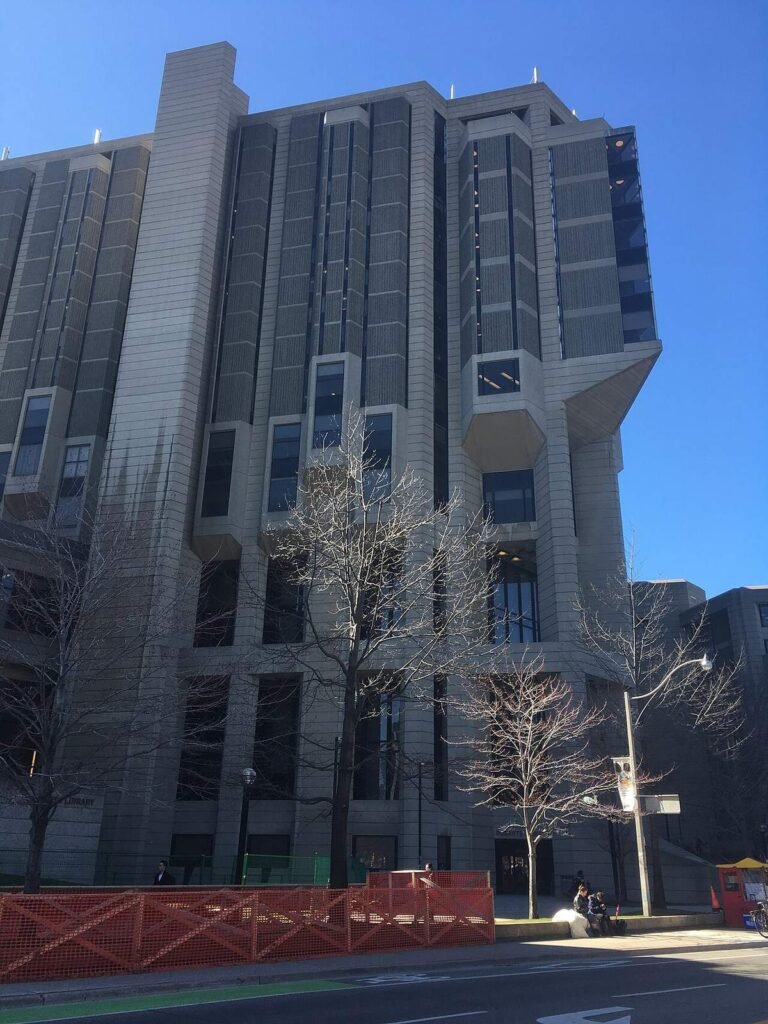
U of T has three campuses: St. George (downtown Toronto, the original and largest campus, home to the central administration) at 27 King’s College Circle; Mississauga (UTM) at 3359 Mississauga Road; and Scarborough (UTSC) at 1265 Military Trail [22]. St. George is what most people picture — historic sandstone, the Back Campus, and the Robarts Library tower, pictured in this guide.
Student life runs through the seven colleges at St. George, which provide community, academic support and residence options [21], and through the Career Centre, which partners with Google, RBC and McKinsey [20]. The university is Canada’s largest, with 103,140 students and 27,897 international students from 176 countries [4][5]. Co-op streams are especially strong at UTM and UTSC, and Engineering offers a Professional Experience Year (PEY) [22].
Toronto is Canada’s largest city and one of the most expensive — St. George sits in the most expensive part of it, while Mississauga and Scarborough have lower accommodation costs [13]. Residence at St. George spans roughly CAD 9,000–33,965 a year depending on the college and room (Knox Residence single: CAD 19,808–20,358) [22]; private accommodation around St. George may require a 12-month lease and separate utility payments [10].
Note: International graduates are eligible for a 3-year post-graduation work permit (PGWP) [9] — the single biggest structural advantage of a Canadian degree over an American or British one. It is the reason many Indian families choose U of T despite the fees.
Placement & Career Outcomes
U of T does not publish a single first-destination salary table in the public domain, so I am using the figures the guides report from university data — and saying plainly which are which.
| Outcome | Figure | Source |
|---|---|---|
| Median starting salary (graduates) | CAD 60,000–80,000 | [20] |
| Employed within 6 months | About 90% | [20][21] |
| Employed within 6 months (second guide figure) | 93% | [20] |
| Placement rate within 3 months of graduation | Around 85% | [19] |
| THE Global University Employability rank 2027 | #22 in the world | [7] |
| Top recruiters | KPMG, EY, Deloitte, PepsiCo, Scotiabank, National Bank Financial (and Mackenzie Investments) | [19] |
| Employers ranking U of T in Canada’s top 5 for talent | 90% of employers | [20] |
| Career Centre partners | Google, RBC, McKinsey | [20] |
| Post-graduation work permit | 3 years | [9] |
Two honest notes. First, the employment figures disagree even within a single guide — one page reports both 90% and 93% employed within six months [20] — so treat “about 90%” as the honest summary. [RESEARCH GAP: Requires manual lookup of employment within six months — 90% vs 93%] Second, the salary-by-degree figures some guides repeat (Executive Masters $208,000; PhD $85,000; MBA $83,000) are quoted in US dollars of unclear vintage and are repeated identically across comparison pages [19]; I have not used them as headline figures. [RESEARCH GAP: Requires manual lookup of salary-by-degree figures for U of T graduates (Executive Masters $208,000; PhD $85,000; MBA $83,000)]
The structural advantage is real: U of T is ranked 22nd in the world for graduate employability (THE 2027) [7], guides report that 90% of employers rank it in Canada’s top five for talent [20], and the 3-year PGWP [9] turns the degree into a work permit — which is the outcome Indian families are actually buying.
Notable Scholars & Alumni
U of T’s alumni list is dominated by the people who built modern Canada — and two discoveries that changed medicine and computing.
| Person | What they did |
|---|---|
| Frederick Banting & Charles Best | Discoverers of insulin [22] |
| Lester B. Pearson | Former Prime Minister of Canada and Nobel Peace Prize laureate [22] |
| William Lyon Mackenzie King | Longest-serving Prime Minister of Canada [22] |
| Geoffrey Hinton | Nobel laureate and pioneer of deep learning — the “Godfather of AI” [8][22] |
| Margaret Atwood | Writer — one of the world’s most celebrated novelists [19] |
| Roberta Bondar | Canada’s first female astronaut [20] |
| The 12 Nobel laureates | 12 Nobel laureates studied or taught at U of T — the count was 10 until Geoffrey Hinton’s 2024 Nobel Prize in Physics and Anne Carson’s 2026 Nobel Prize in Literature [19] |
| 100+ Rhodes Scholars | Among the highest counts of any university [2] |
Top Professors & Research Leaders
The project document for this guide asks for the top professors and principal investigators by name. I am not listing individual professors here, and I want to be plain about why: I could not verify a current, accurate list of individual PIs from a citable source, and a stale or wrong list of “top professors” would mislead you more than it would help. Professors move, retire, and change labs; a 2026 guide that names 2023’s stars is worse than useless. [RESEARCH GAP: Requires manual lookup of current principal investigators by name for the University of Toronto]
What I can tell you, verified: U of T offers PhD programmes across 80+ graduate units with major research centres and strong funding support [5], and it is ranked 4th in the world for research citations (NTU 2026) [7]. The strongest route to a professor is the department route — read the faculty pages of the department you want, find the labs publishing in your area in the last two years, and write to the PI with a specific question about their work. That email, not a list in a guide, is what gets a PhD applicant noticed.
More University Guides

National University of Singapore Guide 2027: Fees, MOE Grant & Admissions
Singapore · 2027

ETH Zurich Guide 2027: Fees, Admissions & Scholarships
Switzerland · 2027
Stanford University Guide 2027: Fees, Aid & Admissions
USA · 2027
Frequently Asked Questions
How much does the University of Toronto cost for an Indian student in 2027?
International undergraduate tuition for 2026–27 is CAD 66,110 a year (about ₹44 lakh) in Arts & Science and CAD 72,860 (about ₹48 lakh) in Engineering [10][11][12]. With incidental fees, UHIP and living costs, a realistic first-year total is about CAD 92,000–95,000 (about ₹61–63 lakh).
What is the Lester B. Pearson Scholarship and can Indians apply?
Yes. The Lester B. Pearson International Scholarship covers full tuition, books, incidental fees and residence for four years [10][11]. Only about 37 students a year worldwide win it, your school can nominate only one student, and the nomination for September 2027 entry closed on 9 October 2026 [10][11].
What are the University of Toronto deadlines for 2027 entry?
The OUAC 105 deadline is 15 January 2027 for Engineering and most programmes, including Arts & Science, Rotman Commerce and Computer Science; their documents and supplementals are due by 1 February 2027 [15][16]. The Rotman MBA Round 2 closes 11 November 2026; Round 3 is 13 January 2027 [15].
What Class 12 marks do I need for U of T?
The floors are 85%+ for Arts & Science and 90%+ for Engineering, Computer Science and Rotman Commerce (CBSE/CISCE) [15]. The competitive reality is higher: 93–97% in the required subjects, and 95%+ for Toronto CS at St. George [18]. Class 12 Standard Mathematics is required for calculus programmes [15][16].
Do I need the SAT for the University of Toronto?
No. There is no SAT or ACT needed anywhere in Canada [18]. Admission is computed from your Grade 12 subject marks, using Grade 11 finals and Grade 12 mid-year or predicted marks [18]. You do need English: IELTS 6.5 with no band below 6.0, or TOEFL iBT 4.5 overall on the new scale (89 on pre-21-Jan-2026 tests) [16][17].
Can I work in Canada after graduating from U of T?
Yes — international graduates are eligible for a 3-year post-graduation work permit (PGWP) [9]. Outcomes support it: guides report median starting salaries of CAD 60,000+, about 90% employed within six months, and U of T ranked 22nd in the world for graduate employability (THE 2027) [7][20].
Sources & Last Updated
- Vappingo — University of Toronto Admissions 2026 — founded 1827; THE 2026 #21; ARWU 2025 #21 (no ARWU edition gives #21 — ARWU 2026 is #24); ~93,000 students (stale — 103,140 in Fall 2025); 26% international; QS 2026 #25 (matches no QS edition — QS 2026 is #29, QS 2027 is #32).
- Y-Axis — University of Toronto — founded 1827; 90,000+ students (stale — 103,140 in Fall 2025); 20%+ foreign; acceptance 40%+ (overall, a guide estimate — no official figure published); QS 2026 #29; living costs CAD 18,000–22,000/year; 100+ Rhodes Scholars.
- VeryToronto — Toronto Universities — founded 1827 as King’s College; 97,000+ students; 700+ UG and 200+ graduate programmes; 160+ countries; domestic tuition CAD 6,100–16,200 (the 16,200 upper bound matches no figure in the official 2026–27 schedule — Arts & Science (Ontario) is 6,100, Engineering (Ontario) 14,180, Engineering (non-Ontario) 17,730); international average CAD 60,500 (misleading — U of T sets tuition by faculty, CAD 50,490–72,860 for 2026–27).
- PFEC Global — Top Canadian Universities for Indian Students — QS 2026 #29; 97,000+ students; 25% international; 25,000+ international students; 3 campuses; tuition CAD 35,000–65,000 (stale — the published 2026–27 international undergraduate range is CAD 50,490–72,860).
- Leverage Edu — Top Universities in Canada — QS 2026 #29; THE 2026 #21; founded 1827, rechartered 1850; ~97,000 students; ~25% international from 160+ countries; 12,000+ faculty; PhD programmes across 80+ departments; Rotman #1 in Canada (QS Global MBA 2026).
- Collegedunia — Queen’s University vs University of Toronto — QS 2026 #29; THE 2026 #21; founded 1827; 95,000+ students; 3 campuses; domestic CAD 6,500–8,000; international CAD 45,000–65,000 (stale ranges from earlier editions — do not use for U of T).
- Shiksha — Top Universities in Toronto — QS 2026 #29; founded 1827; 700+ UG and 200 graduate programmes; 4th in the world for research citations (NTU 2026), not “top 5”; 22nd in the world for graduate employability (THE 2027), not 11th — the 11th is the THE GEURS 2027 North America rank; alumni 720,000+ (not 660,000+); BSc/BA first-year tuition INR 35.97–37.43 lakh.
- Winifac — University of Toronto Overview — founded 1827; 97,000+ students; QS 2026 #25 (matches no QS edition — QS 2026 is #29, QS 2027 is #32); ARWU #26 is the 2024 rank (ARWU 2026 is #24); THE 2026 #21; Nobel laureates including Geoffrey Hinton; Bachelor’s from CAD 61,000/year.
- EduGPS — Study in Canada — QS 2026 #29; THE 2026 #21; founded 1827; Canada’s #1 university; tuition CAD 45,000–65,000/year (stale — the published 2026–27 international undergraduate range is CAD 50,490–72,860); 3-year PGWP; PAL process for Ontario study permits.
- Collegedunia — University of Toronto Programmes & Fees — UG CAD 50,490–72,860; PG CAD 46,080–76,890; Rotman MBA first-year tuition CAD 71,670 and first-year total CAD 96,301–106,818 (Collegedunia’s own calculation, not an official Rotman figure — the official Rotman total academic fee is CAD 144,770 for the 2027 intake); BA/BSc CAD 66,110; Engineering Science CAD 72,860; UHIP CAD 948; IRCC living funds CAD 23,448; Pearson nomination 9 October 2026 and application 6 November 2026; U of T Scholars CAD 10,000.
- StudyU — University of Toronto — Arts & Science CAD 66,110; Engineering CAD 72,860; incidental fees ~CAD 2,100; UHIP CAD 948; living proof CAD 23,448; residence guaranteed if apply by 31 March and accept by 2 June; Pearson ~37/year; President’s Scholars CAD 15,000, ~150 awards; U of T Scholars CAD 10,000, ~900 awards.
- StudyU — Universities in Toronto — UG CAD 50,490–72,860; CS year 2+ CAD 72,480 and Commerce CAD 78,160 for 2027/28; 4% rise in international UG fees projected for 2027/28; research MA/MSc CAD 33,460; MEng CAD 72,860 (wrong — the published 2026–27 MEng fee is CAD 72,850; 72,860 is the undergraduate Engineering fee).
- CampCareer — University of Toronto Guide 2026 — Canada’s highest undergraduate fees; Pearson ~37/year (full tuition, books, residence); President’s Scholars CAD 30,000/year for up to 4 years is wrong — the award is CAD 15,000 in the first year, non-renewable, ~150 awards; U of T Scholars CAD 5,000–15,000 conflicts with the verified CAD 10,000 first year (~900 awards).
- VisaEduLoans — Study in Canada — IRCC living-funds proof CAD 22,895 is superseded — the requirement from 1 September 2026 is CAD 23,448 a year; U of T tuition CAD 45,000–70,000; Pearson full tuition plus living for 4 years.
- Collegedunia — University of Toronto Admissions — OUAC 105; Class XII 85–90%; PG mid-B ~75%; Rotman MBA Round 2 closes 11 November 2026; UG deadline 15 January 2027; Arts & Science / Rotman Commerce / CS 2 February 2027 (documents 16 February) — both wrong: the OUAC deadline is 15 January 2027 for ALL first-entry programmes and documents are due by 1 February 2027 (U of T’s own deadlines page); OUAC fee CAD 156; Engineering / CS / Rotman 90%+ with Standard Mathematics; supplemental applications.
- GyanOne — Canada Undergraduate Admissions — OUAC Group B CAD 159 is wrong — the fee is CAD 156 for three choices (plus CAD 50 for each extra choice); Applied Mathematics not accepted for calculus programmes; Pearson nomination early October (Class 12); early apply by 7 November 2026; deadline 15 January 2027; Engineering supplementary 15 January; Rotman Commerce and CS 1 February; documents 1 February; IELTS 6.5, no band below 6.0; India not on the English exemption list.
- SukhadaEdu — University of Toronto — UG deadline 15 January 2027; Class 12 90%+ competitive; proof of funds CAD 23,448 + tuition; IELTS 6.5, no band below 6.0; TOEFL 100 (writing 22) is stale — on the new 1–6 scale (from 21 January 2026) the undergraduate minimum is 4.5 overall (4.5 Writing, 4.0 Speaking); pre-21-Jan-2026 tests need 89 overall; PG IELTS 7.0; OUAC fee CAD 156; PG B+ (~75%+).
- Plinth Education — Studying in Canada from India (Undergraduate) — CS/engineering/commerce 93–97%; Toronto CS St. George 95+; arts and life sciences high 80s to low 90s; OUAC 105 CAD 156; 15 January 2027 deadline; no SAT; PAL plus CAD 23,448; missing prerequisite is an automatic rejection; offers use Class 11 finals and Grade 12 mid-year marks.
- Collegedunia — University of Toronto vs University of California, Los Angeles — placement rate ~85% within 3 months; top recruiters Mackenzie Investments, KPMG, EY, Deloitte, PepsiCo, Scotiabank, National Bank Financial; salary-by-degree figures (USD, unclear vintage — see unverified); 10 Nobel laureates (stale — U of T has 12 who studied or taught there, after Geoffrey Hinton’s 2024 Physics prize and Anne Carson’s 2026 Literature prize); alumni including Margaret Atwood.
- AcademicJobs — University of Toronto Acceptance Rate — all figures here are single-aggregator guide figures, not officially verified: median starting salaries CAD 60,000+; 90% employed within 6 months (and 93% on the same page — see unverified); 720,000+ alumni; 90% of employers rank U of T in Canada’s top 5 for talent; Career Centre partners Google, RBC, McKinsey; Roberta Bondar as an alumna.
- The Custodian — University of Toronto — 3 campuses; 700+ UG and 200+ graduate programmes; 7 colleges at St. George including Trinity College; 90%+ employment within 6 months; alumni 720,000+ (not 650,000+).
- CloudFront — University of Toronto Guide — 3 campuses with addresses (St. George 27 King’s College Circle; Mississauga 3359 Mississauga Road; Scarborough 1265 Military Trail); QS 2026 #29; THE ~21; 700+ UG and 200+ graduate programmes; residence CAD 19,808–20,358/year (the Knox Residence single-room figure, not a St. George-wide range — St. George residence spans roughly CAD 9,000–33,965 a year); alumni Frederick Banting & Charles Best (insulin), Lester B. Pearson, William Lyon Mackenzie King, Geoffrey Hinton.
Last updated: 11 November 2026. Figures are the published 2026–27 academic-year values unless stated otherwise; 2027–28 figures are not yet published.
By Rohit Gupta
If this guide helped you, share it with someone applying to Canada. For questions, write to universityresearchers3@gmail.com.
[…] 🇨🇦 Canada […]