
NUS Guide 2027: Fees, MOE Grant & Admissions for Indian Students

QS 2027 #10, MOE Tuition Grant, S&T Scholarship and the December application window — verified from official sources.
By Rohit Gupta
Last updated: 11 November 2026
Singapore is the closest thing to a perfect deal for an Indian student: a top-10 world university, four hours from Delhi, in a country where English is an official language and the degree leads directly to a job. The National University of Singapore is ranked #10 in the world (QS 2027) — Asia’s highest-ranked university in the QS World table (QS 2026: #8) — and its fees, once the Singapore government’s MOE Tuition Grant is applied, are lower than most private colleges in India charge for a mediocre degree. But NUS is also one of the hardest universities in the world to get into from India, and the guides that call it an “easy backup” are lying to you. This guide gives you the real fees with and without the grant, the real marks you need, the scholarship that actually accepts Indians, and the one that does not — with every key fact linked to its source so you can check it yourself.
Key points
- NUS is ranked #10 in the world (QS 2027) — Asia’s highest-ranked university in the QS World table (QS 2026: #8). It was founded in 1905 and is Singapore’s oldest and largest university. [1][2][4]
- The MOE Tuition Grant cuts international tuition by 30–50% on most programmes in exchange for a 3-year work bond with a Singapore-registered company. With the grant, most undergraduate programmes cost SGD 21,400–30,450 a year (about ₹15.7–22.3 lakh); without it, SGD 33,400–44,450 (about ₹24.5–32.5 lakh). [8][9][12][20]
- The Science & Technology Undergraduate Scholarship is the scholarship that accepts Indians — 100% of subsidised tuition plus a SGD 6,000-a-year living allowance. The famous ASEAN Undergraduate Scholarship does NOT accept Indians — India is not an ASEAN member. [4][19][20]
- Undergraduate applications for August 2027 entry run 16 December 2026–17 February 2027. CBSE and ISC students need no SAT, ACT or English test; state-board students must submit SAT/ACT plus AP courses. [13][15][16]
- NUS publishes no fixed Class 12 percentage, but the guides agree: competitive entry is 90%+ for Computing, Business and Engineering, and 95–98% for the most competitive courses like Computer Science. [13][14]
- Outcomes are excellent: median fresh-graduate pay S$4,600 a month (about ₹3.4 lakh), with 88.1% employed within six months (Graduate Employment Survey 2024); NUS MBA graduates: 93% of the Class of 2024 received at least one job offer within three months; average post-MBA salary US$88,002 (about ₹84 lakh). [18][19]
- The application fee is SGD 20, inclusive of prevailing GST, non-refundable — small, but the window is short: two months, one form, no second chance. [4][17]

Table of Contents
NUS at a Glance
| Fact | Detail |
|---|---|
| Full name | National University of Singapore |
| Founded | 1905 (as King Edward VII College of Medicine); became NUS in 1980 [2][3] |
| Location | Singapore (Kent Ridge campus; also Bukit Timah and Outram) |
| Type | Public autonomous research university — Singapore’s oldest and largest [3][7] |
| QS World Ranking 2027 | #10 (96.2); QS 2026: #8 (95.9) [1][2][4] |
| THE World Ranking 2027 | #15 (91.1, record high); THE 2026: #17 [2] |
| ARWU 2026 | #53; ARWU 2025: #56 (ARWU 2020: #80) [2] |
| U.S. News Best Global 2026–27 | #16; 2025–26: #20 [3] |
| Students | 52,851 enrolled in AY2025/26 (31,086 undergraduate + 21,765 graduate, NUS Registrar’s Office); NUS’s own public figure is “about 40,000 students” (different basis) [1][2][5][7] |
| International students | About 39%, from 100+ countries [2][3][6] |
| Indian students | 750+ enrolled (agency-reported figure, not an official NUS number) [1] [RESEARCH GAP: Requires manual lookup of the number of Indian students at NUS] |
| Faculties and schools | 17 (NUS About page, QS profile; the Graduate School brochure’s “16” is the outlier) [22][23] |
| Programmes | ~174 programmes; 55 undergraduate courses, 94 graduate courses [4][22] |
| Campuses | 3 — Kent Ridge, Bukit Timah, Outram; main campus 370 acres [4][23] |
| Endowment | SGD 6 billion [4] |
| UG tuition (with MOE grant) | SGD 21,400–30,450/year (most programmes) [8][12] |
| UG tuition (without grant) | SGD 33,400–44,450/year (most programmes); Medicine SGD 190,150 [8][12] |
| Application fee (UG) | SGD 20, inclusive of prevailing GST, non-refundable [4][17] |
| Acceptance rate | No official figure — guides estimate 5–10% overall (Shiksha) to 5–20% (StuBard); NUS handles more than 32,000 undergraduate applications a year [6][7] |
| Teaching starts (Aug 2027 intake) | 9 August 2027 [17] |
Why This Matters — the Three Myths That Cost Indian Families
Myth 1: “NUS costs SGD 17,550 a year.” That figure appears in at least one popular 2026 guide [2] — and it is wrong for 2026–27. The cheapest undergraduate programme with the MOE Tuition Grant is SGD 21,400 a year (Computing, Humanities & Sciences), and without the grant the cheapest is SGD 33,400 (Business) [8][12]. The SGD 17,550 figure is an older, subsidised rate that no longer exists. If you budget on it, you will be short by at least SGD 3,850 a year — about ₹2.8 lakh — before you even arrive. The cheapest subsidised rate in AY2026/27 is SGD 21,400 a year (SGD 18,050 for ASEAN students).
Myth 2: “Apply for the ASEAN Undergraduate Scholarship — it covers full tuition.” It does cover full tuition — for nationals of ASEAN member countries: Brunei, Cambodia, Indonesia, Laos, Malaysia, Myanmar, the Philippines, Thailand and Vietnam [20]. India is not an ASEAN member, so Indian students cannot apply for it [20]. I have seen this scholarship recommended to Indian students in guide after guide. It is the single most repeated error in NUS advice for Indians. The scholarship that does accept Indians is the Science & Technology Undergraduate Scholarship — same full-tuition coverage, plus a living allowance — and it is the one this guide covers in detail [4][19][20].
Myth 3: “NUS is a safe backup if the US and UK do not work out.” NUS is not a backup; it is harder to enter than most Ivy League universities for an Indian student. The guides put competitive entry at 95–98% in the relevant CBSE/ISC subjects for Computing, Business and the top engineering courses, and 90–94% for science, arts and social sciences [14]. There is no SAT to rescue a weak board result — for CBSE and ISC students, the board marks are the application [13][15][16]. If your Class 12 marks are below 90%, NUS undergraduate admission is not a realistic plan, and you should aim for an NUS Master’s instead, where your Bachelor’s degree and not your school marks decide.
Note: NUS uses a cohort-based fee system — the tuition rate in your offer letter stays fixed for the whole duration of your degree [8][11]. Fees are revised each August, and a fresh table for the August 2027 cohort will be published by NUS in April 2027, typically rising 4–7% a year [10]. The figures in this guide are the AY2026/27 rates; expect the August 2027 rates to be a little higher.
Rankings That Actually Matter
NUS is the highest-ranked university in Asia, and it has held a world top-10 position in the QS rankings for two consecutive years. But Indian families should notice one thing: the ranking systems disagree about NUS far more than they disagree about Oxford or MIT.
| Ranking system | NUS’s position | What it tells you |
|---|---|---|
| QS World University Rankings 2026 | #8 (95.9; same as 2025) | Asia’s highest-ranked university in the QS World table; directly behind ETH Zurich (#7) in the 2026 top ten [1][2][4] |
| QS World University Rankings 2027 | #10 (96.2) | A two-place fall in the newest edition [4] |
| Times Higher Education 2027 | #15 (91.1, record high) | THE weighs teaching and research environment more heavily [2] |
| ARWU (Shanghai) 2026 | #53 | A low position for a top-10 QS university — ARWU weighs Nobel prizes and highly-cited researchers, where NUS is thin [2] |
| QS Asia 2027 | =6 (98.7); QS Asia 2026: =3 (99.0, tied NTU) | HKU leads QS Asia; NUS is =6 in 2027 (=3 in 2026) [1][5] |
| U.S. News Best Global Universities 2026–27 | #16 (2025–26: #20) | U.S. News weighs research reputation and publications more heavily [3] |
A note on the numbers: the QS 2026 top ten runs MIT 1, Imperial 2, Stanford 3, Oxford 4, Harvard 5, Cambridge 6, ETH Zurich 7, NUS 8, UCL 9, Caltech 10. NUS at #8 is the only Asian university in the world top ten. The ARWU #53 looks low until you understand the method — ARWU rewards Nobel Prizes and Nature/Science papers, where a young, applied-research university scores lower than a centuries-old one. That does not make NUS a worse university; it makes ARWU a worse measure for it.
My advice on rankings: For an Indian student choosing between NUS and a top-20 American or British university, the ranking is not the deciding factor — the total cost and the work outcome are. NUS with the MOE grant costs about ₹15.7–22.3 lakh a year in tuition; a comparable American university costs ₹60–90 lakh. And NUS graduates walk into Singapore’s job market, where the median fresh-graduate salary is S$4,600 a month (about ₹3.4 lakh) [18][19].
The table below puts the NUS guide 2027’s key numbers in one place. Where a figure is missing, I tag it rather than estimate it.
| Metric | Figure | Note |
|---|---|---|
| QS World Ranking 2026 | #8 (95.9) [1][2][4] | Asia’s highest-ranked university in the QS World table |
| QS World Ranking 2027 | #10 (96.2) [4] | A two-place fall |
| THE World Ranking 2027 | #15 (91.1) [2] | Record high; 3rd in Asia, 1st in Singapore |
| ARWU (Shanghai) 2026 | #53 [2] | ARWU weighs Nobel prizes and highly-cited researchers |
| U.S. News Best Global 2026–27 | #16 (2025–26: #20) [3] | — |
| Acceptance rate | No official figure — guides estimate 5–10% overall (Shiksha) to 5–20% (StuBard); NUS handles more than 32,000 undergraduate applications a year [6][7] | No official figure published |
| Student–faculty ratio | 21.5 students per staff (THE World University Rankings 2027 data) | THE NUS profile |
| Publication volume | — | [RESEARCH GAP: Requires manual lookup of NUS’s annual publication volume] |
| UG tuition with MOE grant | SGD 21,400–30,450/year [8][12] | Most programmes |
| UG tuition without grant | SGD 33,400–44,450/year [8][12] | Most programmes; Medicine SGD 190,150 |
Faculties, Schools & Programmes
NUS is organised into 17 faculties and schools across three campuses (the Graduate School brochure’s “16” is the outlier; NUS’s own About page, the QS profile and Wikipedia all say 17) offering about 174 programmes, with more than 60 doctoral and PhD programmes and around 40 research institutes and centres of excellence [22][23]. It has three campuses — Kent Ridge (main), Bukit Timah (Law and Public Policy) and Outram (Duke-NUS) [23].
| Faculty / School | What it is | For Indian students |
|---|---|---|
| School of Computing | One of the world’s leading computing schools [22] | Computer Science, Information Systems, Business Analytics, Artificial Intelligence — the most competitive NUS programmes for Indians [3][14] |
| College of Design and Engineering | Engineering, Architecture, Design | Biomedical, Civil, Chemical, Electrical & Computer, Mechanical, Materials — 90–95% needed for the top courses [14][22] |
| NUS Business School | Business, Accountancy, Finance | BBA, Accountancy; MBA (17 months, SGD 106,849.76 for the August 2027 intake) [9][22] |
| Faculty of Science | Biological Sciences, Chemistry, Mathematics, Physics, Pharmacy, Statistics | The broad Science degree takes 90–94% profiles [14][22] |
| Faculty of Arts & Social Sciences | Humanities, Social Sciences, Asian Studies | Part of the College of Humanities and Sciences with Science [22] |
| Faculty of Law | Law | Class 12 applicants cannot apply for Law (with Dentistry, Medicine, Nursing) [15][16] |
| Yong Loo Lin School of Medicine | Medicine, Nursing, Pharmacy | Medicine: SGD 190,150/year without the grant — the most expensive NUS programme [8][12] |
| Faculty of Dentistry | Dentistry | Class 12 applicants cannot apply [15][16] |
| Lee Kuan Yew School of Public Policy | Public Policy | MPP and the famous Master in Public Policy — a top choice for Indian civil-service aspirants [1][22] |
| Duke-NUS Medical School | Graduate-entry medicine (with Duke University) | Graduate entry only [22] |
| Saw Swee Hock School of Public Health | Public Health | [22] |
| Yong Siew Toh Conservatory of Music | Music | [22] |
| NUS Graduate School for Integrative Sciences & Engineering | Interdisciplinary PhD programmes | [22] |
| School of Continuing and Lifelong Education | Continuing education | [22] |
Pro tip: NUS offers double degrees (for example Arts & Social Sciences with Engineering, or Business with Law) and cross-faculty enrichment [23]. If you are torn between two fields, a double degree at NUS is a real option — but it extends your degree and your fees, so count the cost before you choose it.
Research & Labs
I judge a research university by what its labs let a scholar actually investigate — and that is the question this NUS guide 2027 is asked most, so I answer it here before the fees.
NUS has about 40 research institutes and centres of excellence [22], and 30 university-level research institutes and centres [23]. Its named research strengths are energy, environmental and urban sustainability; diseases common among Asians; active ageing; advanced materials; and risk management of financial systems [23] — which lets a researcher work on the problems Asia actually faces, from Asian diseases to ageing populations, rather than importing a Western research agenda. The heart of that system is University Town (UTown), a residential and learning hub with its own colleges, dining, sports and the CREATE research tower [4][23].
The structure around the research matters as much as the labs: NUS is organised into 17 faculties and schools offering about 174 programmes, with more than 60 doctoral and PhD programmes [22][23], and most courses build in internships, so students graduate with multinational experience already on their CV [19]. The employers that recruit from that pipeline — Temasek, A*STAR, GIC, Google, Micron [18] — are the reason the three-year MOE bond is an asset rather than a burden.
Researcher Insider Tip: If you are torn between two fields, a double degree at NUS is a real option — Arts & Social Sciences with Engineering, or Business with Law [23] — but it extends your degree and your fees, so count the cost before you choose it.
Fee Structure & Financial Aid
NUS fees are the most complicated in this whole guide series — because there are two prices for everything, and the cheaper one comes with a three-year promise. Indian students are classified as non-ASEAN international students, which determines the fee tier [12].
Undergraduate tuition, AY2026/27 (from the NUS Registrar’s Office fee table)
| Programme | With MOE Tuition Grant (SGD/year) | Without grant (SGD/year) | About |
|---|---|---|---|
| Computing (BComp) | 21,400 (₹15.7 lakh) | 39,700 (₹29.1 lakh) | The most competitive programme for Indians [12] |
| Business (BBA) | 22,200 (₹16.3 lakh) | 33,400 (₹24.5 lakh) | [12] |
| Humanities and Sciences | 21,400 (₹15.7 lakh) | 36,650 (₹26.8 lakh) | [12] |
| Science (Pharmacy) | 23,650 (₹17.3 lakh) | 43,050 (₹31.5 lakh) | [12] |
| Law | 30,450 (₹22.3 lakh) | 44,450 (₹32.5 lakh) | [12] |
| Medicine (except Nursing) | 87,800 (₹64.3 lakh) | 190,150 (₹1.39 crore) | The most expensive NUS programme [12] |
| Most programmes (range) | 21,400–30,450 | 33,400–44,450 | [8][11] |
The MOE Tuition Grant — read this before anything else
The MOE Tuition Grant is a Singapore government subsidy that lowers tuition for international students who agree to work for a Singapore-registered company for three years after graduation [8][12][20]. It cuts fees by 30–50% on most programmes [9] — roughly 45% on most programmes [10] — saving about SGD 11,200–19,400 a year [1] (Medicine saves SGD 102,350 — a 53.8% cut). You apply for it through the university at the time of admission [20]. The grant is available to all international students at public universities, including Indians [20].
Note: The three-year bond is a real legal commitment, not a formality. If you take the grant and then leave Singapore without completing the bond, you must repay the subsidy. Think of it as a three-year employment contract you sign at 18. For most Indian students it is an excellent deal — Singapore salaries are high and the job market is strong — but do not take it if you are certain you want to return to India immediately after graduating.
Postgraduate and MBA fees (AY2026/27)
| Programme | Fee | Notes |
|---|---|---|
| Taught Master’s (most, with subsidy) | SGD 21,900–41,400 total | [11] |
| Taught Master’s (most, without subsidy) | SGD 41,800–118,489 total | [11] |
| MSc Business Analytics (1 year) | SGD 85,000 total | [9][10] |
| NUS MBA (full-time, 17 months) | SGD 106,849.76 total for the August 2027 intake (including 9% GST; SGD 98,027.30 before GST); SGD 99,953 was the AY2026/27 total | Both figures are correct — for different intakes [8][9][10] |
| PhD (most programmes, without subsidy) | SGD 41,800–43,750 a year | [8] |
| PG tuition range (general) | SGD 57,880–99,953 | [9] |
Living costs (AY2026/27)
| Cost | Amount | Source |
|---|---|---|
| NUS’s own living-cost estimate (UG, incl. on-campus accommodation) | SGD 11,750/year (₹8.6 lakh) | [8] |
| NUS official average (per academic year) | SGD 10,900/year (₹8.0 lakh) | [10] |
| Guide range (accommodation + food + transport) | SGD 12,000–19,200/year | [12] |
| Guide range (all living costs) | SGD 12,360–26,280/year [RESEARCH GAP: AY2027/28 living-cost table not yet published (expected ~April 2027); figures shown are AY2026/27] | [11] |
| Monthly budget (guides) | SGD 1,250–2,500/month | [9] |
| On-campus hostel fees | SGD 4,000–10,290/year | [4] |
| Total cost of attendance (UG with grant) | SGD 33,150–42,200/year (₹24.3–30.9 lakh) | [8] |
| Total cost of attendance (UG without grant) | SGD 45,150–56,200/year (₹33.1–41.1 lakh) | [8] |
(Rupee figures use SGD 1 ≈ ₹73.2, the rate on 11 November 2026. Check the live rate before you budget.)
Pro tip: NUS calculates its living-cost estimate excluding the vacation period [8]. If you plan to stay in Singapore through the holidays — and most Indian students do, because flights home are expensive — build a separate buffer into your budget.
Per-programme Master’s fees beyond the verified ranges (taught Master’s with subsidy SGD 21,900–41,400 total; without subsidy SGD 41,800–118,489 total; PhD SGD 41,800–43,750/year; MSBA SGD 85,000) were not verified one by one from citable sources. [RESEARCH GAP: Requires manual lookup of per-programme Master’s fees at NUS beyond the verified ranges]
Scholarships for Indian Students
| Scholarship | What it covers | Who can apply | Bond / condition |
|---|---|---|---|
| MOE Tuition Grant | Cuts tuition 30–50% on most programmes (saves SGD 11,200–19,400/year; Medicine saves SGD 102,350 — a 53.8% cut) [1][9] | All international students, including Indians [20] | 3-year work bond with a Singapore-registered company [8][20] |
| NUS Science & Technology Undergraduate Scholarship | 100% of subsidised UG tuition + SGD 6,000/year living allowance + SGD 1,750 one-time computer allowance + SGD 200 one-time settling-in allowance + annual accommodation allowance (lowest on-campus double-room rate) + travel allowance (incoming + return) [4] | Citizens of Asian countries excluding Singapore — India qualifies; Computing, Engineering (excluding Infrastructure and Project Management) or Science (excluding Environmental Studies and Pharmacy); renewal GPA ≥3.50 every semester [4][18][20] | Six-year service bond with a Singapore-registered company immediately after graduation (S&T scholarship terms); the MOE Tuition Grant itself carries a 3-year bond [8]; no separate application — considered automatically through admission [20] |
| NUS International Undergraduate Scholarship | 100% of subsidised UG tuition + SGD 5,800/year living allowance + SGD 1,750 computer allowance + SGD 5,000/year accommodation allowance [4] | International undergraduates | Requires the MOE grant bond [8] |
| ASEAN Undergraduate Scholarship | 100% of subsidised UG tuition + SGD 5,800/year living + SGD 1,750 computer + SGD 3,000/year accommodation [4] | Nationals of ASEAN member countries only — India does NOT qualify [20] | Do not apply — Indians are not eligible |
| NUS Research Scholarship (postgraduate) | Tuition fee subsidy + stipend S$2,700/month, plus S$500/month after passing the qualifying exam (up to 4 years) [19] | Postgraduate research students | UpGrad reports S$2,900 (master’s) / S$3,000 (PhD) + up to S$500 after the qualifying exam — the S$2,700 figure is the conservative NUS Graduate School figure |
| SINGA (Singapore International Graduate Award) | Tuition (up to 4 years) + S$2,700/month stipend, rising to S$3,200 after the qualifying exam + S$1,500 airfare grant + S$1,000 settling-in allowance [18] | International graduate researchers | Next deadline for the August 2027 intake: 1 December 2026 |
| NUS MBA scholarships | Dean’s Awards and corporate-sponsored awards covering 50–100% of tuition [19] | Admitted MBA students | — |
About the S&T Scholarship, because it is the one that matters: it is NUS’s flagship award for Indian undergraduates — full subsidised tuition, a living allowance, a computer allowance and a settling-in allowance [4]. It is for top students from Asia in computing, engineering and science [18], it is highly competitive, and your academic record must be exceptional [20]. There is no separate application — you are considered automatically through the admission process [20]. That means your NUS application itself is your scholarship application; there is no second form to save you.
Funding, Grants & Assistantships
The funding below is what this NUS guide 2027 needs to show before the fees make sense — because at NUS the grant, the scholarship and the three-year bond are one decision, not three.
The MOE Tuition Grant is the foundation: a Singapore government subsidy that cuts tuition by 30–50% [9] — roughly 45% on most programmes [10] — saving about SGD 11,200–19,400 a year [1], in exchange for working for a Singapore-registered company for three years after graduation [8][12][20]. You apply for it through the university at the time of admission [20]. On top of the grant, the NUS Science & Technology Undergraduate Scholarship covers 100% of subsidised tuition plus a SGD 6,000-a-year living allowance, a SGD 1,750 one-time computer allowance and a SGD 200 settling-in allowance [4] — and you are considered automatically through admission, with no separate application [20]. The NUS International Undergraduate Scholarship covers 100% of subsidised tuition plus a SGD 5,800-a-year living allowance, a SGD 1,750 computer allowance and a SGD 5,000-a-year accommodation allowance [4].
For postgraduate researchers, the NUS Research Scholarship offers a tuition fee subsidy plus a stipend of S$2,700 a month, plus S$500 a month after passing the qualifying exam (up to 4 years) [19], and SINGA (Singapore International Graduate Award) offers tuition (up to 4 years) plus a stipend of S$2,700 a month, rising to S$3,200 after the qualifying exam, plus a S$1,500 airfare grant and a S$1,000 settling-in allowance [18]. MBA students can win Dean’s Awards and corporate-sponsored awards covering 50–100% of tuition [19]. During study, students on a Student’s Pass may work 16 hours a week during term and full-time during vacations [18][19].
How to apply for funding, step by step:
- Take the MOE Tuition Grant with your admission — apply through the university at the time of admission [20], and treat the three-year bond as a three-year employment contract you sign at 18.
- Let admission consider you for the S&T Scholarship automatically — there is no separate form; your NUS application itself is your scholarship application [20].
- Apply for SINGA or the NUS Research Scholarship for postgraduate research, and for Dean’s Awards once admitted to the MBA [18][19].
Crucial Compliance Note: The ASEAN Undergraduate Scholarship does NOT accept Indians — India is not an ASEAN member [20]. Do not apply for it. The Science & Technology Undergraduate Scholarship is the award that accepts Indians [4][20].
How to Apply
Undergraduate, August 2027 entry
1. Check your board. NUS accepts CBSE, ISC and recognised state boards [15][16]. You need a good pass in five subjects including English, with Mathematics for science, engineering and computing, and the specific sciences each course lists [14][15].
2. Understand the marks bar — honestly. NUS publishes no fixed percentage and assesses each application holistically on academic and non-academic achievements [16]. But the guides that track actual admissions agree: 95–98% in the relevant CBSE/ISC subjects for Computing, Business and the top engineering courses, 92–95% for Engineering and Science, and 90–94% for Arts, Social Sciences and the broad Science degree [14] (guide estimates from five years of observed outcomes — NUS publishes no fixed percentage). A conditional offer is made on Grade 11 marks and the school’s predicted Grade 12 result, and confirmed when the board result arrives in May [14].
3. Know whether you need the SAT. CBSE and ISC students do not need the SAT, ACT, AP scores, a separate English test or JEE scores [13][15][16]. State-board students must submit SAT (600 Reading & Writing, 650 Maths) or ACT with Writing (29, Writing 8) plus at least three AP courses, or five AP courses — with AP Calculus BC compulsory for every programme except Law [15]. A strong SAT (1500+) can be uploaded as supporting information, but it does not substitute for a weak board mark [14].
4. Apply in the window: 16 December 2026–17 February 2027. Applications run through the NUS Office of Admissions online portal [13][17]. The fee is SGD 20, inclusive of prevailing GST, non-refundable [4][17]. CBSE applicants upload provisional Class 12 results before the deadline, then update finals within 3 days of release [13][15].
5. Answer the short-response questions and list your achievements. The application has mandatory short-response questions and space for up to four achievements [15]. Some programmes run tests or interviews [15][16]. NUS also runs aptitude-based admission for a share of places, where the currency is olympiad medals, national science fair placings and projects a reader can check [14].
6. Note the exclusions. Class 12 applicants cannot apply for Dentistry, Law, Medicine or Nursing [15][16]. If you want those, you must already hold the relevant qualification.
Postgraduate (Master’s, PhD, MBA)
1. Check the level requirement. Postgraduate applicants need a second-class Bachelor’s degree or equivalent; the guides put the eligibility floor at a Bachelor’s with 60% and above [13]. Individual graduate schools handle PG applications (unlike UG, which is centralised) [13].
2. Check English. The eligibility floor is IELTS 6.0 or TOEFL iBT 85 for PG applicants [13] — but individual programmes often require more, so check your programme page. Note the TOEFL scale changed on 21 January 2026: the old 85 ≈ 4.5 on the new 1–6 scale, and competitive faculties ask for more (Medicine / Public Health: IELTS 7.0, TOEFL 94 old / 5.0 new; Computing PhD: TOEFL 90). Scores are valid 2 years.
3. Watch the MBA clock. The NUS MBA Round 1 deadline was 29 October 2026 — already closed — for the August 2027 intake; Round 2 is 20 January 2027 and Round 3 is 31 March 2027 [13]. PG coursework, PhD and MBA windows are open now [13].
My advice on timing: The UG window is only two months (16 December–17 February) and it closes before most Indian board results arrive. Get your predicted grades from your school in August of Grade 12 — a one-line letter from the principal with subject-wise predictions is enough, but it has to exist [14]. If your school has no format for predicted grades, ask early; a missing prediction is the most common avoidable reason Indian applications stall.
Key Dates for 2027 Entry
| Date | What happens |
|---|---|
| 29 October 2026 | NUS MBA Round 1 deadline (August 2027 intake) — already closed [13] |
| 20 January 2027 | NUS MBA Round 2 deadline (August 2027 intake) [13] |
| 31 March 2027 | NUS MBA Round 3 deadline (August 2027 intake) [13] |
| 16 December 2026 | UG international application window opens [13][15][17] |
| 17 February 2027 | UG international application deadline [13][15][17] |
| Within 3 days of board-result release | CBSE/ISC applicants update final Class 12 results [13][15] |
| April 2027 | Fresh NUS fee table for the August 2027 cohort published (expect a 4–7% rise) [10] |
| May–July 2027 | UG admission outcomes released [15] |
| 9 August 2027 | Teaching starts (August 2027 intake) [17] |
Documents You Will Need
| Document | Notes |
|---|---|
| Class 12 mark sheets / predicted grades (UG) | Five subjects including English; predicted grades from the school principal if finals are pending [14][15] |
| Provisional Class 12 results (CBSE/ISC) | Upload before 17 Feb 2027; update finals within 3 days of release [13][15] |
| SAT/ACT + AP scores (state-board UG applicants only) | SAT 600 R&W / 650 Maths, or ACT with Writing 29 (Writing 8), plus 3 APs — or 5 APs; AP Calculus BC compulsory except Law [15] |
| Short-response answers + up to 4 achievements (UG) | Mandatory in the application [15] |
| Bachelor’s degree + transcripts (PG) | Second-class or equivalent; 60%+ floor [13] |
| IELTS 6.0 / TOEFL iBT 85 (PG floor; old 85 ≈ 4.5 on the new 1–6 scale from 21 January 2026) | Individual programmes may require more (Medicine / Public Health: IELTS 7.0, TOEFL 94 old / 5.0 new; Computing PhD: TOEFL 90) [13] |
| Passport | Valid for the Singapore Student’s Pass application |
| Proof of funds | For the Student’s Pass — ICA publishes no fixed proof-of-funds figure; you declare your financial support in the application and ICA may ask for more documents. Universities commonly ask for first-year tuition plus SGD 8,000–10,500 for living. |
| Application fee SGD 20, inclusive of prevailing GST (UG) | Paid online [4][17] |
Campus & Student Life
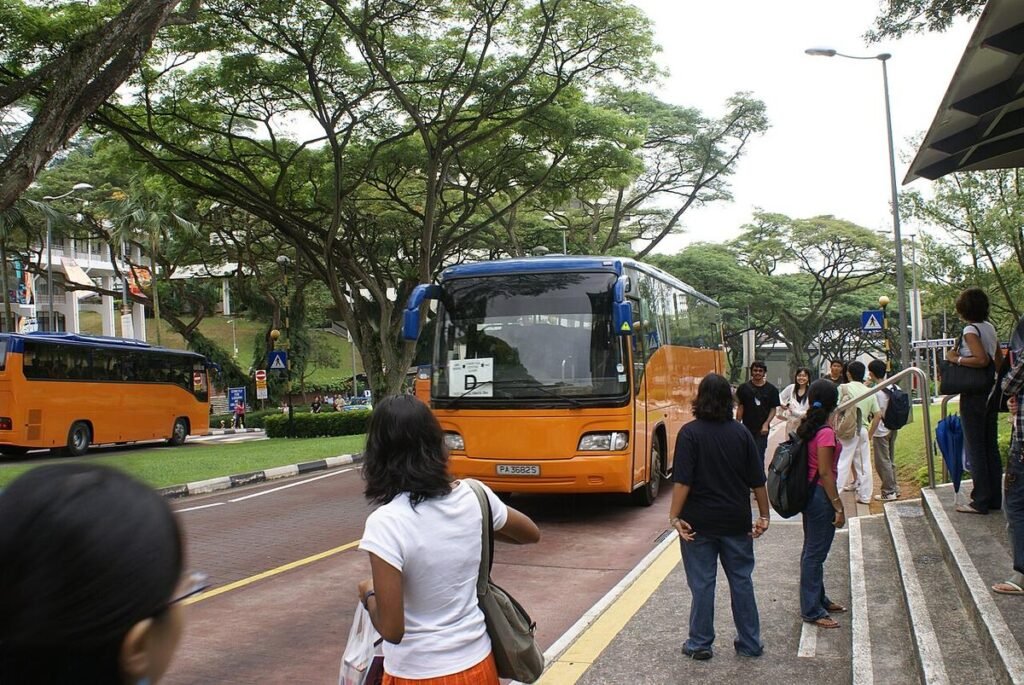
NUS’s main campus sits on 370 acres at Kent Ridge in south-west Singapore, with the Bukit Timah campus (Law and Public Policy) and the Outram campus (Duke-NUS) completing the three-campus footprint [4][23]. The heart of student life is University Town (UTown) — a residential and learning hub with its own colleges, dining, sports and the CREATE research tower, pictured in this guide’s hero image.
NUS enrolled 52,851 students in AY2025/26 (31,086 undergraduate + 21,765 graduate, NUS Registrar’s Office enrolment statistics), about 39% of them international, from more than 100 countries [1][2][3][6]. NUS’s own public figure is “about 40,000 students from 100 countries” — the difference is the basis (the Registrar total is a headcount including part-time coursework masters; the public figure is a full-time-equivalent/marketing figure). On-campus hostel fees run SGD 4,000–10,290 a year [4] — cheap by Singapore standards, which is why hostel places are competitive. Most courses build in internships, so students graduate with multinational experience already on their CV [19].
Students on a Student’s Pass may work 16 hours a week during term and full-time during vacations [18][19]. After graduation, those who secure roles move into an Employment Pass or S Pass, provided salaries meet the threshold — at least S$5,600 a month in most sectors (S$6,200 in financial services) in 2026, rising with age, and S$6,000 / S$6,600 for new applications from 1 January 2027. There is no separate lower threshold for fresh graduates.
Note: Singapore is Southeast Asia’s most expensive city [9]. The NUS living-cost estimate (SGD 11,750 a year including on-campus accommodation [8]) assumes you live in a hostel and eat at hawker centres. Private accommodation off campus costs far more — budget SGD 1,500–2,500 a month if you live outside [5][9].
Placement & Career Outcomes
NUS does not publish a single placement report in the Indian sense, so I am using the university-reported outcomes the guides cite — and saying plainly which figures are university data and which are guide estimates.
| Outcome | Figure | Source |
|---|---|---|
| Median fresh-graduate pay | S$4,600/month (about ₹3.4 lakh/month, Graduate Employment Survey 2024) | [18][19] |
| Employed within 6 months | 88.1% (Graduate Employment Survey 2024) | [18][19] |
| PG starting salary (engineering, computing) | SGD 55,000–70,000/year | [19] |
| PG starting salary (life sciences, biotech) | SGD 50,000–65,000/year | [19] |
| PG average starting salary | SGD 4,500–6,500/month | [9] |
| NUS MBA employed within 3 months | 93% (Class of 2024) | [19] |
| NUS MBA average salary | US$88,002/year (≈ SGD 114,000; ≈ ₹84 lakh, Class of 2024) | [18][19] |
| Top MBA recruiters | McKinsey, BCG, JP Morgan, Grab | [19] |
| Employment Pass threshold | At least S$5,600/month (most sectors); S$6,200/month (financial services); S$6,000 / S$6,600 for new applications from 1 January 2027 | [19] |
| Major employers (all graduates) | Temasek, A*STAR, GIC, Google, Micron | [18] |
The structural advantage is the three-year MOE bond itself: it guarantees you three years of Singapore work experience at Singapore salaries, in a market where the median fresh graduate already earns S$4,600 a month (about ₹3.4 lakh) [18][19]. For an Indian student, that bond is not a burden — it is the return on investment.
Notable Scholars & Alumni
NUS’s alumni list is dominated by the people who built Singapore — and it includes those who attended its predecessor institutions (King Edward VII College of Medicine, Raffles College and the University of Singapore) [21].
| Person | What they did |
|---|---|
| Lee Kuan Yew | 1st Prime Minister of Singapore [21] |
| Goh Chok Tong | 2nd Prime Minister of Singapore [21] |
| Tony Tan | 7th President of Singapore [21] |
| S. R. Nathan | 6th President of Singapore [21] |
| Halimah Yacob | 8th President of Singapore — the first woman in the role (LLB 1978) [21] |
| Mahathir Mohamad | 4th and 7th Prime Minister of Malaysia [21] |
| Kishore Mahbubani | President of the UN Security Council (2001–02); Dean of the Lee Kuan Yew School of Public Policy [21] |
| Margaret Chan | 7th Director-General of the World Health Organization [21] |
| Ho Ching | Former CEO of Temasek Holdings (BEng 1976) [21] |
| Min-Liang Tan | CEO of Razer Inc. [21] |
| Olivia Lum | CEO of the Hyflux Group [21] |
| Vivian Balakrishnan | Singapore’s Minister for Foreign Affairs [21] |
| Ng Ser Miang | Vice-President of the International Olympic Committee [21] |
NUS has produced four Singapore Presidents and two Singapore Prime Ministers [21]. For an Indian student, the honest reading is this: NUS’s network is a Singapore-and-ASEAN network, not a global one. If your career plan is Singapore, Southeast Asia or China, it is unmatched. If your plan is the United States, a US university’s network will serve you better.
NUS has one affiliated Nobel laureate: Professor Sir Konstantin Novoselov, who won the Nobel Prize in Physics in 2010 (with Andre Geim, for graphene) and joined NUS as Distinguished Professor of Materials Science and Engineering on 8 April 2019 — the first Nobel laureate to join a Singapore university. He won the prize for work done at the University of Manchester before joining NUS.
Top Professors & Research Leaders
The project document for this guide asks for the top professors and principal investigators by name. I am not listing individual professors here, and I want to be plain about why: I could not verify a current, accurate list of individual PIs from a citable source [RESEARCH GAP: Requires manual lookup of current NUS principal investigators by department], and a stale or wrong list of “top professors” would mislead you more than it would help. Professors move, retire, and change labs; a 2026 guide that names 2023’s stars is worse than useless.
What I can tell you, verified: NUS has about 40 research institutes and centres of excellence [22], 30 university-level research institutes and centres [23], and research strengths in energy, environmental and urban sustainability, diseases common among Asians, active ageing, advanced materials, and risk management of financial systems [23]. The strongest route to a professor is the department route — read the faculty pages of the department you want, find the labs publishing in your area in the last two years, and write to the PI with a specific question about their work. That email, not a list in a guide, is what gets a PhD applicant noticed.
More University Guides
 ETH Zurich Guide 2027: Fees, Admissions & Scholarships for Indian StudentsSwitzerland • University Guide
 Stanford University Guide 2027: Fees, Aid, Admissions & the Silicon Valley AdvantageUSA • University Guide
 MIT Guide 2027: Fees, Admissions & Scholarships for Indian StudentsUSA • University Guide
Frequently Asked Questions
How much does NUS cost for an Indian student in 2027?
With the MOE Tuition Grant, most undergraduate programmes cost SGD 21,400–30,450 a year (about ₹15.7–22.3 lakh) in tuition in AY2026/27; without the grant, SGD 33,400–44,450 (about ₹24.5–32.5 lakh) [8][12]. Add living costs of about SGD 11,750 a year for a total of SGD 33,150–42,200 a year with the grant [8].
What is the MOE Tuition Grant and should I take it?
It is a Singapore government subsidy that cuts your tuition by 30–50% in exchange for working for a Singapore-registered company for three years after graduation [8][20]. For most Indian students it is an excellent deal — Singapore salaries are high and 88.1% of graduates were employed within six months (Graduate Employment Survey 2024) [18][19].
Can Indian students apply for the ASEAN Undergraduate Scholarship at NUS?
No. The ASEAN scholarship is for nationals of ASEAN member countries only [20]. India is not an ASEAN member. The scholarship that does accept Indians is the Science & Technology Undergraduate Scholarship: full subsidised tuition plus a SGD 6,000-a-year living allowance [4][20].
What are the NUS deadlines for 2027 entry?
Undergraduate applications run 16 December 2026–17 February 2027 [13][15][17]. The NUS MBA Round 1 deadline was 29 October 2026 (already closed); Round 2 is 20 January 2027 and Round 3 is 31 March 2027 [13]. Teaching for the August 2027 intake starts 9 August 2027 [17]. CBSE applicants upload provisional Class 12 results before the deadline, then update finals within 3 days of release [13][15].
Do I need the SAT for NUS?
Not if you are a CBSE or ISC student — NUS requires no SAT, ACT, AP scores, separate English test or JEE from CBSE/ISC applicants [13][15][16]. State-board students must submit SAT or ACT with Writing plus AP courses [15]. Board marks are the application: 95–98% for Computing and Business [14].
What salary can I expect after graduating from NUS?
The median fresh graduate earns S$4,600 a month (about ₹3.4 lakh), with 88.1% employed within six months (Graduate Employment Survey 2024) [18][19]. Postgraduate engineers and computing graduates start at SGD 55,000–70,000 a year (guide figure, Economic Times), and NUS MBA graduates: 93% of the Class of 2024 received at least one job offer within three months, with an average post-MBA salary of US$88,002 (about ₹84 lakh) [19].
Sources & Last Updated
Last updated: 11 November 2026. All sources were checked on 11 November 2026. Where a source disagreed with another, I have said so in the text.
- National University of Singapore (NUS) — Kadamb Overseas — QS 2026 #8, Asia’s #1, founded 1905, 38,000 students, 750+ Indian students (agency data), tuition SGD 18,000–50,000/year, living SGD 1,200–1,800/month, MOE grant saves SGD 11,200–19,400/year (Medicine SGD 102,350).
- National University of Singapore: Admissions Guide 2026 — Vappingo — founded 1905, QS 2026 #8, THE 2026 #19 and ARWU 2025 #80 are stale (THE 2027 #15; ARWU 2026 #53); ~38,000 students and 37% international are stale (52,851 enrolled AY2025/26; 39% international), top programmes CS/Engineering/Business.
- National University of Singapore — upGrad — oldest and most prestigious university in Singapore, 17 faculties and schools (the page’s “16” is the outlier), QS 2026 #8, tuition SGD 33,400–175,000/year, 39% international, established 1905 (as King Edward VII College of Medicine), became NUS in 1980.
- National University of Singapore (NUS): Rankings, Fees, Courses, Admission 2027 — Shiksha — QS 2027 #10, founded 1905, 55 undergraduate + 94 graduate courses, first-year tuition SGD 17,334–190,150 (the 17,334 low end is not a Registrar’s rate — cheapest subsidised is SGD 21,400), hostel SGD 4,000–10,290/year, 370-acre campus, endowment SGD 6 billion (guide figure — not confirmed against the NUS annual report), application fee S$20, inclusive of prevailing GST, S&T / ASEAN / NUS International scholarship amounts.
- Top Universities in Singapore: Full Guide 2026 — uhomes — QS 2026 table (NUS #8, ~40,000+ students), tuition with MOE grant SGD 17,950–39,200 (a secondary guide range, not the Registrar’s table — the Registrar’s cheapest subsidised rate is SGD 21,400), living SGD 1,500–2,500/month (SGD 18,000–30,000/year), Asia’s #1.
- National University of Singapore: Acceptance Rate, Rankings & Scholarships — StuBard — QS 2026 #8, students from 100+ countries, acceptance rate ~5–20% (no official figure), tuition SGD 17,000–50,000+/year, UG SGD 17,000–22,000, graduate SGD 37,000–99,000+.
- INSEAD vs National University of Singapore (NUS) — Collegedunia — QS 2026 #8, THE 2025 #17 (the page’s “#19” is THE 2024), founded 1905, ~40,000 students, UG acceptance 5–7% for international students is a MISREADING (5–7% is NUS College’s share of each UG cohort), NUS MBA ~SGD 87,000 is stale (AY2026/27 SGD 99,953; August 2027 intake SGD 106,849.76), UG fees ~SGD 31,000/year.
- NUS Fees for Indian Students 2026 — Yocket — total cost of attendance SGD 33,150–201,900/year, MOE Tuition Grant 3-year bond, UG with grant SGD 21,400–30,450 (the page’s “21,350” looks like a typo for 21,400) / without SGD 33,400–44,450, MBA SGD 106,849.76 (August 2027 intake), living UG SGD 11,750 / PG SGD 19,500, cohort-based fees, living estimate excludes vacation period.
- National University of Singapore (NUS): Fees 2026–27, Deadlines, Scholarship, and Rankings — Collegedunia — PG tuition SGD 57,880–99,953, MOE grant cuts fees 30–50%, living SGD 1,500–2,500/month, MBA Round 1 29 October 2026 (already closed; the page’s “15 November 2026” is wrong), MSc Business Analytics SGD 85,000, MBA SGD 99,953, PG average starting salary SGD 4,500–6,500/month.
- National University of Singapore Fees — Collegedunia — UG Computing with grant SGD 21,400 / without SGD 39,700, MBA SGD 99,953, NUS official average living cost SGD 10,900/academic year, 4-year UG Computing with grant ~INR 72–80 lakh total, fees rise 4–7% a year, fresh fee table April 2027.
- Cost of Studying in Singapore for Indian Students (2026) — Yocket — total first-year cost SGD 34,703–218,050, living SGD 12,360–26,280/year, NUS UG with grant SGD 21,400–87,800 / without SGD 33,400–190,150, Master’s with subsidy SGD 21,900–41,400 / without SGD 41,800–118,489, cohort-based fees.
- Cost of Studying in Singapore 2026 — LeapScholar — NUS UG fee table from the Registrar’s Office AY2026/27 (Business 22,200/33,400; Computing 21,400/39,700; Humanities & Sciences 21,400/36,650; Law 30,450/44,450; Medicine 87,800/190,150; Pharmacy 23,650/43,050), living SGD 12,000–19,200/year, total with grant SGD 30,150–41,500/year.
- National University of Singapore (NUS) Admissions 2026–27 — Collegedunia — UG Class XII 85–90%, PG second-class Bachelor’s, MBA Round 1 29 October 2026 (already closed; the page’s “15 November 2026” is wrong), UG window 16 December 2026–17 February 2027, UG competitive entry 90%+ for Computing/Business/Engineering, no SAT/ACT for CBSE/ISC, state boards need SAT/ACT/AP, provisional results before deadline + finals within 3 days, PG English IELTS 6.0 / TOEFL iBT 85.
- How to Get Into NUS or NTU from India: 2026–27 Guide — Plinth Education — 95–98% for Computing/Business/top engineering, 90–94% for science/arts, no SAT required, conditional offer on Grade 11 + predicted Grade 12, IB 42–44 for competitive courses, aptitude-based admission (olympiads, science fairs, projects).
- Singapore Undergraduate Admissions: NUS, NTU, SMU — GyanOne — state boards: SAT 600 Reading & Writing / 650 Maths or ACT with Writing 29 (Writing 8) + 3 APs or 5 APs, AP Calculus BC compulsory except Law, no English test for Indian Standard 12, JEE not required, mandatory short-response questions + up to 4 achievements, Dentistry/Law/Medicine/Nursing excluded for Class 12 applicants, window 16 Dec 2026–17 Feb 2027, outcomes by July.
- Undergraduate in Singapore: NUS, NTU, SMU Admissions for Indian Students — Karan Gupta — NUS publishes no fixed percentage, holistic assessment, no SAT/ACT/English test/JEE for CBSE/ISC, window 16 December 2026–17 February 2027.
- 2027 Application Process to Study in Singapore: Key Dates — Ardent Overseas — NUS window 16 Dec 2026–17 Feb 2027, application fee S$20, teaching starts 9 August 2027, six autonomous universities, no national portal.
- Singapore’s NTU, NUS, SMU: Smart ROI for Indian Students — VisaVerge — average fresh-graduate pay above SGD 4,200/month and ~95% employed within six months are stale (GES 2024: median S$4,600, 88.1%); top MBA cohorts SGD 95,000–110,000 has no official basis (NUS MBA Class of 2024: 93% within 3 months, average US$88,002), S&T Scholarship (tuition + stipend + settling-in for top Indians in computing/engineering/science), SINGA, part-time work 16 hours/week.
- Singapore’s hidden gems: Why more Indian students should look at NTU, NUS and SMU — The Economic Times — S&T Scholarship, NUS Research Scholarship S$2,700/month + S$500 after the qualifying exam (UpGrad reports S$2,900/S$3,000), average starting salary above SGD 4,200/month and 95% placed within six months are stale (GES 2024: median S$4,600, 88.1%), PG engineering/computing SGD 55,000–70,000, life sciences SGD 50,000–65,000, MBA 93% employed within 3 months (average salary US$88,002, Class of 2024), part-time 16 hours/week, Employment Pass threshold S$5,600/month (S$6,000 from 1 January 2027).
- Study in Singapore After 12th in 2026 — LeapScholar — ASEAN Undergraduate Scholarship NOT available to Indians (India is not ASEAN), MOE Tuition Grant 30–50% + 3-year bond, S&T Scholarship for citizens of Asian countries excluding Singapore (India qualifies), full subsidised tuition + living allowance, automatic consideration through admission.
- List of National University of Singapore people — Wikipedia — four Singapore Presidents and two Singapore Prime Ministers among alumni (including predecessor institutions), Lee Kuan Yew, Goh Chok Tong, Tony Tan, S. R. Nathan, Halimah Yacob, Mahathir Mohamad, Kishore Mahbubani, Ho Ching, Margaret Chan, Min-Liang Tan, Olivia Lum, Vivian Balakrishnan, Ng Ser Miang.
- Graduate Education in NUS (brochure) — NUS Graduate School — 17 faculties and schools (the brochure’s “16” is the outlier), ~174 programmes, >60 doctoral and PhD programmes, ~40 research institutes and centres of excellence, School of Computing and College of Design & Engineering descriptions.
- National University of Singapore (NUS) — QS TopUniversities profile — 17 faculties and schools across three campuses, 30 university-level research institutes and centres, research themes (energy, sustainability, Asian diseases, active ageing, advanced materials, financial risk).
By Rohit Gupta
If you found this guide useful, share it with another Indian student who is dreaming of NUS. And if you spot a fact that has changed — a deadline, a fee, a new scholarship — write to me at universityresearchers3@gmail.com and I will check it against the official source and update this guide.
[…] 🇸🇬 Singapore […]
[…] 🇸🇬 Singapore […]