
University of Melbourne Guide 2027: Fees, Scholarships & Admissions for Indian Students

QS 2027 #22, AUD 44,356–65,360 fees, the 20% MIUS scholarship, the 30 November deadline and visa figures — verified from official sources.
By Rohit Gupta
Last updated: 11 November 2026
The University of Melbourne is the university most Indian families mean when they say “Australia” — ranked #22 in the world (QS 2027) [7] (#2 in Australia, behind UNSW at #19), in a city ranked the world’s #4 best student city for 2027 [2]. It is also the Australian university with the most unusual degree structure: you do not apply for “law” or “engineering” as an undergraduate at all. You take one of nine broad bachelor’s degrees for three years, then specialise in a professional master’s — the Melbourne Model.
This University of Melbourne guide 2027 explains the Model, the real fees by degree, the 20% undergraduate scholarship that is automatic for Indian citizens, the 30 November deadline, and the visa figures you must show — with every key fact linked to its source so you can check it yourself.
Key points
- Melbourne is ranked #22 in the world (QS 2027) — #2 in Australia behind UNSW (#19) — and #34 in THE 2027. It was founded in 1853 and is Australia’s second-oldest university, a Group of Eight member with 58,000+ students. [7]
- The Melbourne Model means nine broad bachelor’s degrees (Agriculture, Arts, Biomedicine, Commerce, Design, Fine Arts, Music, Oral Health, Science) for three years — then a professional master’s (Law, Medicine, Engineering) at graduate level. [18][19]
- International undergraduate tuition for 2027 is AUD 44,356–65,360 a year (about ₹29–42 lakh), with the Bachelor of Commerce at AUD 56,451–62,464 and the Bachelor of Science at AUD 55,565–65,360. [8]
- The Melbourne International Undergraduate Scholarship gives 20% fee remission for the whole degree from 2027 intakes — automatic, no separate application, and Indian citizens qualify (225 awards). [11][12][13]
- Semester 1, 2027 undergraduate applications close on 30 November 2026; Semester 2, 2027 closes on 31 May 2027. Class 12 with 75% or above is the published floor for the main bachelor’s degrees. [8][10][13]
- The Student visa (subclass 500) costs AUD 2,500 from 1 July 2026, and you must show AUD 29,710 a year in living funds plus first-year tuition and travel. [15][17]
- Outcomes: 88.3% of postgraduate coursework graduates were in work (QILT Graduate Outcomes Survey 2023) with an average salary of AUD 88,000; undergraduates 67.7% in work with a median full-time salary of AUD 65,300. [20]
Table of Contents
University of Melbourne at a Glance
| Fact | Detail |
|---|---|
| Full name | The University of Melbourne (UniMelb) |
| Founded | 1853 — Australia’s second-oldest university, oldest in Victoria [1][6][19] |
| Location | Parkville, Melbourne, Victoria, Australia (main campus, ~15 minutes’ walk from the CBD) [18] |
| Type | Public research university — Group of Eight (Go8) member [2][3][5] |
| QS World Ranking 2027 | #22; THE 2027: #34; ARWU 2026: #37 [7] |
| Students | 58,000+ across seven campuses [2][5] |
| International students | 46% from 150+ countries; 1,300+ Indian students [2][5] |
| Courses | 300+ courses — 90+ undergraduate, 200+ master’s [2][10] |
| Undergraduate degrees | 9 broad degrees (Melbourne Model) [18] |
| Graduate degrees | 400+ across 9 faculties [18] |
| Residential colleges | 10 residential colleges (8 affiliated + 2 university-owned) [18][19] |
| Alumni | 10 Nobel laureates, 4 Australian prime ministers, 5 governors-general [19] |
| Endowment | ≈ AU$1.3 billion (2022) [21] |
| CRICOS code | 00116K [29] |
| UG tuition 2027 (international) | AUD 44,356–65,360/year [8] |
| PG tuition 2027 (international) | AUD 48,992–65,984/year (2026 standard band — 2027 verification pending) [8] |
| Living-funds proof (student visa) | AUD 29,710/year + first-year tuition + travel [15][16][17] |
| UG application deadline (Sem 1, 2027) | 30 November 2026 [8][10][13] |
| Acceptance rate | No official figure — guides estimate ~70–80% overall [5][22] |
Why This Matters — the Three Myths That Cost Indian Families
Myth 1: “Melbourne is ranked #33 in the world.” One guide still reports QS 2026 #33 [1] — but that was the QS 2023 position. Melbourne jumped to #14 in QS 2024, #13 in QS 2025, and sits at #19 in QS 2026 [7], with #22 in QS 2027 [7]. The #33 figure is three editions out of date; I have used #22 (QS 2027).
Myth 2: “Apply for the Bachelor of Law or Bachelor of Engineering — like in India.” You cannot. Under the Melbourne Model, introduced in 2008 [28], there is no undergraduate law or engineering degree. You take one of nine broad bachelor’s degrees — Agriculture, Arts, Biomedicine, Commerce, Design, Fine Arts, Music, Oral Health or Science [18] — for three years, then specialise in a professional master’s: the Juris Doctor for law, the Doctor of Medicine, or the Master of Engineering [18][19].
The Model launched in 2008 with six degrees; today there are nine. A student who wants to be a lawyer studies a Bachelor of Arts or Commerce first, then the JD. If you wanted a four-year BTech straight after Class 12, Melbourne is not that university — and the sooner you know it, the better.
Myth 3: “The scholarship is 25% — or 50%.” Both figures are wrong for 2027 entry, and both are still floating around on scholarship-listing sites [14][25][26]. The Melbourne International Undergraduate Scholarship was 25% for awards before 2027; from 2027 intakes it is 20% fee remission for the duration of the course, with the number of awards increasing to 225 [11][12][13]. The 50% figure belongs to a different award — the Commerce Undergraduate International Merit Scholarship for the Bachelor of Commerce [11]. The AG Whitlam scholarship is a living allowance of AUD 10,000 a year, not a fee remission. And the best part: there is no separate scholarship application — you are automatically considered when you apply for the course [11][12][13].
Note: Melbourne is not cheap, but it is cheaper than the American and Canadian alternatives in this guide series. A Bachelor of Commerce costs AUD 56,451–62,464 a year (about ₹36–40 lakh) [8] against Stanford’s US$67,731 (about ₹64 lakh) tuition alone — and Melbourne’s 20% scholarship, applied automatically, takes roughly AUD 11,000–12,500 a year off that [11][12].
Rankings That Actually Matter
Melbourne is #1 in Australia in THE 2027, ARWU 2026 and U.S. News 2026–27 — and #2 in QS 2027, behind UNSW (#19). The ranking to watch is the employability ranking — which is where the guides disagree, and I have said so plainly below.
| Ranking system | Melbourne’s position | What it tells you |
|---|---|---|
| QS World University Rankings 2026 | #19 | #1 in Australia [2][3][5][6] |
| QS World University Rankings 2027 | #22 | [7] |
| Times Higher Education 2026 | #37 | #1 in Australia [2][3][5][6] |
| THE 2027 | #34 | [7] |
| ARWU (Shanghai) 2025 | #38 | [6] |
| ARWU (Shanghai) 2026 | #37 | [7] |
| U.S. News 2026–27 | =28 | #1 in Australia [7] |
| QS Graduate Employability | #8 in the world (QS 2022 edition) | Older edition — see note below [3][20] |
| THE Global Employability 2027 | #32 | #1 in Australia [20] |
| QS Best Student Cities 2027 | #4 (Melbourne) | [2] |
A note on the numbers: Melbourne’s QS rank has moved a lot — #33 in 2023, #14 in 2024, #13 in 2025, #19 in 2026, #22 in 2027 [7]. The employability figures disagree: one guide reports Melbourne as #1 in Australia for graduate employability [2], while the placement data reports THE Global Employability 2027 #32 and QS Graduate Employability 2022 #8 [20].
I have used the #32 (THE 2027) and #8 (QS 2022) figures with their editions stated. [RESEARCH GAP: Requires manual lookup of graduate employability rank — one guide’s ’30th worldwide’ figure is unverified and has been removed from the text; QS 2022 #8 and THE 2027 #32 are used] By subject, Melbourne performs exceptionally well in Sports-related subjects, Legal Studies and Life Sciences and Medicine, all ranking in the top 20 of the QS World Ranking by Subjects [4].
My advice on rankings: If you are choosing between Melbourne and a top-30 American university, the ranking gap is small and the cost gap is large. The deciding factor should be the post-study work rights — Australia’s Temporary Graduate visa — and the fact that Melbourne’s degrees are three years at bachelor’s level, which saves a full year of tuition and living costs against a four-year American degree.
The table below compares Melbourne on the metrics a researcher needs. Ranks, fees and student numbers are verified from my sources; where a metric is not published, I mark the gap instead of guessing it.
| Metric | Figure |
|---|---|
| QS World University Rankings 2026 | #19 [2][3][5][6] |
| THE 2026 | #37 [2][3][5][6] |
| ARWU (Shanghai) 2025 | #38 [6] |
| Acceptance rate | No official figure — guides estimate ~70–80% overall [5][22] |
| Student-to-teacher ratio | 24:1 (THE 2027) [7] |
| Publication volume | 15,900+ research outputs a year (University of Melbourne, Facts and figures — SciVal, April 2025) |
| International UG tuition 2027 | AUD 44,356–65,360/year [8] |
| PG tuition 2027 | AUD 48,992–65,984/year (2026 standard band — 2027 verification pending) [8] |
| Living-funds proof (student visa) | AUD 29,710/year [15][16][17] |
| Students | 58,000+ [2][5] |
| International students | 46% from 150+ countries; 1,300+ Indian students [2][5] |
| Accommodation (hostel) | International House (catered residential college): AUD 37,586 for a 40-week full year, 21 meals a week (International House, 2027 fees) |
The Melbourne Model & Faculties
Melbourne offers just nine undergraduate degrees — Bachelor of Agriculture, Arts, Biomedicine, Commerce, Design, Fine Arts, Music, Oral Health and Science — within which all majors fall [18]. You also take “breadth” subjects — roughly one-quarter of your degree — outside your primary faculty [28]. Professional qualification comes at graduate level: Law (Juris Doctor), Medicine (Doctor of Medicine), Engineering (Master of Engineering) and Architecture [18][19].
| Faculty / School | What it is | For Indian students |
|---|---|---|
| Faculty of Arts | Humanities and social sciences | Bachelor of Arts, AUD 44,356–57,764/yr [8] |
| Faculty of Science | Science, maths, computing, data science | Bachelor of Science, AUD 55,565–65,360/yr [8] |
| Faculty of Business and Economics | Commerce, economics, management | Bachelor of Commerce, AUD 56,451–62,464/yr [8] |
| Faculty of Engineering and Information Technology | Engineering and IT (graduate level) | Master of Engineering after a BSc/BBiomed [18] |
| Melbourne Law School | Law (graduate level) | Juris Doctor, AUD 63,789/yr [8] |
| Faculty of Medicine, Dentistry and Health Sciences | Medicine and health (graduate level) | Doctor of Medicine after a bachelor’s with prerequisites [18] |
| Faculty of Architecture, Building and Planning | Architecture and planning | Bachelor of Design, AUD 45,928–63,924/yr [8] |
| Faculty of Fine Arts and Music | Fine arts and music | Bachelor of Music / Fine Arts [18] |
| Melbourne Graduate School of Education | Education | Graduate entry [18] |
| Melbourne Business School | MBA and management | MBA AUD 60,192/yr (2026 figure) [8] |
Pro tip: If you want medicine, do not apply for a “medical” bachelor’s — there isn’t one. Any student can do the Doctor of Medicine as long as they complete the necessary prerequisites (e.g. anatomy, physiology and biochemistry at second-year level) in their bachelor’s degree [18]. Choose the Bachelor of Biomedicine or Science and plan the prerequisites from year one.
Fee Structure & Financial Aid
Melbourne charges international fees at faculty-tiered rates — STEM, law and business master’s programmes are priced above humanities and social science degrees [8]. These are the published 2027 international figures (exchange rate used: 1 AUD = ₹64.4, 11 November 2026, Wise mid-market). One row below — the Master of Business Administration — still shows the latest published (2026) figure, because the university has not yet published its 2027 fee; it is flagged as unverified in the table below.
| Programme (international, 2027) | Annual tuition (AUD) | About |
|---|---|---|
| Bachelor of Arts | 44,356–57,764 (₹28.6–37.2 lakh) | [8] |
| Bachelor of Design | 45,928–63,924 (₹29.6–41.2 lakh) | [8] |
| Bachelor of Commerce | 56,451–62,464 (₹36.4–40.2 lakh) | Class 12 with 90%+ and Mathematics [8] |
| Bachelor of Science | 55,565–65,360 (₹35.8–42.1 lakh) | Class 12 with 75%+ [8] |
| Undergraduate band (all degrees) | 44,356–65,360 (₹28.6–42.1 lakh) | [8] |
| Master of Global Media Communication | 52,416 (₹33.8 lakh) | [8] |
| Master of Data Science | 61,452 (₹39.6 lakh) | [8] |
| Juris Doctor | 63,789 (₹41.1 lakh) | [8] |
| Master of Business Administration | 60,192 (₹38.8 lakh) — 2026 figure; 2027 not yet published [RESEARCH GAP: 2027 fee for the MBA not yet published — latest published figure is AUD 60,192 a year (AUD 120,384 for the two-year programme)] | [8] |
| Master of Finance | 64,640 (₹41.6 lakh) | [8] |
| Postgraduate standard band | 48,992–65,984 (₹31.6–42.5 lakh) — 2026 standard band; 2027 verification pending | [8] |
Compulsory extras and living costs
| Cost | Amount (AUD) | Notes |
|---|---|---|
| Living costs (guide estimate) | 1,500–3,000/month (18,000–36,000/year) | [9] |
| Student visa living-funds proof | 29,710/year | Plus first-year tuition and travel [15][16][17] |
| Overseas Student Health Cover (OSHC, single) | 665–726/year | Mandatory for the full visa period [16][17] |
| Student visa (subclass 500) application charge | 2,500 | From 1 July 2026; non-refundable even if refused [15][17] |
| University application fee (UMAP) | 154 (₹9,900) | Non-refundable, per application; no fee for graduate research degrees [8] |
| Realistic first-year total (BCom, no scholarship) | ~89,000–95,000 | Tuition 56,451–62,464 + living 29,710 + OSHC ~700 + visa 2,500 |
Note: The visa fee changed recently and older guides still quote the old figure. The subclass 500 application charge was AUD 1,600, rose to AUD 2,000 on 1 July 2025, and rose again to AUD 2,500 on 1 July 2026 [15][16][17]. One guide in this research still reports AUD 2,000 [16] — that was the fee before 1 July 2026, not the fee today. I have used AUD 2,500.
Scholarships for Indian Students
| Scholarship | What it covers | Who can apply | Deadline / status |
|---|---|---|---|
| Melbourne International Undergraduate Scholarship (MIUS) | 20% fee remission for the duration of the course (from 2027 intakes); 225 awards [11][12][13] | International students with an offer for an Overseas Fee place in a bachelor’s degree, citizens of countries with GDP per capita of US$10,000 or less (World Bank data) — India is on the list [11][12] | Automatic — no separate application; apply for the course by 30 November 2026 (Sem 1, 2027) or 31 May 2027 (Sem 2, 2027) [11][12][13] |
| AG Whitlam International Undergraduate Scholarship | Living allowance of AUD 10,000 per year for three years (up to AUD 30,000); 15 awards | International students with an offer for an Overseas Fee place in the Bachelor of Commerce; no prior tertiary study; selection by course entry score | Automatic — no separate application |
| Melbourne Chancellor’s Scholarship | 50% tuition fee remission for the standard duration | International students who completed Australian Year 12 or IB in Australia with ATAR 99.90+; via VTAC — NOT available to India-based CBSE applicants | Automatic via VTAC application |
| Commerce Undergraduate International Merit Scholarship | 50% fee remission for the duration of the Bachelor of Commerce (up to 300 points) | Bachelor of Commerce international students | Automatic — tied to the course application |
| Melbourne Research Scholarship / Graduate Research Training Program (RTP) | Tuition + stipend | Research master’s and PhD students | Via the graduate research application [3] |
| Residential college scholarships | Vary by college | Students in Trinity, Ormond, Newman and other colleges | Separate applications, often 2–3 months before the university’s own scholarship rounds close [11] |
About the MIUS, because it is the award most Indian students will actually win: it is based entirely on citizenship and academic results — no essay, no interview, no separate form [12]. You must have received (or be on track to receive) an offer for an Overseas Fee place in a bachelor’s degree for commencement in the year the scholarship is offered [12], and successful candidates are notified within five working days of receiving their course offer [12].
The academic bar is high and competitive — the university publishes no fixed percentage for the MIUS: selection is on final secondary-school results, with the scores required reviewed annually. Guide estimates range from 82%+ to 95–96% for Indian boards, but neither figure is on the official page. [RESEARCH GAP: The official MIUS page states no percentage bar — the exact academic bar for Indian boards is not published; selection is on final secondary results, reviewed annually]
Pro tip: Do not miss the residential colleges. Trinity, Ormond, Newman and the other colleges run separate scholarship applications with their own deadlines, often 2–3 months before the university’s own scholarship rounds close [11]. A student who only applies for the university-wide awards can miss the college money entirely — and college scholarships can cover accommodation, which is your second-biggest cost.
Research & Labs
Melbourne’s research strength is concentrated in institutes, not just faculties. The university is associated with the Walter and Eliza Hall Institute of Medical Research, the Florey Institute of Neuroscience and Mental Health, the Melbourne Institute of Applied Economic and Social Research and the Grattan Institute [19]. Those associations are what let a research student work on medical, neuroscience, economic and policy questions inside institutes built for exactly that work.
The people verify it. Melbourne’s staff and honorary staff include Associate Professor Tilman Ruff AO, co-founder of the International Campaign to Abolish Nuclear Weapons (ICAN), awarded the 2017 Nobel Peace Prize, and Professor Marcia Langton AO, Redmond Barry Distinguished Professor and one of Australia’s leading Aboriginal scholars [23]. Public health at Melbourne is ranked #18 globally (ShanghaiRanking 2026) [23], and by subject Melbourne sits in the top 20 of the QS World Ranking by Subjects in Sports-related subjects, Legal Studies and Life Sciences and Medicine [4].
The scale behind it: 400+ graduate degrees across 9 faculties [18], 300+ courses — 90+ undergraduate, 200+ master’s [2][10], and a Group of Eight research university with 58,000+ students [2][5].
Researcher Insider Tip: If you want research experience as an undergraduate, use the Melbourne Model’s breadth subjects — roughly one-quarter of your degree outside your primary faculty [28] — to test a second field before you commit to a professional master’s. And for a PhD, read the faculty pages of the department you want and write to the PI with a specific question about their work; that email is what gets an applicant noticed.
On individual professors, see the Top Professors & Research Leaders section below — I name no one there beyond the two verified names given there, for the reason given there. [RESEARCH GAP: Requires manual lookup of current principal investigators by name for the University of Melbourne]
Funding, Grants & Assistantships
The money most Indian students will actually win is the Melbourne International Undergraduate Scholarship (MIUS): 20% fee remission for the duration of the course from 2027 intakes, 225 awards, automatic with no separate application [11][12][13]. Indian citizens qualify because India is on the GDP-per-capita (US$10,000 or less) country list [11][12]. At roughly AUD 11,000–12,500 a year off a Bachelor of Commerce [11][12], it is the single biggest discount in this guide.
The second award is the AG Whitlam International Undergraduate Scholarship: a living allowance of AUD 10,000 a year for three years (up to AUD 30,000) for Bachelor of Commerce students, awarded automatically [11]. The Melbourne Chancellor’s Scholarship and the Commerce Undergraduate International Merit Scholarship vary by award [3]. For research students, the Melbourne Research Scholarship / Graduate Research Training Program (RTP) covers tuition plus a stipend [3]. Residential colleges — Trinity, Ormond, Newman and others — run their own scholarships, with separate applications often 2–3 months before the university’s own scholarship rounds close [11].
Crucial Compliance Note: The MIUS is 20% from 2027 intakes — not the 25% some sites still show, and not 50%. The 50% figure belongs to the Commerce Undergraduate International Merit Scholarship for the Bachelor of Commerce [11]. The AG Whitlam scholarship is a living allowance of AUD 10,000 a year for three years.
How to apply for funding, step by step:
- Apply for the course by the deadline. The MIUS is automatic — you are considered when you apply for the course by 30 November 2026 (Semester 1, 2027) or 31 May 2027 (Semester 2, 2027) [11][12][13].
- Check the academic bar. The MIUS bar for Indian boards is high and competitive — the university publishes no fixed percentage; selection is on final secondary-school results [12].
- Do not miss the college scholarships. Trinity, Ormond, Newman and the other colleges run separate applications with their own deadlines, often 2–3 months before the university’s rounds close [11].
- For research degrees, apply through the graduate research application. The Melbourne Research Scholarship / RTP covers tuition plus a stipend [3].
How to Apply
Undergraduate, Semester 1 2027 (February/March start)
1. Apply through the University of Melbourne Application Portal (UMAP). The portal opened on 1 March 2026 for Semester 1, 2027 entry [26]. There is no central Australian portal like UCAS or OUAC — you apply directly to the university.
2. Meet the deadline — 30 November 2026. Undergraduate applications for Semester 1, 2027 close on 30 November 2026 and remain open for Indian applicants [8][10][13]. Late applications may be accepted if places are still available, but they are not guaranteed and leave less time for your visa [13].
3. Check your marks against the floor. The published floor for the main bachelor’s degrees (Commerce, Science, Arts, Design) is Class 12 with 75% or above [8]. Melbourne recognises the CBSE All India Senior School Certificate (AISSC) and the CISCE Indian School Certificate (ISC) for direct entry, as well as IB, A Levels and the US High School Diploma [3]. For the MIUS scholarship the bar is far higher — and the university publishes no fixed percentage for it [12].
4. Prove your English. The requirement is IELTS 6.5 and above, TOEFL 79 and above, or PTE 58 and above (no communicative skill below 50) [10]. One guide specifies IELTS 6.5 with no band below 6.0 [11].
5. Get your offer, then apply for the visa. Once you have an offer and a Confirmation of Enrolment (CoE), you apply for the Student visa (subclass 500) — see the Documents section below.
Postgraduate (Master’s, JD, MBA, PhD)
1. Apply through the same UMAP portal for coursework master’s degrees, and through the graduate research application for research master’s and PhD study [3][13].
2. Check the English floor. The postgraduate floor is IELTS 6.5–7.5, TOEFL 79–100, PTE 58–78 depending on the programme — standard 6.5/79/58; MBA 7.0/PTE 65; Juris Doctor 7.5/100/78 [10]. MBA programmes may also ask for GRE or GMAT [10].
3. Watch the semester dates. Semester 1, 2027 starts in February/March; Semester 2, 2027 starts in July [8][13]. Applications for Semester 2, 2027 close on 31 May 2027 [13].
My advice on timing: Apply by 30 November 2026 for Semester 1, 2027 — and treat that as a hard deadline, not a target. One guide reports a 31 October 2026 application close for Semester 1, 2027 [12]; the majority report 30 November [8][10][13]. I have used 30 November. But if you can apply in October, do it, and the conflict becomes irrelevant.
Key Dates for 2027 Entry
| Date | What happens |
|---|---|
| 1 March 2026 | UMAP portal opened for Semester 1, 2027 entry [13] |
| 30 November 2026 | Undergraduate applications close — Semester 1, 2027 (February/March start) [8][10][13] |
| February–March 2027 | Semester 1, 2027 teaching begins [8] |
| 31 May 2027 | Undergraduate applications close — Semester 2, 2027 (July start) [13] |
| July 2027 | Semester 2, 2027 teaching begins [8] |
| 1 July 2026 | Student visa (subclass 500) application charge rose to AUD 2,500 [15][17] |
Documents You Will Need
| Document | Notes |
|---|---|
| Class 10 and Class 12 mark sheets | CBSE AISSC / CISCE ISC accepted for direct entry [3] |
| Class 12 with 75% or above | Published floor for the main bachelor’s degrees [8] |
| IELTS 6.5+ / TOEFL 79+ / PTE 58+ | IELTS 6.5 with no band below 6.0; PTE 58 with no skill below 50 [10][11] |
| Bachelor’s degree + transcripts (PG) | For master’s entry [10] |
| GRE / GMAT (MBA, some programmes) | [10] |
| Confirmation of Enrolment (CoE) | Required before you can apply for the student visa [15][17] |
| Overseas Student Health Cover (OSHC) | Mandatory for the full visa period; AUD 665–726/year single [16][17] |
| Proof of funds: AUD 29,710 + first-year tuition + travel | Genuine access to funds for 12 months [15][16][17] |
| Genuine Student (GS) requirement | Replaced the old Genuine Temporary Entrant test in 2024 [17] |
| Student visa (subclass 500) application | Charge AUD 2,500 from 1 July 2026; Home Affairs: 50% of Higher Education visas decided within 25 days, 75% within 61 days (Nov 2026) — straightforward applications commonly take 4–6 weeks, but allow up to 7 months [15][30] |
Campus & Student Life
Melbourne’s main campus is in Parkville, an inner suburb north of the CBD, about 15 minutes’ walk from the city centre [18]. The university has seven campuses in total [5] — Parkville (main), Southbank (arts), Burnley (horticulture), Creswick (forestry), Dookie (agriculture), Shepparton (health) and Werribee (veterinary science) [19].
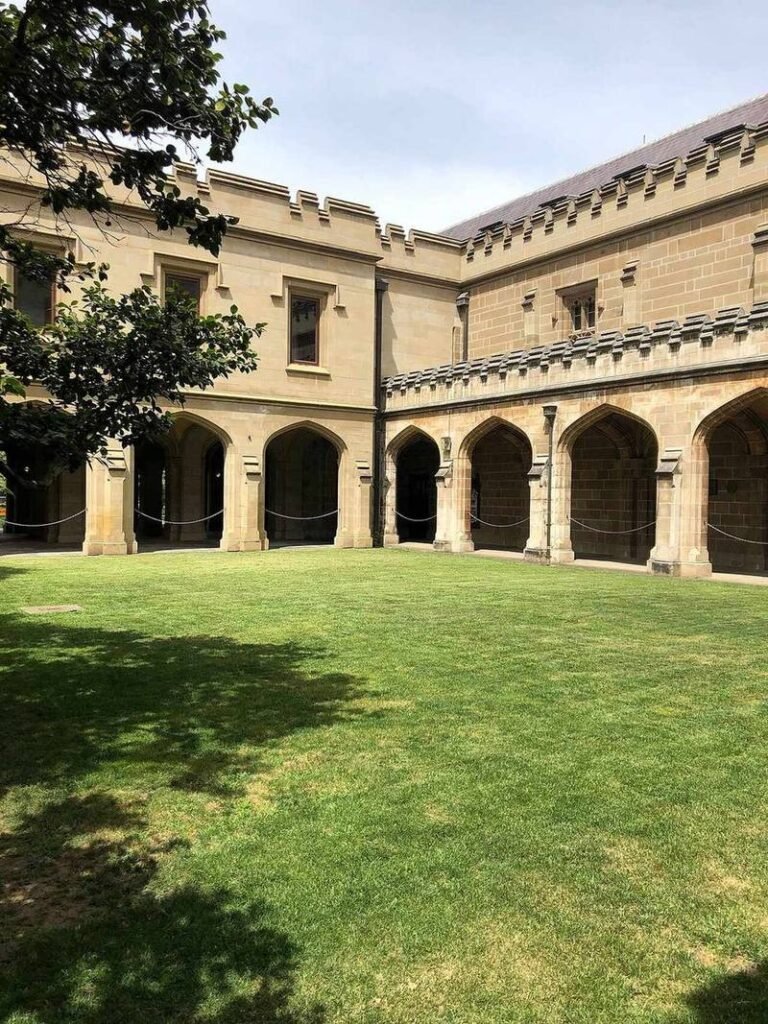
The Parkville campus blends Victorian-era sandstone quadrangles — the Old Arts Building and the Old Quad, pictured in this guide — with contemporary research facilities [19].
There are 10 residential colleges [18] — Trinity (1872), Ormond (1881), Janet Clarke Hall (1886), Queen’s (1887, opened 1888), St Mary’s (1918), Newman (1918), University College (1937), St Hilda’s (1964), International House and Wilam Hall [18][19] — surrounding the northern crescent of Parkville, plus five university-owned halls of residence [19]. Eight of the ten are affiliated colleges; International House and Wilam Hall are owned and operated by the university. (A ninth affiliated college, Graduate House, is graduate-only.)
Student life runs through 230+ clubs [2], and the university’s specialist support for international students is the Melbourne University Overseas Students’ Service. Melbourne itself is ranked #4 in the QS Best Student Cities list 2027 [2], and has won the Economist’s most liveable city award seven times.
Note: International students on a subclass 500 visa can work up to 48 hours a fortnight while the course is in session, and unlimited hours during scheduled course breaks [17]. That is enough for part-time work — it is not enough to fund your tuition, and no honest guide should tell you otherwise.
Placement & Career Outcomes
Melbourne does not publish a single first-destination salary table in the public domain, so I am using the figures the guides report from the official Graduate Outcomes Survey — and saying plainly which are which.
| Outcome | Figure | Source |
|---|---|---|
| PG coursework graduates in work (QILT GOS 2023) | 88.3% | [20] |
| PG coursework average salary (QILT GOS 2023) | AUD 88,000 | [20] |
| UG graduates in work (QILT GOS 2023) | 67.7% | [20] |
| UG median full-time salary (QILT GOS 2023) | AUD 65,300 | [20] |
| Graduates in full-time work within 4 months (2023 GOS) | 88%+ | [22] |
| Median graduate starting salary (2023 GOS) | ~AUD 70,000 | [22] |
| MPH domestic graduates employed within 6 months (GOS 2023–2025) | 9 in 10 | [23] |
| MPH median full-time salary (GOS 2025) | $106,000 | [23] |
| QS Graduate Employability | #8 in the world (QS 2022 edition) | [3][20] |
| THE Global Employability 2027 | #32 | #1 in Australia [20] |
| Top employers | NAB, EY, Deloitte, ANZ, Google, Microsoft | [20] |
| Bachelor’s graduates in employment (2017 survey, 3–5 years after) | 97% | [20] |
Two honest notes. First, the headline employment figures disagree across guides — one reports 96%+ of graduates employed within four months with a median starting salary of AUD 75,000+ [21], against the QILT-based 88%+ and ~AUD 70,000 [22]. I have used the QILT figures as the headline. [RESEARCH GAP: Requires manual lookup of employment within four months — 96%+ and median AUD 75,000+ vs QILT 88%+ and ~AUD 70,000] Second, the undergraduate placement rate (67.7%) is much lower than the postgraduate rate (88.3%) [20] [RESEARCH GAP: Requires manual lookup of salary-by-degree figures for Melbourne graduates (LLM $136,000; MBA $104,000; MFin $100,000; BSc $64,000)] — which is exactly what you would expect at a university where most undergraduates go on to a professional master’s rather than straight into work. Judge Melbourne on the postgraduate figures, not the undergraduate ones.
The structural advantage is real: Melbourne is ranked #1 in Australia for graduate employability [3][21], its top employers include NAB, EY, Deloitte, ANZ, Google and Microsoft [20], and the post-study work visa turns the degree into Australian work experience — which is the outcome Indian families are actually buying.
Notable Scholars & Alumni
Melbourne’s alumni include ten Nobel Prize laureates (among faculty, researchers and alumni), four Australian prime ministers and five governors-general [19].
| Person | What they did |
|---|---|
| Julia Gillard | Former Prime Minister of Australia [24] |
| Germaine Greer | Author and feminist scholar [24] |
| Nicole Kidman | Actor [24] |
| Randeep Hooda | Actor [24] |
| Rony Chieng | Comedian [24] |
| Tahir Bhasin | Actor [24] |
| Stephanie Alexander | Food writer and restaurateur [24] |
| The 10 Nobel laureates | Ten Nobel Prize laureates among faculty, researchers and alumni [19] |
| Four Australian prime ministers | Including Julia Gillard [19][21] |
Top Professors & Research Leaders
The project document for this guide asks for the top professors and principal investigators by name. I am not listing individual professors here, and I want to be plain about why: I could not verify a current, accurate list of individual PIs from a citable source, and a stale or wrong list of “top professors” would mislead you more than it would help. Professors move, retire, and change labs; a 2026 guide that names 2023’s stars is worse than useless. [RESEARCH GAP: Requires manual lookup of current principal investigators by name for the University of Melbourne]
What I can tell you, verified: Melbourne’s staff and honorary staff include Associate Professor Tilman Ruff AO, co-founder of the International Campaign to Abolish Nuclear Weapons (ICAN), awarded the 2017 Nobel Peace Prize, and Professor Marcia Langton AO, Redmond Barry Distinguished Professor and one of Australia’s leading Aboriginal scholars [23]. The university is associated with the Walter and Eliza Hall Institute of Medical Research, the Florey Institute of Neuroscience and Mental Health, the Melbourne Institute of Applied Economic and Social Research and the Grattan Institute [19].
The strongest route to a professor is the department route — read the faculty pages of the department you want, find the labs publishing in your area in the last two years, and write to the PI with a specific question about their work. That email, not a list in a guide, is what gets a PhD applicant noticed.
More University Guides
 University of Toronto Guide 2027: Fees, Admissions & Scholarships for Indian StudentsCanada • University Guide
 NUS Guide 2027: Fees, MOE Grant & Admissions for Indian StudentsSingapore • University Guide
 ETH Zurich Guide 2027: Fees, Admissions & Scholarships for Indian StudentsSwitzerland • University Guide
Frequently Asked Questions
How much does the University of Melbourne cost for an Indian student in 2027?
International undergraduate tuition for 2027 is AUD 44,356–65,360 a year (about ₹29–42 lakh), with the Bachelor of Commerce at AUD 56,451–62,464 and the Bachelor of Science at AUD 55,565–65,360 [8]. A realistic first-year total is about AUD 89,000–95,000 without a scholarship.
What is the Melbourne International Undergraduate Scholarship and can Indians apply?
Yes — it gives 20% fee remission for the whole degree from 2027 intakes (225 awards), is automatic with no separate application, and Indian citizens qualify because India is on the GDP-per-capita (US$10,000 or less) country list [11][12][13]. The academic bar is high and competitive — the university publishes no fixed percentage for the MIUS.
What are the University of Melbourne deadlines for 2027 entry?
Undergraduate applications for Semester 1, 2027 close on 30 November 2026; for Semester 2, 2027 they close on 31 May 2027 [8][10][13]. Apply through the UMAP portal, which opened on 1 March 2026 [13]. Semester 1 teaching begins in February–March 2027 and Semester 2 in July 2027 [8].
What Class 12 marks do I need for the University of Melbourne?
The published floor for the main bachelor’s degrees (Commerce, Science, Arts, Design) is Class 12 with 75% or above [8]. Melbourne recognises CBSE AISSC and CISCE ISC for direct entry [3]. For the MIUS scholarship the bar is far higher — and the university publishes no fixed percentage for it.
What is the Melbourne Model?
Instead of dozens of specialised undergraduate degrees, Melbourne offers nine broad bachelor’s degrees (Agriculture, Arts, Biomedicine, Commerce, Design, Fine Arts, Music, Oral Health, Science) for three years, with about a quarter of the degree in ‘breadth’ subjects outside your faculty [18][19]. Professional degrees — Law, Medicine, Engineering — are studied at graduate level [18][19].
Can I work in Australia after graduating from the University of Melbourne?
Yes — international graduates can apply for post-study work rights (the Temporary Graduate visa). Outcomes support it: 88.3% of postgraduate coursework graduates were in work (QILT GOS 2023) with an average salary of AUD 88,000, and Melbourne is ranked #1 in Australia for graduate employability [3][20][21].
Sources & Last Updated
- Vappingo — University of Melbourne Admissions 2026 — founded 1853; THE 2026 #37; top programmes Medicine, Law, Arts. Two figures are wrong: ARWU 2025 #39 (ARWU 2025 is #38, ARWU 2026 is #37) and QS 2026 #33 (that is the QS 2023 position — QS 2026 is #19, QS 2027 is #22). The 2027 ranking figures in this guide are the official 2027 editions, not this page’s figures.
- Shiksha — What is Student Life like at the University of Melbourne — established 1853; 53,000+ students; 45% international from 150+ countries; QS 2026 #19; THE 2026 #37; #4 in the QS Best Student Cities list 2027; 300+ programmes; 230+ clubs.
- CloudFront — The University of Melbourne — QS 2026 #19; THE #37; 53,000+ students; graduate employability #8 (QS); scholarships list (MIUS, Commerce Merit, Chancellor’s, Research, RTP, Science Graduate, International House, Human Rights, Trinity College); CBSE/ISC accepted for direct entry; #1 in Australia.
- UniEnrol — 10 Top Universities in Australia (QS World Rankings 2026) — Melbourne #19 in QS 2026, #1 in Australia, Group of Eight member; 48,000 students; 51% international; 23:1 student-to-teacher ratio; Sports, Legal Studies and Life Sciences & Medicine in the QS subject top 20.
- Collegedunia — University of Melbourne Acceptance Rate 2026 — acceptance rate approximately 70–80% (estimated; the university does not publish official acceptance rates); 1,300+ Indian students enrolled; QS 2026 #19; #1 in Australia by THE 2026; 53,000+ students across seven campuses; 20,000+ international students (45%); 150+ countries.
- GlobalScholarships — 7 Best Universities in Melbourne for International Students — founded 1853, second-oldest in Australia; QS 2026 #19; THE 2026 #37; ARWU 2025 #38.
- XuanXiao — The University of Melbourne Rankings — QS 2027 #22, THE 2027 #34, ARWU 2026 #37, US News 2027 #28; QS history: 2023 #33, 2024 #14, 2025 #13, 2026 #19, 2027 #22; students 55,445 (THE 2027); international 52.8% (THE 2027); 51% international (QS); 11th in QS Sustainability Rankings 2026.
- Collegedunia — University of Melbourne: Admissions, Fees 2026, Rankings & Scholarships — all of this page’s fee figures are the 2026 figures (BA 38,004–56,252; BCom 52,360–59,052; BSc 52,944–62,208; BDes 43,868–57,900; PG standard band 48,992–65,984; MBA 60,192; MFin 65,984; MDS 57,984; JD 57,984; MGMC 48,992). The 2027 figures in this guide are from each course’s own official fee page, via Unipage’s fee table (https://www.unipage.net/en/47/university_of_melbourne). This page also publishes the AUD 154 application fee (used for the C-35 row). Class 12 floor 75%+ is the university-wide floor (BCom needs 90%+ with Mathematics). Semester 1, 2027 closes 30 November 2026; Semester 2, 2027 closes 31 May 2027. Exchange rate used in this guide is 1 AUD = ₹64.4 (Wise, 11 November 2026), not this page’s ₹68 (September 2026).
- Shiksha — The University of Melbourne Fees 2027 — UG AUD 37,884–80,984; PG first-year AUD 20,992–112,000; 1st-year UG INR 29.2–58.7 lakh; PG INR 27.9–61.15 lakh; living costs AUD 1,500–3,000/month; hostel INR 21.69–21.81 lakh/year; OSHC INR 43.32K–43.56K.
- Shiksha — The University of Melbourne Courses & Fees 2027 — 300+ courses, 90+ undergraduate, 200+ master’s; Semester 1, 2027 deadline 30 November 2026; MBA may require GRE/GMAT. The English figures are wrong as stated: the undergraduate PTE floor is 58, not 64 (64 is a course-specific requirement, e.g. Master of Business); the postgraduate ranges are IELTS 6.5–7.5, TOEFL 79–100, PTE 58–78 (standard 6.5/79/58; MBA 7.0/PTE 65; JD 7.5/100/78), not IELTS 6.5–7 / TOEFL 79–94 / PTE 58–72.
- LeapScholar — University of Melbourne Scholarships 2026 — MIUS 20% fee remission from 2027 intakes, 225 awards; most scholarships need no separate application; residential colleges run separate scholarship applications, often 2–3 months before the university’s own rounds close. Two figures are wrong: the AG Whitlam scholarship is NOT a 50% fee remission — it is a living allowance of AUD 10,000 a year for three years (up to AUD 30,000), 15 awards, for Bachelor of Commerce students, with no country restriction (official AG Whitlam page: https://scholarships.unimelb.edu.au/awards/ag-whitlam-international-undergraduate-scholarship); and the ‘82%+’ is for top undergraduate merit awards generally, not the MIUS — the official MIUS page (https://scholarships.unimelb.edu.au/awards/melbourne-international-undergraduate-scholarship) states no percentage bar.
- ZorviaMag — The Melbourne International Undergraduate Scholarship 2027 — 20% fee remission from 2027 (was 25% before 2027), 225 awards; citizenship of a country with GDP per capita of US$10,000 or less (World Bank data), India included; notified within five working days of the course offer; no separate scholarship form; can be deferred with the course offer; 31 October 2026 deadline claim (conflicts with 30 November — see unverified).
- WorldOpportunitiesHub — University of Melbourne Undergraduate Admissions 2027 for International Students — UG applications for 2027 open; MIUS 20% fee remission; Semester 1, 2027 apply by 30 November 2026; Semester 2, 2027 apply by 31 May 2027; late applications may be accepted if places remain.
- StudyCorner — Melbourne International Undergraduate Scholarship — GDP per capita US$10,000 or less; Semester 1, 2027 deadline 30 November 2026, Semester 2, 2027 deadline 31 May 2027; automatic consideration, no separate application. Two figures are wrong: the MIUS ’95–96%’ for Indian boards is secondary-only — the official MIUS page (https://scholarships.unimelb.edu.au/awards/melbourne-international-undergraduate-scholarship) states no percentage bar; and the 25% figure is stale (pre-2027) — the MIUS is 20% from 2027 intakes.
- GoStudyIn — Australia Student Visa Requirements: Fees, Funds & English — subclass 500 needs a CoE, Genuine Student requirement, and at least AUD 29,710 in annual living costs; visa application charge AUD 2,500 from 1 July 2026.
- My Migration — International Students in Australia — subclass 500, living funds AUD 29,710/year plus tuition and travel. The OSHC range (AUD 500–700/year single) is too low at the top end — the verified 2026 provider range is AUD 665–726/year. Internally inconsistent on the visa charge (its table says AUD 2,000; its text says AUD 2,500): AUD 2,000 was the rate from 1 July 2025; the current charge is AUD 2,500 from 1 July 2026.
- AustralianVisaOnline — Student Visa 500 Australia: 2026 Costs & Requirements — subclass 500 costs AUD 2,500 (main applicant); work rights up to 48 hours per fortnight during term, unlimited during breaks; financial capacity AUD 29,710/year living costs + tuition + travel; OSHC AUD 500–700/year single; CoE and Genuine Student requirement.
- AugStudy — The Group of Eight: The University of Melbourne — main campus Parkville, about 15 minutes’ walk from Melbourne CBD; 50,000+ students. Three figures are stale or wrong: there are NINE undergraduate degrees today (Agriculture, Arts, Biomedicine, Commerce, Design, Fine Arts, Music, Oral Health, Science — official glossary: https://www.unimelb.edu.au/glossary), not six; NINE faculties, not 18; and the colleges list omits Wilam Hall and wrongly includes Medley Hall — the 10 residential colleges are Trinity, Ormond, Janet Clarke Hall, Queen’s, St Mary’s, Newman, University College, St Hilda’s, International House and Wilam Hall. The ‘400+ graduate degrees’ figure is kept as AugStudy-reported (Shiksha reports 340+ graduate programs — unresolved conflict).
- Wikipedia — University of Melbourne — founded 1853, Australia’s second-oldest university and oldest in Victoria; main campus Parkville; 10 Nobel laureates, 4 Australian prime ministers, 5 governors-general; 9 affiliated colleges and 5 university-owned halls; law school 1857, engineering 1861, medicine 1862; colleges from 1872 (Trinity 1872, Ormond 1881, Janet Clarke Hall 1886, Queen’s 1887, St Mary’s 1918, Newman 1918, University College 1937, St Hilda’s 1964); associated with WEHI, the Florey Institute, the Melbourne Institute and the Grattan Institute. Used only where no official source exists: ’10 academic units’ is the older count (the official figure is 9 faculties); ‘most of any Australian university’ is wrong for prime ministers (Sydney has 6).
- Shiksha — University of Melbourne Placement Overview 2023 (PDF) — THE Graduate Employability 2025 #44; QS Graduate Employability 2022 #8; QILT Graduate Outcomes Survey 2023: PG coursework placement 88.3%, average salary AUD 88,000; UG placement 67.7%, average salary AUD 65,300; median UG AUD 65,300, PG AUD 88,000; top employers NAB, EY, Deloitte, ANZ, Google, Microsoft; 97% of bachelor’s graduates in employment (2017 survey, 3–5 years after).
- EducationalHub — Study at the University of Melbourne — 170+ countries; 4 Australian prime ministers; #1 Australian university for graduate employability. Three figures are wrong or untraceable: the ‘endowment AUD 3.8 billion’ is annual revenue, not an endowment — the endowment is ≈ AU$1.3 billion (2022); ‘8 Nobel laureates’ is the pre-2024 count — there are 10 (faculty, researchers and alumni); and ‘96%+ graduates employed within 4 months / median AUD 75,000+’ cannot be traced to QILT or any official source — this guide uses the QILT Graduate Outcomes Survey 2023 figures (PG 88.3% in work, AUD 88,000; UG 67.7%, AUD 65,300) instead. The ’53K+ students’ figure is superseded by the official 58,000+ (EFTSL).
- AcademicJobs — UniMelb Acceptance Rate — acceptance rate around 70% overall, 65–75%; PG 60–80%; PhD ~40%; 88%+ in full-time employment within four months (2023 Graduate Outcomes Survey); median starting salary around AUD 70,000.
- University of Melbourne (official) — Study Public Health — public health ranked #18 globally (ShanghaiRanking 2026); staff include Associate Professor Tilman Ruff AO (co-founder of ICAN, 2017 Nobel Peace Prize) and Professor Marcia Langton AO (Redmond Barry Distinguished Professor); 9 in 10 domestic Master of Public Health graduates employed within six months (Graduate Outcomes Survey 2023–2025), median full-time salary $106,000 (Graduate Outcomes Survey 2025).
- Collegedunia — University of Edinburgh vs The University of Melbourne — Melbourne alumni Julia Gillard, Randeep Hooda, Germaine Greer, Nicole Kidman, Rony Chieng, Stephanie Alexander, Tahir Bhasin; acceptance rate 70.0% (guide estimate — the university publishes no official acceptance rate). The salary-by-degree figures (LLM $136,000, MBA $104,000, MFin $100,000, BSc $64,000) are NOT used in this guide: the comparison page is internally inconsistent on them (another row on the same page says MBA $167,000, MFin $128,000).
- TopAustraliaUniversities — Melbourne International Undergraduate Scholarship — reports the MIUS as ‘up to 50% tuition reduction’. That is wrong: the MIUS is 20% fee remission from 2027 intakes (25% before 2027), 225 awards — official MIUS page: https://scholarships.unimelb.edu.au/awards/melbourne-international-undergraduate-scholarship. The 50% fee remission belongs to the Commerce Undergraduate International Merit Scholarship.
- StudyAU — University of Melbourne Application Process 2026 — UMAP portal opened 1 March 2026 for Semester 1, 2027 entry; Semester 1 closes 30 November 2026, Semester 2 closes 31 May 2027. The MIUS figure is wrong: it is 20% fee remission from 2027 intakes, 225 awards — not ‘50% for ~50 students’ (official MIUS page: https://scholarships.unimelb.edu.au/awards/melbourne-international-undergraduate-scholarship).
- EBSCO — University of Melbourne — Melbourne Model pioneered in 2008; 53,000+ students across seven campuses; Trinity College 1872, Newman and St Mary’s 1918, University College 1937. Three figures are wrong: ’11 residential colleges’ (there are 10); Ormond ‘1879’ is the foundation-stone year — the college opened in 1881; Queen’s ‘1888’ is the opening year — it was founded in 1887. The ‘53,000+ students’ figure is superseded by the official 58,000+ (EFTSL). This source is no longer cited in the body.
- The Broken Cap — University of Melbourne Review: The Melbourne Model, Academics & Admissions — Melbourne Model introduced in 2008; six core bachelor’s degrees (Arts, Science, Commerce, Design, Biomedicine, Fine Arts/Music); breadth subjects 50–75 credit points (roughly one-quarter of the degree); 10 academic faculties and graduate schools; Southbank Arts Campus; 10 residential colleges.
- StudyOptions — The University of Melbourne — CRICOS 00116K; main campus Parkville for over 165 years; Melbourne University Overseas Students’ Service; QS 2026 #19. Three figures are stale: ‘student population 60,000’ (official: 58,000+ EFTSL — https://www.unimelb.edu.au/about/facts-and-figures); THE 2025 #39 (THE 2027 is #34); ARWU 2024 #37 (ARWU 2026 is #37, ARWU 2025 #38).
- JRM Migration — Subclass 500 Student Visa Australia 2026 — visa fee AUD 2,500 from 1 July 2026; living-cost funds AUD 29,710/year; Genuine Student requirement replaced the Genuine Temporary Entrant test. The ‘4–6 weeks’ processing time is a guide estimate, not a department figure — this guide uses the Department of Home Affairs global processing times (subclass 500, Higher Education: 50% within 25 days, 75% within 61 days, 90% within 7 months — https://immi.homeaffairs.gov.au/visas/getting-a-visa/visa-processing-times/global-visa-processing-times).
Last updated: 11 November 2026. Figures are the published 2027 academic-year values unless stated otherwise; 2028 fees are not yet published.
By Rohit Gupta
If this guide helped you, share it with someone applying to Australia. For questions, write to universityresearchers3@gmail.com.
[…] 🇦🇺 Australia […]