
MIT Guide 2027: Fees, Admissions & Scholarships for Indian Students

QS #1, need-blind aid, EA/RA deadlines, SAT rules and UROP — verified from official sources.
By Rohit Gupta
Last updated: 11 November 2026
MIT is the #1 university in the world — QS has ranked it first for more than a decade, a record no other university comes close to.[1][20] For an Indian student who wants to build things — software, robots, rockets, companies — there is no stronger name on a CV. But MIT is also the most misunderstood elite university in one specific way: families assume it is only for the rich, when its aid policy is among the most generous in the world. Families earning under $100,000 (≈ ₹95 lakh) pay nothing; families under $200,000 (≈ ₹1.9 crore) pay no tuition; and the median price actually paid by a scholarship recipient was $11,432 a year in 2025-26 (≈ ₹10.9 lakh; the last year with full data; $10,268 was the 2024-25 figure).[4]
This guide gives you the verified facts: the 2026-27 fees with the aid arithmetic, the Fall 2027 deadlines (MIT runs its own application portal, not the Common App, and its regular round is called Regular Action, due 4 January 2027 — not 1 January like Harvard), the SAT/ACT requirement, the UROP research programme that lets undergraduates do real research from year one, and what MIT graduates actually earn. Everything with a number in it is linked to its source and cited — and everything I could not verify is listed honestly at the end. If you searched for an MIT guide 2027 Indian students can trust, this is the one I would want you to read — every number linked to its source, and everything I could not verify listed honestly at the end.
Key points
- Rankings: QS 2027 #1 (100.0) — 15th consecutive year at #1, THE 2027 #2 (97.8), ARWU 2026 #3 (74.1).[1][21]
- Founded in 1861 — motto Mens et Manus (Mind and Hand) — with 11,816 students (MIT Facts 2026) and 4,030 international students (28%).[22]
- Undergraduate tuition 2026-27: $66,720 a year (≈ ₹63.4 lakh); full cost of attendance $92,760 (≈ ₹88.1 lakh).[4][5]
- Financial aid: need-blind for international students; 100% of demonstrated need met; families under $100,000 (≈ ₹95 lakh) pay $0; families under $200,000 (≈ ₹1.9 crore) pay $0 tuition; 57% of undergraduates held an MIT Scholarship in 2024-25 (58% in 2025-26).[4][6]
- Fall 2027 deadlines: Early Action 1 November 2026; Regular Action 4 January 2027; SAT or ACT is required, taken before 30 November (EA) or 31 December (RA).[9][12]
- Acceptance rate: 4.6% for the Class of 2030 (1,299 admitted from 28,349 applicants, at decision release in March 2026).[3]
- Outcomes: average starting salary for graduates entering industry $145,820 (≈ ₹1.39 crore); Sloan MBA median base $175,000 (≈ ₹1.66 crore) (Class of 2025).[13]
| At a glance | |
|---|---|
| Full name | Massachusetts Institute of Technology (MIT) |
| Founded | 1861 (chartered 10 April 1861) |
| Location | Cambridge, Massachusetts, USA |
| Type | Private research university |
| Motto | Mens et Manus — Mind and Hand |
| Students | 11,816 (MIT Facts 2026); 4,561 undergraduates, 7,255 graduate students[22] |
| International students | 3,430 (28.8%) in 2024-25; 4,030 (28%) in fall 2025, from 138 countries[3][22] |
| Schools | 5 schools + Schwarzman College of Computing[18][19] |
| QS 2027 / THE 2027 / ARWU 2026 | #1 / #2 / #3[1][21] |
| Endowment | $27.4 billion (fiscal 2025)[5] |
| Nobel laureates | 106 Nobel laureates and 18 A.M. Turing Award winners among current and former community members (MIT Facts 2026)[15] |
| Undergraduate tuition (2026-27) | $66,720 a year; cost of attendance $92,760[4] |
| F-1 visa fees | $785 total (SEVIS $350 + MRV $185 + $250 Visa Integrity Fee, payable at visa issuance) |
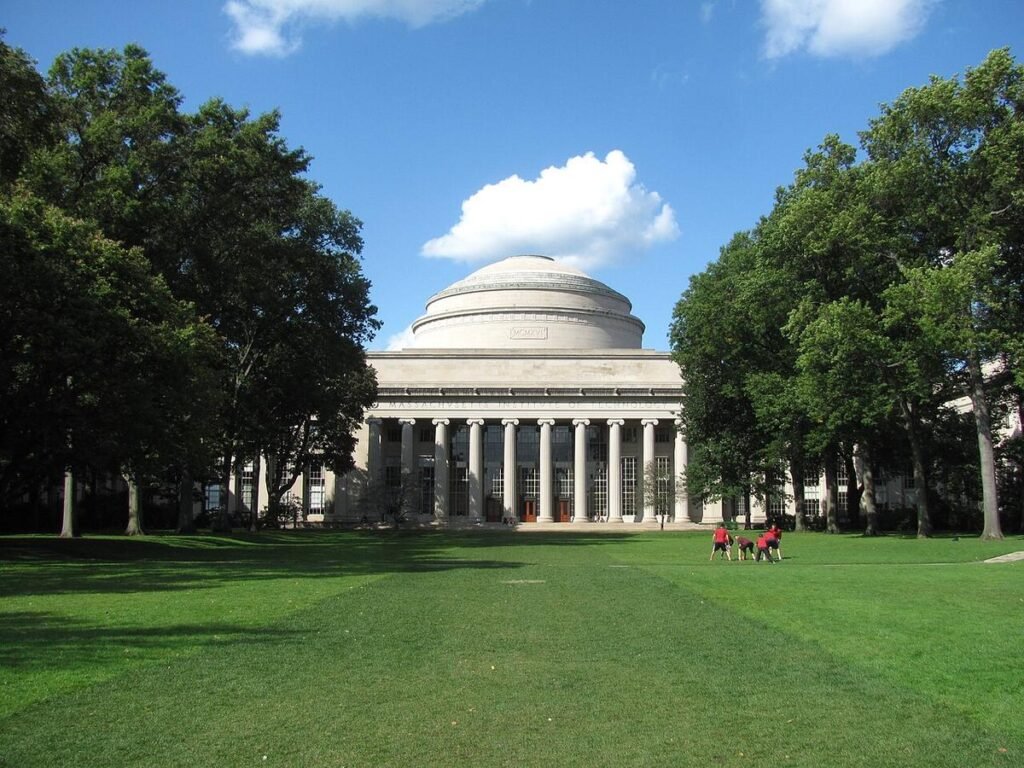
Table of Contents
The 3 MIT Traps Every Indian Family Falls Into
The first confusion I clear up for every Indian family is the IIT-versus-MIT question. They are not the same kind of institution, and the comparison misses the point. IITs select through one exam; MIT selects holistically — your essays, recommendations, research, and character matter as much as your test score. And MIT’s undergraduate college is tiny: about 4,500 undergraduates total, with only 529 international undergraduates in fall 2025.[3] For an Indian applicant, the undergraduate international places are among the scarcest in the world. That is the honest starting point: MIT is harder to get into as an international undergraduate than as a graduate student, and you should apply to both levels with different expectations.
The second confusion is money. MIT’s sticker price — $92,760 a year — is the highest of the three US universities in this series. But the price almost nobody pays is the sticker: 57% of undergraduates held an MIT Scholarship in 2024-25 (58% in 2025-26), the median scholarship was $69,777 in 2024-25, and the median price paid by a scholarship recipient was $11,432 a year in 2025-26 (≈ ₹10.9 lakh).[4][6] Families under $200,000 typically attend tuition-free; under $100,000, they pay nothing.[4] MIT planned $176 million in need-based scholarships for 2025-26.[4] Do the aid arithmetic before you decide MIT is unaffordable.
The third confusion is the application itself. MIT does not use the Common Application — it runs its own portal, with its own short essays and its own deadlines.[9][10] Its regular round is called Regular Action (not Regular Decision) and it is due 4 January 2027, not 1 January like Harvard.[9] And its Early Action is non-restrictive — unlike Harvard’s Restrictive Early Action, you can apply early to other universities too.[3] These small differences have sunk applications from students who copied Harvard’s dates onto MIT’s form.
Note: If you are reading this after 1 November 2026, Early Action for Fall 2027 has closed. Regular Action is still open until 4 January 2027 — but your SAT or ACT must be taken before 31 December 2026, and your financial aid documents are due 15 February 2027.[9][12]
Pro tip: MIT’s financial aid application is separate from the admissions application and has its own deadlines — 30 November 2026 for Early Action, 15 February 2027 for Regular Action — for international students too.[9] File the CSS Profile and IDOC on the aid calendar, not the admissions calendar, or your aid decision will arrive late or not at all.
1861, Five Schools, One Maker Culture: What MIT Actually Is
MIT was founded in 1861, chartered on 10 April 1861 just as the American Civil War began, by the scientist William Barton Rogers — founded, in his words, to accelerate the nation’s Industrial Revolution.[3] It is a private research university in Cambridge, Massachusetts, across the Charles River from Boston, and its motto is Mens et Manus — Mind and Hand — which is not decoration: MIT’s entire identity is learning by doing, building, and making.
Today MIT has 11,816 students (MIT Facts 2026) — 4,561 undergraduates and 7,255 graduate students (11,816 in total) — with 4,030 international students (28%).[22] In fall 2025 the international count was 4,030 (28%) from 138 countries — 3,437 in degree programmes (529 undergraduates and 2,908 graduates) plus 593 exchange, visiting and special students — of whom only 529 were undergraduates — most international students at MIT are graduate students, which is why the undergraduate international acceptance rate is so low.[3] Indian students number 286, the second-largest international community at MIT after China (980), in 2025-26 (MIT International Students Office).[23] The university has over 1,000 faculty members, including Nobel laureates, MacArthur Fellows and Turing Award winners, and a student-to-faculty ratio of about 3:1.[15][26]
MIT’s research mission is visible everywhere: the Computer Science and Artificial Intelligence Laboratory (CSAIL) — the world’s premier computer science research facility — the Media Lab, the Research Laboratory of Electronics, Lincoln Laboratory, and the Koch Institute for Integrative Cancer Research.[26] MIT alumni have founded over 30,000 active companies — including Intel, Qualcomm, Dropbox, Bose, HubSpot, iRobot and Akamai — collectively generating about $1.9 trillion in annual revenue (Roberts, Murray & Kim, 2019 update of the 2014 survey; MIT’s current marketing rounds this to $2 trillion) and employing around 4.6 million people.[24]
MIT’s Real Rank in 2027: #1 in the World for the 15th Straight Year
| Ranking | MIT position | Notes |
|---|---|---|
| QS World University Rankings 2027 | #1 (100.0) | #1 for the 15th consecutive year[1][3] |
| Times Higher Education (THE) 2027 | #2 (97.8) | Behind Oxford[21] |
| ARWU (Shanghai) 2026 | #3 (74.1) | Behind Harvard and Stanford[21] |
| U.S. News Best National Universities 2027 | #1 (score 100) | Ahead of Princeton (#2, 99) and Harvard (#3, 96); published 22 September 2026 — MIT’s first time at #1 after five years at #2[27] |
| U.S. News Best Global Universities 2026-27 | #2 (score 97.0) | Behind Harvard (#1, 100.0); published 16 June 2026[1] |
| QS Subject Rankings 2026 | #1 | Engineering & Technology; Computer Science & Information Systems; Physics & Astronomy[20] |
My advice on rankings: MIT has held QS’s top spot for 15 consecutive years — a record no other university comes close to — and scored a perfect 100.0 on the QS 2027 table.[1][2][3] But the ranking that matters most for an Indian applicant is the subject table: MIT is #1 in Engineering & Technology, #1 in Computer Science, and #1 in Physics & Astronomy.[20] If you want to study those subjects, there is no higher-ranked place on Earth to do it.
The table below is the quick reference for this MIT guide 2027 Indian students asked for — the ranks, the acceptance rate and the fees in one place.
| Metric | Figure | Source |
|---|---|---|
| QS World University Rankings 2027 | #1 | [1] |
| THE World University Rankings 2027 | #2 | [21] |
| ARWU (Shanghai) 2026 | #3 | [21] |
| Acceptance rate | 4.6% (1,299 admitted from 28,349 applicants, Class of 2030, at decision release in March 2026; 1,334 from 29,281 is the Class of 2029 final count) | [3] |
| Student-to-faculty ratio | About 3:1 | [15][26] |
| Researcher-to-faculty ratio | — [RESEARCH GAP: Requires manual lookup of MIT’s researcher-to-faculty ratio] | — |
| Publication volume | — [RESEARCH GAP: Requires manual lookup of MIT publication volume] | — |
| Undergraduate tuition (2026-27) | $66,720 a year; cost of attendance $92,760 | [4] |
The $92,760 Question: What MIT Really Costs (and Who Pays $0)
Undergraduate, 2026-27
| Item | Per year |
|---|---|
| Tuition ($33,360 per term) | $66,720[4] |
| Housing | $14,090[5] |
| Food | $8,104[5] |
| Student life fee | $420[5] |
| Books | $930[5] |
| Personal expenses | $2,496[5] |
| Total cost of attendance | $92,760 (≈ ₹88.1 lakh)[4] |
MIT Student Financial Services’ own itemised figure is $92,760 (the components sum exactly).[3][4] For comparison, the 2025-26 cost of attendance was $89,340.[6] Graduate costs are higher: for a standard 9-month academic year the estimated total is $109,017, rising to $144,315 for a 12-month period.[8]
The aid arithmetic is what makes MIT possible for Indian families:
| Family income (per year) | What you pay |
|---|---|
| Under $100,000 | $0 — nothing toward the full cost (median MIT Scholarship $85,236; median net price $0)[6] |
| $100,000–$200,000 | $0 tuition; family contribution toward housing and food on a sliding scale, up to about $23,970 a year (median net price $19,734)[3][6] |
| Over $200,000 | Assessed individually (median MIT Scholarship $37,750; median net price $49,083)[6] |
In 2024-25, 57% of MIT undergraduates received an MIT Scholarship, 39% attended tuition-free, and the median scholarship was $69,777.[6] The median price paid by a scholarship recipient was $10,268 a year in 2024-25.[4] (In 2025-26 it was $11,432, ≈ ₹10.9 lakh.) The average need-based grant is $71,120 (Common Data Set H2, estimated), and first-years who received need-based aid got an average grant of $73,398.[4][5] 411 international undergraduates received MIT aid averaging $81,991.[4] In 2025-26, about 60% of MIT students received financial aid, and around 40% attended tuition-free.[3]
Note: MIT has no merit scholarships, no sports scholarships and no special international awards for undergraduates — the “MIT Scholarship” is its need-based grant, and asking for aid does not affect your admission decision.[6] If an agent promises you an “MIT merit scholarship”, they are selling you something that does not exist.
Pro tip: Use MIT’s Net Price Calculator on the Student Financial Services website (sfs.mit.edu) before you apply. It takes ten minutes and tells you, with your family’s actual income and assets, what MIT would most likely cost you. Most Indian families who run it are surprised — in the good direction.
Graduate programmes
Graduate funding works differently from undergraduate aid: most MIT PhD students are funded through research assistantships, teaching assistantships or fellowships that cover tuition plus a stipend, and the funding decision is made by the department, not by a central aid office. Master’s students (MEng, SM, MBA, Master of Finance, Master of Business Analytics) generally pay tuition and should budget the graduate cost of attendance above — $109,017 for 9 months — unless they win a fellowship.[8] Check your programme’s funding page before you apply: a PhD offer without funding at MIT is rare, but a master’s offer without funding is normal.
How to Get MIT to Pay for Your Degree
The funding picture below is the part of this MIT guide 2027 Indian students ask me about most — the MIT Scholarship, need-blind aid and the rest, with the deadlines that decide them. The aid tables in the fees section above have the full figures; this section tells you how the money actually works.
MIT has no merit scholarships, no sports scholarships and no special international awards for undergraduates — the “MIT Scholarship” is its need-based grant, and asking for aid does not affect your admission decision.[6] In 2024-25, 57% of MIT undergraduates received an MIT Scholarship, 39% attended tuition-free, and the median scholarship was $69,777.[6] The median price paid by a scholarship recipient was $10,268 a year in 2024-25.[4] (In 2025-26 it was $11,432.) MIT planned $176 million in need-based scholarships for 2025-26.[4]
Graduate funding works differently from undergraduate aid: most MIT PhD students are funded through research assistantships, teaching assistantships or fellowships that cover tuition plus a stipend, and the funding decision is made by the department, not by a central aid office. Master’s students (MEng, SM, MBA, Master of Finance, Master of Business Analytics) generally pay tuition and should budget the graduate cost of attendance — $109,017 for 9 months — unless they win a fellowship.[8] Check your programme’s funding page before you apply: a PhD offer without funding at MIT is rare, but a master’s offer without funding is normal.
Crucial Compliance Note: MIT’s financial aid application is separate from the admissions application and has its own deadlines — 30 November 2026 for Early Action, 15 February 2027 for Regular Action — for international students too.[9] File the CSS Profile and IDOC on the aid calendar, not the admissions calendar, or your aid decision will arrive late or not at all.
How to apply for funding, step by step:
- Run the Net Price Calculator first. Use it on the Student Financial Services website (sfs.mit.edu) before you apply — ten minutes with your family’s actual income and assets tells you what MIT would most likely cost you.
- File the CSS Profile and IDOC on the aid calendar, not the admissions calendar. Aid documents are due 30 November 2026 for Early Action or 15 February 2027 for Regular Action — the same deadlines for international students.[9]
- For a PhD, check your department’s funding page. PhD funding comes through research or teaching assistantships, decided by the department — confirm the package before you apply.
- For a master’s, budget the full graduate cost unless you win a fellowship. The estimated total is $109,017 for a 9-month academic year.[8]
The MIT Application Timeline: Every Deadline That Decides 2027 Entry
Undergraduate — Fall 2027 entry
1. Apply through MIT’s own portal. MIT does not use the Common Application or the Coalition Application. You apply through MIT’s own online application.[10] You do not apply to a major on entry — you choose your course (major) later, and you can change it.
2. Choose your round. Early Action is non-binding and non-restrictive — you can apply early to other universities too, including Harvard and Caltech in their regular rounds.[3] Regular Action is MIT’s name for the regular round. Note the Caltech trap: Caltech’s Restrictive Early Action bars early applications elsewhere and does not include MIT in its exceptions — a Caltech REA applicant can apply to MIT only in Regular Action.[11]
3. Sit the SAT or ACT — it is required. MIT reinstated testing, and the SAT or ACT is required for all first-year applicants for Fall 2027. MIT counts a test only if you take it before 30 November 2026 for Early Action or before 31 December 2026 for Regular Action.[9][12] The middle 50% SAT range is 1520–1570 and the ACT middle range is 34–35 (enrolled first-year students, MIT Common Data Set 2025-26).[5] (The ‘1520–1580’ figure in one infographic is the implied range from MIT’s admitted-student section scores — SAT Math 780–800 and ERW 740–780; MIT’s admitted-student ACT Composite range is 34–36.) You self-report full test sittings on the application; MIT verifies scores when admitted students enrol.[12]
4. Write MIT’s short essays. MIT asks for several short essays (not one long personal statement) plus two teacher recommendations and your school transcript.[6] The essays are where MIT looks for the maker: what you built, what you fixed, what problem you could not leave alone.
5. Pay the $75 application fee or get a waiver. The fee is $75; waivers are available for students who cannot afford it.[6]
6. Interviews. Most interviews happen in November 2026 (EA) or January 2027 (RA), with MIT alumni interviewers (Educational Counsellors) around the world, usually online for Indian applicants.[9]
7. File financial aid separately. The aid application (CSS Profile + IDOC) is due 30 November 2026 for Early Action or 15 February 2027 for Regular Action — the same deadlines for international students.[9] English test scores are accepted through the January test dates (before 31 January 2027) for Regular Action; MIT’s minimum TOEFL iBT is 90 (recommended 100) on the pre-21 January 2026 0–120 scale; on the new 1–6 scale (from 21 January 2026) the minimum is 5 (recommended 5.5). IELTS minimum 7 (recommended 7.5).[9][10] (The English test is strongly recommended, not required, for non-native speakers who have used English for fewer than five years or do not speak it at home or at school.)
| Key date | What happens |
|---|---|
| 1 Nov 2026 | Early Action deadline (application + fee) |
| Before 30 Nov 2026 | SAT/ACT must be taken (Early Action) |
| 30 Nov 2026 | Financial aid documents due (Early Action) |
| Mid-Dec 2026 | Early Action decisions released |
| Before 31 Dec 2026 | SAT/ACT must be taken (Regular Action) |
| 4 Jan 2027 | Regular Action deadline (application + fee) |
| 15 Feb 2027 | Financial aid documents due (Regular Action) |
| Mid-Mar 2027 | Regular Action decisions released |
| 1 May 2027 | Reply deadline for admitted students |
| Sep 2027 | Term starts (Fall) |
Graduate — Fall 2027 entry
Each department runs its own admissions process, with deadlines typically between 1 December 2026 and 15 January 2027. Most MIT PhD programmes require the GRE (check your department — several have made it optional), and international applicants need TOEFL or IELTS. The Sloan MBA runs in rounds (Round 1 closed 29 September 2026; Round 2 closes 12 January 2027 at 3:00 p.m. ET; there is no Round 3 this cycle). Graduate applications go through each department’s portal, not the undergraduate portal.
Research From Year One: UROP, MISTI and the Maker Culture That Sets MIT Apart
This is the section that explains why MIT is different from every other university in this series. MIT’s motto is Mens et Manus — Mind and Hand — and the Institute is built around doing, not just studying.
UROP — the Undergraduate Research Opportunities Program — lets undergraduates work directly with faculty on real research, for pay or academic credit, from their first year. About 95% of undergraduates participate in UROP at some point, and one report puts participation at 93% for the Class of 2025.[25] You do not wait for graduate school to do research at MIT; you join a lab, build something, and often publish before you graduate. For an Indian student who has spent years in an exam system, UROP is the single biggest change in how you learn.
MISTI — the MIT International Science and Technology Initiatives — runs tailored international internships and research placements in companies and labs worldwide, with airfare and housing covered in many cases.[18] It is how MIT students get global experience without pausing their degree.
The maker culture is supported by more than 40 design and fabrication spaces, project-based courses, and the January Independent Activities Period (IAP) — four weeks in January for building pinball machines, learning stand-up comedy, taking a short intensive course, or running a research project.[25] Signature courses like 2.009 (Product Engineering Processes) have students design, invent and build a working product in a semester. MIT students may also cross-register at Harvard, Wellesley and MassArt.[25]
Inside MIT’s 168-Acre Workshop: Campus, Libraries and Labs
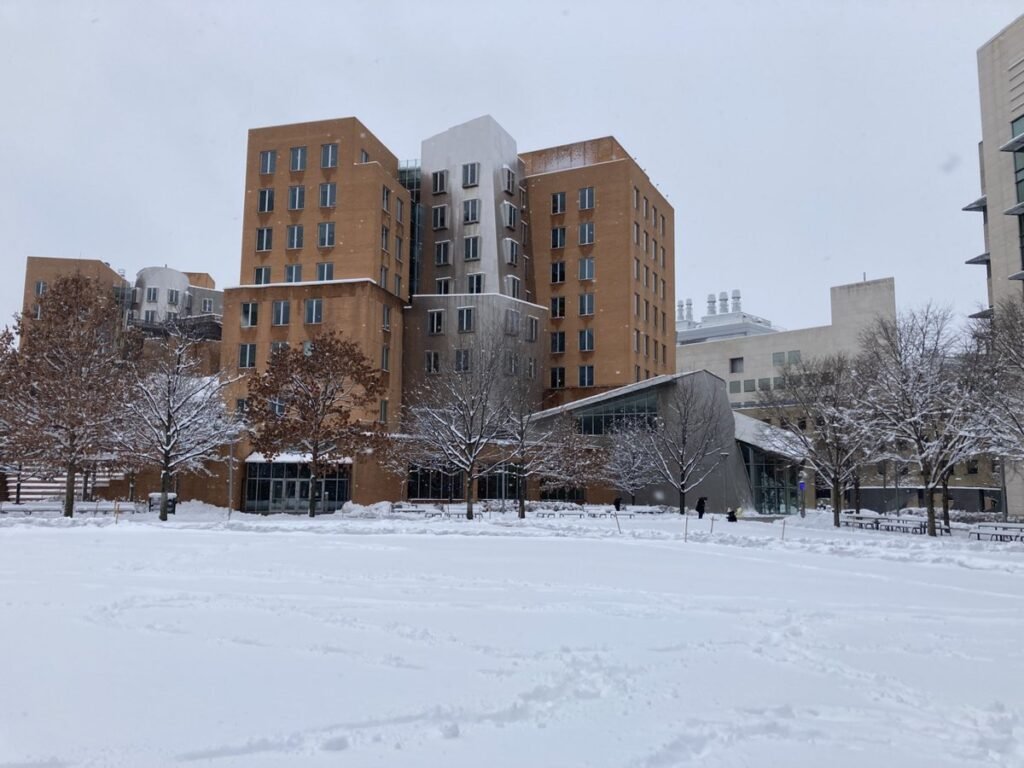
MIT’s campus sits along the Charles River in Cambridge, centred on the Great Dome (Building 10) and Killian Court, with the Stata Center — Frank Gehry’s famously irregular building, home to CSAIL — as its most photographed landmark. The campus is a workshop: machine shops, maker spaces, and laboratories sit next to dormitories, and the line between “classroom” and “lab” barely exists.
The MIT Libraries system includes the Barker Engineering Library, the Hayden Library (humanities and science), the Dewey Library (management and social sciences) and the Rotch Library (architecture and planning), plus the MIT Museum and the List Visual Arts Center. MIT’s research infrastructure — CSAIL, the Media Lab, the Research Laboratory of Electronics, Lincoln Laboratory, the Koch Institute and the Broad Institute (joint with Harvard) — is the largest concentration of research facilities of any university campus in the world. The Broad Institute deserves a note: it is a joint MIT–Harvard biomedical research institute, and it is where much of the world’s genomics research happens.
The Five Schools (Plus One College) That Run MIT — and Which One Fits You
MIT is organised into five schools plus the MIT Stephen A. Schwarzman College of Computing, which acts as a cross-cutting entity integrating computing education and research across all five schools (formally opened in September 2019; announced October 2018).[18][19] Undergraduates pursue a Bachelor of Science (S.B.) across 56 major programs and 62 minor programs (MIT Facts 2026).[27]
| School / College | What it covers | Flagship areas |
|---|---|---|
| School of Engineering (largest) | Aeronautics & astronautics, civil, electrical, mechanical, nuclear, chemical, materials, biological engineering | Course 6 (EECS) — the largest major; Course 2 (Mechanical Engineering)[18] |
| School of Science | Biology, brain & cognitive sciences, chemistry, earth/atmospheric/planetary sciences, mathematics, physics | Physics; Mathematics; Biology[18] |
| MIT Sloan School of Management | Management, finance, analytics, entrepreneurship | MBA; Master of Finance; Master of Business Analytics; Management Science (Course 15)[18] |
| School of Humanities, Arts, and Social Sciences (SHASS) | Economics, political science, linguistics, history, literature, philosophy | Economics — 14 MIT alumni have won the Nobel Prize in Economics; Political Science[18] |
| School of Architecture and Planning | Architecture, urban planning, media arts | Architecture; Urban Studies and Planning; Media Lab[18] |
| Schwarzman College of Computing (cross-cutting) | AI, data science, computing across all disciplines | CSAIL; AI & Decision-Making; Ethical computing[19] |
For Indian students, the strongest draws are Course 6 (Electrical Engineering & Computer Science) — the largest major and the one most Indian applicants target — Course 2 (Mechanical Engineering), Course 18 (Mathematics), Course 8 (Physics), Course 14 (Economics), and at graduate level the Sloan MBA, the Master of Business Analytics, and the PhD programmes in EECS, physics and economics. MIT’s Course 6-3 (Computer Science and Engineering) is a four-year B.S. whose graduates report a median starting salary of $126,500.[14]
The Labs Where the Future Gets Built: CSAIL, the Media Lab and the Broad
I judge a research university by what its laboratories let a scholar actually investigate, and MIT’s answer is the densest concentration of research facilities on any university campus in the world. The Computer Science and Artificial Intelligence Laboratory (CSAIL) is the world’s premier computer science research facility — the home of much of modern AI, robotics and systems research.[26] The Media Lab is famously anti-disciplinary: technology, art, design and social science in one building.[18] The Research Laboratory of Electronics (RLE) is MIT’s oldest and largest interdepartmental lab, spanning physics, electrical engineering and biology.[18]
For the life sciences, the Koch Institute for Integrative Cancer Research is where biology meets engineering at the cancer frontier, and the Broad Institute — a joint MIT–Harvard biomedical research institute — is where much of the world’s genomics research happens.[18] The campus also hosts Lincoln Laboratory, and the maker culture is supported by more than 40 design and fabrication spaces where machine shops and laboratories sit next to dormitories.[25]
The MIT Libraries system — Barker Engineering, Hayden (humanities and science), Dewey (management and social sciences) and Rotch (architecture and planning) — backs every school, alongside the MIT Museum and the List Visual Arts Center.
The interdisciplinary openings I can verify are built into the newest structure: the MIT Stephen A. Schwarzman College of Computing acts as a cross-cutting entity integrating computing education and research across all five schools (formally opened in September 2019; announced October 2018).[18][19] MIT students may also cross-register at Harvard, Wellesley and MassArt.[25]
Researcher Insider Tip: A laboratory matters more than a logo. A scholar who wants AI or robotics belongs near CSAIL, a scholar who wants genomics belongs near the Broad Institute, and a scholar who wants to build things belongs in the maker spaces — whatever the overall ranking says.
Faculty excellence, in one number: 106 Nobel laureates and 18 A.M. Turing Award winners among current and former community members (MIT Facts 2026), and 14 MIT alumni have won the Nobel Prize in Economics — nine people have won it while serving on the MIT Economics faculty.[15][28]
What MIT Graduates Actually Earn After Graduation
MIT does not run “placements” the way an Indian university does — it reports graduate outcomes through its annual Graduating Student Survey, and the figures below come from MIT’s own Institutional Research via that survey.[13]
| Outcome (2025 Graduating Student Survey) | Figure |
|---|---|
| Master’s graduates in full-time jobs (autumn after graduation) | 77.4%[13] |
| Bachelor’s graduates in full-time jobs (autumn after graduation) | 45.9%[13] |
| Average starting salary, graduates entering industry | $145,820 (≈ ₹1.39 crore)[13] |
| Sloan MBA median base salary (Class of 2025) | $175,000 (≈ ₹1.66 crore) (median other compensation $24,350 on top)[13] |
| Sloan MBA job-seekers with an offer within 3 months | 91%[13] |
| Master of Business Analytics median base salary (Class of 2025) | $143,000 (≈ ₹1.36 crore); 98.5% accepted an offer within 6 months[13] |
| Computer Science & Engineering B.S. median starting salary | $126,500 (guide-reported); top employers Google, Microsoft, Amazon, Meta, Apple[14] [RESEARCH GAP: Requires manual lookup of the MIT Course 6-3 median starting salary from MIT-published data] |
The bachelor’s full-time figure (45.9%) looks low only because MIT counts graduate-school enrolment separately — 41.2% of bachelor’s graduates went straight to graduate or professional school (2025 Graduating Student Survey).[13] The salary figure to remember is the $145,820 average starting salary for graduates entering industry, from MIT Student Financial Services — a mean across all industries and degree levels, so it overstates a humanities salary and understates a quant role.[13] For computer science specifically, one guide reports 97% in employment or graduate school within 6 months and an average starting salary of $128,000 — guide figures, not MIT-published, so treat them as indicative.[26] [RESEARCH GAP: Requires manual lookup of MIT computer science employment and starting-salary figures from MIT-published data]
Note: Do not compare MIT’s “average starting salary” with an IIT placement package — they measure different things. MIT’s figure is a mean across all industries and degree levels for graduates entering industry, and it excludes the large share who go to graduate school. The Sloan MBA medians above are the honest figures for that cohort, not a promise for every graduate.
My advice on careers: at MIT, the career advantage is not a placement cell — it is the network and the maker record. Employers recruit at MIT because UROP, IAP projects and the maker portfolio prove what a graduate can build, not just what they studied. Start building in year one; the job follows the portfolio.
Nobel Laureates, Moonwalkers and Khan Academy: MIT’s Alumni That Changed the World
MIT’s faculty and alumni include 106 Nobel laureates and 18 A.M. Turing Award winners (MIT Facts 2026).[15] Its alumni network spans about 146,000 living alumni (MIT Admissions, 2026), and its alumni have founded over 30,000 active companies generating about $1.9 trillion in annual revenue (Roberts, Murray & Kim, 2019 update of the 2014 survey; MIT’s current marketing rounds this to $2 trillion).[17][24][28]
| Person | MIT connection | Why they matter |
|---|---|---|
| Kofi Annan | M.S. Management, 1972 (Sloan) | 7th Secretary-General of the United Nations; Nobel Peace Prize 2001[16] |
| Buzz Aldrin | Sc.D. Astronautics, 1963 | Apollo 11 astronaut; second person to walk on the Moon[16] |
| Richard Feynman | B.S. Physics, 1939 | Nobel Prize in Physics 1965; quantum electrodynamics[16] |
| Amar Bose | Ph.D. Electrical Engineering, 1956 | Founder, Bose Corporation[16] |
| Drew Houston | S.B. Computer Science, 2006 | Co-founder and CEO, Dropbox[16][17] |
| Salman Khan | S.B. Mathematics and S.B. EECS, M.Eng. EECS, 1998 | Founder, Khan Academy[16] |
| Irwin Jacobs | M.S. 1957, Sc.D. 1959 | Co-founder, Qualcomm; former MIT professor[17] |
| Tom Leighton | Ph.D. Mathematics, 1981 | Co-founder and CEO, Akamai Technologies[16] |
| Paul Krugman | Ph.D. Economics | Nobel Prize in Economic Sciences 2008[17] |
| Andrea Ghez | B.S. Physics, 1987 | Nobel Prize in Physics 2020 (black holes)[15] |
| Shirley Ann Jackson | Ph.D. Physics, 1973 | Renowned physicist; former president of Rensselaer Polytechnic Institute[15] |
| Tim Berners-Lee | CSAIL faculty (not an alumnus) | Inventor of the World Wide Web[16] |
For Indian readers, the MIT–India thread runs through Amar Bose — whose name is on speakers in homes across India — and through the 286 Indian students on campus in 2025-26, the second-largest international community after China.[23] MIT’s economics community includes 14 Nobel laureates in Economics among its alumni, and nine people have won the prize while serving on the MIT Economics faculty.[28]
How to Find the Supervisor Who Gets You Funded
I do not name individual current professors in this guide, deliberately. Supervisors move, retire, and take sabbaticals; a name printed in November 2026 can be out of date by the time you apply. What I can tell you is where the research power sits and how to find the right person: [RESEARCH GAP: Requires manual lookup of current individual professors/PIs at MIT]
- CSAIL (Computer Science and Artificial Intelligence Laboratory) — the world’s premier computer science research facility; the home of much of modern AI, robotics and systems research.[26]
- Media Lab — famously anti-disciplinary: technology, art, design and social science in one building.[18]
- Research Laboratory of Electronics (RLE) — MIT’s oldest and largest interdepartmental lab, spanning physics, electrical engineering and biology.[18]
- Koch Institute for Integrative Cancer Research — biology meets engineering at the cancer frontier.[18]
- Broad Institute (joint MIT–Harvard) — genomics and biomedical research; one of the most cited institutes in the world.[18]
- Department of Economics — 14 MIT alumni have won the Nobel Prize in Economics; nine won while serving on the MIT Economics faculty.[28]
My advice on finding a supervisor: go to your target department’s website, open its faculty pages, read two or three recent papers from the lab, and write to the professor with a specific question about that work — not a generic “I want to do a PhD with you”. Supervisors reply to specific questions. For PhD funding, remember that MIT PhD programmes are typically fully funded (tuition + stipend) through research or teaching assistantships — confirm the funding package on your programme’s page, because the exact terms vary by department.
Living in Cambridge: The Real Monthly Cost and the Visa Rules for 2027
| Cost | Figure (2026-27) |
|---|---|
| Housing (on campus) | $14,090 a year[5] |
| Food (on campus) | $8,104 a year[5] |
| Books | ~$930 a year[5] |
| Personal expenses | ~$2,496 a year[5] |
| Student life fee | $420 a year[5] |
| Health insurance | Enrolled in MIT’s Student Health Insurance Plan unless you show comparable cover and file a waiver[6] |
| F-1 visa fees | $785 total (SEVIS $350 + MRV $185 + $250 Visa Integrity Fee, payable at visa issuance)[29] |
| Work during term | Up to 20 hours a week on campus (F-1 rules) |
Cambridge, Massachusetts is an expensive city — Boston-area rents are among the highest in the United States — which is why living on campus is usually the best value. Most MIT undergraduates live on campus for all four years, in dormitories with strong house cultures (and strong prank traditions — the “hacks”, like putting a police car on the Great Dome, are part of MIT folklore).
The F-1 visa process is standard: a Form I-20 from MIT, proof of funds, the SEVIS fee, a visa interview at the U.S. consulate, and the MRV fee — plus the new $250 Visa Integrity Fee, payable when the visa is issued — $785 in total government fees ($350 SEVIS + $185 MRV + $250 Visa Integrity Fee).[29] After graduation, F-1 students can work on OPT (Optional Practical Training) — 12 months, with a 24-month STEM extension (36 months total) for eligible degrees — as verified in our USA country draft; confirm the current OPT rules on the USCIS page before you plan around them, because immigration rules change. [RESEARCH GAP: Requires manual lookup of the current OPT rules (12 months, 24-month STEM extension) on the USCIS page]
Daily life: the campus runs on maker energy — the January IAP, the Mystery Hunt puzzle competition, and the 500+ student organisations (from the MIT Robotics Team to the South Asian Students Association) fill the calendar.[20] The Charles River is across the road for rowing and running, and Boston is fifteen minutes away on the Red Line. Winters are cold and snowy; buy a proper winter coat before you arrive. And the first semester is graded pass/no record — MIT’s deliberate design to let you adjust without GPA pressure.
More University Guides
 Harvard University Guide 2027: Fees, Admissions & Scholarships for Indian StudentsUSA • University Guide
 University of Cambridge Guide 2027: Fees, Admissions & Scholarships for Indian StudentsUK • University Guide
 University of Oxford Guide 2027: Fees, Admissions, Scholarships & CollegesUK • University Guide
Frequently Asked Questions
Is MIT really need-blind for international students?
Yes. MIT reads every undergraduate application need-blind, international students included, and meets 100% of demonstrated need for everyone it admits.[3][6] Families earning under $100,000 pay nothing; families under $200,000 pay no tuition.[4] By contrast, Caltech — MIT’s closest peer in engineering — is need-aware for international students.[7]
MIT or IIT — which is better?
Different systems, not rungs on one ladder. IITs select through one exam (JEE Advanced) and cost a fraction of MIT; MIT selects holistically. IIT gives you India’s strongest engineering peer group; MIT gives you UROP research from year one and the world’s strongest tech startup network.[25]
Do I need the SAT or ACT to apply to MIT for Fall 2027?
Yes. MIT requires the SAT or ACT for all first-year applicants, and counts a test only if you take it before 30 November 2026 for Early Action or before 31 December 2026 for Regular Action.[9][12] The middle 50% SAT range is 1520–1570; the ACT middle range is 34–35 (enrolled students, MIT Common Data Set 2025-26).[5]
What is UROP, and why does everyone talk about it?
UROP — the Undergraduate Research Opportunities Program — lets undergraduates work with faculty on research, for pay or credit, from their first year.[18] About 95% of undergraduates participate.[25] It is the biggest difference between MIT and most other universities: you do research as an undergraduate, not only in graduate school.
What do MIT graduates earn?
MIT Student Financial Services cites an average starting salary of $145,820 for graduates entering industry.[13] Computer Science & Engineering bachelor’s graduates report a median starting salary of $126,500.[14] Sloan MBA (Class of 2025) reports a median base salary of $175,000, with 91% of job-seekers holding an offer within three months.[13]
Can I apply early to MIT and Harvard or Caltech at the same time?
MIT’s Early Action is non-restrictive — but Harvard’s REA bars early applications to other private institutions, so MIT EA + Harvard REA is not allowed by Harvard’s rules.[11] Caltech’s REA bars early applications elsewhere, with no exception for MIT.[11] The safe combination is MIT Early Action + Harvard Regular Decision.
Sources & Last Updated
- Collegedunia — Top Ten Universities in the World 2026 — QS 2027 top 10 (MIT 1st, 100.0); THE 2027 (MIT 2nd, 97.8); U.S. News Best National Universities 2027 (MIT 1st, 100); U.S. News Best Global Universities 2026-27 (MIT 2nd, 97.0).
- QS World University Rankings — official site — the ranking publisher.
- UniversityFinder — MIT for International Students 2026-27 — Class of 2030: 1,299 admitted from 28,349 (4.6%); international fall 2025: 4,030 (28%), 138 countries, 529 undergraduates; QS 2027 #1; COA $92,760 (MIT SFS, 2026-27); need-blind; families under $200,000 no tuition, under $100,000 pay nothing; ~40% tuition-free 2025-26.
- College Council — How Much Does MIT Cost? (2026) — tuition $66,720, COA $92,760 (2026/27, MIT SFS); median net price for scholarship recipient $10,268; 57% hold MIT Scholarship; average need-based grant $71,120; 411 international undergraduates aided, $81,991 average; $100,000/$200,000 thresholds; $176 million planned 2025-26.
- ConnectPrep — MIT Admissions 2026-27 — COA $92,760; tuition $66,720; budget breakdown (housing $14,090, food $8,104, student life fee $420, books $930, personal $2,496); first-years on aid 60.6%; average grant $73,398; endowment $27.4B FY2025; middle 50% SAT 1520–1570; EA 1 Nov, RA 4 Jan.
- Scholardemia — MIT Admission Requirements for International Students 2027 — own portal; $75 fee; two teacher recommendations; need-blind; COA $92,760 (2025-26: $89,340); 57% scholarship, 39% tuition-free, median scholarship $69,777; income-band medians ($0–$100k: $85,236/$0; $100k–$200k: $67,848/$19,734; over $200k: $37,750/$49,083); EA 1 Nov 2026, RA 4 Jan 2027; aid deadlines 30 Nov / 15 Fe
- LeapScholar — Caltech vs MIT for Indian Students — MIT need-blind vs Caltech need-aware for internationals; MIT COA $92,760; median net price $10,268; Caltech COA $98,622.
- News-Nest — How Much Does It Cost to Study at MIT in 2026-2027? — graduate COA 9-month $109,017, 12-month $144,315; 57% of undergraduates receive MIT scholarships.
- College Council — How to Get Into MIT (international students) — EA 1 Nov 2026, RA 4 Jan 2027; SAT/ACT required, taken before 30 Nov (EA) / 31 Dec (RA); aid due 30 Nov (EA) / 15 Feb (RA); decisions mid-Dec / mid-March.
- Karan Gupta — MIT India Guide 2027 — own portal (not Common App); EA Nov 1 (non-binding), RA Jan 1 (conflicts with 4 Jan — not used); SAT/ACT required; TOEFL iBT minimum 90 (recommended 100); IELTS minimum 7 (recommended 7.5) — MIT Admissions tests page.
- IvyStrides — Caltech vs MIT — both test-required for 2026-27; MIT EA Nov 1, RA Jan 4; Caltech REA bars MIT EA (apply MIT RA instead).
- SummitPrep — Last SAT and ACT Dates Colleges Accept — MIT tests before Nov 30 (EA) / Dec 31 (RA); self-report; RA applications due Jan 4, 2027.
- Collegedunia — MIT Placements — 2025 Graduating Student Survey: master’s 77.4% in full-time jobs, bachelor’s 45.9%; average starting salary entering industry $145,820 (SFS); Sloan MBA median $175,000, 91% offers within 3 months; Master of Business Analytics median $143,000, 98.5% within 6 months.
- Collegedunia — MIT BS Computer Science and Engineering — Course 6-3 median starting salary $126,500; top employers Google, Microsoft, Amazon, Meta, Apple; 95%+ within 6 months (guide-reported).
- StandYou — Massachusetts Institute of Technology — 106 Nobel laureates, 18 Turing Award winners (MIT Facts 2026); Kofi Annan, Buzz Aldrin, Shirley Ann Jackson, Drew Houston, Andrea Ghez; alumni founded Intel, Qualcomm, Dropbox, Bose; five schools.
- DigitalDefynd — 100 Famous Alumni Members of MIT University — Feynman B.S. Physics 1939; Sal Khan S.B. Mathematics and S.B. EECS, M.Eng. EECS, 1998; Kofi Annan M.S. Management 1972; Buzz Aldrin Sc.D. 1963; Amar Bose Ph.D. EE 1956; Tim Berners-Lee (CSAIL); Drew Houston S.B. CS 2006; Tom Leighton Ph.D. Math 1981.
- Wikipedia — List of Massachusetts Institute of Technology alumni — about 146,000 living alumni (MIT Admissions, 2026); Drew Houston B.S. 2006; Irwin Jacobs M.S. 1957, Sc.D. 1959 (Qualcomm); Daniel Lewin M.S. 1998 (Akamai); Paul Krugman PhD (Nobel Economics 2008).
- StarlyNews — Unpacking the Genius of MIT — five schools (Architecture & Planning; Engineering; Humanities, Arts & Social Sciences; Sloan; Science); Schwarzman College cross-cutting; UROP; MISTI.
- MIT — Courses (official, web.mit.edu) — Schwarzman College cross-cutting across all five schools; UROP, UPOP, MISTI, PKG, IAP, D-Lab, NEET, Sandbox.
- UpGrad — MIT Ranking 2026-27 — QS #1, 15th consecutive year (QS 2027); subject #1 in Engineering & Technology, CS & Information Systems, Physics & Astronomy; acceptance ~4.6%; 500+ student organisations; 120+ countries.
- Vappingo — MIT Admissions Guide 2026 — QS #1; THE #2; ARWU #3; founded 1861; 11,816 enrolment (MIT Facts 2026); 28% international (4,030).
- Top10Explorer — Top 10 Universities in the World in 2026 — MIT Facts 2026: 11,816 students; 4,030 international (28%); QS #1.
- Kanan — IIT vs MIT — QS #1 for twelve consecutive years; 11,920 students (2023-24); 300 Indian students, 2nd largest international community.
- MyInformerNews — Top 50 Tech Universities in the USA 2026 — MIT alumni companies $2 trillion annual revenue; founders of Dropbox, HubSpot, iRobot, Akamai, Qualcomm.
- AdmissionSight — MIT vs Dartmouth — five schools + Schwarzman College; ~95% UROP participation; 40+ maker spaces; cross-registration at Harvard, Wellesley, MassArt.
- CC-Consultings — Best Computer Science Universities 2025-2026 — CSAIL premier facility; 97% employment or graduate school within 6 months; average starting salary $128,000 (guide figures).
- The Chopras — Georgia Tech vs MIT — MIT 1st in the US by U.S. News Best National Universities 2027; UG 4,561; graduate 7,255; 56 majors and 62 minors.
- 33rd Square — Why is MIT Ranked #1 in the World? — 14 MIT alumni Nobel laureates in Economics; 30,000+ alumni companies employing ~4.6 million people.
- StudyU — Cost of Studying in the USA 2026 — F-1 visa fees $785 total (incl. $250 Visa Integrity Fee); health insurance $2,300–$5,000 a year.
Last updated: 11 November 2026. Rankings are QS 2027 and THE 2027. Fees are 2026-27 rates; always confirm the current figures on the programme page at mit.edu before applying. $1 ≈ ₹95 used for rough conversions in this guide.
By Rohit Gupta
If this guide helped you, share it with someone dreaming of MIT. For questions, write to universityresearchers3@gmail.com.