
University of Cambridge Guide 2027: Fees, Admissions & Scholarships for Indian Students

QS 2027 #6, 2027-28 fees with college fee, Gates Cambridge scholarships, 2027-entry deadlines and supervisions — verified from official sources.
By Rohit Gupta
Last updated: 9 November 2026
I have spent weeks checking Cambridge against its own pages, because this is the university Indian families ask me about second only to Oxford — and the one they misunderstand most. Cambridge is not Oxford with a different postcode. You cannot apply to both in the same year. Cambridge charges a separate college fee on top of tuition — Oxford does not. And Cambridge teaches through supervisions, small weekly sessions with a specialist, which is the single biggest reason its graduates leave with the depth they do.
This guide gives you the verified facts: the 2027-28 fees with the college fee shown separately, the 2027-entry timeline (the UCAS deadline has already passed, so read this for the January mature round or for 2028 entry), the Gates Cambridge and Cambridge Trust scholarships, and what a Cambridge degree actually returns after graduation. Everything with a number in it is linked to its source and cited — and everything I could not verify is listed honestly at the end. If you searched for a University of Cambridge guide 2027 Indian students can trust, this is the one I would want you to read — every number linked to its source, and everything I could not verify listed honestly at the end.
Key points
- Rankings: QS 2027 #6, THE 2027 #5, U.S. News 2025-26 #5 — one of the top six universities on every major table.[2][3]
- Founded in 1209 — the fourth-oldest surviving university in the world and the second-oldest in the English-speaking world — with 31 autonomous colleges and 24,927 students (2025-26).[1][19]
- Undergraduate tuition 2027-28: £30,798–£70,554 a year for overseas students, plus a college fee of £12,500–£15,950 a year that Oxford does not charge.[4][5]
- 2027 entry is closed for most applicants — UCAS closed 15 October 2026, My Cambridge Application closed 22 October 2026; decisions come out 27 January 2027.[7][8]
- Gates Cambridge funds about 70 full-cost postgraduate scholarships a year; the Cambridge Trust PhD Scholarship funds about 60 a year — the two awards this University of Cambridge guide 2027 Indian students ask about most.[12][13][14]
| At a glance | |
|---|---|
| Full name | University of Cambridge |
| Founded | 1209 |
| Location | Cambridge, England (about 50 miles north of London)[27] |
| Students | 24,927 (2025-26): 12,850 undergraduates, 12,080 postgraduates[1] |
| International students | 9,570 (2024-25), from 140+ countries[18] |
| Colleges | 31 autonomous colleges[1] |
| Schools | 6 academic schools; 150+ departments and faculties[19] |
| QS 2027 / THE 2027 / U.S. News 2025-26 | #6 / #5 / #5[2] |
| Nobel laureates | 126 among alumni and affiliates[1] |
| Undergraduate tuition (overseas, 2027-28) | £30,798–£70,554 a year + college fee £12,500–£15,950[4] |
| Cambridge Judge MBA (2027-28) | £86,250[4] |
| Living costs | £1,330/month (undergraduate), £1,725/month (postgraduate) — 2027-28[4] |
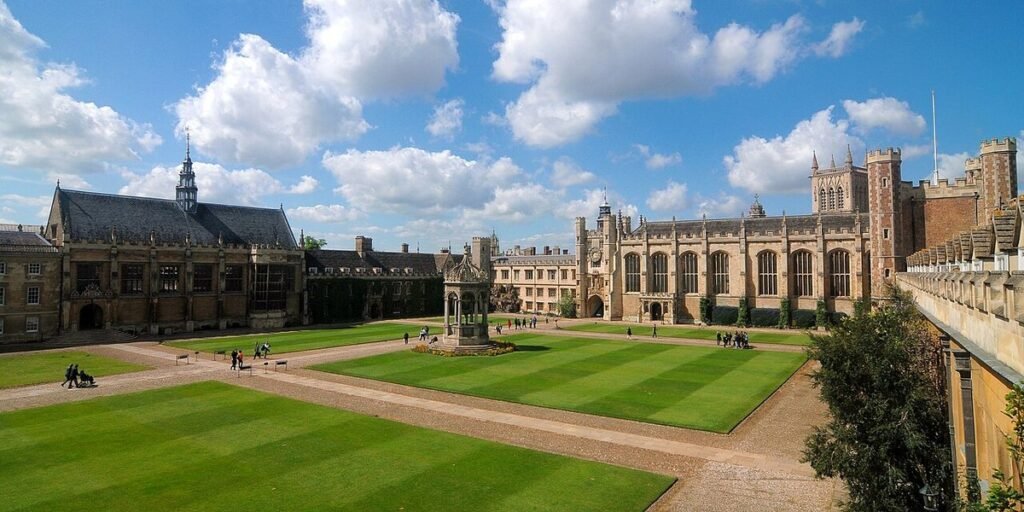
Table of Contents
The 3 Cambridge Traps Every Indian Family Falls Into
The first confusion I clear up for every Indian family is the Oxford-versus-Cambridge choice. For undergraduate study, you cannot apply to both in the same year — UCAS forces you to choose one.[2] Postgraduates can apply to both, but undergraduates must pick. So the question is not “which is better” — it is “which fits this student”.
The second confusion is money. Cambridge’s headline tuition looks lower than Oxford’s at the bottom end — £30,798 a year for humanities against Oxford’s £39,620 — but Cambridge then adds a college fee of £12,500–£15,950 a year on top, which Oxford builds into its tuition.[4][5] A humanities student at Cambridge actually pays £43,298–£46,748 a year before living costs. Families who budget only the tuition figure run short by more than £12,000 a year. I show the full arithmetic in the fees section, because this is the single most expensive misunderstanding in this guide.
The third confusion is what “Cambridge” actually is. It is not one campus with one admissions office. It is a federation of 31 self-governing colleges plus the university’s departments, and your college — not the university — admits you, houses you, and arranges your supervisions.[1][19] Your degree is a Cambridge degree, but your daily life is a college life.
Note: If you are reading this after 15 October 2026, the 2027-entry undergraduate window has closed. Do not panic and do not pay any agent who promises a late entry — there is no late route for the October round. Your real options are the January mature round (only at Hughes Hall, St Edmund’s and Wolfson, only for applicants aged 21+, UCAS by 13 January 2027), or a clean, early application for 2028 entry.[7][9]
Pro tip: Cambridge accepts the CBSE Class 12 qualification for direct entry into some undergraduate courses — a change that expanded its India ties in 2026.[18] If you are a CBSE student, check the course page for your subject before assuming you need a foundation year. State-board applicants typically need around 95% or above, against roughly 90% for CBSE.[20]
800 Years, 31 Colleges, One Tripos: What Cambridge Actually Is
Cambridge was founded in 1209, when a group of scholars left Oxford after conflicts there and settled in Cambridge.[19] It is the fourth-oldest surviving university in the world and the second-oldest university in the English-speaking world, after Oxford.[19] The oldest college, Peterhouse, dates to 1284; the most recent, Robinson, to 1977.[19]
Today the university has 24,927 students (2025-26 figures) — 12,850 undergraduates and 12,080 postgraduates — drawn from more than 140 countries, with 13,113 members of staff in academic, academic-related, contract research, technical and administrative roles.[1][19] International students number 9,570 (2024-25), and the university counts more than 333,629 living alumni as of December 2024.[1][18] Among its alumni and affiliates are 126 Nobel Prize laureates, 47 Heads of State and 217 Olympic medallists.[1][18] Cambridge’s count of 126 covers alumni, academics who carried out research at Cambridge in postdoctoral or faculty positions, and official appointments such as visiting fellowships and lectureships.[1]
The structure is what makes Cambridge different from every other top university. There are 31 constituent colleges, each a self-governing charitable corporation with its own governance, endowments and statutes.[19] The colleges admit students, provide accommodation and meals, and arrange supervisions. The university — through its six schools and 150+ departments, faculties and institutes — sets the syllabus, runs lectures and examinations, and awards the degree.[19] You apply to a college, but you read a Tripos: a single named course (Natural Sciences, History, Engineering, Law, and so on) that you follow from the first week to the last, examined subject by subject at the end of each stage, with no distribution requirement and no double major.[19]
The teaching heart of the system is the supervision: a weekly session, usually one-on-one or one-on-two, with a specialist in your subject, built around an essay or problem set you submitted beforehand.[18] Nothing in a supervision is marked, which is exactly why it works — it is the one place you can be wrong out loud and find out why. Lectures and practical classes run alongside, but the supervision is where Cambridge’s reputation for depth is actually made.
Cambridge’s research mission is visible in its history: the discovery of the DNA double helix by affiliates James Watson and Francis Crick at the Cavendish Laboratory, the splitting of the atom, and the development of IVF are all Cambridge work.[19] The university’s own summary puts it plainly — over 800 years it has produced 126 Nobel-affiliated scholars (its own count, covering alumni, postdoctoral and faculty researchers, and visiting fellows and lecturers).[1]
Cambridge’s Real Rank in 2027: The Numbers That Decide Your Future
| Ranking | Cambridge position | Notes |
|---|---|---|
| QS World University Rankings 2027 | #6 | Unchanged from QS 2026 (#6); published 18 June 2026[2] |
| Times Higher Education (THE) 2027 | #5 | Down from joint #3 in THE 2026; behind Oxford (#1), MIT (#2), Princeton and Stanford (joint #3)[2] |
| U.S. News Best Global Universities 2025-26 | #5 | Behind Harvard, MIT, Stanford and Oxford[2] |
| THE Global Employability Ranking 2026 | #1 | The world’s most employable graduates, by recruiter survey[16] |
| QS Graduate Employability 2022 | #11 | Older table; THE 2026 is the current measure[16] |
QS World University Rankings 2027 — top 10
| Rank | University | Overall score |
|---|---|---|
| 1 | Massachusetts Institute of Technology (MIT) | 100 |
| =2 | Imperial College London | 99.2 |
| =2 | Stanford University | 99.2 |
| 4 | University of Oxford | 98.6 |
| 5 | Harvard University | 97.4 |
| 6 | University of Cambridge | 97.1 |
| 7 | California Institute of Technology (Caltech) | 96.6 |
| =8 | ETH Zurich | 96.3 |
| =8 | UCL | 96.3 |
| 10 | National University of Singapore (NUS) | 96.2 |
QS World University Rankings 2027, published 18 June 2026 (topuniversities.com).
My advice on rankings: Cambridge sits in the global top six on every table that matters, and the differences between #3 and #6 are noise — what matters is that it is top-five or top-six everywhere, every year. The ranking that should catch an Indian family’s eye is the THE Global Employability 2026 #1 — recruiters rate Cambridge graduates as the most employable in the world.[16] That is the number that pays back the fees. Cambridge is QS 2027 #6 with an overall score of 97.1, confirmed against the official QS table published 18 June 2026.[2][3]
The table below is the quick reference for this University of Cambridge guide 2027 Indian students asked for — the ranks, the acceptance rate and the fees in one place.
| Metric | Figure | Source |
|---|---|---|
| QS World University Rankings 2027 | #6 | [2] |
| THE World University Rankings 2027 | #5 | [2] |
| U.S. News Best Global Universities 2025-26 | #5 | [2] |
| Undergraduate acceptance rate (success rate, 2025 cycle) | 16.3% overall; 10.7% non-UK; 6.8% India-domiciled | [2] |
| Researcher-to-faculty ratio | — [RESEARCH GAP: Requires manual lookup of the Cambridge researcher-to-faculty ratio] | — |
| Publication volume | — [RESEARCH GAP: Requires manual lookup of Cambridge publication volume] | — |
| Undergraduate tuition (overseas, 2027-28) | £30,798–£70,554 a year + college fee £12,500–£15,950 | [4] |
The Hidden College Fee That Adds £12,500+ to Your Cambridge Bill
This is the section I want you to read twice. Cambridge fees have two parts, and most Indian guides quote only the first.
Undergraduate tuition, 2027-28 (overseas students)
| Subject group | University Composition Fee (per year) | Examples |
|---|---|---|
| Group 1 — humanities, law, economics, English, history | £30,798 | BA Economics, BA Law, BA English[4] |
| Group 2 — Mathematics | £34,356 | BA Mathematics[4] |
| Group 3 — Architecture, Design, Geography, Music | £40,296 | BA Architecture, BA Geography, BA Music[4] |
| Group 4 — engineering, computer science, natural sciences | £46,872 | BA Engineering, BA Computer Science, BA Natural Sciences[4] |
| Group 5 — medicine, veterinary medicine | £70,554 | MBBS (6 years), VetMB[4] |
On top of every one of those figures, every overseas undergraduate pays a college fee of £12,500–£15,950 a year, depending on which college admits you.[4] So the real first-year totals are:
| Course | Tuition + college fee (per year) | 3-year total (approx.) |
|---|---|---|
| BA Economics / Law / English | £43,298–£46,748 | ₹1.63–₹1.76 crore |
| BA Engineering / Computer Science | £59,372–£62,822 | ₹2.23–₹2.36 crore |
| MBBS (6 years) | £83,054–£86,504 | ₹6.24–₹6.50 crore |
Conversions at £1 = ₹125.29 (Wise mid-market, 9 November 2026). The 2027-28 fees above are the official published rates for October 2027 entrants.[4]
Postgraduate tuition, 2027-28
Postgraduate fees are set per course and also come in two parts — the University Composition Fee plus a college fee for overseas postgraduates.[4] Cambridge does not publish a single postgraduate fee range — fees are set per course, so check your exact course page for the University Composition Fee.[4] The Cambridge Judge MBA is £86,250 for September 2027 entry — a single 12-month payment, the same for all nationalities — with total cost of attendance around £106,950 including living costs (£20,700 for 12 months).[4]
Scholarships — the money that actually moves the needle
| Scholarship | Who it is for | What it covers | Key dates / notes |
|---|---|---|---|
| Gates Cambridge | Postgraduate (PhD, MLitt, eligible 1-year master’s), any country outside the UK | Full cost: tuition, maintenance £23,152 a year (2026-27), airfare, visa + IHS[13] | US round closed 14 Oct 2026; international round 8 Dec 2026 or 6 Jan 2027 by course[11][12] |
| Cambridge Trust PhD Scholarship | PhD applicants from outside the UK/Ireland with Overseas fee status | International fees + maintenance + visa + IHS; up to 6 extra months for write-up[14] | About 60 awards a year; deadlines 8 Dec 2026 / 6 Jan 2027; decisions Feb–Jul 2027[14] |
| Cambridge Trust (other levels) | Undergraduate and master’s international students | Full or part-cost awards; UG awards are need-based and part-cost only[15] | No separate application — your course application is the funding application[15] |
| Commonwealth Shared Scholarships | Master’s students from India and other Commonwealth countries | Full tuition + stipend £1,378/month (£1,690 London) + return airfare[26] | Opens 10 Nov 2026, closes 8 Dec 2026, 16:00 GMT; nominated by the university[26] |
| Chevening | Master’s, one year, leadership potential | Full tuition + living + travel | 2027-28 cycle closed 6 Oct 2026; next cycle expected August 2027[15] |
| Inlaks Shivdasani | Indian postgraduates | Up to US$100,000 (reported) | Apply in the year before entry; check current terms[15] |
Gates Cambridge deserves a closer look because it is the scholarship Indian families ask about most. It was established in October 2000 through a US$210 million donation from the Bill & Melinda Gates Foundation — the largest single gift ever made to a UK university.[12] Each year it awards around 70 full-cost scholarships (the official figure), roughly two-thirds to PhD students.[12][13] It does not fund the MBA, MFin, PGCE or MASt courses.[13] There is no separate Gates application: you tick the funding box in your Cambridge postgraduate application, and your department nominates you.
Note: The Cambridge Trust funds 1,100–1,400 students a year across all its awards, but most of those are part-cost or co-funded awards.[15] Do not read that number as 1,100 full scholarships — the full-cost awards for international postgraduates are the Gates (about 70) and the Cambridge Trust PhD (about 60), plus a smaller number of Trust master’s awards.
Pro tip: For Gates and the Cambridge Trust, your course application deadline IS your funding deadline — 8 December 2026 or 6 January 2027 depending on your course.[11][14] There is no second chance to apply for funding after you submit. If you are applying for 2028 entry, put the funding deadline in your calendar before the course deadline, because it is the earlier of the two that decides everything.
How to Get Cambridge to Pay for Your Degree
The funding picture below is the part of this University of Cambridge guide 2027 Indian students ask me about most — Gates Cambridge, the Cambridge Trust and the rest, with the deadlines that decide them. The scholarship table in the fees section above has the full list; this section tells you how the money actually works.
Gates Cambridge was established in October 2000 through a US$210 million donation from the Bill & Melinda Gates Foundation — the largest single gift ever made to a UK university.[12] It awards around 70 full-cost scholarships a year, roughly two-thirds to PhD students.[12][13] It covers tuition, a maintenance allowance of £23,152 a year (2026-27), airfare, visa and health-surcharge costs.[13] It does not fund the MBA, MFin, PGCE or MASt courses.[13] There is no separate Gates application: you tick the funding box in your Cambridge postgraduate application, and your department nominates you.
The Cambridge Trust PhD Scholarship funds about 60 awards a year — international fees, maintenance, visa and IHS, plus up to six extra months for write-up — with decisions from February to July 2027.[14] The Trust funds 1,100–1,400 students a year across all its awards, but most of those are part-cost or co-funded awards.[15] Do not read that number as 1,100 full scholarships — the full-cost awards for international postgraduates are the Gates (about 70) and the Cambridge Trust PhD (about 60), plus a smaller number of Trust master’s awards. For undergraduates and master’s students, Trust awards are need-based and part-cost only, and there is no separate application — your course application is the funding application.[15]
The Commonwealth Shared Scholarship opens 10 November 2026 and closes 8 December 2026, 16:00 GMT — full tuition, a stipend of £1,378 a month (£1,690 in London) and return airfare, nominated by the university.[26] Chevening’s 2027-28 cycle closed 6 October 2026; the next cycle is expected in August 2027.[15] The Inlaks Shivdasani Scholarship offers up to US$100,000 (reported) for Indian postgraduates — apply in the year before entry and check the current terms.[15]
Crucial Compliance Note: The Commonwealth Shared Scholarship opens 10 November 2026 and closes 8 December 2026 at 16:00 GMT, and you are nominated by the university.[26] Put both dates in your calendar now — the window is four weeks, and the nomination has to happen inside it.
How to apply for funding, step by step:
- Check your course’s funding deadline first. Gates, Cambridge Trust and most other funding in this University of Cambridge guide 2027 Indian students use close on 8 December 2026 or 6 January 2027, depending on your course.[11][14]
- Tick the funding box in your Cambridge postgraduate application. There is no separate Gates application — your department nominates you.[12][13]
- Apply for the Commonwealth Shared Scholarship by 8 December 2026, 16:00 GMT, if you are a Master’s applicant — the university nominates you, and the scheme opens 10 November 2026.[26]
- Apply for Chevening and Inlaks separately, in the year before entry. Chevening’s 2027-28 cycle closed 6 October 2026; the next cycle is expected in August 2027.[15]
The Cambridge Application Timeline: Every Deadline That Decides 2027 Entry
Undergraduate — 2027 entry (October round, now closed)
1. Choose Cambridge, not Oxford. You cannot apply to both for undergraduate study in the same year.[2] Choose by course: Cambridge’s Natural Sciences Tripos lets you mix physics, chemistry and materials before specialising; its Engineering Tripos is famously broad; Oxford’s PPE has no Cambridge equivalent.
2. UCAS. Five choices, one personal statement, fee £34.50. For 2027 entry the Oxbridge/medicine deadline was 6pm UK time, 15 October 2026 — already passed.[8]
3. Admissions tests. Most courses require one: ESAT (engineering, natural sciences, medicine-adjacent), TMUA (mathematics, economics, computer science), TARA (a new test for 2027 entry), UCAT (medicine), LNAT (law). For 2027 entry the tests ran 12–16 October 2026; booking closed 28 September 2026.[8][10]
4. My Cambridge Application. A short supplementary questionnaire every Cambridge applicant completes after UCAS. Deadline for 2027 entry: 6pm UK time, 22 October 2026.[7] Most applicants from outside the UK, Ireland, the Channel Islands and the Isle of Man pay a £60 fee for it.[21]
5. Interviews. Most applicants are interviewed — typically one or two interviews totalling 35 minutes to an hour, online or in person depending on the college.[9] The main interview period for 2027 entry is 7–18 December 2026; invitations mostly arrive in November.[7][9]
6. Decisions. Applicants interviewed in the main period learn the outcome on 27 January 2027.[7] About one in five offers is made through the Winter Pool — strong applicants reconsidered by colleges with remaining places.[9]
7. Results and confirmation. Offers are almost always conditional on final exam results, confirmed in August 2027.
The January mature round — still open
If you are aged 21 or over, the mature round at Hughes Hall, St Edmund’s and Wolfson is still open: UCAS by 13 January 2027 at 6pm UK time, My Cambridge Application by 20 January 2027, interviews March–April 2027.[9] Medicine, Graduate Medicine and Veterinary Medicine are excluded from this round.
Postgraduate — 2027-28 entry
1. Find your course and college. Postgraduate applications go through the Cambridge Graduate Application Portal, not UCAS. You apply to a course first; the college is allocated, though you can state a preference.
2. Check the funding deadline. Your course’s funding deadline — 8 December 2026 or 6 January 2027 — is the deadline for Gates, Cambridge Trust and most other funding.[11][14] The US-round Gates deadline (14 October 2026) has passed.
3. Submit references and transcripts early. Cambridge asks for a transcript with My Cambridge Application for undergraduates; postgraduates should request references weeks before the deadline, because a late reference can sink an otherwise complete application.
4. Interviews. Most postgraduate courses interview shortlisted candidates online, usually between January and March 2027.
| Key date | What happens |
|---|---|
| 1 Sep 2026 | UCAS applications submittable for 2027 entry (applications opened 12 May 2026) |
| 28 Sep 2026 | Admissions test booking closed (2027 entry) |
| 12–16 Oct 2026 | Admissions tests (ESAT, TMUA, TARA, UCAT, LNAT) |
| 15 Oct 2026, 6pm UK | UCAS deadline — Oxford & Cambridge (closed) |
| 22 Oct 2026, 6pm UK | My Cambridge Application deadline (closed) |
| Nov 2026 | Interview invitations sent |
| 7–18 Dec 2026 | Main interview period |
| 8 Dec 2026 / 6 Jan 2027 | Postgraduate funding deadlines (by course) |
| 13 Jan 2027, 6pm UK | UCAS deadline — January mature round |
| 20 Jan 2027, 6pm UK | My Cambridge Application — January mature round |
| Mid–late Jan 2027 | Winter Pool interviews |
| 27 Jan 2027 | Decisions released (main interview period) |
| Mar–Apr 2027 | Mature-round interviews |
| Aug 2027 | Final decisions on exam results |
| Oct 2027 | Term starts (Michaelmas) |
31 Colleges, One Degree: How Cambridge’s Strange System Actually Works
There are 31 colleges, and they are not halls of residence — they are self-governing institutions, each with its own fellows, endowments, dining hall, library and traditions.[19] Twenty-nine admit undergraduates; a few (Darwin, Clare Hall, Hughes Hall) are postgraduate-only, and three (Hughes Hall, St Edmund’s, Wolfson) admit only mature students aged 21+.[19] Two colleges — Murray Edwards and Newnham — admit women only.[19]
You can apply to a specific college or make an open application, letting the university allocate you. My advice: an open application is not a weaker application. College choice is a genuine strategic decision — some colleges receive far fewer applications per place than others for the same course — but no college is “better” academically, because your lectures, examinations and degree are the university’s, and your supervisions are arranged by your college from specialists across the university.[20]
What the college gives you, in practice: accommodation (most undergraduates live in college for at least the first year, and many for all three), meals in hall, a Director of Studies who oversees your academic progress, a tutor for pastoral support, a college library, and the supervision system itself. The college also charges the college fee — £12,500–£15,950 a year in 2027-28 (Darwin £12,500 to Murray Edwards £15,950; Trinity’s net college fee is £14,745 after a bursary) — that surprises families who only budgeted tuition.[4] [RESEARCH GAP: Requires manual lookup of college-specific acceptance rates]
The supervision is the part I would sell Cambridge on. Once a week, you sit with a specialist — often a world-leading researcher — and one or two other students, and defend an essay or problem set you prepared. It is unassessed, which means you can be wrong out loud and find out why. No other teaching format at any university I have written about does this as systematically. If you are the kind of student who learns by arguing an idea until it breaks, Cambridge will suit you better than anywhere else. If you want lectures and a syllabus and to be left alone, it may not.
Inside Cambridge’s 100+ Libraries and World-Famous Labs
Cambridge is not a single campus — it is a city university, with colleges, departments and libraries spread across the city of Cambridge, about 50 miles north of London.[27] That matters for daily life: you will cycle everywhere, your college and your department may be a twenty-minute ride apart, and the city itself — population around 150,000 — is built around the university.

The library system is one of the largest in the UK: more than 100 libraries, including the Cambridge University Library, one of the six legal-deposit libraries in the UK, which holds over eight million items.[19] Every college has its own library, open long hours, and the faculty libraries sit next to the departments they serve.
The research infrastructure is the point of Cambridge for a researcher. The Cavendish Laboratory is where the DNA double helix was worked out and the electron discovered. The MRC Laboratory of Molecular Biology — technically an MRC institute, but inseparable from Cambridge science — has produced more Nobel laureates than most countries. The Cambridge Judge Business School, the Department of Engineering (the largest department in the university), the Computer Laboratory, and the School of Clinical Medicine at Addenbrooke’s Hospital anchor the applied side. Museums — the Fitzwilliam, the Museum of Archaeology and Anthropology, the Sedgwick Museum of Earth Sciences — are free and open to the public, and they are teaching collections, not tourist attractions.
The Six Schools That Run Cambridge (And Which One Fits You)
Academic work is organised into six Schools, each an administrative grouping of related faculties, departments and institutes, covering 150+ departments, faculties and other institutions.[19]
| School | What it covers | Flagship departments |
|---|---|---|
| Arts and Humanities | Architecture, classics, English, history of art, modern and medieval languages, music, philosophy | Faculty of English; Faculty of Classics; Department of Architecture[19] |
| Biological Sciences | Biology, biochemistry, genetics, plant sciences, zoology, veterinary medicine | Department of Genetics; Department of Biochemistry; Department of Plant Sciences[19] |
| Clinical Medicine | Medicine, clinical research, public health | School of Clinical Medicine (Addenbrooke’s); Department of Medicine[19] |
| Humanities and Social Sciences | Economics, law, politics, sociology, geography, education, business | Faculty of Economics; Faculty of Law; Cambridge Judge Business School[19] |
| Physical Sciences | Mathematics, physics, chemistry, earth sciences, astronomy | Cavendish Laboratory; Department of Pure Mathematics and Mathematical Statistics; Department of Chemistry[19] |
| Technology | Engineering, computer science, manufacturing | Department of Engineering; Computer Laboratory[19] |
More faculties and departments worth knowing: beyond the flagships above, Arts and Humanities also holds the Faculties of Asian and Middle Eastern Studies, Divinity, History, Modern and Medieval Languages and Linguistics, Music and Philosophy. Biological Sciences holds the Faculty of Biology (Biochemistry, Genetics, Pharmacology, Physiology, Development and Neuroscience, Psychology, Zoology) and the Faculty of Veterinary Medicine. Humanities and Social Sciences holds the Faculties of Education, History and Human, Social and Political Science, plus the Departments of Land Economy and History and Philosophy of Science. Physical Sciences holds the Faculties of Earth Sciences and Geography, Mathematics (including the Department of Applied Mathematics and Theoretical Physics) and Physics and Chemistry (including the Cavendish Laboratory, Chemistry and Materials Science and Metallurgy). Technology holds the Faculties of Business and Management (Cambridge Judge), Computer Science and Technology and Engineering, plus the Department of Chemical Engineering and Biotechnology. Clinical Medicine is a single Faculty of Clinical Medicine.[19]
For Indian students, the strongest draws are Natural Sciences (the flexible Tripos that lets you combine physics, chemistry, biology and materials before specialising), Engineering (a general first two years, then specialisation), Computer Science, Economics, Law and Medicine. At postgraduate level, the MPhil in Machine Learning and Machine Intelligence, the MPhil in Advanced Computer Science, the MBA at Judge, and the PhD programmes in the sciences attract the most Indian applicants.
For 2027 entry there is one genuinely new undergraduate course: Linguistics and Modern Languages (BA), which combines the study of how language works with a modern foreign language. Land Economy has been retitled Environment, Law, and Economics from 1 October 2027 — the name changes, the content does not. Design is listed for 2027 entry but is not a new 2027 launch.
The Labs Where DNA Was Discovered — and Where You Could Work
I judge a research university by what its laboratories let a scholar actually investigate, and Cambridge’s answer starts with the Cavendish Laboratory — the laboratory of the electron, the neutron and the DNA double helix.[19] A physics scholar there works in the rooms where the electron was discovered and where Watson and Crick worked out the double helix with Maurice Wilkins.[19] That history is not decoration: it is why the Cavendish still attracts the physicists who want to work on the hardest problems in the subject.
The MRC Laboratory of Molecular Biology is technically an MRC institute, but it is inseparable from Cambridge science, and its groups have produced more Nobel laureates than most countries.[19] A life-sciences scholar who joins an LMB group is working inside the institute that defined molecular biology. The School of Clinical Medicine at Addenbrooke’s Hospital anchors the applied medical side, letting a clinical researcher work inside a hospital research system rather than beside one.[19]
For engineers, the Department of Engineering is the largest department in the university, and the Computer Laboratory anchors computer science, including machine learning and systems research.[19] Cambridge Judge Business School anchors management, finance and entrepreneurship research.[19] The library system backs all of it: more than 100 libraries, including the Cambridge University Library — one of the six legal-deposit libraries in the UK — holding over eight million items, with every college running its own library open long hours.[19]
The interdisciplinary openings I can verify sit in the Tripos itself. Natural Sciences lets you combine physics, chemistry, biology and materials before specialising, and at postgraduate level the MPhil in Machine Learning and Machine Intelligence and the MPhil in Advanced Computer Science draw the most Indian applicants.[19] The museums — the Fitzwilliam, the Museum of Archaeology and Anthropology, the Sedgwick Museum of Earth Sciences — are free, open to the public, and teaching collections, not tourist attractions.[19]
Researcher Insider Tip: A laboratory matters more than a logo. A scholar who wants molecular biology belongs near the LMB, a scholar who wants physics belongs near the Cavendish, and a scholar who wants clinical research belongs at Addenbrooke’s — whatever the overall ranking says.
The scale of that excellence, in one number: 126 Nobel laureates among alumni and affiliates (Cambridge’s own count, covering alumni, postdoctoral and faculty researchers, and visiting fellows and lecturers).[1]
What a Cambridge Degree Actually Pays After Graduation
Cambridge does not run “placements” the way an Indian university does — there is no placement season and no company day. What it has is a Careers Service and an outcome record that recruiters respect worldwide. The honest numbers, from the UK Graduate Outcomes survey:
| Outcome | Figure | Source |
|---|---|---|
| In work or further study within 15 months | 89% | Graduate Outcomes, via Shiksha[16] |
| Of working graduates, in high-skilled employment | 91% | Graduate Outcomes, via Shiksha[16] |
| Median salary, full-time employed graduates, 15 months after graduation (2022-23 cohort) | £36,000 | Graduate Outcomes 2022-23, via StudyGB[17] |
| THE Global Employability Ranking 2026 | #1 in the world | Times Higher Education[16] |
The THE Global Employability Ranking 2026 puts Cambridge at #1 in the world — ahead of every US Ivy and every other UK university — because global recruiters rate its graduates as the most employable anywhere.[16] For the MBA specifically, one guide reports an average salary of £93,085 and a placement rate of 79% for the class of 2025 — treat both as guide-reported figures, not university-published data, and check the Judge employment report before quoting them.[16] [RESEARCH GAP: Requires manual lookup of the Cambridge Judge MBA average salary (£93,085) and placement rate (79%) from the Judge employment report]
Note: Do not compare Cambridge’s “89% in work or further study” with an IIT placement percentage — they measure different things. Cambridge counts further study (including PhDs at Cambridge itself) as a positive outcome, and many Cambridge graduates deliberately take lower-paid first jobs in academia, public service or the arts. The salary medians above are the honest figures, not the highest packages quoted by agents.
My advice on careers: the degree opens the door, but the Graduate Route visa is what lets you walk through it in the UK — two years of post-study work if you apply by 31 December 2026, 18 months for applications from 1 January 2027, three years for PhD graduates.[23] Start your job search in your final year, not after graduation, because the Graduate Route clock starts when your visa is granted, not when you find a job.
126 Nobel Laureates and 3 Indian PMs: Cambridge’s Alumni That Change History
Cambridge’s alumni list is remarkable by the Nobel count alone — 126 laureates among alumni and affiliates (Cambridge’s own count, covering alumni, postdoctoral and faculty researchers, and visiting fellows and lecturers).[1] Older guides still quote 121; the university’s current figure is 126.[22]
| Person | College | Why they matter |
|---|---|---|
| Isaac Newton | Trinity | Laws of motion and universal gravitation; Lucasian Professor of Mathematics[19] |
| Charles Darwin | Christ’s | On the Origin of Species; theory of evolution by natural selection[19] |
| Stephen Hawking | Trinity Hall | Black-hole radiation; A Brief History of Time; Lucasian Professor[19] |
| Srinivasa Ramanujan | Trinity | Self-taught mathematical genius; worked with G.H. Hardy at Cambridge[19] |
| James Watson & Francis Crick | Cavendish Laboratory | Discovered the DNA double helix (1953), with Maurice Wilkins[19] |
| Alan Turing | King’s | Father of computer science; the Turing machine and the Turing Test[19] |
| John Maynard Keynes | King’s | Founder of modern macroeconomics[19] |
| Amartya Sen | Trinity | Nobel Prize in Economics 1998; later Master of Trinity College[19] |
| Jawaharlal Nehru | Trinity | First Prime Minister of independent India[19] |
| Rajiv Gandhi | Trinity | Prime Minister of India, 1984–1989[19] |
| Manmohan Singh | St John’s | Economist; Prime Minister of India, 2004–2014[19] |
For Indian readers, the Cambridge–India thread runs deep: three Indian prime ministers, a Nobel economist, and Ramanujan — whose notebooks still generate new mathematics a century later. One guide estimates around 1,200 Indian students at Cambridge across all programmes; I could not verify that number from an official source, so treat it as an estimate.[27] [RESEARCH GAP: Requires manual lookup of the number of Indian students at Cambridge from an official source]
How to Find the Supervisor Who Gets You Funded
I do not name individual current professors in this guide, deliberately. Supervisors move, retire, and take sabbaticals; a name printed in November 2026 can be out of date by the time you apply. What I can tell you is where the research power sits and how to find the right person: [RESEARCH GAP: Requires manual lookup of current individual professors/PIs at Cambridge]
- Cavendish Laboratory (physics) — the laboratory of the electron, the neutron and DNA. If you want a physics PhD, start at the Cavendish research-group pages, not at a general ranking.[19]
- MRC Laboratory of Molecular Biology — technically an MRC institute, but inseparable from Cambridge science; its groups have produced more Nobel laureates than most countries.[19]
- Department of Engineering — the largest department in the university, with research groups from aerospace to bioengineering.[19]
- Computer Laboratory — computer science, including machine learning and systems research.[19]
- Cambridge Judge Business School — management, finance and entrepreneurship research.[19]
My advice on finding a supervisor: go to your target department’s website, open its research-group pages, read two or three recent papers from the group, and write to the group leader with a specific question about that work — not a generic “I want to do a PhD with you”. Supervisors reply to specific questions. They ignore generic emails. For funding, remember the Cambridge Trust PhD Scholarship (about 60 awards a year) is decided by departmental ranking — your department puts you forward, so the supervisor relationship matters before the funding decision, not after.[14]
Living in Cambridge: The Real Monthly Cost and the Visa Rules for 2027
| Cost | Figure (2027-28) |
|---|---|
| Undergraduate living costs | £1,330 a month (£11,970 for 9 months; £15,960 for 12 months)[4] |
| Postgraduate living costs | £1,725 a month (£20,700 for 12 months; £15,525 for 9 months)[4] |
| MBA living costs | £20,700 a year[4] |
| Student visa application fee | £558 (from 8 April 2026)[23] |
| Immigration Health Surcharge | £776 a year (£1,164 for a 12-month master’s)[23] |
| Funds you must show (outside London) | £1,136 a month (from 30 November 2026)[23] |
| Work during term | Up to 20 hours a week[23] |
| Graduate Route after study | 2 years if you apply by 31 Dec 2026; 18 months from 1 Jan 2027; 3 years for PhD[23] |
Cambridge is cheaper than London — it counts as “outside London” for the funds requirement — but it is not a cheap city. College accommodation is usually the best value in the first year; private rents in the city run higher. Budget around £1,330 a month all-in as an undergraduate (the university’s own 2027-28 estimate), and more if you eat out often or live outside college.
The visa itself is straightforward if your documents are clean: a Confirmation of Acceptance for Studies (CAS) from Cambridge, proof of funds held for 28 days, a TB test (mandatory for applicants from India), and the IHS payment.[23] Apply through the official gov.uk Student visa route and check the current fee there before you pay — the £558 figure is from April 2026 and fees are reviewed annually.[25]
Daily life: you will cycle everywhere — Cambridge is flat, and the city is built around the university. May Week (actually in June, after exams) and the May Balls are the famous celebrations. The colleges run formal halls, boat clubs, and more than 500 student societies between them. Winter is dark and cold; buy a good coat and good lights for your bicycle before you arrive.
More University Guides
 University of Oxford Guide 2027: Fees, Admissions, Scholarships & CollegesUK • University Guide
 Top Universities in Russia for Indian Students 2027Russia • University Guide
 Top Universities in South Korea for Indian Students 2027: Rankings, Fees, GKS Scholarship & How to ApplySouth Korea • University Guide
Frequently Asked Questions
Can I apply to both Oxford and Cambridge?
No — not for undergraduate study in the same year. UCAS forces you to choose one.[2][24] Postgraduates can apply to both. Choose by course, not by brand: Cambridge’s Natural Sciences and Engineering Tripos structure is different from anything Oxford offers, and Oxford’s PPE has no Cambridge equivalent.
What is the total cost of studying at Cambridge, including the college fee?
For 2027-28, an overseas undergraduate in humanities pays £30,798 tuition plus £12,500–£15,950 college fee — £43,298–£46,748 a year before living costs. Engineering and computer science run £59,372–£62,822 a year; medicine runs £83,054–£86,504 a year for six years. Add about £1,330 a month in living costs.[4][6]
What is the Gates Cambridge Scholarship, and how many awards are there?
Gates Cambridge is a full-cost postgraduate scholarship for non-UK citizens, funded by a US$210 million Gates Foundation donation in 2000.[12] It awards around 70 scholarships a year, roughly two-thirds to PhD students.[12][13] It covers tuition, £23,152 maintenance (2026-27 rate; 2027-28 rate not yet published), airfare, visa and health-surcharge costs.[13]
When will I hear back about my 2027-entry application?
If you were interviewed in the main period (7–18 December 2026), decisions are released on 27 January 2027.[7] About one in five offers comes through the Winter Pool, with interviews in mid to late January 2027.[9] Final confirmation depends on your exam results in August 2027.
What is a supervision, and is it really that different?
Yes. A supervision is a weekly session with a subject specialist and one or two other students, built around work you submitted beforehand.[18] It is unassessed, so you can be wrong out loud and find out why. Lectures give you the syllabus; supervisions teach you to think.
Does Cambridge accept CBSE Class 12 for direct undergraduate entry?
For some undergraduate courses, yes — Cambridge expanded its India ties by accepting CBSE 12 for direct entry into some courses in 2026.[18] Check the course page for your subject before assuming you need a foundation year. State-board applicants typically need around 95% or above, against roughly 90% for CBSE.[20]
What is Cambridge’s rank in QS 2027 and THE 2027?
Cambridge is #6 in QS World University Rankings 2027 (score 97.1, published 18 June 2026) and #5 in THE World University Rankings 2027 (score 96.9, published 30 September 2026). Oxford is #1 in THE 2027 for the 11th straight year, and MIT is #1 in QS 2027.
What is the college fee at Cambridge, and does Oxford charge one?
Cambridge charges a separate college fee of £12,500–£15,950 a year on top of tuition (2027-28), varying by college. Oxford builds its college costs into tuition and does not charge a separate college fee. Always add the college fee to the tuition figure when budgeting for Cambridge.
How long can I stay in the UK after graduating from Cambridge?
On the Graduate Route visa you can stay 2 years if you apply on or before 31 December 2026, or 18 months if you apply on or after 1 January 2027. PhD graduates get 3 years. You cannot extend the Graduate visa, but you can switch to another visa such as Skilled Worker.
What is the acceptance rate for Indian students at Cambridge?
In the 2025 undergraduate cycle, India-domiciled applicants had a 6.8% success rate (370 applications, 38 offers, 25 acceptances). The overall success rate was 16.3% and the non-UK success rate was 10.7%. Cambridge does not publish a single ‘international acceptance rate’.
Is there a new course at Cambridge for 2027 entry?
Yes: Linguistics and Modern Languages (BA) is a new undergraduate course for 2027 entry. Land Economy has been renamed Environment, Law, and Economics from 1 October 2027 (content unchanged). Design is listed for 2027 entry but is not a new 2027 launch.
Sources & Last Updated
- University of Cambridge — Cambridge at a glance (official) — 24,927 students (2025-26): 12,850 UG, 12,080 PG; 31 colleges; 126 Nobel laureates; 47 Heads of State; 217 Olympic medallists; 333,629 living alumni; 13,113 staff.
- Collegedunia — Top Ten Universities in the World 2026 — QS 2027 top 10 (Cambridge 6th, 97.1); THE 2027 (Cambridge 5th, 96.9); U.S. News 2025-26 (Cambridge 5th).
- QS World University Rankings — official site — the ranking publisher.
- Collegedunia — University of Cambridge fees — UG tuition £30,798–£70,554 (Group 1 £30,798; Group 4 £46,872; Group 5 Medicine £70,554); college fee £12,500–£15,950 UG; MBA £86,250 (Sept 2027); living costs UG £1,330/month, PG £1,725/month; MBA living £20,700/year.
- Collegedunia — University of Cambridge — Cambridge does not publish a single PG fee range; MBA £86,250 (September 2027 entry, verified); October 2027 intake, Michaelmas term only.
- LeapScholar — Oxford University vs Cambridge University 2026 — Cambridge UG tuition £30,798–£70,554 plus £12,500–£15,950 college fee; Oxford college fee included in tuition; living costs compared.
- University of Cambridge — Application dates and deadlines (official) — My Cambridge Application 22 October 2026 (6pm); interviews first 3 weeks of December; decisions 27 January 2027; mature round 13/20 January 2027.
- Ivy Education — Oxbridge Application Deadlines 2027 Entry — UCAS deadline 15 October 2026 6pm; My Cambridge Application 22 October 2026; tests TMUA, ESAT, TARA; Oxford decisions 12 January 2027; Cambridge decisions 27 January 2027.
- YourDreamSchool — Oxbridge Admissions Pack — UCAS and My Cambridge Application closed for 2027 entry; interviews first 3 weeks of December 2026; Winter Pool about 1 in 5 offers; mature round UCAS 13 January 2027, interviews March–April 2027.
- Medistudents — University of Cambridge School of Clinical Medicine — Medicine interviews 7–18 December 2026; UCAT 13 July–24 September 2026; decisions 27 January 2027; MBBS A100, 6 years.
- Gates Cambridge — Apply: timeline (official) — official Gates Cambridge application timeline.
- LeapScholar — Gates Cambridge Scholarship 2026 — around 70 awards a year (official figure); founded 2000, US$210 million donation.
- ScholarHunter — Gates Cambridge Scholarship 2027 — around 70 awards a year; maintenance £23,152 for 12 months (2026-27); US deadline 14 Oct 2026; international 8 Dec 2026 or 6 Jan 2027; excludes MBA, MFin, PGCE.
- Gizpulse — Cambridge Trust PhD Scholarship 2027/28 — about 60 awards a year; deadlines 8 Dec 2026 / 6 Jan 2027; covers fees, maintenance, visa, IHS; decisions mid-Feb to end Jul 2027.
- LeapScholar — Cambridge University Scholarship for Indian Students 2026 — Cambridge Trust funds 1,100–1,400 students a year; UG Trust awards need-based and part-cost only; Chevening closed 6 Oct 2026; no country-specific Gates counts published.
- Shiksha — University of Cambridge Placements — 89% in work or further study within 15 months; 91% in high-skilled employment; THE Global Employability 2026 #1; MBA average salary £93,085, placement rate 79% (guide-reported).
- StudyGB — Russell Group vs Red Brick Universities — Cambridge Graduate Outcomes 2022-23: median salary £36,000 for full-time employed graduates 15 months after graduation; UK-wide median £28,000.
- Shiksha — University of Cambridge — CBSE 12 accepted for direct entry into some UG courses; 24,927 total students; 9,570 international students; supervision system (weekly one-on-one or one-on-two).
- Wikipedia — University of Cambridge — founded 1209; fourth-oldest surviving university; 31 colleges; six schools; 150+ departments; 126 Nobel Prizes; 22,565 students (2024/25); Peterhouse 1284, Robinson 1977; DNA double helix at the Cavendish.
- GoStudyIn — Oxbridge for Indian Students: 2027 Entry Guide — UCAS deadline 15 October 2026; Cambridge 31 colleges vs Oxford 39; Indian applicants roughly 5–8% at Cambridge for high-demand courses; state boards typically need 95%+, CBSE around 90%; 91% of Cambridge graduates in permanent employment within 15 months.
- College Council — Cambridge University detailed guide for international applicants — My Cambridge Application £60 fee for most international applicants; UCAS 15 October 2026; My Cambridge Application 22 October 2026.
- GradCafe — Cambridge University Acceptance Rate — 121 Nobel laureates (older count); 11 Fields Medalists, 7 Turing winners; ~25,000 students; UG acceptance about 18.70% (2021-22 cycle).
- CareerBox — UK Student Visa Fees 2026–27 — visa fee £558 from 8 April 2026; IHS £776 a year; living funds £1,136/month outside London (from 30 November 2026); Graduate Route 2 years to 31 Dec 2026, 18 months from 1 Jan 2027, 3 years PhD; work 20 hours a week; TB test mandatory for Indians.
- UCAS — the UK’s centralised undergraduate admissions system; five choices; one personal statement.
- gov.uk — Student visa — official Student visa rules, fees and application guidance.
- Commonwealth Shared Scholarships 2027–28 for Indian Students (University Researcher) — opens 10 November 2026, closes 8 December 2026 16:00 GMT; full tuition; stipend £1,378 a month (£1,690 London); return airfare; nominated by the university.
- EduDhruv — University of Cambridge Complete Guide 2027 — founded 1209, second-oldest in the English-speaking world; about 50 miles north of London; approximately 1,200+ Indian students (single-source estimate).
- Casita — University of Cambridge — QS World University Rankings 2027 #6; six schools; 150+ faculties and departments; supervisions as small-group teaching.
- QS World University Rankings 2027 — official table (topuniversities.com) — Cambridge #6, 97.1; top 10 (MIT 100, Imperial/Stanford 99.2, Oxford 98.6, Harvard 97.4).
- Times Higher Education World University Rankings 2027 — official (timeshighereducation.com) — Cambridge #5, 96.9; Oxford #1, 97.9, 11th consecutive year; 0.1 margin over MIT.
- University of Cambridge — Undergraduate tuition fees 2027-28 (official PDF) — Home £10,050; overseas £30,798–£70,554; college fee £12,500–£15,950.
- University of Cambridge — Living costs 2027-28 (official) — UG £1,330/month; PG £1,725/month.
- Gates Cambridge — The Scholarship (official) — ~70 awards/year; maintenance £23,152 (2026-27 rate); US round closed 14 Oct 2026; International round 8 Dec 2026 / 6 Jan 2027.
- UCAS — Dates and deadlines (official) — Cambridge deadline 15 Oct 2026, 18:00 UK; standard deadline 13 Jan 2027.
- GOV.UK — Graduate visa (official) — 2 years to 31 Dec 2026; 18 months from 1 Jan 2027; 3 years PhD.
- University of Cambridge — Undergraduate admissions statistics, 2025 cycle (official PDF) — 22,513 apps, 4,893 offers, 16.3% success rate; non-UK 10.7%; India 370/38/25, 6.8%.
- Cambridge Judge Business School — MBA fees (official) — MBA £86,250, September 2027 entry.
Last updated: 9 November 2026. Rankings are QS 2027 and THE 2027. Fees are 2027-28 overseas rates; always confirm the current figures on the course page at cam.ac.uk before applying. £1 = ₹125.29 (Wise mid-market, 9 November 2026) used for conversions in this guide.
By Rohit Gupta
If this guide helped you, share it with someone dreaming of Cambridge. For questions, write to universityresearchers3@gmail.com.