
Stanford University Guide 2027: Fees, Aid, Admissions & the Silicon Valley Advantage

QS 2027 #=2, $97,545 cost of attendance, need-aware aid, Knight-Hennessy and GSB MBA outcomes — verified from official sources.
By Rohit Gupta
Last updated: 11 November 2026
I have spent weeks reading Stanford’s own pages, its Common Data Set, and the guides Indian students actually use — and one thing kept jumping out at me. Stanford is the university every Indian family has heard of, yet the advice about it is full of confident mistakes. The biggest one: that Stanford is “need-blind for international students”. It is not. Stanford is need-aware for international applicants who ask for aid, and that single fact changes how an Indian family should plan the whole application. This guide gives you the verified picture — the fees, the aid rules, the deadlines, the scholarships, and what a Stanford degree actually leads to — with every key fact linked to its source so you can check it yourself.
Key points
- Stanford is ranked #=2 in the world (QS 2027) — behind only MIT — and was #3 in QS 2026. It is a private research university in Stanford, California, founded in 1885 and opened in 1891. [1][2][3]
- Undergraduate tuition for 2026–27 is $67,731 (about ₹64 lakh), frozen at the 2025–26 level. Room and board add $22,944, taking the estimated cost of attendance to $97,545 a year (about ₹92 lakh) before travel and health insurance. [4][5][6]
- Stanford is need-aware for international applicants who request aid — your aid request becomes part of the admission decision. Once admitted, Stanford meets 100% of demonstrated need. Families earning under $100,000 (₹95 lakh) pay nothing for tuition, room and board; families under $150,000 (₹1.43 crore) pay no tuition. [4][5][6]
- Restrictive Early Action closes 1 November 2026; Regular Decision closes 5 January 2027. The SAT or ACT is now required for first-year applicants (from the Class of 2030 onward). No English proficiency test is required for first-years. [7][8][9]
- The Knight-Hennessy Scholars programme fully funds up to 100 graduate students a year for up to three years — tuition, living stipend, travel and relocation. Its 2027-cohort deadline was 6 October 2026 (now closed). [13][14]
- Stanford GSB’s MBA Class of 2025 earned a median base salary of $185,000 (about ₹1.76 crore), with 90% of job seekers receiving an offer within three months and 16% launching their own ventures. [10][11][12]
- Admission is brutally selective: 3.80% for the Class of 2029 — 2,302 admitted from 60,646 applicants. Around 500 Indian students are enrolled across all seven schools, according to the guides that track this — the figure traces to Stanford Magazine, May 2005 (482 students); Stanford publishes no current by-country count. [17][18]
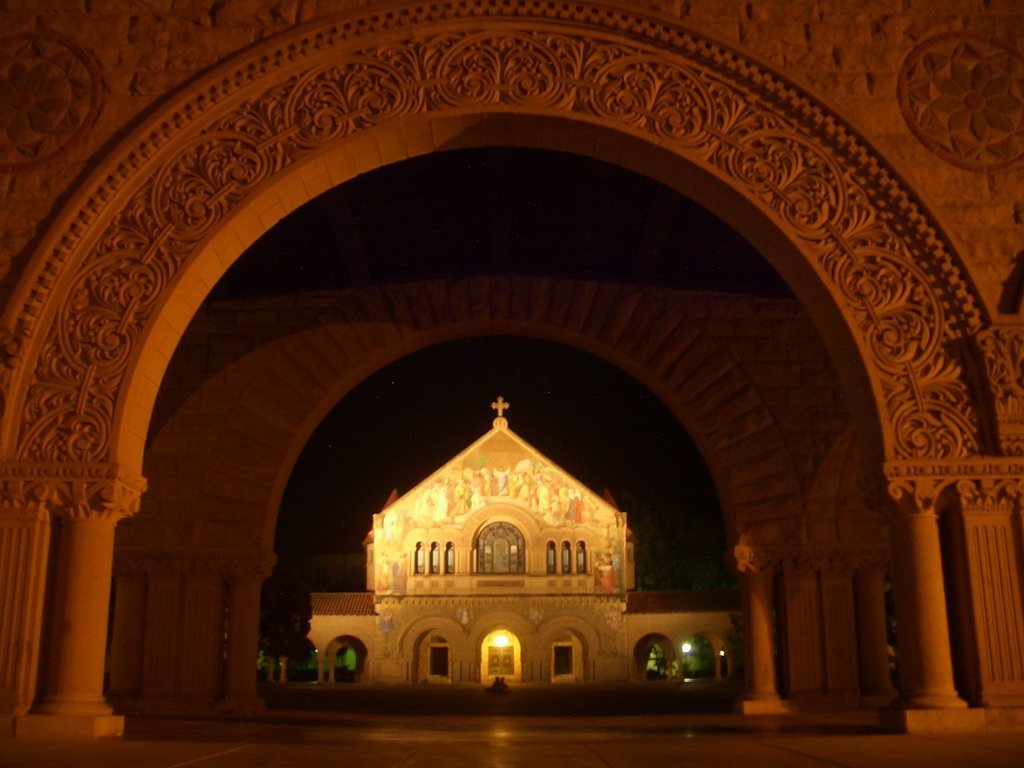
Table of Contents
Stanford in One Table: Rank, Fees, Deadlines and the 3.8% Reality
| Fact | Detail |
|---|---|
| Full name | Leland Stanford Junior University |
| Founded | 1885 by Leland and Jane Stanford, in memory of their son Leland Jr; opened 1 October 1891 [1][20] |
| Location | Stanford, California — in the heart of Silicon Valley [1][3] |
| Type | Private research university |
| QS World Ranking 2027 | #=2 (score 99.2); QS 2026: #3 (98.9) [2][3][29] |
| THE World Ranking 2027 | #=3 (97.0); THE 2026: =5 (97.1, tied Harvard) [3] |
| U.S. News Best Global 2026–27 | #3 (global score 94.4) [1] |
| U.S. News Best National 2027 | =5 (score 94, tied Caltech) |
| ARWU 2026 | #2 (score 80.2); ARWU 2025: #2 (76.8) |
| Students (Autumn 2025) | 7,289 undergraduates + 10,025 graduate students = 17,314 (matriculated, Stanford Facts) [15] |
| International students | 13% of undergraduates are international (Fall 2025); graduate students come from 127 countries [3][28] — the 4,351 figure is c. 2019–20 and arithmetically inconsistent with Autumn 2025 enrolment: 4,351 ÷ 17,314 = 25.1%, not 23–24% |
| Indian students | Around 500 across all seven schools (guide-reported, not an official Stanford figure — the figure traces to Stanford Magazine, May 2005, which reported 482 Indian students; Stanford publishes no current by-country count) [17][18] [RESEARCH GAP: Requires manual lookup of the number of Indian students at Stanford] |
| Campus | 8,353 acres — one of the largest university campuses in the US [3][27] |
| Endowment | $40.8 billion (FY2025, as of 31 August 2025; $37.6bn was FY2024) [1] |
| Schools | 7 — Business, Doerr School of Sustainability, Education, Engineering, Humanities & Sciences, Law, Medicine [15][16] |
| Undergraduate majors | 63 (2026–27 Bulletin) [22] |
| Student–faculty ratio | 5:1 [3][17] |
| Alumni | 248,000+ [15] |
| Undergraduate tuition 2026–27 | $67,731/year (frozen) [4][5] |
| Cost of attendance 2026–27 | $97,545/year [5][6] |
| Application fee (first-year) | $100 (nonrefundable; fee waiver available) [3] ($90 is a stale IPEDS/aggregator figure) |
| Acceptance rate (Class of 2029) | 3.80% — 2,302 of 60,646 [17] |
The Two Myths That Cost Indian Families a Stanford Place
Myth 1: “Stanford is need-blind for everyone, like Harvard and MIT.” This is the most expensive misunderstanding in Indian Stanford advice. I found at least one popular guide claiming Stanford is “need-blind for all applicants including international students” [27] — that is wrong. Stanford is need-blind only for US citizens, permanent residents, undocumented students and eligible non-citizens. For everyone else — including every Indian applicant — requesting financial aid makes admission need-aware, which means the aid request itself becomes a factor in the decision [4][6]. Once you are admitted, Stanford meets 100% of your demonstrated need [4][5]. So the real question for an Indian family is not “can we afford Stanford if we get in?” — it is “do we apply with aid and accept a harder admission read, or apply without aid and pay roughly ₹92 lakh a year?” You must request aid in your initial application; you cannot ask for it later [4][5].
Note: If your family can genuinely pay the full cost without aid, applying without an aid request removes the need-aware disadvantage. If you cannot, apply with aid anyway — a Stanford place with full aid is worth far more than a rejection with your finances intact. Do not let an agent tell you to hide a need you actually have; Stanford’s aid office, not your agent, decides what you can afford.
Myth 2: “Stanford is a startup factory — you go there to found the next Google.” The startup story is real — Google, Yahoo, Netflix, NVIDIA, Instagram, Hewlett-Packard and PayPal all trace back to Stanford people [15][26] — but it is a terrible reason to choose Stanford. Only about 16% of the GSB MBA Class of 2025 launched their own venture on graduation [10][12], and most Stanford graduates take ordinary, excellent jobs in technology, finance, consulting and research. Stanford’s real advantage is different: seven world-class schools on one contiguous campus, so an engineer can take design classes at the d.school, a biologist can work at SLAC, and a business student can sit in a law seminar [16]. The startups are a by-product of that ecosystem, not the product.
My advice: Treat Stanford as a research university first and a Silicon Valley address second. If your goal is a funded PhD, a strong MS, or a rigorous undergraduate education with extraordinary aid, Stanford is one of the three best places on earth. If your only goal is “get rich from a startup”, you will be disappointed — and you will have paid ₹92 lakh a year for the disappointment.
Rankings That Actually Matter — and the Ones That Are Just Noise
Stanford’s rankings are remarkably stable: it has sat in the world’s top ten for years, usually inside the top five. But Indian families should read them the way a researcher reads them — as a signal about research strength, not as a league table of teaching quality.
| Ranking system | Stanford’s position | What it tells you |
|---|---|---|
| QS World University Rankings 2026 | #3 (score 98.9) | Behind MIT (#1) and Imperial (#2); ahead of Oxford (#4) and Harvard (#5) [2][3][29] |
| QS World University Rankings 2027 | #=2 (score 99.2) | Stanford’s best QS result since 2021 — joint 2nd, equalling the outright #2 it held in 2017–2021 [2] |
| Times Higher Education 2026 | =5 (score 97.1, tied Harvard) | THE weighs teaching and research environment more heavily [3] |
| Times Higher Education 2027 | =3 (score 97.0) | The current edition [3] |
| U.S. News Best Global Universities 2026–27 | #3 (global score 94.4) | Strongest on research reputation and publications [1] |
| U.S. News Best National Universities 2027 | =5 (score 94, tied Caltech) | Behind MIT (#1, 100), Princeton (#2, 99), Harvard (#3, 96) and Yale (#4); published 22 September 2026 — 2027 ranks are not directly comparable to earlier editions (Carnegie Classification changes; new “Earnings by Major” factor). Stanford was #4 in 2026, now =5. |
| ARWU (Shanghai) 2026 | #2 (score 80.2) | Research output and Nobel-level recognition [30] |
| QS subject strengths 2026 | #2 for Accounting & Finance (93.6); #2 for Engineering & Technology (93.5) | The two subject areas Indian applicants ask about most [31] |
A note on the numbers: I found one guide claiming Stanford is QS 2026 #2 and THE 2026 #3 [30]. Those are the 2027-edition figures, not 2026 — the QS 2026 list itself places Stanford at #3 [29]. The 2027-edition figures are now verified and used alongside the 2026 figures in this guide.
My advice on rankings: If you are choosing between Stanford, MIT and Harvard, the ranking gap between them is noise — all three are within a point or two of each other on every system. Choose on fit: Stanford wins on Silicon Valley access and interdisciplinary freedom; MIT wins on pure engineering intensity; Harvard wins on brand and breadth. For a PhD, choose on the professor and the lab, not the university rank.
The table below puts the Stanford University guide 2027 Indian students’ key numbers in one place. Where a figure is missing, I tag it rather than estimate it.
| Metric | Figure | Note |
|---|---|---|
| QS World Ranking 2026 | #3 (score 98.9) [2][3][29] | Behind MIT (#1) and Imperial (#2) |
| QS World Ranking 2027 | #=2 (99.2) [2] | Stanford’s best QS result since 2021 — joint 2nd, equalling the outright #2 it held in 2017–2021 |
| THE World Ranking 2026 | =5 (97.1, tied Harvard) [3] | Shiksha’s #5 was right; Vappingo/upGrad’s #3 is the THE 2027 figure |
| THE World Ranking 2027 | =3 (97.0) [3] | The current edition |
| ARWU (Shanghai) 2026 | #2 (80.2) [30] | Research output and Nobel-level recognition |
| U.S. News Best Global 2026–27 | #3 (94.4) [1] | Strongest on research reputation and publications |
| Acceptance rate (Class of 2029) | 3.80% — 2,302 of 60,646 [17] | Brutally selective |
| Student–faculty ratio | 5:1 [3][17] | — |
| Publication volume | — | [RESEARCH GAP: Requires manual lookup of Stanford’s annual publication volume] |
| Undergraduate tuition 2026–27 | $67,731/year [4][5] | Frozen from 2025–26 |
| Cost of attendance 2026–27 | $97,545/year [5][6] | Before travel and health insurance |
Seven Schools, One Campus: Where Do You Actually Belong?
Stanford is unusual among its peers: all seven of its schools sit on one contiguous campus, which makes cross-school study genuinely easy [16]. Only three of the seven award undergraduate degrees — Humanities & Sciences, Engineering, and the Doerr School of Sustainability [15][22]. There is no pre-med, pre-law or pre-business major; students aiming for those graduate schools complete the prerequisites inside a regular major [22].
| School | What it is | For Indian students |
|---|---|---|
| School of Humanities and Sciences (H&S) | The largest school — 45+ departments, about 560 faculty [15][16] | Economics, Psychology, English, Symbolic Systems, Human Biology, Data Science — the most popular UG majors [22] |
| School of Engineering | Founded 1925; central to Silicon Valley’s creation [20] | Computer Science, Electrical Engineering, Mechanical Engineering, Aeronautics — Computer Science is Stanford’s largest undergraduate major by enrolment (639 declared majors, Autumn 2025) [20][22] |
| Graduate School of Business (GSB) | One of the world’s top MBA programmes; small cohort, leadership-focused [11][16] | MBA, MSx (mid-career), PhD — see Placement & Career Outcomes |
| School of Medicine | Moved from San Francisco to the main campus in 1959 [19] | MD, MS and PhD programmes; Biosciences PhD stipends run about $58,460/year (2026–27) [13][19] |
| Stanford Law School | Small classes, interdisciplinary focus [16] | JD, LLM, JSD; graduate deadline 15 February 2027 [16][21] |
| Graduate School of Education | World leader in cross-disciplinary education research [16] | MA, PhD in education and learning sciences [16] |
| Stanford Doerr School of Sustainability | Launched 2022 — Stanford’s first new school in 75 years, built on a historic $1.1 billion donation; seven departments and two institutes [15][20] | Climate, energy, Earth systems — a fast-growing option for Indian science graduates [15][20] |
Stanford offers 63 named undergraduate majors under the 2026–27 Bulletin, four of which (Data Science, Economics, Human Biology, and Science, Technology, and Society) offer both a BA and a BS [22] — Stanford Facts counts the same programmes as 66–67 “fields of undergraduate study”, treating BA and BS variants differently. Students declare a major by the end of sophomore year — and in fall 2025, 53% of undergraduates had not yet declared [22], so arriving undecided is normal, not a weakness. Across all seven schools there are about 150 graduate programmes [18].
Pro tip: If you are torn between Computer Science and something else, Stanford’s Symbolic Systems major — a mix of CS, philosophy, linguistics and psychology — is one of the most distinctive undergraduate programmes in the world [20]. It is also brutally competitive.
The Labs Where the Future Gets Built: SLAC, the Research Park and the d.school
I judge a research university by what its labs let a scholar actually investigate — and that is the question this Stanford University guide 2027 Indian students ask me most, so I answer it here before the fees.
Three institutions on the campus shape a Stanford education in ways no classroom can [3][27]. SLAC National Accelerator Laboratory (opened 1962) is a US Department of Energy national laboratory managed by Stanford, on campus [19] — it lets physicists and photon scientists work at national-facility scale, and the first website in North America went online at SLAC in 1991 [19]. Stanford Research Park (founded 1951 — first ground lease to Varian Associates, October 1951) is now a 700-acre research park where the university meets industry [19][27] — it lets a researcher test an idea beside the companies that might build it, and it became the physical seed of Silicon Valley [19][27]. The d.school — Hasso Plattner Institute of Design (opened 2005) is a hub for design thinking [19][25] — it lets students from radically different backgrounds solve human-centred problems together [19][25].
The scale behind those facilities is what makes them usable: 15 independent laboratories, centres and institutes [19], seven schools on one contiguous campus [16], 17,314 students (Autumn 2025), 2,402 faculty and about 2,600 postdoctoral scholars [19], and a 5:1 student–faculty ratio (Stanford Facts’ approximate undergraduate figure; the Common Data Set reports 10:1 on a different faculty definition) [3][17]. An engineer can take design classes at the d.school, a biologist can work at SLAC, and a business student can sit in a law seminar [16] — that cross-school access is the research advantage, and the startups are a by-product of it, not the product.
Doctoral research here is funded, not self-paid: Biosciences PhD stipends run about $58,460 a year (about ₹55.5 lakh; 2026–27) and GSB PhD stipends about $59,500 a year (about ₹56.5 lakh; 2026–27) [13].
Researcher Insider Tip: If you are applying for a PhD, write to the PI, not the admissions office. Read the faculty pages of your department, find the labs publishing in your area in the last two years, and write with a specific question about their work — that email is what gets a PhD applicant noticed.
The ₹92-Lakh Question: What Stanford Really Costs — and Who Pays Nothing
Here is the part Indian families actually need — and Stanford deserves credit for being unusually transparent about it. Undergraduate tuition was frozen for 2026–27 at $67,731, the same as 2025–26 [4][5]. Room and board rose 3.5% to $22,944 [4]. The university’s own estimated cost of attendance is $97,545 a year [5][6] — and that is before travel and health insurance, which are not included in the estimate [5].
| Cost (2026–27, undergraduate) | Amount per year | About |
|---|---|---|
| Tuition | $67,731 (₹64 lakh) | Frozen from 2025–26 [4][5] |
| Room and board (housing + food) | $22,944 (₹21.8 lakh) | Rose 3.5% this year [4][5] |
| Tuition + room and board | $90,675 (₹86.1 lakh) | Before books and personal costs [4] |
| Student fees allowance | $2,610 | Included in the official estimate [6] |
| Estimated cost of attendance | $97,545 (₹92.7 lakh) | Official figure, before travel and insurance [5][6] |
| Health insurance + travel | Not in the estimate | Budget separately — a return India–US flight and insurance add several thousand dollars [5] |
(Rupee figures use $1 = ₹95. Check the live rate before you budget — a 5-rupee move changes the annual cost by about ₹4.9 lakh.)
The aid rules, plainly stated
- Need-aware for internationals, need-blind for Americans. Stanford is need-blind for US citizens, permanent residents, undocumented students and eligible non-citizens. For international applicants who request aid, the request becomes part of the admission decision [4][6]. This is the single most important sentence in this guide.
- 100% of demonstrated need is met for every student Stanford admits — international students included [4][5].
- Families earning under $100,000 a year (with typical assets) are not expected to contribute anything — no tuition, no room, no board [4][5].
- Families earning under $150,000 a year pay no tuition [4][5].
- 69% of undergraduates receive financial aid (2024/25), and 86% of the recent graduating class left debt-free [5][20].
- There are no merit scholarships. All institutional aid is need-based; beyond a handful of athletic awards, Stanford gives no scholarship for marks, leadership or talent alone [4][5]. There are more than 1,600 named undergraduate scholarships, but you do not apply for them one by one — the aid office matches your financial-aid file to the funds that fit [5].
- You must request aid with your initial application. If you do not, you cannot ask for institutional aid later in your undergraduate years [4][5].
Graduate costs
Graduate tuition varies sharply by programme. The guides put it at roughly $14,000 to $30,000 per quarter depending on programme and unit load in 2026–27 [5], with graduate tuition up about 3% on the previous year [4]. Per quarter in 2026–27: standard 8–10 units $14,180; standard 11–18 units $21,815; Engineering 11–18 units $23,239; GSB MBA first year $29,729; Law $26,593; MD $24,034; TGR $4,254. The GSB MBA is the most expensive route: first-year MBA tuition is $89,187 (₹84.7 lakh), with a total first-year cost of attendance of about $140,940 (about ₹1.34 crore) for a single student [23]. Standard graduate tuition is $65,445 a year in 2026–27 ($21,815 per quarter × 3); $63,540 was the 2025–26 rate [13]. PhD students in most departments are funded — Biosciences PhD stipends run about $58,460 a year and GSB PhD stipends about $59,500 a year (2026–27) [13].
Note: The MBA is STEM-designated, so MBA graduates are eligible for the 24-month STEM OPT extension — 36 months of OPT in total [10]. This is a genuine advantage of the Stanford MBA for Indian students planning a US work window.
The Scholarships That Actually Change an Indian Student’s Arithmetic
Stanford has no scholarship you apply to for undergraduate study — aid is decided from your financial-aid file [4][5]. For graduate study, the fellowships below are the ones that actually change an Indian student’s arithmetic.
| Scholarship | What it covers | Who can apply | Deadline / status |
|---|---|---|---|
| Knight-Hennessy Scholars | Full tuition + living stipend + annual travel + one-time relocation, for up to 3 years [13][14] | Any nationality, any graduate field; bachelor’s earned January 2020 or later (military: January 2018); no age limit [13][14] | 6 October 2026, 1:00 PM PT — CLOSED for the 2027 cohort [13][14] (8 October is wrong; it appears only in stale aggregators) |
| Stanford need-based aid (UG) | Up to full cost of attendance [4][5] | Admitted international undergraduates who requested aid with their application [4][5] | With your admission application (REA 1 Nov 2026 / RD 5 Jan 2027) [7][8] |
| GSB Fellowships (MBA) | Need-based; about half of MBA students receive a fellowship, averaging about $50,000 a year (about $100,000 over the two-year MBA) [32] | Admitted MBA students (need-based) [32] | With the MBA application (Round 1: 9 September 2026; Round 2: 6 January 2027; Round 3: 7 April 2027) [32] |
| JN Tata Endowment Loan Scholarship | Loan of ₹1–20 lakh at 2% simple interest, plus a gift/travel component [20] | Indian students for overseas study | 2027 dates not yet announced — prior cycle ran 5 January–29 March 2026; expect January–March 2027; confirm on the JN Tata site [RESEARCH GAP: Requires manual lookup of JN Tata Endowment 2027 dates] |
| Inlaks Shivdasani Scholarships | Up to USD 120,000 total for the whole course (tuition, living, travel, visa, health); excludes Engineering, Computer Science, MBA/Business, Medicine/Dentistry and Fashion Design | Indian graduates under 30 with an admission offer in hand | 2027 dates not yet announced — pattern is mid-February to 31 March (2026 deadline: 31 March 2026); confirm on the Inlaks site [RESEARCH GAP: Requires manual lookup of Inlaks Shivdasani Scholarships 2027 dates] |
| Fulbright–Nehru Master’s Fellowship | Full funding for a US master’s | Indian citizens with a bachelor’s degree and work experience | The 2027–28 (Fall 2027) Master’s call closed in May 2026 and no 2027–28 round was announced as of November 2026; the next cycle is expected to open ~February 2027 for Fall 2028 entry — check usief.org.in [RESEARCH GAP: Requires manual lookup of Fulbright–Nehru Master’s Fellowship 2027–28 dates] |
Note: The Reliance Dhirubhai Fellowship (historically about $150,000 in total over the two-year MBA for Indian citizens admitted to the GSB MBA, five a year, tied to returning to India) is not confirmed as available for 2027 entry — check with GSB Financial Aid before applying [32].
About Knight-Hennessy, because it deserves the detail: funding up to 100 scholars a year in any Stanford graduate programme [14]. You apply to Knight-Hennessy and separately to your Stanford graduate programme — Knight-Hennessy does not admit you; it funds you once Stanford does [13]. Your Stanford programme application must be in by its own deadline or 1 December 2026, whichever is earlier, to keep Knight-Hennessy eligibility [13][14]. MBA applicants must apply in Round 1 for Knight-Hennessy eligibility. Knight-Hennessy does not fund HCP, MLA, JSD/MLS, or current PhD students adding an MA/MS in their PhD discipline. The 2027-cohort deadline has passed; if you are reading this in November 2026, aim for the 2028 cohort and use the year to build the leadership record Knight-Hennessy actually selects for — it is not a marks prize.
Pro tip: The Reliance Dhirubhai Fellowship was historically the most valuable India-specific MBA award at Stanford (about $150,000 over two years, five a year) [32] — but its availability for 2027 entry is not confirmed, so do not budget on it. It is decided with your GSB application, so there is no separate form to miss; but you must be an Indian citizen admitted to the MBA, and the fellowship is tied to returning to India after graduation. Read that condition before you count the money.
How to Get Stanford to Pay for Your Degree
The funding below is what this Stanford University guide 2027 Indian students need to see before the fees make sense — because at Stanford the aid decision and the admission decision are the same decision for an international applicant.
Undergraduate aid is need-based only: Stanford meets 100% of demonstrated need for every student it admits, international students included [4][5]. Families earning under $100,000 pay nothing for tuition, room and board; families under $150,000 pay no tuition [4][5]. 69% of undergraduates receive financial aid (2024/25), and 86% of the recent graduating class left debt-free [5][20]. There are no merit scholarships — beyond a handful of athletic awards, Stanford gives no scholarship for marks, leadership or talent alone [4][5] — but there are more than 1,600 named undergraduate scholarships, and the aid office matches your financial-aid file to the funds that fit [5].
For graduate study, the fellowships that change the arithmetic are Knight-Hennessy (up to 100 scholars a year, up to three years of full funding [13][14]), GSB Fellowships — need-based, averaging about $50,000 a year (about $100,000 over the two-year MBA) [32], and the Reliance Dhirubhai Fellowship (historically about $150,000 over two years for Indian citizens admitted to the GSB MBA — five a year, tied to returning to India — but not confirmed as available for 2027 entry; check with GSB Financial Aid) [32]. PhD students in most departments are funded: Biosciences stipends run about $58,460 a year and GSB PhD stipends about $59,500 a year (2026–27) [13]. Beyond Stanford, the JN Tata Endowment Loan Scholarship offers a loan of ₹1–20 lakh at 2% simple interest plus a gift/travel component [20] and the Inlaks Shivdasani Scholarships offer up to USD 120,000 in total for Indian graduates — excluding Engineering, Computer Science and MBA applicants.
How to apply for funding, step by step:
- Request aid with your initial application — through the Common Application financial-aid section plus the CSS Profile [32]. If you do not request aid now, you forfeit institutional aid for your entire undergraduate period [4][5].
- Apply to Knight-Hennessy in parallel if you hold a bachelor’s earned in January 2020 or later — and separately to your Stanford graduate programme, by its own deadline or 1 December 2026, whichever is earlier [13][14].
- Let the aid office match you to the 1,600+ named scholarships — you do not apply for them one by one [5].
Crucial Compliance Note: Request aid with your initial application. If you do not, you cannot ask for institutional aid later in your undergraduate years [4][5] — and for international applicants the aid request itself makes admission need-aware [4][6].
How to Apply Without Wasting Your One Shot
Undergraduate (first-year), Autumn 2027 entry
If you are reading this after 1 November 2026, Restrictive Early Action for Fall 2027 has closed. Regular Decision is still open until 5 January 2027. The REA dates below are kept for the 2028-entry cycle.
1. Choose your route — REA or Regular Decision. Stanford’s early option is Restrictive Early Action (REA): non-binding, but you may not apply to any other private college or university under an early plan [7]. REA closes 1 November 2026; Regular Decision closes 5 January 2027 [7][8]. Decisions come by mid-December (REA) and by early April (RD); admitted students reply by 1 May 2027 [7].
2. Apply through the Common Application, which opened 1 August 2026 for this cycle [21]. There is no Spring or Winter entry for international students — Autumn is the only intake [21].
3. Submit the SAT or ACT — it is required. Stanford reinstated the test requirement for the Class of 2030 onward, so the old “test-optional” advice no longer applies [8]. There is no minimum score and no score that guarantees admission [7]. For the Class of 2029 — the last test-optional cycle — the middle 50% of SAT submitters scored 1520–1570 and ACT submitters 34–36 [7][8]. You may self-report scores in the application; official reports are required only if you enrol [7]. Stanford accepts SAT superscores and ACT superscores [7]. The latest sittings Stanford lists are the end of October for the SAT and the end of September for the ACT (REA), and the end of December for either test (RD) [24].
4. Do not worry about an English test. Stanford does not require a TOEFL, IELTS, Duolingo or other English proficiency exam for first-year applicants [9]. You may self-report one if you wish, but fluency itself is required and an English score cannot substitute for the SAT/ACT [9].
5. Indian school marks need no conversion. Stanford accepts CBSE, ISC and other Indian boards directly, and Class 12 marks need no conversion to a US GPA [8]. The guides suggest strong applicants typically show 90%+ in Class 12 [21] — that is a guide benchmark, not a Stanford cutoff.
6. Decide about financial aid before you submit — and submit it with the application. Request aid through the Common Application financial-aid section plus the CSS Profile [32]. If you do not request aid now, you forfeit institutional aid for your entire undergraduate period [4][5].
7. Optional extras. An optional alumni interview is available where volunteers exist — many admitted students are never interviewed, and not being interviewed does not count against you [22]. An optional arts portfolio has earlier Common Application dates: 15 October 2026 (REA) and 5 December 2026 (RD) [7][9].
Graduate and professional programmes
1. Apply to the programme, not to “Stanford”. Each of the seven schools runs its own admissions. Graduate application deadlines run from 6 October 2026 (Knight-Hennessy) through 15 February 2027 (Law JD) [21]. The MS in Computer Science closes 8 December 2026 and skips the GRE [8]. The standard graduate application fee is $125 [21]. The Law JD application fee is $85 via LSAC, not $125 [21].
2. English requirements are set by the programme. The university minimum for graduate admission is TOEFL 90 iBT / IELTS 7.0; many programmes, including GSB, require TOEFL 100 — check the programme page [21] — unlike the undergraduate route, where no English test is required at all.
3. Apply to Knight-Hennessy in parallel if you hold a bachelor’s earned in January 2020 or later — see the scholarship table above. Your programme application must be in by its own deadline or 1 December 2026, whichever is earlier [13][14].
My advice on timing: REA is worth it only if Stanford is genuinely your first choice and your application is ready by 1 November. A rushed REA application is worse than a polished Regular Decision one — Stanford’s REA pool is the strongest in the world, and a weak early file does not get a second read in January.
Every Deadline That Decides 2027 Entry — Miss One and You Wait a Year
| Date | What happens |
|---|---|
| 1 August 2026 | Common Application opened for Fall 2027 [21] |
| 6 October 2026 | Knight-Hennessy Scholars deadline, 1:00 PM PT — closed [13][14] |
| 15 October 2026 | REA arts portfolio Common Application date [7][9] |
| 1 November 2026 | Restrictive Early Action deadline (first-year) [7][8] |
| 5 December 2026 | RD arts portfolio Common Application date [7][9] |
| 8 December 2026 | MS Computer Science applications close [8] |
| Mid-December 2026 | REA decisions released [7] |
| 5 January 2027 | Regular Decision deadline (first-year) [7][8] |
| 15 February 2027 | Law JD graduate deadline [21] |
| Early April 2027 | RD decisions released [7] |
| 1 May 2027 | Reply deadline for admitted students [7] |
| September 2027 | Autumn quarter begins; Doerr, Engineering and H&S welcome the new class |
The Documents That Decide Your File — and the Ones That Don’t Matter
| Document | Notes |
|---|---|
| Class 12 mark sheets + school transcripts (CBSE/ISC/state board) | No GPA conversion needed [8] |
| SAT or ACT scores (self-reported; official if you enrol) | Required for first-year applicants [7][8] |
| Common Application + Stanford’s short-answer questions | Word limits vary by question — check the live application |
| CSS Profile + IDOC (if requesting aid) | With your initial application — aid cannot be added later [4][5] |
| Two teacher recommendations | Standard for first-year applicants |
| Bachelor’s degree + transcripts (graduate applicants) | Earned January 2020 or later for Knight-Hennessy eligibility [13][14] |
| TOEFL 90 iBT / IELTS 7.0 minimum (graduate applicants; some programmes require 100) | Programme-set; first-year applicants need no English test [9][21] |
| GRE/GMAT/LSAT/MCAT (programme-dependent) | MS CS skips the GRE [8]; check your programme’s page |
| Passport (18+ months validity) + financial documents | For the F-1 visa — see the USA guide linked below |
| F-1 visa: SEVIS fee $350 + MRV fee $185 = $535 in certain government fees. A further $250 Visa Integrity Fee is in law (P.L. 119-21, for visas issued on/after 1 October 2025) and would take the total to $785 if/when collected — but as of November 2026 it does not appear on the State Department fee schedule and collection is inconsistent by consulate; check travel.state.gov before the interview. Post-completion OPT: 12 months, plus a 24-month STEM extension for eligible STEM degrees (36 months total); the Stanford MBA is STEM-designated. | From my Cheapest Universities in the USA guide |
Inside Stanford’s 8,353-Acre World: Campus, Clubs and Silicon Valley Prices
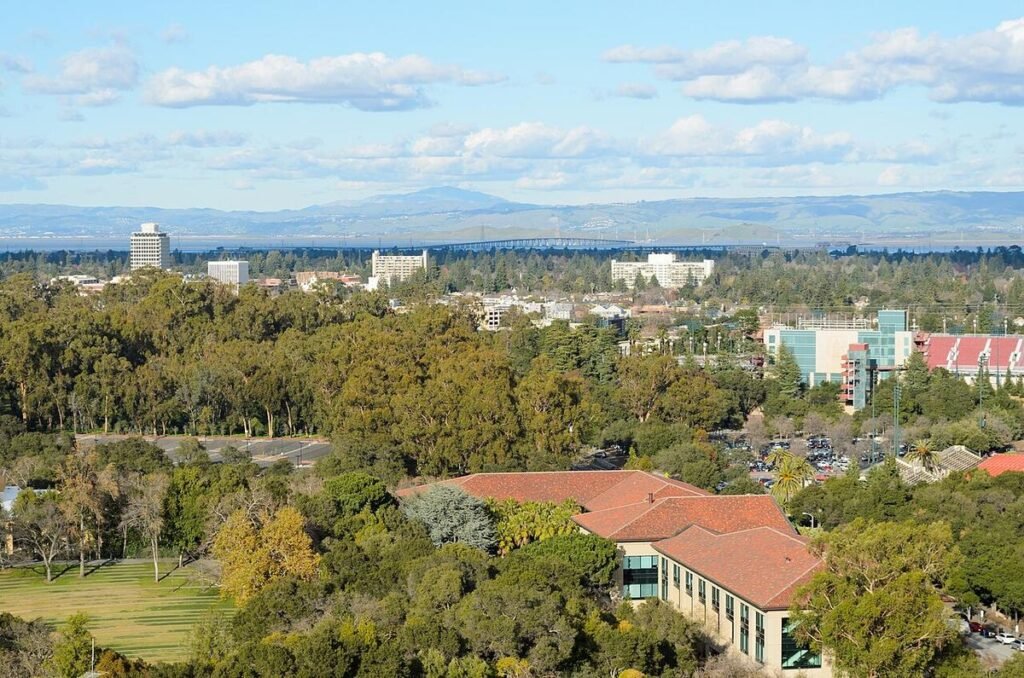
Stanford’s campus is 8,353 acres of palm-lined walkways and Spanish colonial revival architecture, with the Main Quad, Memorial Church and the Hoover Tower as its landmarks [3][27]. It is one of the largest campuses in the US — and that size is not decorative. Three institutions on it shape a Stanford education in ways no classroom can:
- Stanford Research Park (founded 1951). A 700-acre research park where the university meets industry — founded 1951 with the first ground lease to Varian Associates, and the park became the physical seed of Silicon Valley [19][27].
- SLAC National Accelerator Laboratory (opened 1962). A US Department of Energy national laboratory managed by Stanford, on campus [19]. The first website in North America went online at SLAC in 1991 [19].
- The d.school — Hasso Plattner Institute of Design (opened 2005). A hub for design thinking that brings students from radically different backgrounds together to solve human-centred problems [19][25].
The university comprises seven schools and 15 independent laboratories, centres and institutes, with 17,314 students (Autumn 2025), 2,402 faculty and about 2,600 postdoctoral scholars, enrolling students from all 50 US states (entering Class of 2030) and 127 countries (graduate students, Fall 2025) [19]. The student–faculty ratio is 5:1 [3][17], and there are 600+ student clubs and organisations [33]. Undergraduates live on campus — Stanford guarantees housing, and the residential system is built around the same close-knit house culture you find at Oxford and Cambridge, with the added advantage that a Nobel laureate might be your neighbour in the faculty-in-residence programme.
Note: The campus is beautiful, but it is also expensive to live near. Palo Alto is one of the most expensive towns in America. Your cost-of-attendance budget must include the reality that a coffee, a haircut and a weekend trip to San Francisco all cost Silicon Valley prices.
What Stanford Graduates Actually Earn — the GSB Numbers, Honestly Read
Stanford does not publish a single university-wide placement report the way Indian universities do, so I am honest about what is verified: the strongest published outcomes are the GSB MBA’s, and the undergraduate picture comes from the university’s own career data as reported by the guides.
| Outcome | Figure | Source |
|---|---|---|
| GSB MBA median base salary (Class of 2025) | $185,000 (about ₹1.76 crore at $1 = ₹95) | [10][11][12] |
| GSB MBA average base salary (Class of 2025) | $190,901 | [11] |
| GSB median signing bonus | $30,000 | [10][12] |
| GSB median expected performance bonus | $43,000 | [10] |
| GSB job seekers with an offer within 3 months | 90% (81% accepted within 3 months) | [10][11][12] |
| GSB graduates launching their own venture | 16% of the class | [10][12] |
| GSB graduates seeking employment | 63% of the class | [10] |
| GSB industries (Class of 2025) | Technology 35%, Finance 33% (including Private Equity 16% and Venture Capital 6%), Consulting 11% | [12] |
| Undergraduates graduating debt-free | 86% of the recent graduating class [20] | (88% was the 2024 class on the admissions aid page) |
| Undergraduates receiving financial aid | 69% | [5] |
The MBA numbers deserve a careful read. The $185,000 median base salary is among the highest reported by any US business school for the Class of 2025 [10]. But note that only 63% of the class actively sought employment — the rest went into founder or family-business roles [10]. And the MBA is STEM-designated, so the 24-month STEM OPT extension applies — MBA graduates are eligible for up to 36 months of OPT [10].
For undergraduates, the honest picture is that Stanford does not publish a first-destination salary table in the public domain the way some universities do. [RESEARCH GAP: Requires manual lookup of Stanford’s undergraduate first-destination salary figures] What is verified is the outcome that matters most to Indian families: 86% of the recent graduating class left debt-free [20], and the university’s 248,000+ alumni network spans every continent and sector [15]. If you want a salary number before you choose, ask the specific department — Computer Science and Economics publish their own outcomes; the university as a whole does not.
The Google Founders, the Nobel Laureates — and the Names You Should Read Critically
Stanford’s alumni list reads like a history of modern technology — and that is precisely why Indian students should read it critically. These are exceptional people; the university did not make them, it gave them the room to become themselves.
| Person | What they did |
|---|---|
| Larry Page & Sergey Brin | Co-founders of Google; PageRank was developed at Stanford [15] |
| Jerry Yang & David Filo | Co-founders of Yahoo [15] |
| Reed Hastings | Co-founder of Netflix [15] |
| Jensen Huang | Co-founder and CEO of NVIDIA [15] |
| Kevin Systrom & Mike Krieger | Co-founders of Instagram [15] |
| William Hewlett & David Packard | Founders of Hewlett-Packard — the original Silicon Valley garage story [26] |
| Phil Knight | Co-founder of Nike (with Bill Bowerman); Stanford GSB MBA 1962 [26] |
| Peter Thiel & Reid Hoffman | Thiel co-founded PayPal (via Confinity); Hoffman was an early PayPal executive (COO) and co-founder of LinkedIn [26] |
| Evan Spiegel | Co-founder of Snapchat [26] |
| Elon Musk | Attended Stanford briefly before leaving to found Zip2 [26] |
| Sally Ride | First American woman in space; BS, BA, MS and PhD from Stanford [15] |
| Eileen Collins & Ellen Ochoa | NASA astronauts [15] |
| Sandra Day O’Connor | First woman Justice of the US Supreme Court [15] |
| Stephen Breyer, Anthony Kennedy, William Rehnquist | US Supreme Court Justices — Breyer and Kennedy are Stanford undergraduates (Harvard Law); Rehnquist is a Stanford Law graduate [15] |
| Herbert Hoover | 31st President of the United States [26] |
Stanford is home to 22 living Nobel laureates (38 listed in total, including 16 deceased) in the current Stanford community — Stanford’s faculty-based count, which excludes alumni-only connections such as John Steinbeck [15][26]. Either way, the research culture is the point: Stanford’s faculty and alumni include Nobel laureates, startup founders, CEOs and global leaders across every field [26].
Why This Guide Names No Professors — and How to Find Yours
The project document for this guide asks for the top professors and principal investigators by name. I am not listing individual professors here, and I want to be plain about why: I could not verify a current, accurate list of individual PIs from a citable source [RESEARCH GAP: Requires manual lookup of current Stanford principal investigators by department], and a stale or wrong list of “top professors” would mislead you more than it would help. Professors move, retire, and change labs; a 2026 guide that names 2023’s stars is worse than useless.
What I can tell you, verified: Stanford’s research is organised through its 15 independent laboratories, centres and institutes [19], its seven schools [16], and national facilities like SLAC [19]. The strongest route to a professor is the department route — read the faculty pages of the department you want (Computer Science, Electrical Engineering, Economics, Biosciences), find the labs publishing in your area in the last two years, and write to the PI with a specific question about their work. That email, not a list in a guide, is what gets a PhD applicant noticed.
More University Guides
 MIT Guide 2027: Fees, Admissions & Scholarships for Indian StudentsUSA • University Guide
 Harvard University Guide 2027: Fees, Admissions & Scholarships for Indian StudentsUSA • University Guide
 University of Cambridge Guide 2027: Fees, Admissions & Scholarships for Indian StudentsUK • University Guide
Frequently Asked Questions
Is Stanford University need-blind for international students?
No — Stanford is need-aware for international applicants who request financial aid, which means your aid request becomes part of the admission decision. Once admitted, Stanford meets 100% of your demonstrated need. Families earning under $100,000 a year (with typical assets) pay nothing for tuition, room and board, and families under $150,000 pay no tuition.
How much does Stanford cost for Indian students?
For 2026–27, undergraduate tuition is $67,731 a year (about ₹64 lakh), frozen at the 2025–26 level, and the estimated cost of attendance is $97,545 a year (about ₹92 lakh) before travel and health insurance. Graduate costs vary sharply: standard graduate tuition is $65,445 a year, while the GSB MBA first year costs about $140,940 in total.
What are the Stanford application deadlines for 2027 entry?
For first-year undergraduates, Restrictive Early Action closed on 1 November 2026 and Regular Decision closes on 5 January 2027, with decisions by early April and a reply deadline of 1 May 2027. The Common Application opened on 1 August 2026. For graduate programmes, deadlines run from 6 October 2026 (Knight-Hennessy, now closed) through 15 February 2027 (Law JD); the MS in Computer Science closes on 8 December 2026.
Do I need the SAT or ACT for Stanford?
Yes — Stanford reinstated the SAT/ACT requirement for first-year applicants from the Class of 2030 onward. There is no minimum score. For the Class of 2029, the middle 50% of SAT submitters scored 1520–1570 and ACT submitters 34–36. You may self-report scores and send official reports only if you enrol. No English proficiency test is required for first-year applicants.
What is the Knight-Hennessy Scholars programme?
Knight-Hennessy is Stanford’s flagship graduate fellowship: it fully funds up to 100 scholars a year in any Stanford graduate programme for up to three years — tuition, living stipend, travel and relocation. It is open to all nationalities; your bachelor’s must have been earned in January 2020 or later. You apply to Knight-Hennessy and separately to your Stanford programme. The 2027-cohort deadline was 6 October 2026 and has closed.
Is the Stanford MBA worth it for Indian students?
The outcomes are among the strongest of any US business school: the Class of 2025 earned a median base salary of $185,000 (about ₹1.76 crore), with 90% of job seekers receiving an offer within three months and 16% launching their own ventures. The first-year cost of attendance is about $140,940 (about ₹1.34 crore), though need-based GSB Fellowships average about $50,000 a year. The MBA is STEM-designated, so graduates are eligible for the 24-month STEM OPT extension — up to 36 months of OPT in total.
Sources & Last Updated
Last updated: 11 November 2026. All sources were checked on 11 November 2026. Where a source disagreed with another, I have said so in the text.
- Stanford University — Wikipedia — founded 1885, opened 1891, endowment $40.8 billion (FY2025), U.S. News Best Global 2026–27 #3.
- Stanford University — QS TopUniversities profile — QS 2026 #3, QS 2027 #=2, “22 living Nobel laureates (38 listed in total)”.
- Stanford University: Rankings, Fees, Acceptance Rate — Shiksha — QS 2026 #3, THE 2026 #5, 17,000+ students, 5:1 student–faculty ratio.
- Stanford University Scholarship for Indian Students 2027–28 — LeapScholar — tuition frozen $67,731, need-aware for internationals, $100,000/$150,000 income thresholds, no merit scholarships, aid must be requested at application.
- Stanford University Fees for Indian Students 2026–27 — upGrad — cost of attendance $97,545, room and board $22,944, graduate tuition per quarter, 69% of undergraduates on aid, 1,600+ named scholarships.
- Stanford University: Acceptance Rate, Requirements, Costs & Deadlines — Admission.ai — COA $97,545, tuition $67,731, need-aware policy, student fees allowance $2,610, income thresholds.
- How to Get Into Stanford: Admit Rate, REA and Essays — Oriel Admissions — REA 1 November 2026, RD 5 January 2027, SAT/ACT required, middle 50% SAT 1520–1570 / ACT 34–36, arts portfolio dates, reply 1 May 2027.
- How to Get Into Stanford University From India 2027 — LeapScholar — REA/RD dates, no TOEFL for first-years, MS CS deadline 8 December with no GRE, test requirement resumed for the Class of 2030, Class 12 marks need no conversion.
- Stanford Fall 2027 English Requirements and Dates — SpeaksHark — no English proficiency exam required for first-year applicants, REA 1 November, RD 5 January, arts portfolio dates.
- Stanford Graduate School of Business Rankings, Programs, Admissions, Fees, Placements — Collegedunia — GSB Class of 2025 median base $185,000, signing bonus $30,000, performance bonus $43,000, 90% offers within 3 months, 63% sought employment.
- Stanford GSB MBA Program Profile: Admissions & Outcomes — MBA Schools — median base $185,000, average base $190,900, 18–20% of recent classes launching ventures, Sand Hill Road location.
- Stanford GSB Application — Fortuna Admissions — median base $185,000, 90% offers within 3 months, 16% launching ventures, industries: Technology 35%, Private Equity 16%, Consulting 11%, Venture Capital 6%.
- Knight-Hennessy Scholarship 2027: Eligibility, Benefits & Deadline — LeapScholar — KHS deadline 6 October 2026, bachelor’s earned January 2020 or later, no age limit, up to 3 years of funding, standard graduate tuition $65,445/year (2026–27), PhD stipends $58,460/$59,500 (2026–27).
- Knight-Hennessy Scholarship 2027 — upGrad — up to 100 scholars a year, deadline 6 October 2026 1:00 PM PT, full tuition + living stipend + travel + relocation.
- Why Stanford University? Facts About Stanford University — Indigo Research — Autumn 2025 enrolment 7,289 UG + 10,025 graduate, the seven schools, Doerr School launched 2022 (first new school in 75 years), 248,000+ alumni, Google/Yahoo/Netflix/NVIDIA founders, Supreme Court justices, astronauts.
- Stanford’s Seven Schools — Stanford University (stanford.edu) — seven schools co-located on one contiguous campus, with descriptions of each school.
- How to Get into Stanford University from India in 2026? — Yocket — Class of 2029: 2,302 admitted from 60,646 (3.80%), Class of 2028: 3.61%, 14% international from 70 countries (entering class), ~500 Indian students (2005 figure — Stanford Magazine, May 2005), 5:1 student–faculty ratio.
- Stanford University Admissions — Nomad Credit — ~500 Indian students enrolled across all seven schools (2005 figure), ~150 graduate programmes.
- Stanford University Website Home — University Website Home — Stanford Research Park founded 1951, SLAC opened 1962, first website in North America at SLAC, d.school opened 2005, 15 independent laboratories, centres and institutes, 2,402 faculty, about 2,600 postdoctoral scholars, 127 graduate countries.
- Stanford University: Fees, Acceptance, Placements & More — upGrad — founded 1885, opened 1891, 18,600+ students, 86% of graduates debt-free, Doerr School $1.1 billion donation, School of Engineering founded 1925, JN Tata loan scholarship ₹1–20 lakh.
- Stanford University Admissions 2026–27 — Collegedunia — Common Application opened 1 August 2026, REA 1 November 2026, RD 5 January 2027, graduate application fee $125, PG English minimum TOEFL 90 / IELTS 7.0 (100 is programme-specific), graduate deadlines 6 October 2026–15 February 2027, Class 12 90%+ guide benchmark.
- Stanford University — Schools — EDUBUS — 63 undergraduate majors (2026–27 Bulletin), no pre-med/pre-law/business major, major declared by end of sophomore year, 53% of undergraduates undeclared in fall 2025, optional alumni interviews.
- Best MBA Programs in the USA — HPJobs — GSB first-year MBA tuition $89,187, total first-year cost of attendance ~$140,940, median base salary $185,000, 90% offers within 3 months.
- Stanford SAT/ACT Requirements 2026–2027 — CollegeEssayGrader — SAT/ACT required, superscoring, latest test sittings (REA: end of September ACT / end of October SAT; RD: end of December).
- Stanford University — Admissions, Programs, Fees, Scholarships & Career Outcomes (2026) — WorkStudyCity — d.school and SLAC as academic facilities, SAT 1520–1570 / ACT 34–36 (CDS 2025–26, enrolled submitters), PG TOEFL 100 / IELTS 7.0 / Duolingo 120 (programme-specific).
- Stanford University: Innovation, Research, and Global Impact in Silicon Valley — AUBSP — 22 living Nobel laureates (38 listed in total), founders of HP, Nike, PayPal and Snapchat, Elon Musk attended briefly, Herbert Hoover alumnus.
- Stanford University | India Guide 2027 — Karan Gupta — 8,353-acre campus, Hoover Tower, 700-acre Stanford Research Park, acceptance 3.80% (Class of 2029); also the source of the incorrect “need-blind for all applicants including international students” claim corrected in this guide.
- QS Rankings 2026: Top Universities in the USA for International Students — UniversityLiving — Stanford QS 2026 #3 (score 98.9), top courses CS/Business/Engineering.
- Top 500 QS World 2026 (official QS list, PDF) — University of Management and Technology — QS 2026: MIT 1, Imperial 2, Stanford 3.
- Stanford University: Admissions Guide 2026 — Vappingo — ARWU 2025 #2; also the source of the conflicting QS 2026 #2 / THE 2026 #3 / endowment $37.6 billion (FY2024) figures (flagged in Items I could not verify).
- How many Indians get into Stanford? — Shiksha Q&A — QS subject rankings 2026: #2 for Accounting and Finance, #2 for Engineering and Technology; ~500 Indian students; 17,000+ students.
- Stanford University Scholarships 2026–27 — Collegedunia — GSB Fellowship need-based, averaging about $50,000 a year (about $100,000 total), Reliance Dhirubhai Fellowship historically about $150,000 over two years (5 a year, Indian citizens) — availability for 2027 unconfirmed, CSS Profile + Common Application aid section, UG aid up to full cost of attendance.
- Student Life | Facts — 600+ student clubs and organisations, 8,353-acre campus.
By Rohit Gupta
If you found this guide useful, share it with another Indian student who is dreaming of Stanford. And if you spot a fact that has changed — a deadline, a fee, a new scholarship — write to me at universityresearchers3@gmail.com and I will check it against the official source and update this guide.