
PSL University (Paris Sciences et Lettres): Admissions, Programs, Fees & Complete Guide

Introduction
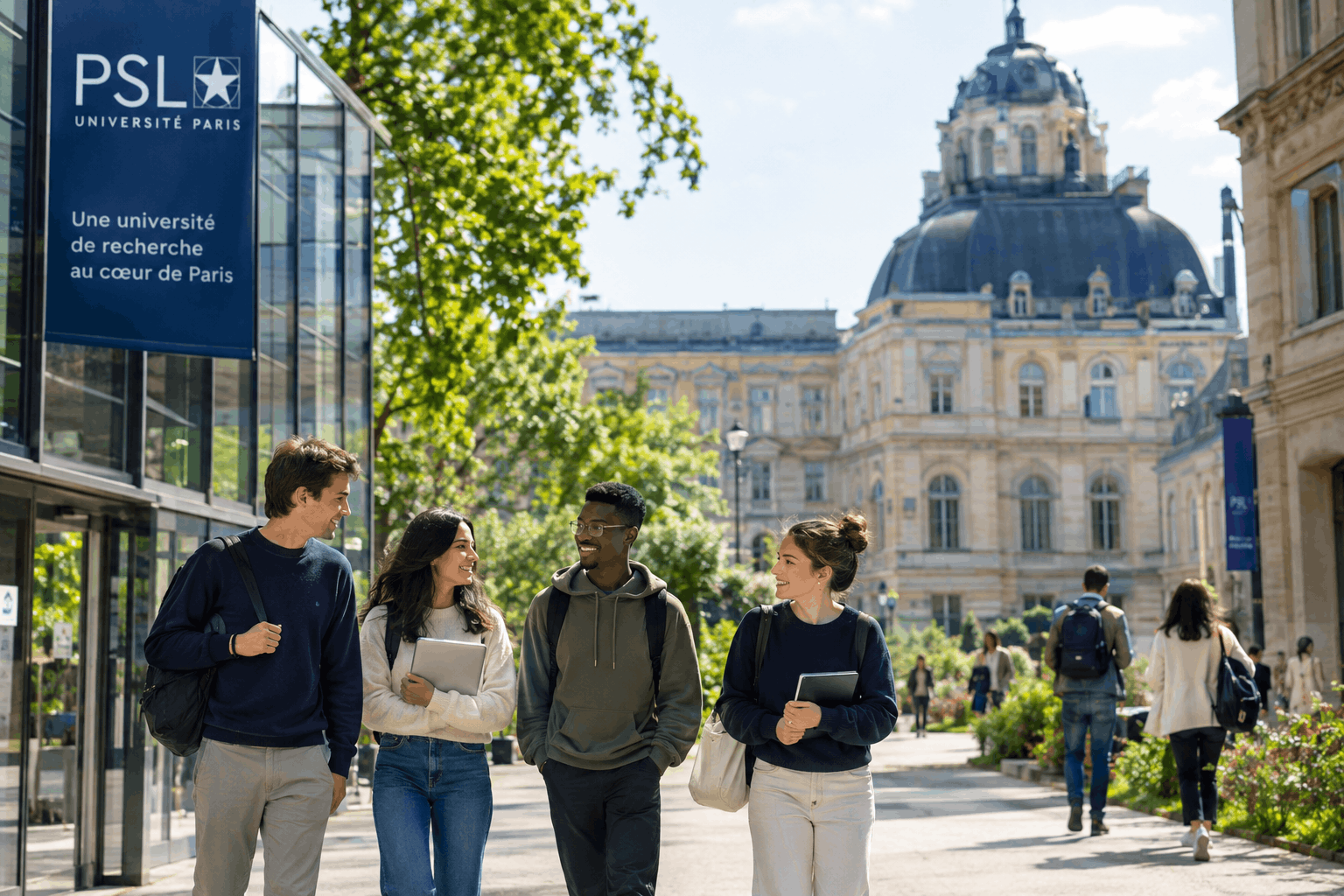
PSL University, formally known as Université Paris Sciences et Lettres (PSL), is a research-focused university in Paris that brings together institutions covering sciences, engineering, humanities and social sciences, economics and management, architecture, and the arts. Rather than functioning like a conventional university with one large campus, PSL operates as a collective university structure connecting multiple established institutions across Paris.
PSL was founded in 2010, and its development was driven by Parisian grandes écoles and national research institutions. The university describes its academic model as interdisciplinary, with research and education spanning both fundamental and applied fields.
For students, one of PSL’s distinctive characteristics is the combination of specialized institutions under one university framework. Its scope includes institutions such as École normale supérieure – PSL, MINES Paris – PSL, Dauphine – PSL, ESPCI Paris – PSL, Chimie ParisTech – PSL, Observatoire de Paris – PSL, and others.
What Is PSL University?
PSL University is a public research university based in Paris, France, created in 2010 and built around a group of major academic and research institutions. Its academic coverage ranges from science and engineering to humanities, social sciences, economics, management, architecture, and artistic creation.
According to PSL’s current official information, the university has approximately 17,000 students, 140 research laboratories, and 2,900 researchers. Around two-thirds of its students are enrolled at master’s or doctoral level.
PSL’s academic environment is therefore particularly research-oriented and postgraduate-heavy. Its programs include bachelor’s degrees, master’s degrees, doctoral tracks, and professional or specialized programs.
PSL University Quick Facts
| Category | Information |
|---|---|
| Official Name | Université Paris Sciences et Lettres (PSL) |
| Common Name | PSL University / Université PSL |
| Location | Paris, France |
| Founded | 2010 |
| University Type | Public research university |
| Students | Approximately 17,000 |
| Researchers | Approximately 2,900 |
| Research Laboratories | 140 |
| Academic Areas | Sciences, engineering, humanities & social sciences, economics, management, arts and related fields |
| Institutions/Schools | 13 |
| Graduate Programs | 18 |
| Official Website | PSL University |
History of PSL University
How PSL University Was Created
PSL is a relatively young university as a formal institution, but its member institutions have much longer histories.
The university itself was founded in 2010. Its creation reflected an effort to bring together prominent Parisian higher-education and research institutions within a common research-university framework.
This structure is important for understanding PSL. It was not created by replacing its constituent institutions with a single traditional campus. Instead, it developed by connecting institutions that already had their own academic traditions, research strengths, facilities, and identities.
The result is a university with a broad disciplinary range while retaining specialized schools and institutions.
From Sciences to Arts and Humanities
PSL’s academic scope extends beyond conventional science and engineering.
Its institutions cover areas including:
- Physics and chemistry
- Mathematics
- Computer science and data science
- Engineering
- Life sciences
- Economics
- Management
- Law
- Humanities
- Social sciences
- Architecture
- Art and design
- Performing arts
- Astronomy and astrophysics
This breadth allows PSL to create academic connections between fields that are often separated within traditional university structures.
PSL University’s Academic Structure
One of the most important things prospective students should understand is that PSL is a university made up of multiple institutions.
Its current scope includes institutions such as:
- École normale supérieure – PSL
- MINES Paris – PSL
- Dauphine – PSL
- ESPCI Paris – PSL
- Chimie ParisTech – PSL
- École nationale des chartes – PSL
- École Pratique des Hautes Études – PSL
- École des arts décoratifs Paris – PSL
- École nationale supérieure d’architecture Paris-Malaquais – PSL
- Conservatoire National Supérieur d’Art Dramatique – PSL
- Observatoire de Paris – PSL
- Collège de France
- Institut Curie
These institutions do not all offer the same type of education. Their programs, admissions processes, academic cultures, and areas of specialization can differ.
For this reason, a prospective student should not treat “PSL University admissions” as one universal admissions process. The specific program and institution can determine the requirements and application route.
Campus and Location
A University Across Paris
PSL’s campus experience is different from that of a university concentrated around one large suburban or rural campus.
The university describes itself as being located in the heart of Paris, with its institutions distributed across different parts of the city.
This gives students access to the wider Parisian academic, cultural, scientific, and professional environment.
At the same time, the distributed structure means that students should check the location of their specific school, department, laboratory, housing arrangements, and classes rather than assuming that every PSL activity takes place at one central campus.
Why the Paris Location Matters
Studying in Paris can place students close to:
- Major research institutions
- Museums and libraries
- Cultural organizations
- Technology and innovation networks
- Businesses and professional organizations
- Historical academic institutions
- International organizations
- Scientific and cultural events
PSL also reports partnerships with international universities and institutions, creating opportunities for academic exchanges and collaboration.
Research at PSL University
Research is central to PSL’s identity.
The university currently reports 140 laboratories and approximately 2,900 researchers. Its research activity covers both fundamental and applied research and emphasizes interdisciplinary work.
This research orientation can be particularly relevant for students considering master’s or doctoral education.
PSL’s official information also highlights research achievements and international research activity, including European Research Council grants and major scientific distinctions associated with its academic community.
However, applicants should distinguish between the university-wide research environment and the research opportunities available in a particular program. A student interested in doctoral study should investigate the relevant laboratory, supervisor, research area, and doctoral track rather than relying only on university-level statistics.
PSL University Programs
PSL offers programs across several academic levels.
Its current 2026–2027 program materials list bachelor’s programs in areas including:
- Applied Economics
- Applied Mathematics
- Artificial Intelligence
- Management
- Law
- Social Sciences
- Organizational Computer Science
- Sustainability Sciences
- Engineering
- Architecture
- Acting and performing arts
- Data science and related interdisciplinary fields
At the graduate level, PSL offers master’s programs across fields including economics, management, finance, law, social sciences, science, engineering, and other disciplines.
The exact programs and admission requirements can change, so prospective applicants should consult the current PSL program listings before making academic plans.
What Makes PSL Different?
PSL’s structure is one of its defining characteristics.
A student is not simply choosing between “PSL University” and another university. In practice, the student is often choosing a specific PSL program or institution within the wider university.
That distinction matters because:
- Academic programs differ by institution.
- Admissions procedures can vary.
- Teaching languages can differ.
- Campus locations can differ.
- Tuition and fees may depend on the specific program and student category.
- Student services can be provided at institutional or university level.
Therefore, applicants should evaluate the exact program rather than using PSL’s overall reputation as the only factor.
Academic Programs and Study Options
PSL University offers programs across a wide range of disciplines, from science and engineering to economics, management, humanities, social sciences, architecture, and the arts. Because PSL is organized around multiple specialized institutions, students should examine the specific program and school rather than assuming that all PSL programs follow the same structure.
Undergraduate Programs
PSL’s undergraduate portfolio includes programs in areas such as:
- Economics
- Mathematics
- Artificial intelligence
- Management
- Law
- Social sciences
- Computer science
- Sustainability
- Engineering
- Architecture
- Arts and performing arts
The university’s current program listings also include interdisciplinary degrees designed to combine different academic areas.
For undergraduate applicants, the main consideration is not simply whether PSL offers a particular subject, but which PSL institution delivers the program and what its admission requirements are.
Graduate Programs
Graduate study is an important part of PSL’s academic environment. The university reports that approximately two-thirds of its students study at master’s or doctoral level.
Master’s-level study covers disciplines including:
- Economics
- Finance
- Management
- Law
- Social sciences
- Mathematics
- Computer science
- Physics
- Chemistry
- Engineering
- Humanities
- Arts and related fields
Some programs are highly specialized, while others are interdisciplinary.
Students considering graduate study should investigate:
- Curriculum
- Research areas
- Faculty expertise
- Language of instruction
- Internship opportunities
- Laboratory or research-center access
- Degree-specific admission requirements
Doctoral Study and Research
PSL has a strong research orientation, making doctoral education an important component of its academic structure.
Doctoral applicants generally need to identify an appropriate research field and understand the requirements of the relevant doctoral school or institution. Research opportunities can be connected to PSL laboratories and research centers.
Because doctoral admissions are substantially different from undergraduate admissions, applicants should check the requirements of the specific doctoral program rather than relying on general PSL admission information.
Interdisciplinary Education at PSL
One of PSL’s distinctive characteristics is its emphasis on interdisciplinary education.
Students may encounter opportunities to work across traditional academic boundaries. For example, subjects such as mathematics, economics, computer science, management, social sciences, and sustainability can overlap in modern academic and professional environments.
This structure can be useful for students whose interests do not fit neatly into one traditional subject.
However, interdisciplinary study also requires students to understand the exact curriculum. A program with a broad title can still have substantial quantitative, technical, theoretical, or research requirements.
Admissions to PSL University
How PSL Admissions Work
There is no single admissions procedure that applies identically to every PSL program.
Because PSL includes multiple institutions, applicants should begin by identifying:
- The degree they want to study.
- The relevant PSL institution.
- The program’s academic requirements.
- The application platform used by that program.
- Required documents.
- Language requirements.
- Application deadlines.
This approach is particularly important for international applicants because application procedures can differ depending on the student’s country, degree level, and chosen program.
Undergraduate Admission Requirements
Undergraduate requirements depend on the individual program.
Applicants may be asked to provide academic records and other supporting documents demonstrating their preparation for the selected field.
Depending on the program, applicants may need to demonstrate:
- Appropriate secondary-school qualifications
- Academic preparation in relevant subjects
- Language proficiency
- Motivation for the selected course
- Additional application materials
Some highly selective programs may also use additional selection procedures.
Applicants should therefore treat the requirements published for their specific program as authoritative.
Graduate Admission Requirements
Master’s applicants generally need an appropriate previous degree or academic background.
The exact requirements can vary considerably between programs.
Applicants may need:
- Bachelor’s degree or equivalent qualification
- Academic transcripts
- Curriculum vitae
- Statement of motivation
- Language certification where required
- Letters of recommendation where required
- Program-specific documents
- Evidence of academic preparation
Some programs may have additional selection stages.
A student applying to a quantitative master’s program, for example, may need substantially different academic preparation from someone applying to a humanities or arts program.
International Student Admissions
PSL welcomes international students and has an international dimension across its institutions.
International applicants should pay particular attention to three areas:
1. Academic Eligibility
Your previous qualification must meet the requirements of the program.
A degree that is accepted for one PSL master’s program may not automatically satisfy the requirements of another.
2. Language Requirements
Language requirements depend on the program.
Some programs may be taught in French, while others offer courses or programs in English. Applicants should therefore check the language of instruction before applying rather than assuming that all PSL programs are available entirely in English.
3. Immigration and Visa Requirements
Students coming to France from outside the European Union may need to complete additional immigration or visa procedures.
These requirements can change, so students should use current French government and official university guidance when preparing their application.
English-Taught Programs
PSL has programs and courses available to international students, including opportunities involving English.
However, PSL should not be treated as an entirely English-language university.
The language of instruction depends on the individual program.
Before applying, international students should verify:
- Percentage of courses taught in English
- French-language requirements
- Required language certificates
- Thesis language requirements
- Language used for examinations
- Language used during internships
This is especially important for students who do not speak French.
Application Process
A typical application journey can involve the following steps:
Step 1: Choose a Program
Start with the subject and degree level rather than the university name alone.
Step 2: Check Eligibility
Review the program’s academic and language requirements.
Step 3: Prepare Documents
Common documents can include:
- Academic transcripts
- Degree certificates
- Resume/CV
- Personal statement
- Language certificate
- Recommendation letters, where applicable
- Identification documents
The exact list depends on the program.
Step 4: Submit the Application
Use the application system specified by the program or institution.
Step 5: Selection
Some programs may evaluate applications based on academic records and supporting materials. Certain programs can have additional selection stages.
Step 6: Admission Decision
Successful applicants receive instructions regarding enrollment and the next steps.
Step 7: Prepare for Arrival
International students should then address accommodation, immigration requirements, insurance, finances, and other practical arrangements.
Application Deadlines
PSL does not have one universal deadline covering every program.
Deadlines can vary according to:
- Degree level
- Program
- Institution
- Applicant nationality
- Application platform
- Academic year
Because deadlines are time-sensitive, students should always verify the current deadline directly through the official program page before submitting an application.
Tuition and Fees
Tuition at PSL depends on the specific program and student circumstances.
Potential factors include:
- Degree level
- Program
- Student status
- Nationality or residency status
- Institutional rules
- Applicable French higher-education regulations
Students should not assume that one tuition figure applies to the entire university.
For this reason, applicants should check the current official fee information for their particular program and academic year.
Important: Tuition and administrative fees can change. Always verify the latest figures through the relevant PSL institution before making financial plans.
Scholarships and Financial Support
Financial support can be available through different channels, depending on the student’s program and circumstances.
Potential sources can include:
- University scholarships
- Program-specific funding
- Merit-based opportunities
- Research funding
- Doctoral funding
- External scholarships
- French or European funding programs
The availability and eligibility requirements vary.
International students should also investigate scholarships offered through their home country, international organizations, and French government or European programs.
Cost of Living in Paris
Tuition is only one part of the cost of studying at PSL.
Because PSL is located in Paris, students also need to plan for:
- Accommodation
- Food
- Transportation
- Health-related expenses
- Study materials
- Personal expenses
- Insurance
- Travel
Housing is likely to be one of the most significant expenses for many students.
Students should create a realistic monthly budget before accepting an offer.
The actual amount required will depend heavily on housing arrangements, lifestyle, location, and personal spending.
Accommodation and Student Housing
PSL’s distributed structure means that housing arrangements can vary depending on the student’s institution and location.
Students should begin searching for accommodation as early as possible.
Possible housing options can include:
- University residences
- Student residences
- Private rentals
- Shared apartments
- Homestays
When comparing accommodation, students should consider more than rent alone.
Important factors include:
- Distance from classes
- Public transportation
- Utilities
- Deposit requirements
- Contract conditions
- Internet access
- Furnishing
- Neighborhood
Student Life at PSL
Student life at PSL reflects the diversity of its constituent institutions.
Students can participate in:
- Student organizations
- Academic associations
- Cultural activities
- Sports
- Events
- Research activities
- Interdisciplinary projects
Because PSL operates across multiple institutions and locations, the student experience can differ significantly depending on the student’s program.
A student at a specialized engineering institution may have a different daily experience from someone studying humanities, management, or the arts.
That variety is an important part of understanding PSL as a university.
International Community
PSL’s international activities provide opportunities for students and researchers to interact with people from different academic and cultural backgrounds.
Students comparing international study destinations can also explore Australian University for international students.
International students should consider not only the university-wide international environment but also the international profile of their specific program.
Students interested in studying in Asia can also explore leading Asian universities for international students.
Before applying, it can be useful to investigate:
- Exchange opportunities
- International partnerships
- English-language courses
- International student support
- Research collaborations
- Opportunities for study abroad
Career and Professional Opportunities
PSL’s location in Paris places students within a major European economic and professional environment.
Depending on the field, students may have opportunities to connect with:
- Companies
- Research organizations
- Startups
- Financial institutions
- Cultural organizations
- Government and public institutions
- International organizations
Career opportunities, however, vary substantially by discipline.
Students should investigate the career services and internship opportunities available through their particular PSL institution or program.
Academic Reputation and Research Profile
PSL University’s identity is closely connected to research. Its structure brings together institutions with established traditions in scientific research, humanities, social sciences, economics, management, engineering, and the arts.
According to PSL’s published figures, its academic community includes approximately 2,900 researchers and 140 research laboratories.
This research structure gives students opportunities to encounter research-led teaching, specialized laboratories, research centers, and interdisciplinary projects. The relevance of these opportunities depends on the student’s program and institution.
For prospective students, it is therefore useful to look beyond university-wide research figures and investigate the specific laboratory, research group, faculty members, and projects associated with the degree they are considering.
Students comparing research-oriented universities internationally may also want to explore Yale University.
PSL University Rankings
Rankings can provide a useful external reference point, but they should not be treated as a permanent measurement of university quality.
PSL’s position can vary between ranking organizations because each ranking uses different methodologies. Factors may include:
- Research output
- Citations
- Academic reputation
- International collaboration
- Employer reputation
- Faculty indicators
- International students
- Other institution-specific measures
PSL’s own editorial framework recommends explaining ranking methodology and recognizing that rankings can change from year to year.
For that reason, students should compare rankings alongside the factors that directly affect their education, such as the curriculum, teaching language, research opportunities, cost, location, and career support.
Major PSL Institutions and Their Academic Areas
One of the easiest ways to understand PSL is to examine the institutions that form its academic ecosystem.
École normale supérieure – PSL
École normale supérieure – PSL (ENS-PSL) has a strong academic and research orientation and is associated with disciplines across the sciences, humanities, and social sciences.
Its environment is particularly relevant to students interested in advanced academic study and research.
MINES Paris – PSL
MINES Paris – PSL is strongly associated with engineering, science, technology, energy, industrial systems, and related research.
Students interested in engineering and technological fields may want to examine its programs separately from other PSL institutions.
Dauphine – PSL
Université Paris Dauphine – PSL is known for academic areas including:
- Economics
- Management
- Finance
- Social sciences
- Mathematics
- Computer science
Its programs can be particularly relevant to students interested in quantitative business, economics, management, and related disciplines.
ESPCI Paris – PSL
ESPCI Paris – PSL focuses heavily on scientific and engineering education and research.
Its academic environment includes areas such as:
- Physics
- Chemistry
- Materials
- Biology
- Engineering
Students interested in laboratory-based scientific research should examine the institution’s specific programs and research opportunities.
Chimie ParisTech – PSL
Chimie ParisTech – PSL specializes in chemistry and related scientific and engineering areas.
Its research-oriented environment can be relevant to students considering scientific careers, advanced research, and industrial applications of chemistry.
Observatoire de Paris – PSL
The Observatoire de Paris – PSL has a specialized role in astronomy and related scientific research.
Its research environment includes areas connected with:
- Astronomy
- Astrophysics
- Space science
- Planetary science
- Related physics
This makes it particularly relevant to students seeking specialized research in astronomy and astrophysics.
Humanities and Social Sciences at PSL
PSL is not limited to science and engineering.
Its academic ecosystem also includes institutions working in humanities, social sciences, economics, law, history, languages, and related fields.
This is significant because students can encounter an academic environment in which scientific and humanistic disciplines coexist within the same university framework.
For students interested in interdisciplinary research, this structure can provide opportunities to connect methods from different fields.
Arts and Creative Disciplines
PSL’s academic scope also includes creative and artistic education.
Its institutions include the École des Arts Décoratifs – PSL and the Conservatoire National Supérieur d’Art Dramatique – PSL, among other institutions connected with artistic education and research.
This means that PSL’s overall academic ecosystem extends beyond conventional university subjects.
Students considering creative programs should, however, evaluate the individual institution’s curriculum, selection process, facilities, and portfolio requirements where applicable.
Research and Innovation
Research Centers and Laboratories
Research is integrated into many areas of PSL’s academic structure.
Research activities can involve:
- Fundamental science
- Applied science
- Engineering
- Digital technologies
- Economics
- Social sciences
- Humanities
- Arts
- Interdisciplinary research
PSL’s research environment includes laboratories and institutes operating across its constituent institutions.
Students interested in highly research-intensive science and technology institutions can also explore University of Melbourne and its research environment.
For a prospective researcher, the most useful question is not simply “How much research does PSL conduct?” but rather:
Does PSL have researchers and laboratories working on the subject I want to study?
That question can help applicants identify a suitable master’s or doctoral environment.
Students interested in research-intensive universities can also explore Cornell University when comparing international academic environments.
Innovation and Entrepreneurship
PSL’s academic environment also connects research with innovation and entrepreneurship.
Depending on the institution and program, students may encounter:
- Innovation projects
- Entrepreneurship programs
- Research commercialization
- Startup-related activities
- Industry collaborations
- Interdisciplinary projects
The availability of these opportunities differs across institutions, so applicants interested in entrepreneurship should investigate the specific support available to their program.
Student Experience
A Different Type of University Experience
The PSL student experience cannot be described through one conventional campus model.
Instead, students belong to particular schools and institutions within the larger PSL university structure.
This can affect:
- Daily class locations
- Student organizations
- Facilities
- Academic culture
- Housing arrangements
- Social activities
- Access to laboratories
- Career services
Consequently, two students studying at different PSL institutions can have substantially different day-to-day experiences.
Student Organizations and Activities
Students can participate in activities outside their formal coursework.
Potential areas include:
- Student associations
- Academic societies
- Sports
- Cultural activities
- Arts
- Conferences
- Research events
- Entrepreneurship activities
- Interdisciplinary projects
Students should check their institution’s current student organizations because the opportunities available can vary.
Studying in Paris
PSL’s Paris location is an important part of the student experience.
Students have access to a city with extensive:
- Public transportation
- Libraries
- Museums
- Cultural institutions
- Research organizations
- Companies
- Restaurants and cafés
- International communities
- Professional networks
At the same time, Paris is a major metropolitan city, and students need to plan carefully for housing and living expenses.
The location can therefore be both an academic opportunity and an important practical consideration.
Students comparing major international cities for higher education can also explore Columbia University in New York.
Career Opportunities
PSL’s career environment varies according to academic discipline.
Students in economics and management may pursue opportunities in areas such as:
- Finance
- Consulting
- Business
- Data analysis
- Management
- Public policy
Students in science and engineering may pursue:
- Research
- Technology
- Engineering
- Energy
- Industrial careers
- Scientific institutions
Students in humanities, social sciences, and the arts can pursue different professional pathways depending on their specialization.
A university-level career statistic should therefore not be interpreted as a guarantee of an individual student’s employment outcome.
Internships
Internships can be an important part of professional development, particularly for students in applied disciplines.
Possible internship environments include:
- Companies
- Research laboratories
- Public institutions
- Cultural organizations
- Financial institutions
- Technology companies
- International organizations
The availability, duration, and requirements of internships depend on the specific program.
Students should examine whether an internship is compulsory, optional, or integrated into the curriculum.
PSL Alumni
Because PSL includes several historically established institutions, its broader academic community is associated with notable scholars, scientists, researchers, artists, economists, and public figures.
However, alumni claims should be interpreted carefully.
Being associated with a university or one of its constituent institutions does not mean that the university alone caused an individual’s achievements.
For an article intended for publication, alumni should be included only when the individual’s association with the relevant institution can be verified.
PSL University vs Other European Universities
A useful comparison should focus on characteristics rather than declaring one institution universally better.
| Factor | PSL University | Other Major European Universities |
|---|---|---|
| Structure | Multi-institution university | Often centralized or federated |
| Location | Paris | Depends on university |
| Research | Strong research orientation | Varies |
| Academic fields | Very broad | Varies by institution |
| Engineering | Strong through specialized institutions | Varies |
| Business/Economics | Strong through institutions such as Dauphine – PSL | Varies |
| Humanities | Strong presence | Varies |
| Arts | Included within PSL’s wider ecosystem | Varies |
| Student experience | Depends heavily on constituent institution | Usually depends on campus structure |
| Language | Program-dependent | Program-dependent |
| International opportunities | University and institution dependent | University dependent |
The right comparison therefore depends on what a student is looking for.
Students considering universities outside Europe can also compare their options with McGill University in Canada.
Someone interested in economics may compare Dauphine – PSL with economics and business institutions elsewhere. An aspiring physicist may instead compare a relevant PSL science institution with other research universities.
Students comparing universities across different international education systems can also explore University of California.
Potential Advantages of Studying at PSL
PSL’s structure provides several characteristics that prospective students may find relevant:
Research-Oriented Environment
Students interested in research can benefit from an ecosystem containing numerous laboratories and researchers.
Specialized Institutions
Rather than placing every academic subject into one standardized structure, PSL includes specialized institutions with distinct academic identities.
Interdisciplinary Opportunities
The university’s broad disciplinary scope creates possibilities for interaction between different fields.
Paris Location
Students study within one of Europe’s major academic and cultural centers.
International Environment
PSL maintains international partnerships and attracts students and researchers from outside France.
Important Considerations Before Applying
PSL also requires careful planning.
Program-Specific Admissions
Students cannot assume that one admissions procedure applies to every PSL program.
Different Institutional Cultures
The experience can differ substantially between constituent institutions.
Cost of Living
Paris can require significant financial planning, especially for accommodation.
Language
Not every program is taught entirely in English.
Competitive Selection
Some programs and institutions can have selective admission processes.
Distributed Campus
Students should check exactly where their classes, laboratories, and other activities will take place.
These considerations do not make PSL unsuitable; they simply mean that applicants should research their particular program carefully.
Application Tips for Prospective Students
Applying to PSL University requires more than selecting the university name and submitting a general application. Because PSL includes multiple institutions and programs, applicants should first identify the exact degree and institution they are applying to. The master prompt also emphasizes that admissions requirements, deadlines, tuition, and language requirements are dynamic and should be verified through official university resources.
1. Start With the Exact Program
Before preparing documents, identify:
- Degree level
- Program name
- PSL institution offering the program
- Language of instruction
- Academic prerequisites
- Application platform
- Required documents
- Current deadline
This prevents applicants from assuming that information for one PSL program applies to another.
2. Review Academic Requirements Carefully
Compare your previous education with the program’s published requirements.
Pay particular attention to:
- Required subjects
- Previous degree
- Academic level
- Prerequisite courses
- Language requirements
- Program-specific selection criteria
3. Prepare Documents Early
Depending on the program, applicants may need:
- Academic transcripts
- Degree certificates
- Curriculum vitae
- Motivation statement
- Recommendation letters
- Language certificates
- Identification documents
- Additional program-specific materials
Applicants should use the exact document list published by their chosen program.
4. Do Not Wait Until the Deadline
International applicants may need additional time for document preparation, translations, language testing, visa procedures, and financial planning.
Preparing early also gives applicants time to correct missing or incomplete documents.
How to Build a Strong Application
A strong application should demonstrate a clear connection between the applicant’s academic background and the program being selected.
Instead of making broad statements about PSL, applicants should explain:
- Why the particular subject interests them
- How their previous studies prepared them
- What they want to learn
- Which academic areas they want to explore
- How the program relates to their future plans
Avoid unsupported claims such as “PSL guarantees a successful career.” The university’s editorial framework specifically requires objective writing and prohibits unsupported promises.
Financial Planning for PSL Students
Tuition
There is no single tuition figure that can accurately represent every PSL student.
Fees can depend on:
- Program
- Degree level
- Institution
- Student status
- Applicable regulations
- Academic year
Applicants should check the current official fee information for their specific program.
The master prompt specifically instructs that tuition information should be treated as subject to updates rather than presented as permanent figures.
Living Expenses
Students studying in Paris should prepare a budget covering more than tuition.
Major expenses can include:
- Housing
- Food
- Transportation
- Utilities
- Insurance
- Study materials
- Personal expenses
- Communication
- Travel
Housing can represent a significant portion of a student’s monthly budget.
A realistic budget should therefore be prepared before enrollment.
Scholarships and Funding
Students should investigate funding from several sources rather than relying on a single scholarship.
Potential sources include:
- PSL or program-specific scholarships
- Merit-based funding
- Need-based support where available
- Research funding
- Doctoral funding
- Government scholarships
- External organizations
- European funding opportunities
Eligibility varies significantly.
Applicants should verify:
- Application deadline
- Eligibility
- Required documents
- Funding amount
- Duration
- Whether the award covers tuition, living expenses, or both
The master prompt specifically advises against publishing outdated scholarship amounts.
Housing for PSL Students
Finding accommodation is an important part of preparing to study in Paris.
Students can investigate:
- Student residences
- University-related housing options
- Private rentals
- Shared apartments
- Other student accommodation
When comparing options, consider:
| Factor | Why It Matters |
|---|---|
| Monthly rent | Determines the basic housing budget |
| Location | Affects commuting time |
| Transport | Important when classes are spread across Paris |
| Deposit | May create an initial financial requirement |
| Utilities | Can increase monthly expenses |
| Furnishing | Affects moving and setup costs |
| Contract | Determines rental obligations |
| Distance from campus | Important for daily convenience |
Because PSL operates across several locations, students should check the location of their specific classes and institution before choosing accommodation.
International Student Support
International applicants should plan for both academic and practical matters.
Important areas include:
- Admissions
- Immigration requirements
- Accommodation
- Language preparation
- Insurance
- Banking
- Transportation
- Academic enrollment
- Student services
International students should use official PSL resources and relevant French government information for current immigration and administrative requirements.
Career Preparation
PSL students can approach career preparation through several stages.
During the Degree
Students can build professional experience through:
- Internships
- Research projects
- Academic events
- Student organizations
- Industry projects
- Networking
- Career services
Before Graduation
Students should prepare:
- CV
- Professional profile
- Internship applications
- Interview skills
- Professional references
- Portfolio where relevant
Career preparation should be adapted to the student’s discipline. A computer science student, economist, researcher, architect, and performing-arts student will naturally have different professional requirements.
Research Careers
Students interested in academic research can investigate:
- Master’s research tracks
- Research laboratories
- Faculty research interests
- Research internships
- Doctoral programs
- Potential supervisors
- Research funding
PSL’s research ecosystem can be particularly relevant for students considering postgraduate research.
However, applicants should identify a specific research area rather than choosing a university solely because of its overall research reputation.
PSL University FAQs
1. What is PSL University?
PSL University, or Université Paris Sciences et Lettres, is a public research university in Paris that brings together multiple academic and research institutions.
2. When was PSL University founded?
PSL was founded in 2010.
3. Where is PSL University located?
PSL is based in Paris, France, with its constituent institutions located across different parts of the city.
4. Is PSL University public?
Yes. PSL is a public research university.
5. How many students attend PSL?
PSL currently publishes a figure of approximately 17,000 students. Because university statistics can change, applicants should check the latest official figures.
6. What does PSL University specialize in?
PSL covers a broad range of subjects, including sciences, engineering, economics, management, humanities, social sciences, architecture, and the arts.
7. Does PSL offer bachelor’s degrees?
Yes. PSL offers undergraduate programs in several academic fields.
8. Does PSL offer master’s degrees?
Yes. Master’s education is an important component of PSL’s academic structure.
9. Does PSL offer doctoral programs?
Yes. Research and doctoral education form an important part of the university’s academic environment.
10. Is PSL University good for research?
PSL has a substantial research infrastructure, with approximately 140 research laboratories and around 2,900 researchers according to its published figures.
11. Does PSL teach programs in English?
Some PSL programs and courses are available in English, but the language of instruction varies by program.
12. Do international students study at PSL?
Yes. PSL has an international student and research community.
13. Is PSL University in Paris?
Yes. Its institutions are located in Paris rather than being concentrated on one conventional single-campus site.
14. How do I apply to PSL?
The application procedure depends on the program and institution. Applicants should begin by selecting the exact program and following its published admissions process.
15. Does PSL have one application deadline?
Not necessarily. Deadlines can vary by program, institution, applicant category, and academic year.
16. How much does PSL University cost?
There is no single tuition price applicable to every PSL student. Fees depend on the program and other circumstances.
17. Does PSL offer scholarships?
Funding opportunities can vary by program and student category. Applicants should investigate current PSL and external scholarship opportunities.
18. Where do PSL students live?
Students can use various accommodation options in Paris, including student residences, private rentals, and shared housing.
19. What is PSL known for?
PSL is particularly notable for its research-oriented structure and its combination of specialized institutions covering numerous academic disciplines.
20. Should students compare individual PSL programs before applying?
Yes. Because PSL consists of multiple institutions with different academic structures, applicants should evaluate the exact program, institution, language, requirements, costs, and career opportunities.
Conclusion
PSL University has a distinctive structure within French higher education. Rather than operating as a single conventional campus, it connects multiple established institutions and academic traditions under a common university framework.
Its academic scope covers sciences, engineering, economics, management, humanities, social sciences, architecture, and the arts. Its research infrastructure is also a central part of the university’s identity.
For prospective students, the most important point is to evaluate the specific PSL institution and program rather than relying only on university-level information. Admissions requirements, language, tuition, deadlines, housing arrangements, and student experience can vary.
Students considering PSL should therefore compare the exact program with their academic preparation, financial situation, preferred language, research interests, location requirements, and career plans.
[…] PSL University (Paris Sciences et Lettres): Admissions, Programs, Fees & Complete Guide […]
[…] PSL University (Paris Sciences et Lettres): Admissions, Programs, Fees & Complete Guide […]